July 8, 2026
The Asymmetric Weapon That Threatens the World's Most Critical Energy Corridor
Modern warfare has historically required enormous resources to disrupt global trade at scale. Navies, air forces, and missile arsenals costing hundreds of billions of dollars have traditionally been the instruments through which state actors project power over international shipping lanes. Yet the events unfolding in mid-2026 around the Strait of Hormuz are rewriting that assumption entirely. A relatively inexpensive category of weapon, the one-way attack drone, is demonstrating that it can impose disproportionate costs on the global energy system, with consequences that ripple from commodity trading floors in London to refinery planning offices in Tokyo.
Furthermore, drone strikes in the Strait of Hormuz represent more than a localised military exchange. They constitute a stress test of the entire architecture of global energy security, revealing structural dependencies, inadequate bypass alternatives, and a growing tension between geopolitical fear premiums and deeply weak physical crude market fundamentals.
When big ASX news breaks, our subscribers know first
Why No Other Waterway Compares to Hormuz
The Strait of Hormuz connects the Persian Gulf to the Gulf of Oman, forming the only maritime exit point for crude oil and liquefied natural gas produced across the Arabian Peninsula and Iran. Its navigable channel is extraordinarily narrow, measuring approximately 3.2 kilometres in each direction, creating a geographic bottleneck with no practical short-term substitute.
What makes Hormuz structurally irreplaceable is sheer volume. Approximately 20 to 21 percent of total global oil consumption transits this corridor daily, representing somewhere between 17 and 20 million barrels per day under normal operating conditions. No pipeline network, no alternative shipping route, and no combination of emergency reserve releases comes close to matching that throughput capacity within any operationally relevant timeframe.
The table below illustrates just how concentrated global energy flows have become through this single passage:
| Metric | Estimated Figure |
|---|---|
| Daily oil transit volume (pre-disruption) | ~17 to 20 million barrels per day |
| Saudi Arabia monthly loadings through Hormuz | ~34 million barrels (recent reporting period) |
| Ras Tanura current flow rate | ~1 million b/d (vs. pre-conflict rate of ~6 million b/d) |
| Large vessels successfully transiting in a recent week | Only 9 |
| Saudi Arab Light OSP cut to Asia (August 2026) | -$11/barrel vs. Oman/Dubai benchmark |
When tanker traffic through this passage collapses to single digits in a single week, the global oil market is not experiencing a routine disruption. It is experiencing something closer to a functional blockade of one of its most critical arteries.
What the Drone Strikes Actually Involved
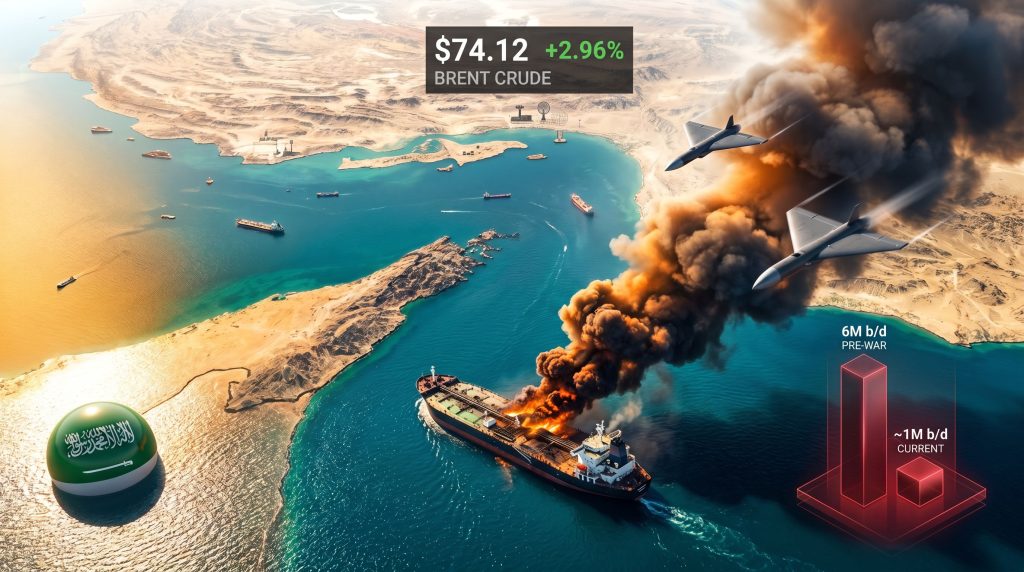
Iranian forces deployed loitering munitions, commonly described as one-way attack drones or kamikaze drones, against commercial vessels transiting the strait. The targets included an oil tanker that was set ablaze and a Thai-flagged cargo vessel, both struck within the operational corridor. The most alarming single incident involved a QatarEnergy-operated LNG carrier, the Al Rekayyat, which was struck approximately 7 nautical miles from the Omani coastline.
Following crew evacuation, the vessel faced the possibility of catastrophic explosion due to an engine room fire, a threat that underscores the particular danger of attacking LNG carriers in confined, heavily trafficked waters. These events have serious implications for the broader LNG supply outlook across the region.
U.S. Central Command confirmed the interception of four Iranian one-way attack drones and six Iranian ballistic missiles targeting vessels or allied assets in the region. Retaliatory U.S. strikes were conducted against Iranian coastal radar installations in Goruk in Hormozgan Province, on Qeshm Island, and against military infrastructure in Sirik in southern Iran. The escalation sequence was preceded by Iran downing a U.S. Army Apache helicopter and an MQ-9 Reaper drone.
A notable contradiction has emerged from Washington. The U.S. administration has simultaneously described its posture as a ceasefire with Iran while CENTCOM continues active defensive and retaliatory operations. This ambiguity creates persistent uncertainty for commercial shipping operators attempting to assess transit risk, and it complicates insurance underwriting in ways that have already had measurable market consequences.
No U.S. personnel casualties have been confirmed in the exchanges. Iranian claims regarding damage to the U.S. 5th Fleet headquarters in Bahrain have been officially denied by CENTCOM. Al Jazeera's reporting on the U.S. strikes against Iran provides further context on the sequence of events.
The Cost-Asymmetry That Changes Everything
One of the least discussed but most strategically significant aspects of the current conflict is the economic disparity between the weapons being deployed and the damage they inflict. One-way attack drones are, relative to conventional military hardware, relatively low-cost to manufacture and operate. Yet their capacity to disrupt global commodity markets is enormous.
Consider the cascading economic effects triggered by a small number of drone strikes:
- Maritime insurance premiums for vessels transiting the strait have surged to levels requiring a $20 billion U.S. government insurance scheme simply to keep commercial operators willing to transit at all.
- Saudi Arabia has been forced to slash its Official Selling Price for Asian-bound crude by $11 per barrel, and European-bound cargo prices by $15 per barrel, the largest monthly reductions for both regions since at least 2000, in an effort to compete for buyers who are increasingly reluctant to take Hormuz-exposed supply chains.
- Saudi Aramco's flagship Ras Tanura terminal, which operated at approximately 6 million barrels per day before the conflict, was running at only around 1 million barrels per day in July 2026, representing an 83 percent reduction in throughput from a single facility.
The diplomatic and logistics costs imposed by even a limited drone campaign vastly exceed the cost of the weapons themselves. This cost-asymmetric dynamic will permanently reshape how maritime energy security is assessed, insured, and defended across all major global chokepoints.
Two Forces Pulling Oil Prices in Opposite Directions
The immediate market reaction to confirmed drone strikes in the Strait of Hormuz was a sharp recovery in crude prices. ICE Brent climbed +2.96% to $74.12 per barrel, WTI crude rose +2.73% to $70.42 per barrel, and Murban crude, a key Gulf-origin benchmark, gained +3.03% to $68.70 per barrel in a single session. The geopolitical risk premium had returned, and these oil price movements reflect the profound sensitivity of energy markets to conflict escalation.
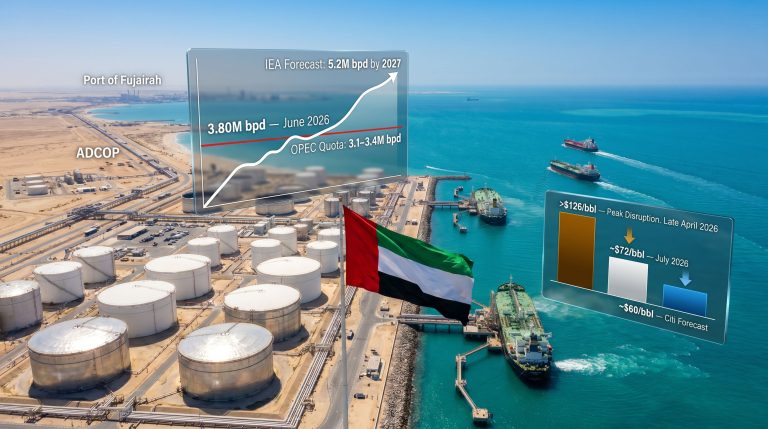
Yet beneath the headline price recovery, physical crude markets tell a starkly different story. Chinese demand for Saudi crude collapsed to just 14 million barrels, or approximately 470,000 barrels per day, in June 2026, the lowest recorded monthly volume on record. Saudi flows to the United States have effectively ceased entirely. Analysts at Citi have projected that oil prices could retreat toward $60 per barrel if Hormuz tanker traffic normalises, a projection that reflects underlying demand weakness rather than geopolitical calm.
Two competing forces are now operating simultaneously in crude markets. A geopolitical fear premium is pushing prices upward while a demand-destruction and oversupply dynamic pulls them lower. The net outcome depends entirely on how long the strait remains functionally impaired and whether physical supply constraints eventually override bearish demand signals.
This tension is not merely theoretical. It has immediate implications for energy traders, refinery procurement managers, and sovereign wealth funds whose revenues depend on oil price stability. The risk is that investors price the geopolitical premium into positions, only to face rapid price normalisation if diplomatic progress unexpectedly accelerates. Indeed, the oil market disruption risks stemming from this conflict extend well beyond the immediate theatre of operations.
Quantifying the Supply Shock and Reserve Depletion
The supply-side consequences of the conflict extend beyond Ras Tanura's reduced throughput. The U.S. Strategic Petroleum Reserve fell by 6.2 million barrels in the single week ending July 3, 2026, reaching 319.5 million barrels, its lowest level since April 1983. This 43-year low severely constrains Washington's ability to deploy emergency releases as a meaningful market stabilisation tool without further depleting a buffer that took decades to accumulate.
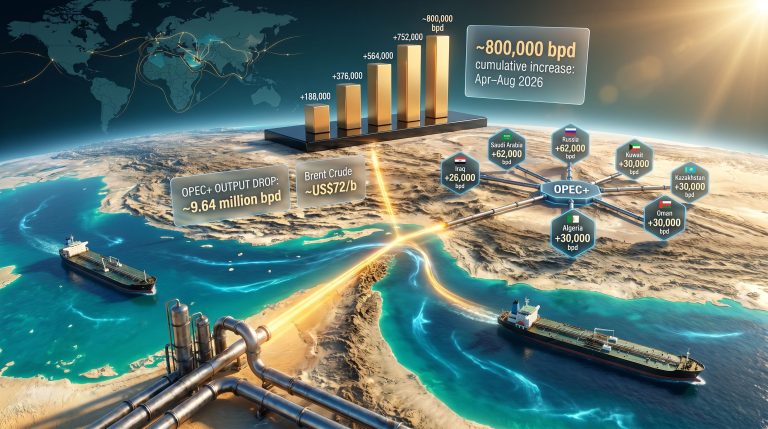
OPEC+ approved an additional production increase of 188,000 barrels per day for August 2026, leaving only 188,000 b/d of voluntary cuts still in place, with the next review scheduled for August 2. However, the production hike is structurally insufficient to compensate for Hormuz-related volume losses, functioning more as a political signal than a meaningful supply response. OPEC's market influence is consequently being tested in ways rarely seen in recent decades.
A parallel development worth monitoring closely involves Iranian floating storage. A two-month U.S. sanctions waiver on Iranian crude and product exports enabled Tehran to reduce its floating storage inventory by approximately 50 percent, from roughly 48 million barrels to approximately 24 million barrels in Southeast Asian waters. This volume re-entering global supply chains adds further downward pressure on physical crude prices, even as geopolitical risk premiums support the headline benchmarks.
The next major ASX story will hit our subscribers first
How Major Importers Are Responding
The exposure of different nations to Hormuz disruption varies considerably, and their responses reveal the strategic calculus being applied across the global energy system:
| Country or Entity | Hormuz Exposure | Emerging Response Strategy |
|---|---|---|
| India | Significant crude and products dependency | Resumed Iraqi crude imports; crude stocks near 1-year high |
| Japan | Heavy LNG and crude reliance | Top refiner actively planning post-Hormuz supply architecture |
| Saudi Arabia | ~6 million b/d pre-conflict export capacity | Evaluating East-West Pipeline expansion |
| Chevron and Iraq | Iraqi crude export dependency | Studying Basrah-Ceyhan and Basrah-Baniyas pipeline alternatives |
India's response is particularly instructive. Despite the ongoing risks of Hormuz transits, India resumed Iraqi crude imports rather than halt Gulf sourcing entirely, reflecting both price opportunity and the limited availability of alternative suppliers at comparable volumes. Indian crude inventories have climbed to near a one-year high as a result of accelerated stockpiling, a strategy that provides a buffer against future supply shocks but does not resolve the structural dependency.
Japan's position is arguably more exposed. Its largest oil refiner is now explicitly planning for a future in which Hormuz becomes either unreliable or intermittently inaccessible, a strategic posture that would have been considered extreme contingency planning as recently as two years ago.
The Bypass Infrastructure Reality Check
Saudi Arabia is actively evaluating an expansion of its East-West Pipeline, which currently holds a capacity of approximately 7 million barrels per day, to redirect Persian Gulf crude production towards Red Sea export terminals at Yanbu. The expansion could potentially accommodate not only Saudi domestic production but also crude flows from neighbouring Gulf states, representing a meaningful long-term bypass solution.
Chevron and Iraq's Basrah Oil Company signed a heads of agreement to study two alternative pipeline corridors:
- The Basrah-Ceyhan Pipeline, routing through Turkey to the Mediterranean.
- The Basrah-Baniyas Pipeline, routing through Syria to the Mediterranean coast.
Both routes would allow Iraqi production, currently being ramped toward the 4 million b/d threshold, to bypass Hormuz entirely. However, both routes also traverse politically complex territory carrying their own risk profiles. Consequently, the geopolitical oil price factors at play extend far beyond the strait itself.
The critical limitation of all bypass options is timing. Pipeline capacity cannot be built or meaningfully expanded during an active conflict. The East-West expansion would require significant capital expenditure and extended construction timelines. Alternative routes through Syria and Turkey carry independent geopolitical risks. In the near term, the global energy system has no viable alternative to Hormuz at scale, which is precisely what gives drone-based interdiction campaigns their strategic leverage.
Energy Majors Repositioning Capital Under Conflict Conditions
The conflict has accelerated capital repositioning decisions across the major integrated oil companies, reflecting both risk management and longer-term strategic recalibration:
- BP divested its non-operated stakes in 10 Canadian offshore licenses associated with the Bay du Nord project, selling to Equinor.
- Shell agreed to sell its 50% stake in the Na Kika platform in the U.S. Gulf of Mexico to Talos Energy and Ridgewood Energy for $1.7 billion.
- ENI acquired a 25% stake in a Chilean lithium project from Energy Exploration Technologies for $225 million, continuing the trend of oil majors diversifying into battery materials.
Meanwhile, Shell signalled a trading windfall for its oil and gas division in Q2, reflecting how commodity market volatility and regional price dislocations created profitable arbitrage opportunities even as physical supply chains were disrupted.
Global Gas Markets and the Broader Energy System Under Pressure
The Hormuz crisis is unfolding against a backdrop of broader stress across global energy markets. The IEA projects that global natural gas consumption will contract by 0.5% in 2026, equivalent to a 20 billion cubic metre year-on-year decline, marking the third annual contraction this decade. High LNG prices driven partly by Middle East conflict uncertainty are accelerating demand destruction, particularly across price-sensitive Asian markets.
Germany is constructing a state-controlled emergency gas reserve requiring an investment of approximately $1.7 billion, with injection volumes targeted for the 2027 to 2028 period. This is a direct structural response to the vulnerability exposed by the energy crisis cycle of recent years, reflecting a recognition that emergency storage capacity must be rebuilt before the next supply shock arrives.
The broader picture is one of multiple simultaneous stresses converging on the global energy system: conflict-induced supply disruption, demand-side weakness from China, OPEC+ production increases that outpace actual absorption capacity, and emergency reserve inventories at multi-decade lows. Any single factor would be manageable in isolation. Their combination creates a genuinely complex risk environment. The Guardian's coverage of the Trump administration's Iran drone strike response offers additional insight into the political dimensions of this escalation.
Key Market Data Summary
| Indicator | Value or Status |
|---|---|
| ICE Brent (post-strike) | $74.12/barrel (+2.96%) |
| WTI Crude (post-strike) | $70.42/barrel (+2.73%) |
| Murban Crude (post-strike) | $68.70/barrel (+3.03%) |
| Saudi Ras Tanura current flow | ~1 million b/d (vs. ~6 million b/d pre-conflict) |
| Saudi OSP cut to Asia (August 2026) | -$11/barrel (largest since 2000) |
| Saudi OSP cut to Europe (August 2026) | -$15/barrel (largest since 2000) |
| Chinese Saudi crude nominations (June 2026) | 14 million barrels / 470,000 b/d (record low) |
| U.S. SPR level (week ending July 3, 2026) | 319.5 million barrels (43-year low) |
| Weekly SPR drawdown | -6.2 million barrels |
| Iranian floating storage (post-waiver) | ~24 million barrels (down ~50% in one month) |
| OPEC+ August production increase | +188,000 b/d |
| U.S. maritime insurance scheme | $20 billion |
| Citi oil price downside target (normalisation) | $60/barrel |
| IEA 2026 gas demand forecast change | -0.5% / -20 bcm year-on-year |
What the Hormuz Crisis Permanently Changes
The drone strikes in the Strait of Hormuz have exposed a structural illusion at the centre of decades of energy security planning: the assumption that market mechanisms and diplomatic frameworks would always be sufficient to prevent sustained disruption to this corridor. That assumption has been invalidated.
The deeper implication is architectural. Japan planning for a post-Hormuz supply structure, Saudi Arabia accelerating pipeline bypass evaluations, and Iraq studying alternative export corridors are not temporary crisis responses. They represent a permanent recalibration of how energy-dependent nations assess supply chain risk. The political and economic costs of Hormuz dependency are now fully visible, and the engineering responses will reshape global energy infrastructure planning for decades.
Perhaps most significantly, the current conflict has demonstrated that drone warfare can function as a strategic energy weapon, imposing costs on the global economy that are wildly disproportionate to the investment required to deploy the weapons themselves. Every major maritime energy chokepoint in global trade, from the Bab-el-Mandeb to the Strait of Malacca, must now be evaluated through this lens.
Disclaimer: This article is intended for informational purposes only and does not constitute financial or investment advice. All price forecasts, supply projections, and geopolitical scenario assessments involve uncertainty and should not be relied upon as the basis for investment decisions. Readers should conduct independent research and seek qualified professional advice before making any financial commitments related to the energy sector.
Want to Capitalise on the Next Major Commodity Discovery Before the Market Catches On?
While geopolitical disruptions reshape global energy supply chains, Discovery Alert's proprietary Discovery IQ model scans ASX announcements in real time, delivering instant alerts on significant mineral discoveries across more than 30 commodities — transforming complex data into actionable opportunities for both short-term traders and long-term investors. Begin your 14-day free trial at Discovery Alert today and position yourself ahead of the market.