July 17, 2026
When a Strait Becomes a Stranglehold: The Geopolitical Roots of Aluminium's Supply Crisis
Commodity markets have always carried the fingerprints of geopolitical risk, but the relationship between regional conflict and industrial metal supply has rarely been as direct or as consequential as it is today. The ongoing Middle East conflict aluminium supply chain crisis, which escalated sharply in early 2026, has exposed a structural vulnerability sitting at the heart of the global aluminium market — one that was hiding in plain sight for years: a heavy concentration of smelting capacity in a region threaded together by a single navigable chokepoint.
The Strait of Hormuz, a narrow waterway less than 40 kilometres wide at its narrowest point, connects the Persian Gulf to the Gulf of Oman and carries not just oil tankers but the alumina and bauxite flows that feed Gulf smelters. When that passage comes under threat, it does not merely inconvenience metal traders. It strikes directly at the raw material inputs that keep some of the world's largest aluminium production facilities running.
Through them, it strikes at the supply chains sustaining Asia's rapidly accelerating renewable energy buildout. Understanding why this particular conflict has generated such outsized consequences requires looking beyond the immediate damage reports and examining the structural architecture of global aluminium production and its intersection with the Asia renewable energy transition. Furthermore, energy transition mineral demand patterns were already placing pressure on global supply chains well before this conflict emerged.
When big ASX news breaks, our subscribers know first
The Scale of Disruption: Quantifying What Has Been Lost
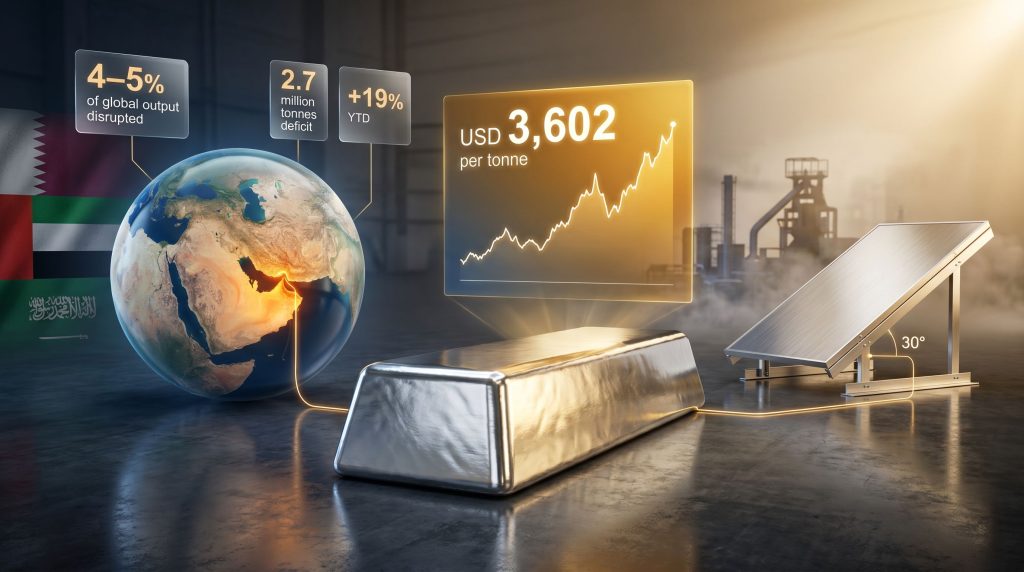
The figures emerging from Gulf production facilities are significant by any measure. Iranian missile strikes targeting Emirates Global Aluminium (EGA) operations and Aluminium Bahrain (Alba) facilities have taken an estimated 3.0 to 3.2 million tonnes of combined annual smelting capacity offline. Compounding this, Qatalum has implemented a 40% production curtailment due to reduced natural gas supply constraints, translating to an additional estimated 259,200 tonnes of lost annual output.
The table below captures the full scope of the disruption as it stands in May 2026:
| Metric | Estimated Figure |
|---|---|
| Gulf smelting capacity offline (combined) | ~3.0–3.2 million tonnes per year |
| Qatalum curtailment (40% shutdown) | ~259,200 tonnes annually |
| Combined share of global supply disrupted | 4–5% of total global output |
| Middle East share of global aluminium production | ~9% |
| Middle East share of non-China production | ~20% |
| Wood Mackenzie projected 2026 output loss | 3.0–3.5 million tonnes |
| ANZ projected market deficit (2026) | 2.7 million tonnes |
| ANZ projected market deficit (2027) | 1.1+ million tonnes |
| LME price increase since conflict onset (Feb 28) | +13% conflict-to-date; +19% YTD |
| LME 3-month benchmark price (May 2026) | USD 3,602 per tonne |
"The Middle East accounts for roughly 9% of total global aluminium production and nearly 20% of supply originating outside China. When viewed through that lens, a 4–5% reduction in global output is not a marginal fluctuation. It is a structural shock to the market's supply architecture."
China's Production Ceiling: Why the World Cannot Simply Rebalance
A logical market response would involve Chinese producers ramping up output to compensate. However, China operates under a self-imposed production cap of 45 million tonnes per year, a policy measure introduced to contain energy consumption and environmental impacts. This ceiling functionally prevents any large-scale expansion of Chinese output in response to external supply shocks, regardless of the price signals that would ordinarily incentivise increased production.
This constraint is more significant than it initially appears. China already produces the majority of the world's aluminium, meaning the 45 million tonne cap is not a distant theoretical limit but an actively binding constraint. Consequently, the global market cannot absorb Gulf production losses through the obvious alternative source, leaving buyers in Asia and elsewhere competing for a reduced pool of primary metal. The China metals market pressures already building before this conflict only compound the challenge facing international buyers.
The Strait of Hormuz: A Single Point of Failure for Gulf Aluminium
ANZ Bank's commodity research highlights a fact that rarely receives adequate attention in mainstream coverage: approximately 75% of Gulf smelting capacity depends on imported alumina and bauxite that must transit the Strait of Hormuz to reach production facilities. This creates a two-layer vulnerability for regional producers.
The first layer is physical damage to smelting infrastructure itself. The second, and arguably more insidious layer, is raw material starvation: even smelters that have escaped direct damage face operational curtailment if alumina inventories run down and resupply shipments cannot safely transit the Strait.
Aluminium smelters are not operations that can be paused and restarted at short notice. The electrolytic reduction cells operate at approximately 960°C and must be maintained continuously. Any interruption causes the molten bath to solidify, requiring a complete reconditioning of the cell lining — a process that typically takes six to eight weeks per pot line. This technical reality is precisely why Oxford Economics Lead Economist Stephen Hare characterised the conflict as a "systemic, multichannel supply shock" in a May 2026 report.
The Hidden Cost Escalation: Freight, Insurance, and Rerouting
Beyond production curtailments, the conflict has introduced significant secondary cost pressures across shipping and logistics networks. Vessels transiting waters adjacent to active conflict zones face sharply elevated war-risk insurance premiums, and some carriers have moved to reroute shipments entirely, adding voyage distance and time.
These costs do not disappear at the factory gate. They are absorbed into the landed cost of aluminium reaching manufacturing facilities across Asia, Japan, South Korea, and Southeast Asia. Physical aluminium premiums in Asian spot markets reflect these pressures, with procurement teams at automotive, construction, and industrial manufacturers facing extended lead times and elevated costs simultaneously.
Asia's Dual Exposure: Import Dependency Meets Manufacturing Pressure
The Middle East conflict aluminium supply chain disruption reaches Asian economies through two distinct pathways, each carrying its own set of implications for industrial activity and the clean energy sector.
Channel One: Raw Material Flow Disruption
- GCC smelter output reductions directly reduce the volume of primary aluminium available to Asian buyers on global markets
- Rising physical premiums in Asian spot markets as alternative supply sources from Australia, Canada, and Russia compete for limited shipping slots
- Procurement teams in Japan, South Korea, Taiwan, and Southeast Asia are facing extended lead times that disrupt manufacturing schedules
- Scrap and secondary aluminium markets are tightening as buyers seek alternatives to constrained primary supply
Channel Two: Downstream Manufacturing Cost Pressure
- Automotive, packaging, construction, and industrial firms are absorbing higher input costs across the production stack
- Manufacturers in Vietnam, Indonesia, and the Philippines are reassessing sourcing strategies and supply chain configurations
- Cost increases are flowing through to finished product pricing, compressing margins across the industrial manufacturing base
For countries like Indonesia, Vietnam, and the Philippines, which have aggressively expanded rooftop solar and utility-scale renewable energy deployment in recent years, this dual exposure creates a particularly uncomfortable dynamic. These nations accelerated their clean energy ambitions partly in response to persistently elevated fossil fuel costs. Now, the very metals required to build that clean energy infrastructure are themselves becoming more expensive and harder to source reliably.
Why Aluminium Is Irreplaceable in the Renewable Energy Transition
The stakes of this disruption for the Asia renewable energy sector are elevated by a fundamental material reality: aluminium is not a commodity that can be easily substituted in clean energy applications. Its combination of electrical conductivity, low density, corrosion resistance, and recyclability makes it uniquely suited to the physical demands of renewable energy infrastructure.
| Application | Aluminium's Role | Supply Shock Vulnerability |
|---|---|---|
| Solar PV mounting systems | Structural frames, racking, and rails | High — volume-intensive and price-sensitive |
| Wind turbine nacelles and towers | Lightweight structural components | Medium — long procurement cycles offer partial buffer |
| Transmission lines and grid conductors | Replacing copper in many grid expansion applications | High — grid build-out is accelerating across Asia |
| EV platforms and battery housings | Lightweighting for extended range efficiency | High — structurally rising demand |
| Battery storage enclosures | Thermal management and structural casing | Medium — growing rapidly with storage deployment |
| Rooftop solar installations | Rails, brackets, and mounting hardware | High — high volume, margin-sensitive |
Will Symons, who leads sustainability advisory work at Deloitte Asia-Pacific, has noted that aluminium's role in solar photovoltaic modules, wind turbines, transmission systems, and power infrastructure stems directly from its conductivity, lightweight properties, and recyclability. These are not incidental advantages but engineering requirements that competing materials cannot fully replicate at commercial scale.
Substituting steel for aluminium in solar mounting systems, for example, increases structural weight and corrosion risk. Copper, while a superior conductor, costs significantly more per unit weight and lacks aluminium's fabrication flexibility. In addition, the broader question of critical minerals and energy security has moved to the centre of policy discussions across the region as a direct consequence of this disruption.
Price Trajectories and Market Deficit Scenarios Through 2027
What the Forecasters Are Saying
ANZ Bank's commodity team has stated that even if the Strait of Hormuz reopens, restocking activity by manufacturers is expected to limit any significant downside correction in prices. The bank projects aluminium will remain above USD 3,400 per tonne through 2026 and maintains that market conditions are structurally skewed to the upside.
Wood Mackenzie projects the conflict will remove between 3.0 and 3.5 million tonnes from global aluminium output in 2026. ANZ's deficit modelling points to a shortfall of 2.7 million tonnes in 2026, narrowing but not closing to 1.1 million tonnes in 2027.
Three Scenarios for the Market Going Forward
Scenario A: Rapid Hormuz Reopening (Optimistic)
- A brief price pullback may occur on news of reopening, but restocking activity is expected to quickly absorb any downside
- The 2026 deficit narrows but does not close, as damaged facilities require months to resume full output
- Renewable project cost increases moderate but remain above pre-conflict baselines
Scenario B: Prolonged Disruption (Base Case)
- The structural deficit of 2.7 million tonnes persists through 2026 as restart timelines extend
- Manufacturers in Asia and Europe permanently restructure sourcing toward Australia, Canada, and inland Chinese producers
- Solar, wind, and grid project costs rise materially, and some deployment timelines shift
Scenario C: Escalation Beyond Current Parameters (Stress Case)
- Full Hormuz closure triggers compounding disruptions across LNG and crude oil flows
- Energy cost increases drive further smelting curtailments beyond the Gulf, potentially affecting energy-intensive producers elsewhere
- Clean energy deployment in Asia faces multi-year cost headwinds that could materially slow transition timelines
Disclaimer: The scenarios outlined above represent analytical projections drawn from third-party research and commodity forecasting. They do not constitute financial advice. Actual outcomes will depend on geopolitical developments, energy market conditions, and supply chain responses that remain inherently uncertain.
The next major ASX story will hit our subscribers first
Nickel: The Secondary Casualty Nobody Is Talking About
The supply chain stress radiating outward from the current disruption is not confined to aluminium alone. Nickel markets are beginning to absorb secondary pressure through a less obvious but structurally significant channel: sulphur supply disruptions. The Middle East accounts for nearly a quarter of global sulphur output used in nickel extraction processes, particularly in hydrometallurgical refining.
| Metal | Price at Conflict Onset (Late Feb 2026) | LME Price (May 2026) | Change |
|---|---|---|---|
| Aluminium (LME 3-month) | ~USD 3,025/t (implied) | USD 3,602/t | +~19% YTD |
| Nickel (LME) | USD 17,238/t | USD 18,933/t | +~9.8% |
While nickel's price movement has been less dramatic than aluminium's, the direction and the mechanism behind it carry significant implications for Asia's battery and electric vehicle supply chains. Lithium-ion battery manufacturing is heavily concentrated across Asia, and nickel-based cathode chemistry dominates the high-energy-density battery formats required for electric vehicles.
Harjeet Singh, Founding Director of Satat Sampada Climate Foundation, has noted that "the crisis reveals the extreme vulnerability embedded in highly centralised mineral supply chains, and that achieving a resilient energy transition requires a fundamental rethink of how clean technology supply chains are configured geographically." For context on how mining and renewable energy solutions are being rethought in response to these pressures, industry analysts are increasingly looking to new extraction and processing models.
Strategic Responses: How Asia's Renewable Sector Can Adapt
Supply Chain Diversification: The Immediate Priority
The conflict has accelerated a conversation that was already underway in supply chain risk management circles: the cost of geopolitical dependency versus the premium associated with diversified sourcing. Australia, Canada, and domestic recycling infrastructure within Asia are emerging as the primary diversification vectors.
Australian alumina refineries and smelters operate outside Gulf geopolitical risk corridors and have the capacity to expand supply, though at a cost premium relative to pre-conflict Gulf pricing. The aluminium industry leaders in these regions are consequently attracting intensified interest from Asian buyers seeking to reduce their exposure to Strait of Hormuz dependency.
Recycling and Secondary Aluminium: The Long-Term Hedge
Secondary aluminium, produced by recycling scrap rather than smelting virgin bauxite, consumes approximately 95% less energy than primary production and is not dependent on Gulf supply chains. Building out closed-loop aluminium recycling systems within Asian manufacturing ecosystems offers a structural hedge against future geopolitical supply disruptions.
The challenge is that secondary aluminium production capacity within Asia remains underdeveloped relative to the scale of primary metal consumption. Building the collection infrastructure, sorting technology, and remelting capacity needed to meaningfully substitute secondary for primary aluminium is a multi-year project requiring coordinated investment across both public and private sectors.
Policy Levers Available to Southeast Asian Governments
- Strategic stockpiling programmes for critical industrial metals, modelled on existing oil reserve frameworks
- Long-term offtake agreements negotiated at the government level with diversified international suppliers
- Import tariff adjustments that incentivise sourcing from geopolitically stable supply corridors
- Integration of critical mineral supply security into national energy transition roadmaps and industrial policy frameworks
- Investment incentives for domestic scrap collection and secondary aluminium processing infrastructure
Will Rising Aluminium Costs Slow Asia's Green Energy Transition?
The cost pass-through mechanism from LME price to installed renewable energy project economics is direct but not immediate. Aluminium costs typically represent 15–25% of total solar mounting system costs and a smaller but still material share of wind turbine and grid infrastructure project budgets. A 19% increase in aluminium prices therefore translates to a measurable increase in project-level costs for new developments entering procurement and construction phases.
Deloitte Asia-Pacific's assessment draws an important distinction between the exposure of operating assets versus new project pipelines. Existing renewable energy installations locked in their aluminium costs during procurement and construction phases prior to the conflict. The risk falls disproportionately on new projects that are currently in development, financing, or early construction phases, where aluminium procurement is either imminent or ongoing.
Will Symons of Deloitte Asia-Pacific has assessed that sustained price increases and prolonged supply constraints could slow renewable energy deployment and complicate grid modernisation plans across the region, particularly if manufacturers permanently shift sourcing toward higher-cost suppliers and those cost increases become structural rather than cyclical.
Grid modernisation represents a particularly vulnerable category. Transmission infrastructure expansion across Asia depends heavily on aluminium conductors, where the metal's combination of conductivity and weight makes it the dominant choice for overhead power lines. Delays or cost blowouts in grid projects have cascading effects on the ability to connect new renewable generation capacity to population centres, potentially creating bottlenecks that persist long after aluminium prices normalise.
Frequently Asked Questions
How much aluminium production has been lost due to the Middle East conflict?
Iranian missile strikes on EGA and Alba facilities have taken approximately 3.0 to 3.2 million tonnes of combined annual capacity offline. Including Qatalum's 40% production curtailment, Wood Mackenzie projects total 2026 output losses could reach 3.0 to 3.5 million tonnes, representing 4–5% of global supply.
Why does the Strait of Hormuz matter so much for aluminium supply?
ANZ Bank analysis indicates that approximately 75% of Gulf smelting capacity depends on imported alumina and bauxite moving through the Strait of Hormuz. Any prolonged shipping restriction starves smelters of raw material inputs, producing curtailments even at facilities that have not suffered physical damage.
Which Asian countries are most exposed to aluminium supply chain disruption?
Indonesia, Vietnam, and the Philippines carry the highest exposure, given their accelerating renewable energy deployment programmes and heavy reliance on imported aluminium for solar mounting systems, grid conductors, and wind energy equipment. Japan, South Korea, and Taiwan face significant manufacturing sector exposure. Reuters reporting on how the Iran conflict is rattling global aluminium supply chains provides further detail on the breadth of regional exposure.
How does aluminium supply affect the cost of solar panels and wind turbines?
Aluminium is used extensively in solar PV mounting frames, racking systems, wind turbine nacelles, transmission conductors, and battery storage enclosures. Price increases in primary aluminium feed directly into project-level costs for new renewable installations, with mounting and racking systems particularly price-sensitive due to their high aluminium volume requirements.
What is the current LME aluminium price forecast for 2026?
ANZ Bank projects aluminium will trade above USD 3,400 per tonne through 2026, with the LME three-month benchmark standing at USD 3,602 per tonne as of mid-May 2026. The bank characterises the price outlook as skewed to the upside given structural supply deficits.
Can recycled aluminium offset the loss of Gulf primary production?
Secondary aluminium can supplement supply but cannot fully compensate for a 3.0 to 3.5 million tonne primary production shortfall in the near term. Asia's secondary processing infrastructure is insufficiently developed at current scale, though investment in recycling capacity offers a long-term structural hedge.
How is the Middle East conflict affecting nickel markets and battery supply chains?
Disruptions to sulphur supply flows through the Strait of Hormuz are increasing input costs for nickel extraction processes. Nickel prices have risen approximately 9.8% since conflict onset, reaching USD 18,933 per tonne in May 2026, with implications for lithium-ion battery manufacturing costs across Asia. Analysis from AL Circle on how end-user sectors are grappling with the present aluminium chaos provides useful industry-level detail on these downstream effects.
Key Takeaways: The Structural Stakes for Aluminium and Asia's Energy Transition
The convergence of the Middle East conflict aluminium supply chain disruption with the accelerating demand for aluminium in Asia renewable energy infrastructure is not a temporary market anomaly. It reflects a structural tension that will shape commodity markets, project economics, and energy transition timelines well beyond the duration of the current conflict.
Critical risk factors to monitor:
- An estimated 3.0–3.5 million tonnes of Gulf aluminium output is at risk in 2026, representing 4–5% of global supply
- The global market deficit could reach 2.7 million tonnes this year, with a residual deficit of more than 1.1 million tonnes potentially extending into 2027
- LME aluminium prices are up approximately 19% year-to-date, with ANZ projecting continued upside bias through 2026
- Asia faces dual exposure through raw material import disruption and elevated manufacturing input costs simultaneously
- China's 45 million tonne production cap prevents the market's largest producer from filling the supply gap
- Nickel supply chains carry secondary risk through sulphur flow disruptions, with flow-on effects for battery and EV manufacturing costs
- New renewable energy projects in solar, wind, and grid infrastructure face the greatest near-term cost exposure
- Supply chain diversification, domestic recycling investment, and strategic stockpiling are emerging as the priority responses across both the private sector and government policy frameworks
The deeper structural tension is this: the energy transition that is driving surging aluminium demand is itself being undermined by the supply disruptions that geopolitical instability creates. Asia's renewable energy ambitions are aluminium-intensive by design, and the region's ability to decarbonise its energy system at the pace its climate commitments require depends on access to reliable, affordable supplies of a metal that has just been revealed as acutely vulnerable to the very kind of geopolitical instability that energy transition is meant to ultimately reduce.
Want to Track the ASX Stocks Positioned to Benefit From Critical Mineral Supply Shocks?
As aluminium and nickel supply chains face structural disruption, Discovery Alert's proprietary Discovery IQ model delivers real-time notifications on significant ASX mineral discoveries, turning complex commodity data into actionable investment insights for both short-term traders and long-term investors. Explore historic examples of major mineral discoveries and their market returns, then begin your 14-day free trial to position yourself ahead of the market.