July 18, 2026
The Invisible Chokepoint: How Gulf Smelter Collapses Are Rewriting Aluminium's Global Price Map
Few commodity markets illustrate the fragility of geographic concentration quite like aluminium. For decades, analysts understood intellectually that the Gulf Cooperation Council's rise as a primary aluminium powerhouse created a structural vulnerability in global supply chains. What many underestimated was how rapidly that vulnerability could crystallise into a genuine market crisis once geopolitical conditions deteriorated. The Middle East aluminium supply disruptions now unfolding represent not a temporary price spike but a fundamental reshaping of how aluminium flows around the world, who pays for it, and how much.
When big ASX news breaks, our subscribers know first
Understanding the Gulf's Strategic Weight in Global Primary Aluminium
The GCC's role in aluminium production is frequently underappreciated by investors outside the commodity sector. GCC nations collectively account for approximately 9% of total global aluminium supply. When the lens narrows to production outside China, that share expands dramatically to roughly 25%, making the region second only to China as a concentrated source of primary metal.
This concentration did not happen by accident. Gulf states leveraged three structural advantages to build world-scale smelting infrastructure over several decades:
- Abundant and historically cheap energy inputs, critical given that smelting is one of the most electricity-intensive industrial processes on earth
- Strategic maritime positioning enabling efficient export access to Asian, European, and North American markets
- Sovereign wealth capital capable of funding large-scale industrial assets that private markets might struggle to finance competitively
The three most significant producing nations — the UAE through Emirates Global Aluminium (EGA), Bahrain through Aluminium Bahrain (Alba), and Qatar through Qatalum — each operate facilities at a scale that takes years or decades to replicate elsewhere. Furthermore, among the global aluminium producers currently navigating this environment, GCC operators have historically been among the most cost-competitive. That replacement timeline is precisely what makes the current Middle East aluminium supply disruptions so consequential.
Two Simultaneous Pressure Channels Driving the Supply Shock
What distinguishes the current crisis from previous geopolitical aluminium disruptions is its dual-channel nature. Rather than a single point of failure, the market is absorbing damage across two simultaneous vectors operating in a reinforcing loop.
Channel One: Direct Infrastructure Damage
Strikes on refining and smelting assets have forced operational suspensions at multiple GCC facilities. Alba has halted operations entirely. EGA faces a recovery horizon of approximately 12 months before its primary facility can restore full production capacity. Qatalum in Qatar has also been affected, compounding the regional output shortfall beyond what any single facility's closure would generate independently.
The 12-month EGA recovery timeline deserves particular attention. Unlike oil wells, which can sometimes restart within days or weeks of conflict-related damage, aluminium smelting infrastructure is extraordinarily difficult to restore quickly. Potline technology — the electrolytic reduction cells at the heart of smelting — can suffer irreversible damage if cooled or disrupted, requiring costly and time-consuming rebuilds rather than simple repairs.
Channel Two: Strait of Hormuz Logistics Exposure
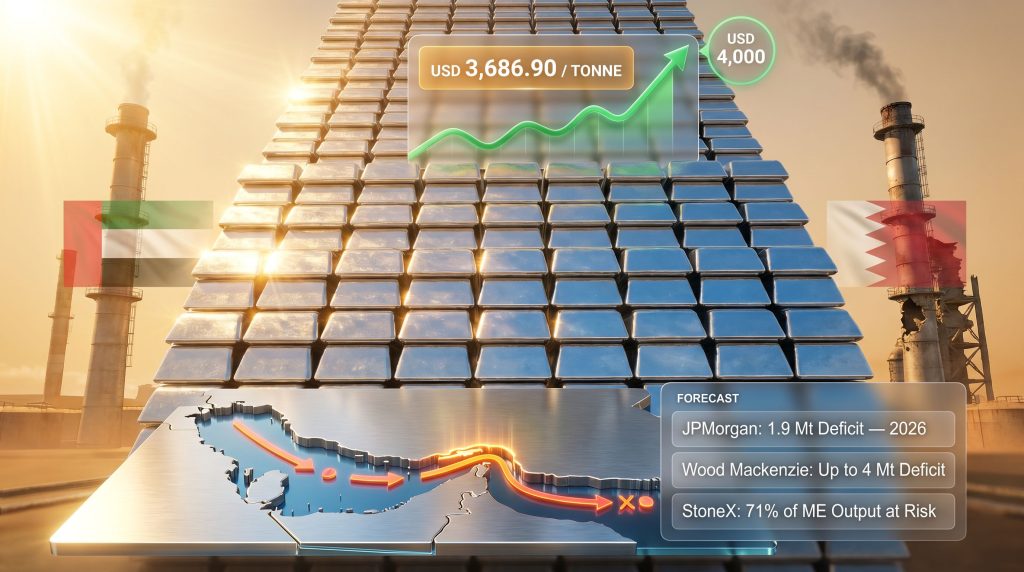
Even undamaged GCC smelters face an existential logistics threat. The Strait of Hormuz serves as the primary maritime corridor for both aluminium metal exports and the inbound alumina feedstock that keeps smelters operational. Analysts at StoneX estimate that up to 71% of Middle Eastern aluminium output is at risk if shipping disruptions escalate further, a concern Reuters has highlighted in their coverage of rising Western supply risks.
A less commonly understood vulnerability: Unlike most industrial commodities, aluminium smelting cannot buffer itself through inventory accumulation during a logistics disruption. The process requires a continuous and uninterrupted flow of alumina at a ratio of approximately two tonnes of alumina for every tonne of aluminium produced. A sustained Hormuz shipping restriction would exhaust alumina stockpiles within weeks, forcing additional involuntary curtailments beyond those already announced.
Gulf smelters source alumina primarily from Australia, Guinea, and Brazil. In addition, the bauxite supply chain that underpins alumina refining globally has come under renewed scrutiny as a result of these disruptions. Rerouting shipments around the Persian Gulf adds substantial freight time and cost premiums, and the longer the disruption persists, the greater the probability that even currently operational facilities are forced into partial or full curtailments.
Quantifying the Deficit: What Major Institutions Are Forecasting
The scale of the projected supply shortfall has prompted some of the most significant deficit forecasts from major financial institutions in years. The table below summarises current institutional projections:
| Institution | Estimated Disruption Volume | Projected Market Deficit | Price Target |
|---|---|---|---|
| JPMorgan Chase | ~2.4 million tonnes (2026) | 1.9 million tonnes | Not specified |
| Wood Mackenzie | Up to 3.5 million tonnes removed | ~4 million tonnes | Not specified |
| Bank of America | Not specified | Not specified | USD 4,000/tonne (Q4 2026) |
| StoneX | 71% of ME output at risk | Not specified | Not specified |
To contextualise these figures: global annual aluminium production sits at approximately 70 million tonnes. A 4 million tonne deficit represents roughly a 3% contraction in total global output. Historical data shows that even a 1–2% supply shortfall in aluminium markets is sufficient to trigger meaningful LME price escalation and downstream industrial rationing. The combination of historically low warehouse inventories and simultaneous Western market tightness amplifies the real-world impact of even the more conservative deficit scenarios.
JPMorgan's base case of a 1.9 million tonne deficit implies a sustained multi-quarter price support environment rather than a brief spike. Bank of America's USD 4,000/tonne target for Q4 2026 represents approximately an 8.5% premium above the four-year high the LME benchmark has already reached, signalling that institutional analysts expect disruption effects to persist well into the second half of the year.
LME Price Action and the Premium Signals That Matter Most
The LME aluminium benchmark has already reached USD 3,686.90 per metric tonne, a four-year high, as disruption fears intensified. Indian domestic pricing reflects the same directional pressure, with aluminium closing at INR 381.2 (approximately USD 3.94 per unit), a 0.62% session gain driven by supply-side anxiety rather than demand-side acceleration.
The most revealing price signal, however, is not the headline LME number but the structure of the forward curve. The aluminium market is in strong backwardation, with cash premiums over three-month contracts climbing to near 19-year highs of approximately USD 84 per tonne.
Backwardation in commodity markets carries a specific informational signal that investors should not overlook:
- When spot prices trade above forward prices, the market is communicating that it perceives an immediate physical shortage, not merely a long-term structural imbalance
- Sustained backwardation at near 19-year highs indicates that holders of physical metal are being rewarded for making inventory available now, confirming genuine tightness rather than speculative positioning
- The steeper and more persistent the backwardation, the stronger the evidence that supply constraints are real rather than sentiment-driven
Beyond the forward curve, two regional premium indicators confirm the same message. Japanese buyers, whose quarterly premium agreements serve as a benchmark for Asian market conditions, have agreed to pay premiums of USD 350–353 per tonne for Q2 2026 shipments, the highest level in 11 years. The US Midwest premium has surged sharply, a consequence that the broader impact of US aluminium tariffs has further compounded, passing directly through to downstream manufacturers in automotive, construction, and packaging sectors.
Technical Price Levels for Market Participants
| Price Level | INR | USD Equivalent | Signal Type |
|---|---|---|---|
| Immediate Support | 377.7 | ~3.90 | Near-term floor |
| Secondary Support | 374.1 | ~3.86 | Deeper correction zone |
| Resistance | 383.7 | ~3.96 | Breakout trigger |
| Upside Target (breakout) | 386.1 | ~3.99 | Momentum extension |
Regional Impact Analysis: Who Bears the Heaviest Burden
North America: Structural Import Dependency Exposed
The UAE and Bahrain collectively supplied 23% of all US unwrought aluminium imports in 2025, a degree of import dependency that the current disruption has rendered acutely problematic. North American traders were already navigating tariff-related tightness and historically low inventory levels before the Gulf crisis intensified. The combination has prompted warnings of a near-term supply crisis among downstream processors, with the US Midwest premium surge now flowing through directly to end-user pricing in automotive stamping, beverage can manufacturing, and construction.
Europe: A Second Stress Vector on an Already Pressured System
European industry was contending with energy cost volatility before Gulf disruptions entered the picture. The Middle East aluminium supply disruptions have added a second simultaneous stress vector to a supply chain that had limited spare capacity to absorb it. Downstream processors across the continent face rising input costs with minimal short-term substitution options, as alternative primary metal sources cannot be brought online quickly enough to offset GCC volumes. These pressures on the aluminum and alumina markets are broadly consistent with the structural vulnerabilities analysts had previously flagged.
India: Billet Shortages and Processing Facility Closures
India's aluminium extrusion sector is experiencing a particularly acute version of the crisis. Extruders are reporting shortages of both energy inputs and imported billets, with some processing facilities forced into temporary curtailments or closures. India's exposure reflects its structural reliance on imported primary aluminium and semi-fabricated products from Gulf producers, a dependency that leaves little buffer when GCC output contracts sharply. Consequently, industrial metals pricing trends across Asia are increasingly being shaped by Gulf supply constraints rather than domestic demand cycles.
China: A Complex Dual Role in a Disrupted Market
China's response to the Gulf disruption illustrates the complexity of its position as simultaneously the world's largest aluminium producer and a significant net importer and exporter depending on market conditions. As Al Circle has reported, end-user sectors worldwide are grappling with the present aluminium chaos in ways that vary significantly by region and industry:
- Aluminium imports rose 6.9% year-on-year in March, as Chinese buyers sought to capitalise on their purchasing scale while international supply chains tightened
- Exports climbed 15% in April, as international buyers actively sought Chinese metal to replace disrupted Gulf volumes
- Domestic production increased 3.1% in April to 3.87 million tonnes, supported by healthy producer margins
- Shanghai warehouse inventories rose 3.3%, creating a partial offset to further price gains by demonstrating that some physical buffer remains in the domestic system
China's export growth partially cushions the Western supply gap but, however, introduces new trade flow dependencies that consuming nations may find geopolitically uncomfortable over the medium term.
The next major ASX story will hit our subscribers first
Short Covering Dynamics and Institutional Positioning
A technically significant dynamic has emerged alongside the fundamental supply disruption. Market data shows active short covering behaviour, with open interest declining 5.86% to 2,780 lots even as prices rose by INR 2.35 (approximately USD 0.024) during the session.
Short covering in a rising price environment carries a specific implication for near-term price trajectory. When bearish participants are forced to exit positions against a rising market, two things happen simultaneously:
- Each covered short adds buying pressure to the market, mechanically pushing prices higher
- The exit of short positions reduces the pool of potential sellers, removing a natural counterweight to bullish momentum
This dynamic, layered on top of genuine physical tightness confirmed by the backwardation structure, creates a reinforcing feedback loop. Institutional positioning data reinforces the same directional signal. The convergence of JPMorgan, Wood Mackenzie, Bank of America, and StoneX around a structural deficit narrative represents a rare degree of major-institution alignment that commodity fund managers typically treat as a significant reallocation signal.
Scenario Analysis: Three Trajectories for the Crisis
The range of possible outcomes from the current Middle East aluminium supply disruptions spans from manageable tightening to historically severe market dislocation, depending on how the geopolitical situation evolves.
Scenario 1: Rapid De-escalation (Low Probability)
Conflict resolution within 60–90 days allows shipping lanes to reopen and damaged facilities to begin accelerated recovery. Under this scenario, LME prices would likely retreat toward the USD 3,200–3,400/tonne range as supply fears ease, and Japanese and US premiums would normalise over two to three quarters. This scenario is assessed as low probability given the structural complexity of the US–Iran dynamic and the scale of confirmed infrastructure damage.
Scenario 2: Prolonged Disruption, Partial Recovery (Base Case)
EGA's 12-month recovery timeline holds. Alba remains offline for 6–9 months. Hormuz shipping continues with intermittent restrictions, adding cost and uncertainty without full closure. The global deficit settles in the 1.5–2.5 million tonne range, prices sustain above USD 3,600–3,800/tonne through H2 2026, and Chinese export growth partially offsets Western supply gaps while introducing new dependencies.
Scenario 3: Full Escalation and Hormuz Closure (Tail Risk)
An extended Hormuz closure removes alumina supply access for all remaining GCC smelters. Wood Mackenzie's 4 million tonne deficit scenario materialises. LME prices breach USD 4,000/tonne ahead of Bank of America's Q4 2026 target. North American and European downstream industries face rationing conditions, and governments may consider strategic stockpile releases as an emergency industrial policy response.
The Structural Lessons Embedded in the Crisis
Beyond immediate price dynamics, the current disruption is forcing a reassessment of supply chain architecture that will likely persist long after the geopolitical situation stabilises. Several structural shifts appear probable:
- Strategic stockpiling acceleration: Governments and large industrial consumers are likely to reconsider minimum inventory thresholds for primary aluminium, particularly in defence-adjacent manufacturing sectors
- Smelting capacity diversification: Investment interest in aluminium smelting capacity outside the Middle East and China is likely to increase, potentially accelerating projects in Southeast Asia, West Africa, and North America
- Secondary aluminium investment: The crisis reinforces the investment case for recycled aluminium infrastructure as a supply chain hedge. Secondary aluminium requires approximately 95% less energy than primary production and is entirely insulated from upstream bauxite and alumina logistics risks
- Upstream focus on bauxite and alumina: The Gulf disruption has demonstrated that smelting capacity is only as resilient as its feedstock supply chain. Expect renewed attention to bauxite reserve control and alumina refinery positioning in geopolitically stable jurisdictions
- Bilateral supply agreements: Consuming nations that previously relied on market mechanisms to source primary aluminium may accelerate government-to-government supply arrangements with stable producing countries
One insight rarely discussed outside specialist commodity circles is the compounding effect of potline damage on recovery timelines. When aluminium reduction cells are disrupted or cooled during conflict-related outages, the molten bath chemistry that makes electrolytic reduction efficient can be permanently altered. Restarting a cold potline is not simply a matter of restoring power. It requires a multi-month process of gradual reheating, electrolyte reconditioning, and anode replacement that cannot be materially accelerated regardless of financial resources available. This technical reality is a key reason why EGA's 12-month recovery estimate is likely conservative rather than pessimistic.
Frequently Asked Questions: Middle East Aluminium Supply Disruptions
How much of global aluminium supply comes from the Middle East?
GCC nations account for approximately 9% of total global aluminium supply and around 25% of all primary aluminium production outside China, making the region among the most strategically significant production zones globally.
Which producers have been most severely affected?
Alba in Bahrain has suspended operations. EGA in the UAE faces a recovery period of approximately 12 months to restore full capacity at its primary facility. Qatar's Qatalum operations have also been affected.
Why is the Strait of Hormuz so critical to aluminium markets specifically?
The Strait of Hormuz serves as the primary maritime route for both outbound aluminium metal and inbound alumina feedstock. Because smelting requires approximately two tonnes of alumina per tonne of aluminium produced, and because smelting cannot easily stockpile against logistics disruptions, any sustained Hormuz restriction can force production curtailments within weeks rather than months.
What is the 2026 aluminium deficit forecast?
JPMorgan Chase projects a 1.9 million tonne global primary aluminium deficit in 2026, driven by an estimated 2.4 million tonne Middle East supply disruption. Wood Mackenzie's more severe scenario estimates a potential 4 million tonne deficit if disruptions escalate to include full Hormuz closure.
How high could aluminium prices realistically go?
Bank of America has set a target of USD 4,000/tonne for Q4 2026. The LME benchmark has already reached a four-year high of USD 3,686.90/tonne. Cash premiums are at near 19-year highs of approximately USD 84/tonne, and Japanese quarterly premiums have reached their highest level in 11 years at USD 350–353/tonne.
Which non-Middle Eastern regions face the greatest exposure?
North America is highly exposed, given that the UAE and Bahrain supplied 23% of US unwrought aluminium imports in 2025. Europe faces compounding raw material and energy cost pressures simultaneously. India is experiencing billet shortages and processing facility closures among downstream extruders.
Disclaimer: This article contains forward-looking statements, analyst forecasts, and scenario projections that involve inherent uncertainty. Price targets and deficit forecasts from financial institutions represent analytical estimates, not guaranteed outcomes. Readers should conduct independent research before making any investment decisions based on the information presented here.
Want To Stay Ahead of the Next Major Commodity Discovery Before the Market Moves?
Discovery Alert's proprietary Discovery IQ model scans ASX announcements in real time, instantly identifying high-potential mineral discoveries across aluminium, bauxite, and more than 30 other commodities — converting complex data into clear, actionable investment insights. Explore how historic discoveries have generated extraordinary returns and begin your 14-day free trial today to position yourself ahead of the broader market.