May 19, 2026
When Chokepoints Become Leverage: The Strategic Logic of Maritime Control Regimes
Throughout modern history, the world's most strategically sensitive waterways have attracted competing governance frameworks. The Bosphorus operates under the Montreux Convention. The Panama Canal functions through internationally recognised treaty arrangements. The Strait of Malacca is managed through a trilateral coastal state agreement endorsed by the International Maritime Organization. Each of these frameworks carries multilateral legitimacy precisely because it was constructed through negotiation rather than unilateral assertion.
What has emerged in the Strait of Hormuz in May 2026 follows an entirely different logic. Iran's simultaneous deployment of a regulatory body and a state-linked insurance platform represents something that maritime governance history rarely produces: a dual-layer control architecture erected by a single sovereign state over one of the world's most indispensable energy corridors. The Iran maritime authority insurance platform has emerged during an active period of military conflict and economic isolation. Understanding what this apparatus is, how it functions, and what it signals requires moving beyond the headlines.
When big ASX news breaks, our subscribers know first
Understanding the Persian Gulf Strait Authority and Its Claimed Jurisdiction
The Persian Gulf Strait Authority, announced formally on 19 May 2026, positions itself as Iran's official legal mechanism for governing navigation through the Strait of Hormuz. Its claimed territorial scope is notably ambitious. Iran has asserted jurisdictional authority stretching from the westernmost point of Qeshm Island to Umm al-Quwain on the UAE's west coast, and from Kuh Mobarak in Hormozgan province to southern Fujairah on the UAE's east coast.
This is not simply an administrative claim. Under the PGSA framework, any vessel intending to transit the waterway must obtain a permit and comply with rules and regulations issued by the authority. Passage without authorisation is classified as illegal under this domestic legal architecture. The PGSA established an official presence on social media platform X on 18 May 2026, one day before the formal announcement, broadcasting operational shipping updates to an international audience.
The jurisdictional claim itself preceded the formal institutional launch. Iran first asserted expanded control over the strait and surrounding waters on 4 May 2026, framing this as a sovereign prerogative during a period of heightened regional tension. The institutional machinery formalised that claim into a governing structure approximately two weeks later.
What the Hormuz Safe Platform Actually Does
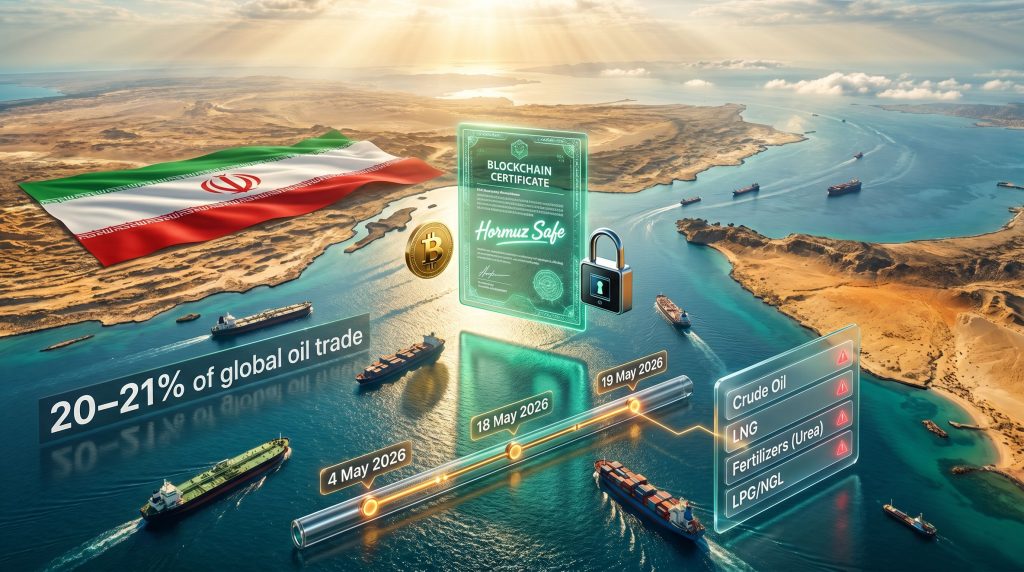
Running in parallel with the PGSA's regulatory function is the Hormuz Safe platform, a state-linked digital insurance mechanism designed to provide coverage for cargo and vessels transiting the Strait of Hormuz and surrounding Mideast Gulf waterways. The Iran maritime authority insurance platform has attracted significant international attention since its launch.
Several technical features distinguish Hormuz Safe from conventional maritime insurance products:
- It issues rapid, verifiable digital insurance certificates using encryption-based verification technology
- Premium payments are settled exclusively in cryptocurrency, including Bitcoin, entirely bypassing Western financial infrastructure
- Coverage appears currently limited to Iranian-flagged vessels and cargo owners, with no confirmed extension to third-party international shipping
- The platform operates outside the established Protection and Indemnity (P&I) club system that governs the vast majority of global merchant shipping insurance
"The dual deployment of a regulatory authority alongside a commercial insurance mechanism is not coincidental. This framework functions simultaneously as a sovereignty assertion, a revenue generation model, and a structurally deliberate response to Western sanctions enforcement."
The Sanctions Circumvention Architecture Behind Hormuz Safe
To appreciate the strategic significance of Hormuz Safe, it helps to understand the pre-existing insurance landscape for Hormuz transits. Western financial institutions, through P&I clubs and Lloyd's of London underwriters, have historically provided the primary insurance coverage for vessels transiting the strait. These institutions operate within SWIFT-connected payment systems and are directly subject to U.S. and EU sanctions frameworks.
As sanctions regimes have tightened, coverage for Iranian-linked shipping has been progressively restricted. The result is a coverage vacuum that Hormuz Safe is designed to fill, without requiring any interaction with Western financial infrastructure. By settling premiums in Bitcoin or other cryptocurrencies, the platform removes the need for correspondent banking relationships entirely.
This mirrors patterns of sanctions evasion that have been documented in Iranian oil trade for years, where intermediary networks across multiple jurisdictions have historically facilitated payment flows. The blockchain-based verification layer for insurance certificates introduces a dimension of digital infrastructure that Western regulators have limited visibility into. The U.S. Office of Foreign Assets Control has previously issued guidance confirming that cryptocurrency transactions with sanctioned entities carry the same legal exposure as traditional financial dealings, but enforcement at the transactional level remains structurally challenging.
Furthermore, discussions on Reddit's Bitcoin community have highlighted the novel use of Bitcoin as a settlement mechanism in this context, underscoring the platform's disruptive potential within the broader crypto ecosystem.
Iranian state media has cited a potential revenue figure exceeding $10 billion if the Hormuz Safe platform achieves wide-scale adoption. This projection warrants significant scepticism. It should be treated as aspirational messaging rather than a credible operational forecast, pending any independent verification.
Timeline: From Conflict to Control Architecture
| Date | Development |
|---|---|
| Late February 2026 | Effective closure of the Strait of Hormuz following Middle East conflict escalation |
| 4 May 2026 | Iran formally asserts expanded jurisdictional control over the strait and surrounding waters |
| 18 May 2026 | PGSA launches official account on X to broadcast operational shipping updates |
| 19 May 2026 | PGSA and Hormuz Safe platform formally announced |
The Strait of Hormuz as an Energy Chokepoint: What Is Actually at Stake
Under normal operating conditions, approximately 20 to 21 percent of global oil trade transits the Strait of Hormuz, according to data from the U.S. Energy Information Administration. This single waterway carries crude exports from Saudi Arabia, Iraq, Kuwait, the UAE, and Iran. Consequently, any disruption to this corridor triggers immediate consequences for global energy pricing, including an oil price rally that compounds existing market pressures.
The effective closure of the strait since late February 2026 has already produced measurable supply chain disruptions across the region. Saudi Arabia's fertilizer producer Sabic completed its first bulk urea loading at Yanbu on the Red Sea in May 2026, representing a structural pivot in export logistics. That single 25,000-tonne cargo required approximately 1,250 truck movements to transport urea from the production hub at Jubail to the Red Sea port.
Fellow Saudi producer Maaden had already executed a comparable overland logistics workaround for phosphate cargoes from Ras Al-Khair to Yanbu in March 2026. As of mid-May 2026, at least 15 Saudi urea-laden vessels were tracked in the Gulf awaiting strait navigation clearance, illustrating the scale of the supply constraint accumulating behind the chokepoint.
The LNG supply outlook is particularly acute, given that Qatar's export flows transit this corridor with no viable large-scale pipeline alternative. In addition, the LNG supply outlook for 2025 and beyond now carries elevated risk premiums directly attributable to Hormuz uncertainty.
Commodity Exposure by Category
| Commodity | Key Exporters Affected | Alternative Route Viability |
|---|---|---|
| Crude Oil | Saudi Arabia, Iraq, Kuwait, UAE, Iran | Limited; partial Red Sea/Suez rerouting possible |
| LNG | Qatar | No viable pipeline alternative at scale |
| Refined Products | Mideast Gulf refiners | Partial rerouting viable at elevated cost |
| Fertilizers (Urea, DAP) | Saudi Arabia (Sabic, Maaden) | Overland trucking to Red Sea ports (high cost) |
| LPG/NGL | Gulf producers | Severely constrained |
The financial consequences of the strait disruption are already propagating through global markets. U.S. refiner Citgo reported a profit of $157 million in the first quarter of 2026, compared with a loss of $82 million in the equivalent period of 2025, with the improvement attributed in part to elevated fuel prices driven by constrained Hormuz supply flows.
The Legal Status Problem: UNCLOS, the IMO, and Unilateral Authority
The PGSA framework faces a fundamental contradiction under international law. The United Nations Convention on the Law of the Sea guarantees the right of transit passage through international straits used for international navigation. This principle directly conflicts with Iran's permit requirement, which effectively conditions passage on compliance with a unilateral domestic framework.
Iran's position is complicated by the fact that it is not a signatory to UNCLOS, a non-membership status it has historically exploited to deflect legal challenges to its maritime claims. The International Maritime Organization has not recognised the PGSA framework, and no major flag state has formally acknowledged its permit requirements as legally binding.
The enforcement environment is further complicated by the continued presence of U.S. naval forces in the region, including a reported naval blockade of Iranian ports, creating a parallel authority structure that places international operators in an impossible compliance position. The broader geopolitical mining landscape illustrates how unilateral sovereign assertions are increasingly reshaping resource and transit governance globally.
Comparative Governance: How the PGSA Measures Against Recognised Frameworks
| Mechanism | Jurisdiction | Legal Basis | International Recognition |
|---|---|---|---|
| PGSA (Iran, 2026) | Strait of Hormuz | Domestic decree | None confirmed |
| Panama Canal Authority | Panama Canal | Treaty-based | Universally recognised |
| Turkish Straits (Montreux Convention) | Bosphorus/Dardanelles | Multilateral treaty | Broadly recognised |
| Malacca Strait coordination | Indonesia/Malaysia/Singapore | Trilateral agreement | IMO-endorsed |
The absence of multilateral legitimacy does not, however, render the PGSA operationally irrelevant. The Islamic Revolutionary Guard Corps retains demonstrated physical enforcement capacity in the strait, meaning the practical risk of non-compliance is real regardless of the framework's legal standing under international law.
Sanctions Risk: What Shippers and Cargo Owners Must Understand
Critical Risk Warning: Any engagement with the Hormuz Safe platform carries material secondary sanctions exposure under U.S. OFAC regulations and EU sanctions frameworks. Vessel operators, cargo owners, and insurers should obtain independent legal counsel before any interaction with this mechanism.
The compliance challenge facing international shipping operators is multilayered:
- Accepting Hormuz Safe coverage may constitute a financial transaction with a sanctioned entity under U.S. law
- EU-flagged vessels or EU-domiciled cargo owners face secondary sanctions exposure under European frameworks aligned with U.S. designations
- The cryptocurrency settlement mechanism does not eliminate sanctions exposure; OFAC has explicitly confirmed that crypto-denominated transactions with sanctioned parties carry equivalent legal risk to traditional financial dealings
- No major international shipping operator has publicly confirmed compliance with PGSA permit requirements as of mid-May 2026
The UAE faces a particularly delicate position. Iran's claimed jurisdictional boundary explicitly incorporates Umm al-Quwain on the UAE's west coast and southern Fujairah on the east coast, meaning a close trading partner and regional neighbour finds portions of its own maritime adjacency subsumed within the PGSA's claimed authority.
The next major ASX story will hit our subscribers first
How China and India Change the Calculus
Perhaps the most consequential variable in the Hormuz Safe story involves neither Western regulators nor regional actors, but the two nations that have historically served as Iran's primary crude oil buyers: China and India. The US-China trade impacts already reshaping global commerce add a further layer of complexity to Beijing's strategic calculations here.
Both nations have demonstrated willingness to navigate around Western sanctions frameworks in the past, particularly in the context of Russian and Iranian oil purchases. If PGSA enforcement escalates to the point where non-compliant vessels face genuine interdiction risk, Chinese and Indian operators may face a commercially pragmatic calculation about whether engaging with Hormuz Safe represents a lower-cost outcome than losing access to affordable Mideast Gulf crude.
This dynamic is precisely what makes the platform strategically significant beyond its immediate operational scope. A scenario in which even a subset of non-Western operators adopt Hormuz Safe would begin to fragment the global maritime insurance market along geopolitical lines, creating distinct Western and non-Western underwriting ecosystems. That fragmentation, once initiated, would be structurally difficult to reverse.
Three Scenarios for the Strait's Future
Scenario 1: De-escalation and Normalisation
A durable ceasefire and diplomatic resolution renders the PGSA framework largely symbolic. Hormuz Safe remains operational for Iranian domestic shipping but fails to achieve broader adoption. Western war risk premiums gradually normalise, and the global maritime insurance market reintegrates.
Scenario 2: Sustained Parallel Governance
Iran maintains PGSA enforcement while international operators navigate a dual-compliance environment. A subset of non-Western operators, particularly from China, India, and Russia, engage with Hormuz Safe to preserve access. Global maritime insurance begins fracturing along geopolitical lines, with distinct regulatory ecosystems emerging.
Scenario 3: Escalation and Prolonged Closure
Full PGSA permit enforcement, combined with IRGC interdiction of non-compliant vessels, effectively creates a permitting chokepoint layered on top of a physical one. Global oil prices surge materially. LNG spot markets experience acute supply shocks. Investment in alternative pipeline infrastructure and Red Sea routing capacity accelerates dramatically.
Frequently Asked Questions: Iran Maritime Authority Insurance Platform
What is the Persian Gulf Strait Authority?
The PGSA is a newly established Iranian body asserting legal authority over navigation through the Strait of Hormuz. It requires vessels to obtain permits before transiting the waterway and issues rules governing passage, though no major international maritime authority has recognised this framework.
What does the Hormuz Safe platform offer?
Hormuz Safe is a state-linked digital insurance platform providing coverage for cargo and vessels transiting the Strait of Hormuz and surrounding Mideast Gulf waters. It uses encryption-based digital certificates and accepts cryptocurrency payments. Current coverage appears limited to Iranian-flagged vessels and cargo owners.
Can international operators use Hormuz Safe without legal risk?
Engagement with Hormuz Safe carries significant secondary sanctions risk under U.S. OFAC and EU frameworks. Independent legal advice is essential before any interaction.
Why does Hormuz Safe use cryptocurrency?
Cryptocurrency settlement bypasses Western banking infrastructure and SWIFT-connected payment channels, reducing Iran's exposure to financial sanctions enforcement. This is a structurally deliberate design choice rather than a commercially motivated technology preference.
Is the $10 billion revenue projection credible?
This figure, cited by Iranian state media, is unverified and should be interpreted within the context of political messaging rather than as an operational forecast. Independent verification does not currently exist.
Key Takeaways for Shippers, Insurers, and Energy Market Participants
- Iran has constructed a dual-layer mechanism combining regulatory control through the PGSA with financial infrastructure through Hormuz Safe to assert sovereignty over the world's most strategically critical energy chokepoint
- The cryptocurrency payment architecture is a deliberate response to Western sanctions pressure, not a commercially driven technology adoption
- International legal recognition remains entirely absent, but the IRGC's physical enforcement capacity creates genuine operational risk for non-compliant vessels regardless of legal standing
- Energy commodity markets, particularly crude oil, LNG, and agricultural fertilizers, face structural disruption as long as strait access remains contested
- The most consequential long-term risk is market fragmentation: if non-Western operators begin adopting the Iran maritime authority insurance platform at scale, the global maritime insurance market may bifurcate in ways that extend well beyond the current crisis
- The $10 billion revenue projection attributed to Iranian state media remains unverified and should be read as aspirational political signalling
This article is intended for informational and analytical purposes only. Nothing contained herein constitutes legal, financial, or compliance advice. Parties with exposure to Mideast Gulf shipping routes or Iranian-linked maritime operations should seek qualified independent legal counsel before making any operational or financial decisions.
Want to Track the Commodity Market Impacts of Strait of Hormuz Disruptions in Real Time?
Discovery Alert's proprietary Discovery IQ model instantly identifies significant ASX mineral discoveries affected by global supply chain disruptions — including the energy and fertiliser commodities most exposed to Hormuz uncertainty — delivering actionable alerts directly to subscribers before the broader market reacts. Explore historic examples of major discovery returns and begin a 14-day free trial at Discovery Alert to position yourself ahead of commodity market volatility.