May 19, 2026
The Chokepoint That Rules Global Energy: Inside NATO's Hormuz Dilemma
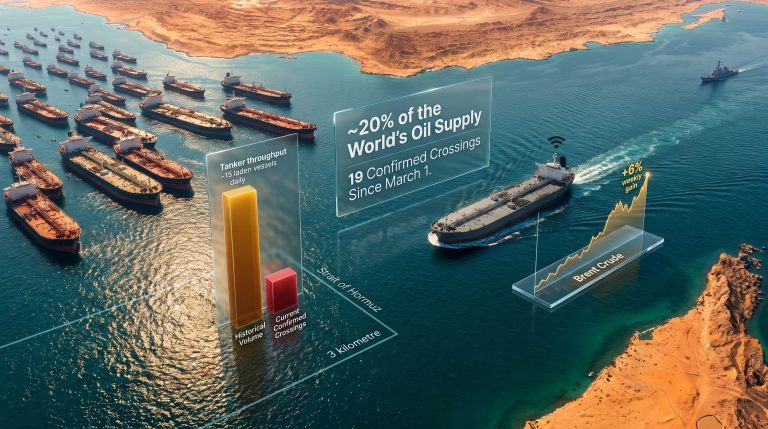
Few geographic features on Earth carry the economic weight of a single narrow maritime passage. Throughout history, the control of key sea lanes has shaped the rise and fall of empires, determined the outcomes of wars, and redirected the flows of global commerce. Today, the Strait of Hormuz occupies that pivotal position in the modern energy order, concentrating roughly one-fifth of all globally traded oil and liquefied natural gas through a corridor barely 21 miles wide at its tightest point. When that corridor closes, the tremors are felt everywhere, from Asian factory floors to European gas bills to emerging market balance sheets.
That is precisely the situation unfolding in mid-2026. Following U.S.-Israeli military operations against Iran that commenced in late February, Iran deployed its most powerful non-nuclear strategic instrument: effective control over the strait. The consequences have been immediate and severe, with energy prices surging and economic growth forecasts deteriorating across major importing economies. Now, NATO finds itself wrestling with a question it was never designed to answer: should the alliance project military force into the Persian Gulf to reopen a blocked waterway, and if so, how?
When big ASX news breaks, our subscribers know first
Why the Strait of Hormuz Has No Real Substitute
Understanding why a NATO Strait of Hormuz mission is even being discussed requires appreciating just how irreplaceable this waterway is to the functioning of the modern global economy. The strait connects the Persian Gulf, home to the world's largest concentration of proven hydrocarbon reserves, with the Gulf of Oman and the wider Indian Ocean trade network. Its geography is remarkably unforgiving: shipping lanes are designated at just two miles wide in each direction, separated by a buffer zone, within a total width of approximately 21 nautical miles.
The nations most acutely exposed to any sustained closure include:
- Japan and South Korea, which import the vast majority of their crude oil from the Persian Gulf and have limited domestic production alternatives
- China, which sources approximately 30% of its total crude imports through the strait, representing millions of barrels per day
- India, which relies on Gulf sources for over 60% of its oil requirements
- European Union member states, which depend heavily on Qatari LNG flowing through the passage
The only meaningful alternative routing is the Cape of Good Hope bypass around the southern tip of Africa, which adds approximately 4,000 nautical miles and two to three weeks to delivery times. That rerouting carries significant cost implications: higher fuel consumption, increased vessel utilisation, elevated war-risk insurance premiums, and corresponding inflationary pressure transmitted throughout supply chains. For time-sensitive energy deliveries underpinning just-in-time industrial operations across Asia, those delays are not merely inconvenient — they are structurally disruptive. Understanding the crude oil price trends at play here helps contextualise just how severe those impacts can become.
The Strait of Hormuz is not simply a shipping lane. It is the single most concentrated point of economic vulnerability in the global energy system, and unlike financial crises or demand shocks, it cannot be addressed through monetary policy or fiscal stimulus alone.
Critically, Qatar's North Field, one of the world's largest natural gas reservoirs, feeds its LNG exports almost exclusively through this corridor. With approximately 25% of globally traded LNG passing through the strait, the global LNG supply outlook becomes acutely precarious. Furthermore, European nations that pivoted toward Qatari LNG following Russia's reduction of pipeline gas supplies face compounding energy security pressures from a simultaneous closure of this waterway.
From Military Strike to Maritime Blockade: The Sequence That Got Us Here
How the Strait Became a Geopolitical Weapon
The sequence of events leading to the current crisis followed a logic that Iran had long telegraphed but many Western analysts underweighted. When U.S.-Israeli military operations against Iran began in late February 2026, Iran activated what strategic planners describe as its most scalable and asymmetric deterrent: the capacity to render the Strait of Hormuz effectively impassable for commercial shipping without necessarily engaging in direct conventional naval battle with superior forces.
Iran's asymmetric naval doctrine, developed over several decades specifically to counter conventional naval superiority, draws on a layered combination of capabilities:
- Fast attack craft and swarm tactics capable of harassing or threatening large commercial vessels without requiring direct engagement with naval escorts
- Coastal defense missile systems positioned along Iran's approximately 1,200-kilometre Persian Gulf coastline
- Mine warfare capabilities particularly effective in the shallow northern Gulf waters, where depths frequently measure less than 50 metres
- Land-based anti-ship missile systems with ranges sufficient to threaten vessels throughout the strait and approaches
This anti-access and area denial architecture was not improvised. It represents a deliberate strategic investment designed to create precisely the dilemma now confronting NATO and the broader international community: the cost and risk of forcing open the strait through military means is considerably higher than simple numerical comparisons of naval assets would suggest.
The U.S. Unilateral Attempt and Its Lessons
Washington's considerable military capabilities proved insufficient to resolve the standoff independently. A U.S. attempt to guarantee passage for commercial vessels was launched and then abandoned within days, a development that carries significant analytical weight. The failure was not purely military. It reflected the complexity of enforcing freedom of navigation in a contested littoral environment against a determined adversary employing asymmetric countermeasures, as well as the political sustainability challenges of maintaining unilateral operations without broader international burden-sharing.
The aborted U.S. mission effectively demonstrated that reopening the strait is not simply a function of deploying overwhelming naval force. It requires sustained operational commitment, rules of engagement that accept the risk of escalation, and political will that can withstand the domestic and diplomatic pressures of potentially lethal confrontations with Iranian forces over an extended period.
The Transatlantic Fracture: European Reluctance and American Frustration
The European response to U.S. pressure has revealed deep structural divisions within NATO that extend well beyond tactical disagreements about a single maritime mission. When the Trump administration demanded that European NATO members join efforts to reopen the strait, the response was a broadly coordinated refusal grounded in multiple overlapping objections. NATO allies have largely refused to join what they view as an active blockade enforcement operation, citing escalation concerns and the absence of a ceasefire framework.
Spain represents the most explicit expression of European opposition, having barred the United States from using its airspace and military installations to conduct operations against Iran. This is not merely rhetorical opposition. It represents a concrete strategic constraint on U.S. operational flexibility that required Washington to recalibrate its approach.
The broader European position has involved nuance rather than uniformity. Most NATO allies have quietly granted access to their bases for logistical support purposes, drawing a distinction between facilitating American operations and actively participating in combat or enforcement missions. This distinction matters institutionally, as it allows member states to maintain their stated opposition to the underlying conflict while avoiding a complete rupture with Washington over alliance obligations.
The U.S. frustration with this position was made concrete through Washington's announcement of the withdrawal of 5,000 troops from Germany, a signal whose symbolic weight in the context of NATO's European deterrence posture is difficult to overstate. The move carries echoes of Cold War-era burden-sharing arguments but with significantly higher geopolitical stakes given the concurrent security environment in Eastern Europe.
The transatlantic divide over Hormuz is not simply about differing assessments of military risk. It reflects fundamentally different views about whether NATO's collective security framework should extend to enforcing freedom of navigation in the Persian Gulf, and about the legitimacy of the underlying conflict that created the disruption.
What a NATO Strait of Hormuz Mission Would Actually Involve
Freedom of Navigation vs. Active Enforcement: A Critical Distinction
The conceptual architecture of any potential NATO mission matters enormously for both operational planning and political sustainability. There is a significant difference between escorting commercial vessels through the strait in a defensive posture and actively enforcing a blockade reversal through offensive operations against Iranian forces or infrastructure. These represent fundamentally different missions with different rules of engagement, different risk profiles, and different political implications for participating states.
A freedom-of-navigation escort operation would involve naval vessels accompanying commercial shipping through the strait, with the implicit deterrent being that any attack on the convoy would constitute an attack on NATO-flagged warships, triggering article-level responses from the alliance. This approach relies on deterrence logic rather than active combat, but its effectiveness depends on Iran's willingness to be deterred, which cannot be assumed given the current conflict environment.
Active enforcement would go considerably further, potentially involving the suppression of Iranian naval and coastal defense capabilities that threaten shipping, the clearance of mines, and the establishment of a sustained naval presence capable of guaranteeing safe passage against active resistance. The operational complexity and escalation risk of this approach are substantially higher and would require significantly greater political consensus among participating nations.
The Coalition-Within-a-Coalition Structure
Given the near-impossibility of achieving unanimous NATO consensus in the near term, the operational architecture most likely to emerge involves a coalition-within-a-coalition model, where NATO assets and member state navies participate in a maritime security framework that operates separately from NATO's formal command structure while drawing on alliance capabilities and coordination mechanisms.
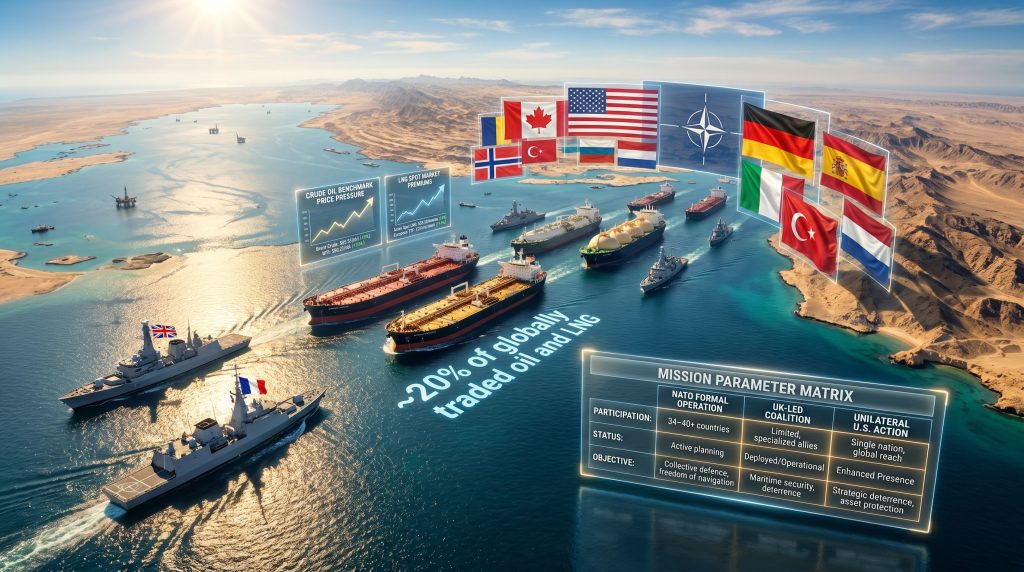
The United Kingdom and France have been developing exactly this framework, coordinating a maritime security plan involving approximately 34 to 40 nations in various support and participation roles. Reuters reporting confirms that NATO Secretary General Rutte communicated directly to allies that Trump sought Hormuz commitments within days, underscoring the urgency driving this coalition-building effort. Some participating countries have already positioned naval assets in the region in preparation for potential deployment, demonstrating that planning has progressed beyond conceptual discussion into concrete operational preparation.
This approach offers several structural advantages over a formal NATO mission:
- It does not require unanimous agreement from all 32 NATO members
- It allows reluctant allies to remain formally uninvolved while the broader coalition proceeds
- It satisfies the demand from many European members that any operation include substantial non-NATO participation, providing political cover against accusations of Western unilateralism
- It preserves institutional flexibility, allowing the mission to be framed as a multilateral humanitarian effort to restore freedom of navigation rather than an extension of the Iran conflict
| Mission Parameter | NATO Formal Operation | UK-France Led Coalition | Unilateral U.S. Action |
|---|---|---|---|
| Consensus Required | All 32 members | Participating nations only | None |
| Legal Framework | Article 5 / UNSCR | Ad hoc coalition authority | U.S. domestic authority |
| Geographic Precedent | Limited | Moderate | Established |
| Current Status | Under discussion | Active planning | Suspended |
| Estimated Participants | To be determined | 34-40+ countries | Not applicable |
The Operational Lessons of Past Alliance Maritime Missions
NATO has conducted maritime security operations in adjacent regions, including counter-piracy missions off the Horn of Africa under Operation Ocean Shield and sustained naval patrols in the Mediterranean under Operation Sea Guardian. However, these missions operated in environments where adversaries lacked sophisticated anti-ship capabilities and where the rules of engagement were relatively unconstrained by escalation risk against a state actor.
The Hormuz environment is categorically different. Enforcing passage against Iranian resistance would pit alliance naval assets against a state actor possessing layered anti-ship capabilities specifically designed to challenge conventional naval superiority in confined littoral waters. The shallow, constrained geography of the northern Gulf creates conditions where Iran's asymmetric advantages are most pronounced and where the operational calculus of a naval escort mission is most uncertain.
The Ankara Summit: NATO's Decision Moment
What July 7-8 Must Resolve
The NATO leaders' meeting in Ankara, scheduled for July 7-8, has assumed the character of a genuine strategic inflection point rather than a routine diplomatic convening. The specific challenge before alliance leaders is not simply whether to authorise a Hormuz mission but rather how to sequence the decision-making process in a way that can unlock the consensus currently blocked by member state divisions.
NATO Supreme Allied Commander Europe Alexus Grynkewich publicly acknowledged that he is actively thinking about the mission possibility, characterising political direction as the necessary precursor to formal operational planning. This sequencing is institutionally significant: formal planning requires political authorisation, but political authorisation cannot be manufactured without first establishing the strategic direction that aligns member state positions.
The Ankara summit must therefore accomplish several interconnected objectives:
- Establish whether a formal NATO mission framework is viable, or whether the coalition-of-the-willing structure will serve as the operational vehicle
- Define the preconditions under which reluctant member states would shift from opposition to support
- Communicate clearly to Iran and international markets whether a credible military response to continued strait closure is being assembled
- Determine the relationship between any maritime security mission and the broader diplomatic effort toward a ceasefire
The Economic Forcing Function
The timing pressure driving the July threshold is not primarily military. It is economic. Energy prices have surged and growth forecasts have deteriorated materially since the strait's closure, creating domestic political pressures on European governments that increasingly outweigh their reluctance to become militarily entangled in the Iran conflict.
The mechanism through which economic deterioration translates into political will for military action follows a recognisable pattern: as the costs of inaction accumulate visibly through energy bills, industrial output data, and revised GDP projections, the political calculation for previously reluctant governments shifts. Leaders who could maintain principled opposition to military involvement when the economic pain was theoretical find that position increasingly difficult to sustain as the concrete costs mount. Consequently, the scale of oil market disruption already under way is itself becoming a driver of political consensus.
If the Strait of Hormuz remains closed through the Ankara summit with no ceasefire in sight, the economic pressure on European governments, particularly those dependent on Middle Eastern LNG, may override the political reluctance that has defined allied posture since February 2026.
The Conditions That Could Unlock Consensus
Alliance officials have articulated a set of preconditions that most reluctant member states have insisted upon before supporting formal involvement:
- A ceasefire or at minimum a significant reduction in active hostilities, allowing a maritime security mission to be framed as post-conflict stabilisation rather than active participation in the war
- The formation of a broad coalition that prominently includes non-NATO nations, distributing the political and operational burden beyond the Western alliance and reducing the appearance of unilateral Western military action in the Middle East
- Clear rules of engagement that limit the mission to defensive freedom-of-navigation protection rather than offensive enforcement operations that could directly engage Iranian forces
- A defined mandate with explicit geographic and temporal limitations that prevents mission creep toward broader military involvement in the conflict
The interconnection between these conditions creates a complex political puzzle: a ceasefire is most likely to be achieved partly through the credible threat of a Hormuz mission, yet the mission cannot be formally authorised until after a ceasefire is achieved. Managing this paradox will require sophisticated diplomatic choreography from alliance leaders at Ankara.
The Macro-Economic Stakes: Modelling a Closed-Strait World
Energy Market Impacts and Price Trajectories
The economic consequences of sustained Hormuz closure operate through multiple transmission mechanisms that compound over time, creating a deteriorating spiral that goes well beyond simple oil price increases. The immediate effect is supply shock: removing roughly one-fifth of globally traded oil from normal market flows creates immediate upward pressure on Brent crude benchmarks, with the magnitude depending on the availability and cost of alternative supplies and the speed with which consuming nations can draw down strategic reserves.
Historical precedent suggests price sensitivity is extreme. The 1990 Iraqi invasion of Kuwait, which threatened but never fully severed Gulf exports, saw oil prices roughly double from approximately $15 to nearly $40 per barrel within months. The 2019 attacks on Gulf tankers, representing a far more limited and temporary disruption, triggered immediate price spikes exceeding 4% despite minimal actual supply impact. A sustained full closure of the strait represents a supply shock of unprecedented magnitude by comparison.
The LNG dimension creates additional complexity, particularly for Asian spot markets where Qatari supply disruption generates immediate premium escalation and intensifies competition with European buyers seeking alternative cargoes. This competition itself drives further price increases across both regions, with cascading effects on electricity generation costs, industrial competitiveness, and consumer energy bills.
Differential Exposure Across Economies
The economic impact of strait closure is not uniformly distributed. The table below illustrates the differential vulnerability of major importing regions:
| Region | Primary Exposure | Secondary Exposure | Available Mitigation |
|---|---|---|---|
| Japan/South Korea | Direct crude oil imports | LNG supply disruption | Limited strategic reserves, minimal alternatives |
| China | Direct crude imports (~30% of total) | Industrial output impact | Domestic production, Russian supply |
| India | Direct crude imports (60%+ of total) | Refining capacity mismatch | Limited alternatives at scale |
| European Union | LNG competition, price contagion | Growth forecast deterioration | Russian alternatives unavailable, U.S. LNG limited |
| Emerging Markets | Energy price inflation | Import bill expansion | Minimal reserve capacity |
Shipping Industry and Financial Market Responses
The maritime industry's response to sustained strait closure has been immediate and financially significant. War-risk insurance premiums for vessels operating in or near the Persian Gulf have escalated sharply, reflecting the actuarial reality of operating in a zone of active conflict. These premium increases are not abstract: they translate directly into the cost of energy delivery, adding basis points to every barrel of oil that makes it to market through alternative routing.
The shipping industry's economic calculation regarding the Cape of Good Hope alternative involves more than simple distance. Longer voyages require more vessel capacity to maintain the same delivery frequency, creating upward pressure on tanker freight rates that feeds back into energy prices at the destination. The specialist tanker fleet required to carry LNG is limited in size and cannot be rapidly expanded, creating supply bottlenecks in LNG delivery that amplify the physical supply disruption.
The investment dimension is equally significant. Capital expenditure decisions in energy infrastructure, refining, and petrochemicals have been disrupted by the uncertainty, with project financing becoming more expensive as lenders price in geopolitical risk premiums. The longer the disruption persists, the more these investment delays compound into structural supply shortfalls that persist even after the strait reopens.
The next major ASX story will hit our subscribers first
The Long-Term Strategic Calculus: What Hormuz Reveals About Alliance Architecture
Redefining NATO's Geographic Mandate
The debate over a NATO Strait of Hormuz mission is simultaneously a debate about what NATO is for in the twenty-first century. The alliance was conceived as a regional collective defense arrangement focused on the North Atlantic and European territory, and its formal geographic mandate has always been the subject of internal tension when out-of-area operations have been proposed.
Prior engagements outside NATO's traditional theatre, including operations in Afghanistan and counter-piracy missions off Somalia, established precedents for out-of-area action but were framed around specific mandates that contained political controversy. A Persian Gulf mission would represent a qualitative expansion of NATO's operational theatre that would set precedent for future engagements in regions previously considered beyond alliance scope.
The implications extend beyond geography. Member states that have resisted the Hormuz mission do so partly out of concern that authorising it would establish a precedent making future out-of-area commitments harder to refuse. The institutional logic of alliance solidarity, once extended to Persian Gulf energy security, would be difficult to confine to this single instance.
Iran's Calculus and the Risk of Escalation
Iran's decision-making regarding the blockade involves a complex strategic calculation that is not simply about maximising military advantage. The blockade functions as leverage in negotiations over the terms under which active hostilities might end, as a demonstration of deterrent capability intended to influence future U.S.-Israeli calculations, and as a rallying mechanism for domestic political cohesion under wartime conditions.
The prospect of a NATO maritime security mission fundamentally alters this calculus. If alliance naval assets escort commercial shipping through the strait, Iran faces a choice between allowing passage to proceed, effectively conceding the blockade's failure, or confronting NATO naval vessels, which carries the risk of triggering a broader military response that Iran cannot absorb without severe consequences. The credibility of the NATO threat is therefore itself a form of diplomatic leverage that may contribute to ceasefire negotiations without requiring the mission to be physically executed. In this context, the broader geopolitical risk landscape across the Middle East and beyond directly shapes how Iran weighs these options.
This dynamic illustrates why the Ankara summit carries weight beyond the operational question of whether a mission is technically feasible. The political signal transmitted by alliance leaders in Ankara may itself influence the trajectory of the underlying conflict.
Energy Security Diversification: The Structural Lesson
The Hormuz crisis has concentrated in a single, acute episode the structural vulnerability that analysts have warned about for decades: the concentration of global energy flows through a small number of geographic chokepoints creates systemic risk that cannot be managed through financial hedging or reserve drawdowns alone. The underlying exposure can only be reduced through genuine energy diversification strategies, including:
- Accelerated investment in renewable energy generation that reduces demand for imported hydrocarbons
- Development of alternative LNG supply sources and receiving infrastructure in Europe and Asia
- Rebuilding strategic petroleum reserve capacity that has been allowed to decline in many consuming nations
- Infrastructure investment enabling more flexible energy routing that reduces dependence on any single corridor
For the European Union, the Hormuz disruption arrives as a second major energy security shock in three years, following the Russian supply disruption after 2022. The cumulative lesson is that dependence on politically volatile supply corridors creates economic vulnerabilities that dwarf the cost of diversification investment. This structural argument for energy independence is likely to accelerate EU energy policy evolution regardless of how the current crisis is resolved.
Frequently Asked Questions: NATO and the Strait of Hormuz
What is the Strait of Hormuz and why does it matter to global energy supply?
The Strait of Hormuz is a narrow maritime passage between Iran and Oman that serves as the primary export corridor for Persian Gulf oil and LNG. Roughly 20% of globally traded petroleum products and a substantial share of LNG shipments pass through this waterway, making it the single most consequential energy chokepoint on Earth. Its closure forces rerouting via the Cape of Good Hope, adding weeks to delivery times and billions to shipping costs.
Has NATO ever conducted a maritime mission in the Middle East before?
NATO has conducted maritime security operations in adjacent regions, including counter-piracy missions off the Horn of Africa and naval patrols in the Mediterranean Sea. However, a formal alliance operation in the Persian Gulf would represent a significant geographic expansion of NATO's operational footprint with no direct precedent, raising novel questions about mandate, rules of engagement, and the long-term implications for alliance scope.
Why hasn't NATO already intervened to reopen the strait?
NATO operates on a unanimity principle, requiring agreement from all member states before a formal mission can be authorised. Several members, citing opposition to the underlying conflict, legal concerns, and escalation risk, have blocked consensus. The alliance has also conditioned involvement on a cessation of hostilities and the formation of a broad, non-NATO-inclusive coalition to avoid the appearance of unilateral Western military action in the Middle East.
What is the UK-France coalition plan for Hormuz?
Separately from NATO's formal deliberations, the United Kingdom and France are coordinating a maritime security framework involving approximately 34 to 40 countries. This coalition is developing operational plans to protect commercial navigation once active fighting subsides, with some participating nations already positioning naval assets in the region in preparation for potential deployment.
What happens to oil prices if the Strait of Hormuz stays closed?
Sustained closure removes approximately one-fifth of global oil supply from normal trade routes, creating immediate upward pressure on crude benchmarks, inflating LNG spot prices particularly in Asia, and forcing costly rerouting via the Cape of Good Hope. The compounding effect of higher shipping costs, elevated insurance premiums, and supply uncertainty typically generates price responses that exceed the physical supply reduction, as markets build in risk premiums based on duration uncertainty.
When is the next major NATO decision point on this issue?
NATO leaders are scheduled to convene in Ankara on July 7-8, a summit widely regarded as the critical juncture at which the alliance must either authorise formal planning for a Hormuz mission or reaffirm its current conditional posture pending a ceasefire.
Key Takeaways: The Hormuz Debate as a Mirror for Alliance Politics
The NATO Strait of Hormuz mission debate is ultimately about more than a single waterway. It is a stress test of the transatlantic alliance's capacity to respond collectively to economic security emergencies that do not fit neatly within the geographic and conceptual boundaries of the collective defense framework established in 1949. Several structural insights emerge from this analysis:
- Unanimity creates structural friction when rapid responses to economic emergencies are required, favouring coalition-of-the-willing frameworks over formal alliance mechanisms in time-sensitive situations
- Economic deterioration is the most powerful forcing function for consensus, ultimately overriding principled political objections when the costs of inaction become sufficiently concrete and widely distributed
- The coalition-within-a-coalition model has emerged as the practical architecture for Western collective security action when formal NATO consensus is unattainable, a pattern likely to persist in future out-of-area engagements
- Iran's asymmetric naval doctrine has performed its intended strategic function, imposing costs and complications on potential enforcement action that exceed what simple comparisons of conventional naval capability would predict
- The Ankara summit represents a genuine inflection point: not just for whether ships move through the Hormuz strait, but for the longer-term question of what geographic scope, strategic mandate, and institutional flexibility the transatlantic alliance will require to remain relevant to twenty-first century security challenges
This article is intended for informational purposes only and should not be construed as financial, legal, or strategic advice. Analysis of geopolitical scenarios and economic forecasts involves inherent uncertainty. Readers should consult primary sources and qualified professionals before making decisions based on information contained herein.
Want To Stay Ahead of the Resource Opportunities Emerging From Global Energy Disruptions?
Discovery Alert's proprietary Discovery IQ model scans ASX announcements in real time, instantly identifying significant mineral discoveries — including those tied to critical energy transition commodities being accelerated by crises like the Hormuz blockade — and delivers actionable alerts before the broader market reacts. Explore how historic ASX mineral discoveries have generated extraordinary returns and begin your 14-day free trial today to ensure you're positioned ahead of the next major find.