
May 19, 2026
When Energy Geography Becomes a Weapon: Understanding the Hormuz Chokepoint
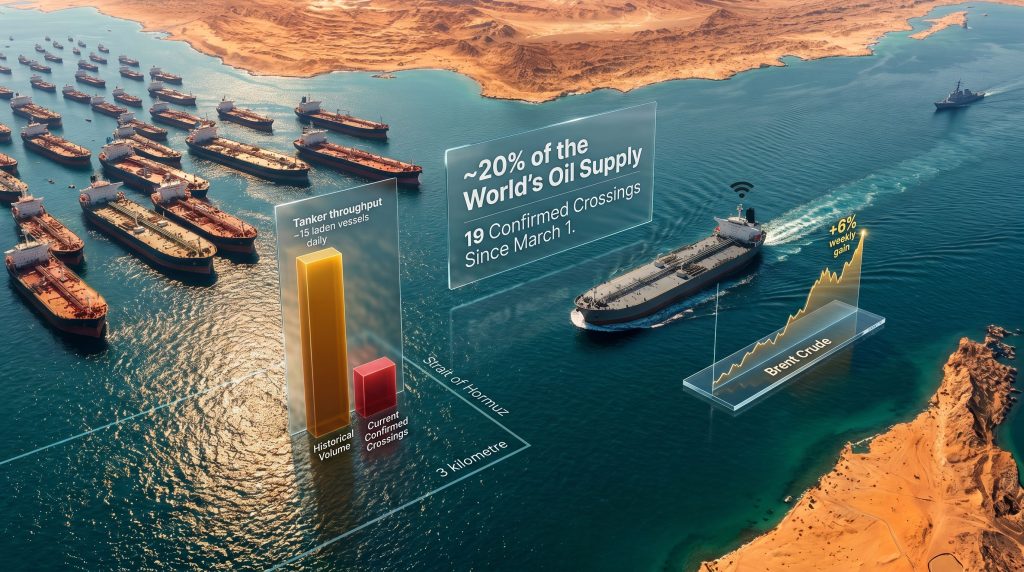
Most people understand oil prices as a financial abstraction, something that moves on a chart and shows up at the fuel pump. Far fewer grasp the physical reality underlying those numbers: that a meaningful share of the world's crude oil supply must physically navigate a body of water barely 33 kilometres wide at its narrowest navigable point before it can reach global markets. The Strait of Hormuz is not merely a geographic feature. It is the single most consequential energy bottleneck on the planet, and when tankers crossing the Strait of Hormuz slow to a trickle, the consequences ripple across every crude-dependent economy on earth.
When big ASX news breaks, our subscribers know first
The Geography That Makes Hormuz Irreplaceable
The strait connects the Persian Gulf to the Gulf of Oman and ultimately to the Arabian Sea, forming the only maritime exit for the vast hydrocarbon reserves of the Gulf region. Its two navigable shipping lanes are each roughly 3 kilometres wide, separated by a traffic separation scheme. Through this narrow corridor, approximately one-fifth of the world's total oil supply transited daily under pre-conflict conditions, along with a substantial portion of global LNG exports originating from Qatar.
The nations most exposed to any interruption are those with the deepest dependencies on Gulf crude: Japan, South Korea, China, India, and several European importers who have historically sourced significant volumes of their crude from UAE, Saudi, Iraqi, and Kuwaiti export terminals. Furthermore, the global LNG supply outlook adds another layer of vulnerability for buyers with no alternative sourcing options.
| Metric | Pre-Crisis Estimate |
|---|---|
| Share of global oil supply via Hormuz | ~20% |
| Approximate daily laden tanker transits | 15-20 vessels |
| Key Gulf exporters dependent on Hormuz | UAE, Saudi Arabia, Iraq, Kuwait, Qatar |
| Primary destination regions | Asia-Pacific, South Asia, Europe |
No alternative maritime route replicates this concentration. The closure or near-closure of Hormuz does not merely inconvenience global energy markets. It fundamentally restructures them.
How Traffic Through the Strait Has Collapsed
Since escalating conflict in the region triggered a wave of retaliatory measures by Iran in late February, commercial shipping through Hormuz has effectively stalled. Vessel-tracking data compiled by Bloomberg indicates that approximately 100 non-Iranian tankers that entered the Persian Gulf before hostilities intensified remain anchored or drifting inside the Gulf, unable or unwilling to attempt the return transit.
The reasons for this mass paralysis are interconnected:
- Attack risk: Iranian military capability and the demonstrated willingness to target commercial vessels during periods of regional tension have made operators acutely risk-averse
- Insurance withdrawal: War-risk insurance premiums have surged sharply, with certain underwriters pulling coverage for Hormuz transits entirely
- Crew welfare obligations: Shipowners face legal duties of care to seafarers that cannot simply be traded away for a freight premium
- Cargo owner instructions: Major commodity traders and oil companies have directed vessel operators to hold position pending clearer security conditions
The cumulative effect is a near-paralysis of normal commercial shipping through the world's most critical energy corridor. These oil market disruption risks extend well beyond the immediate region, affecting supply chains and pricing benchmarks globally.
The Minority Still Crossing: Tactics and Risk Tolerance
Against this backdrop of mass immobility, a small group of operators has continued moving vessels through the strait. According to Reuters, vessel-tracking data confirms that at least 19 non-Iranian oil and LPG tankers have successfully completed both entry into and exit from the Persian Gulf since March 1 of the current conflict period. Of those, seven have been linked to Dynacom Tankers Management, a Greek shipping operator.
This concentration is itself revealing. It suggests the residual transit activity is not a broad market function but rather the deliberate risk-acceptance of a very narrow cluster of operators — a pattern with deep historical roots in Greek maritime commerce, which has long maintained a culture of operating in elevated-risk environments that larger institutional shipowners typically avoid.
What Tactics Are Operators Using?
The tactics being employed to complete these crossings include:
- AIS transponder deactivation: Vessels disable their Automatic Identification System signals, removing themselves from public vessel-tracking platforms and reducing exposure to adversaries relying on open-source maritime intelligence
- Night-time scheduling: Crossings are timed to occur under cover of darkness, lowering visual and optical targeting risk
- Government-level arrangements: Some transits are reportedly facilitated through state-level diplomatic or commercial agreements, with reports suggesting non-standard payment mechanisms including cryptocurrency have featured in certain cases
A critical implication of widespread AIS deactivation is that the figures of 19 confirmed crossings and 100 stranded vessels represent floor estimates only. The actual number of both successful transits and stranded vessels is almost certainly higher than what publicly available tracking data can verify.
What Cargoes Are Still Moving?
The 19 confirmed crossings have predominantly carried cargoes originating from the UAE and Iraq, with three vessels transporting oil from Saudi Arabia or blended cargoes from Saudi Arabia and other Gulf Arab states.
| Cargo Origin | Share of Confirmed Transits |
|---|---|
| United Arab Emirates | Majority of confirmed crossings |
| Iraq | Significant portion of confirmed crossings |
| Saudi Arabia (sole or blended) | Three confirmed vessels |
The disparity reflects structural differences in bypass infrastructure. Saudi Arabia retains partial export flexibility through the East-West Petroline, which has a capacity of approximately 5 million barrels per day to Red Sea terminals at Yanbu, partially reducing Riyadh's dependence on Hormuz transits.
Iraq has no meaningful bypass infrastructure and is almost entirely dependent on Gulf terminal access for its exports, which partly explains the Iraqi cargo proportion among successful crossings. The UAE's ADNOC is actively developing additional bypass capacity through a new pipeline scheduled to double the Habshan-Fujairah bypass route's throughput by 2027, though that capacity does not yet exist at scale.
The 1980s Tanker War: What History Teaches About Conflict Zone Shipping
The current situation is not without historical precedent. During the Iran-Iraq War between 1980 and 1988, both belligerents systematically targeted commercial tankers to economically pressure each other and their trading partners. According to research compiled by the University of Texas Strauss Center, more than 400 commercial vessels were attacked during the Tanker War period.
Yet traffic never ceased entirely. A persistent minority of operators, accepting dramatically elevated freight rates as compensation, continued moving cargoes through the conflict zone throughout the decade-long war. The economic logic was self-sustaining: as long as the risk premium on offer exceeded the operator's assessed probability of loss, some participants remained active.
The Tanker War demonstrated a durable principle of conflict zone shipping: sustained, large-scale attacks deter the majority but rarely eliminate all commercial operators. A residual market always forms around those willing to price risk differently.
That same dynamic is playing out today. The freight rates available to operators willing to transit Hormuz currently command substantial multiples of peacetime market rates, and war-risk surcharges are ultimately passed through the supply chain to end consumers, feeding directly into refined product prices.
The next major ASX story will hit our subscribers first
The LNG Vulnerability No Pipeline Can Solve
While crude oil at least has partial bypass options, the LNG market faces a structurally distinct and more acute exposure. Qatar is the world's largest LNG exporter, and its entire export programme depends on tanker access through Hormuz. There is no pipeline alternative. There is no overland route.
Qatar's LNG simply cannot reach global markets without vessels passing through the strait. This creates a fundamental asymmetry between the crude oil and LNG disruption scenarios. Even a partial Hormuz restriction that allows some crude tankers to transit under risk-premium economics leaves the LNG market with no equivalent relief valve.
Asia-Pacific buyers who depend on Qatari LNG face acute supply shortfalls with no near-term substitute available at equivalent scale — a vulnerability that existing bypass pipelines and alternative supply sources cannot bridge within any commercially relevant timeframe.
Market Impacts Already Unfolding
The macroeconomic effects of reduced tanker throughput are already measurable across multiple indicators. Indeed, understanding the broader crude oil price trends helps contextualise just how dramatically this disruption has altered market dynamics.
- Brent Crude recorded a weekly gain of approximately 6% during the escalation period, with prices trading above $110 per barrel in recent sessions
- WTI and Brent futures have seen WTI prices trading above $100 per barrel throughout the crisis period
- India has raised domestic fuel prices twice within a single week, the first such increase in four years prior to this crisis, reflecting pass-through of elevated import costs
- India's wholesale inflation has reached multi-year highs, with fuel costs rising approximately 25% year-on-year
- The aggregate economic cost of the Middle East oil crisis to global businesses has been estimated at approximately $25 billion
Regional responses have varied based on each country's import dependency and pre-existing supply relationships:
| Country/Region | Response Strategy |
|---|---|
| Japan and South Korea | Deepening bilateral energy security cooperation |
| India | Signed LPG and strategic reserve deal with UAE; managing Russian crude waiver expiry |
| Australia | Seeking emergency jet fuel supplies from alternative sources including China |
| Pakistan | Pursuing diplomatic channels to secure LNG supply through Hormuz |
| UAE (ADNOC) | Accelerating Hormuz-bypass pipeline to double export capacity by 2027 |
Russia's Quiet Strategic Benefit
One of the less-discussed dimensions of the Hormuz disruption is its indirect benefit to Russia. Russian crude exports to Asian customers transit neither Hormuz nor the Suez Canal for their primary routes, meaning Moscow's export infrastructure remains insulated from the current disruption.
As Gulf supply tightens, buyers unable to secure Gulf crude are increasingly turning to alternative suppliers, with Russia positioned as a relatively accessible alternative. Reporting by OilPrice.com indicates that Russia's oil revenue windfall has grown as the Hormuz disruption persists.
Simultaneously, a U.S. naval posture in the region appears to be affecting Iranian floating oil stocks, with reports indicating Iran's floating crude stockpile has risen by approximately 65% as naval interdiction activity constrains Iranian export capability from the other direction.
Three Scenarios for Resolution or Escalation
Scenario 1: Diplomatic De-escalation
A negotiated pause leads to gradually restored commercial confidence. War-risk premiums retreat, more operators resume transits, and the 100 stranded vessels begin exiting the Gulf in an orderly sequence. Crude benchmarks ease from crisis highs as supply expectations normalise. Iran has reportedly articulated formal demands as a condition of any diplomatic resolution, with the Trump administration reported to have paused consideration of a planned military strike — a development that itself caused crude prices to pull back.
Scenario 2: Sustained Stalemate
The current equilibrium persists. A small number of risk-tolerant operators, concentrated among Greek shipping interests, continue crossing while the broader market remains idle. Global oil prices price in a persistent Gulf supply discount. Bypass infrastructure investment accelerates but cannot deliver meaningful additional capacity within a 12 to 24 month window. Asian importers accelerate diversification toward non-Gulf suppliers, including U.S. and Australian LNG.
Scenario 3: Full Strait Closure
A major attack on a transiting vessel or an explicit closure declaration removes all non-Iranian commercial traffic. As reported by the AP, crude prices could spike materially above current levels in such a scenario. Strategic petroleum reserves would be released by IEA member nations. The $25 billion aggregate economic cost estimate escalates substantially. LNG markets face acute shortfalls with no pipeline substitute capable of bridging the gap for Asian buyers.
The Thin Margin Between Open and Closed
The persistence of even a small number of tankers crossing the Strait of Hormuz carries symbolic and practical weight. It signals that the waterway has not been formally closed and that market-based risk pricing continues to function at some level. However, the concentration of that residual activity within a single Greek shipping group underscores just how thin that margin actually is.
If Dynacom and the handful of similarly positioned operators were to suspend operations, confirmed crossings would approach zero. The bypass infrastructure that exists cannot absorb the shortfall. Qatar's LNG has no alternative exit. And the 100 vessels anchored inside the Gulf represent a substantial volume of stranded cargo that current crude oil prices are already reflecting.
The Hormuz situation is not merely a geopolitical story. It is a live demonstration of how physical geography, maritime risk economics, and energy market structure interact when a single point of failure is activated. The difference between partial disruption and full closure may ultimately rest on the decisions of a very small number of shipping operators who have so far chosen to keep moving.
This article contains forward-looking observations and scenario analysis based on current available data. It does not constitute investment or financial advice. Energy market conditions, geopolitical developments, and shipping data can change rapidly. Readers should consult qualified professional advisers before making any investment decisions.
Want To Stay Ahead Of The Next Major Resource Discovery Triggered By Global Energy Shifts?
Discovery Alert's proprietary Discovery IQ model scans ASX announcements in real time, instantly identifying significant mineral and energy discoveries — including those linked to shifting global supply dynamics like the Hormuz disruption — and delivers actionable alerts directly to subscribers. Explore how historic discoveries have generated substantial returns and begin your 14-day free trial today to gain a market-leading edge.