May 20, 2026
The Hidden Contradiction at the Heart of the Green Economy
Every solar panel installed, every electric vehicle that rolls off a production line, and every wind turbine bolted to a hillside carries an invisible geological debt. The materials that make clean energy possible are not synthesised in laboratories or conjured from thin air. They are extracted from the earth through mining operations that require capital, expertise, technology, and time. This structural reality sits at the centre of one of the most consequential industrial shifts in modern history, and it is reshaping global resource strategy in ways that most energy policy discussions still underestimate.
The Simexmin transição energética e mineração conversation is not simply a Brazilian story. It is a window into the broader global reckoning between decarbonisation ambitions and the mineral supply chains needed to achieve them. What emerged from the XII Simpósio Brasileiro de Exploração Mineral, held in Ouro Preto, Minas Gerais between 17 and 20 May 2026, was a technically sophisticated and strategically significant examination of where that supply will actually come from.
When big ASX news breaks, our subscribers know first
Why Clean Energy Technologies Are Mineral-Intensive by Design
The physics and chemistry of low-carbon technologies make mineral intensity unavoidable. A single electric vehicle battery pack requires approximately eight kilograms of lithium, around 35 kilograms of nickel, 14 kilograms of cobalt, and more than 20 kilograms of manganese, depending on cell chemistry. Offshore wind turbines rely on permanent magnets containing neodymium and praseodymium, elements with highly concentrated rare earth supply chains. Photovoltaic cells depend on silver, indium, and tellurium, all of which are produced as byproducts of base metal smelting and face inherent supply constraints.
The following table illustrates the mineral dependencies embedded within key clean energy technologies:
| Clean Energy Technology | Primary Critical Minerals Required |
|---|---|
| EV lithium-ion batteries | Lithium, cobalt, nickel, manganese, natural graphite |
| Solar photovoltaic panels | Silicon, silver, indium, tellurium, selenium |
| Onshore and offshore wind | Rare earths (Nd, Pr), copper, steel, zinc |
| Grid-scale energy storage | Lithium, vanadium, iron, phosphate |
| AI infrastructure and data centres | Copper, cobalt, lithium, rare earths, tantalum |
| Industrial robotics and automation | Rare earths, cobalt, tungsten, specialty steel alloys |
What makes this dependency particularly significant from a supply chain perspective is that unlike fossil fuels, which are extracted and combusted, minerals used in clean technology are embedded into infrastructure with operational lifespans of 15 to 30 years. This creates a cumulative stock demand that compounds over time rather than a flow demand that fluctuates with consumption cycles. Furthermore, understanding critical minerals and energy transition dynamics is increasingly essential for any serious resource strategy.
Four Structural Forces Driving Critical Mineral Demand
Understanding the demand trajectory for critical minerals requires looking beyond individual technology adoption rates. Four converging structural forces are creating a demand environment with few historical precedents:
- Industrial decarbonisation commitments at national and corporate levels are mandating the retirement of fossil fuel infrastructure and its replacement with electrified alternatives across transport, heating, and industrial processes.
- Global EV fleet expansion is accelerating, with battery demand growing faster than many analysts projected even five years ago, placing sustained upward pressure on lithium, nickel, and graphite supply.
- Digitalisation and artificial intelligence infrastructure is consuming minerals at a rate that is frequently overlooked in energy transition narratives. Data centres, 5G networks, and semiconductor manufacturing all require copper, cobalt, and rare earth elements in substantial quantities.
- Robotisation and precision automation in manufacturing environments depends on high-performance electric motors and actuators, the majority of which use rare earth permanent magnets that cannot easily be substituted.
These forces do not operate in isolation. They reinforce one another. A factory automating its production lines to manufacture EV components requires rare earth motors, copper wiring, cobalt-containing control systems, and lithium battery backup infrastructure simultaneously.
Brazil's Geological Position in the Critical Minerals Landscape
Few countries occupy as advantageous a geological position as Brazil when it comes to the minerals that the energy transition demands. The Brazilian territory encompasses some of the most mineralogically diverse geological formations on the planet, ranging from the ancient Precambrian cratons of Minas Gerais and Goiás to the lateritic profiles of the Amazon basin and the pegmatite belts of the northeast.
Brazil holds globally significant reserves across a remarkably broad spectrum of critical minerals:
- Confirmed lithium deposits in spodumene-bearing pegmatites, positioning the country as a hard-rock lithium source outside the primary South American brine triangle.
- Natural graphite reserves of crystalline quality, particularly in Minas Gerais, relevant to anode manufacturing for lithium-ion batteries.
- Nickel laterite deposits of substantial scale, with Piauí emerging as a strategically important jurisdiction.
- World-leading niobium reserves, with Brazil accounting for approximately 90% of global production, a mineral increasingly relevant to high-strength steel alloys and emerging battery chemistries.
- Copper, cobalt, and rare earth occurrences that remain incompletely mapped due to historical gaps in systematic geological surveying.
The president of the Geological Survey of Brazil (Serviço Geológico do Brasil), Vilmar Simões, communicated at the SIMEXMIN 2026 opening that the country possesses singular geological conditions that position it to become a primary global supplier across multiple mineral categories simultaneously. This breadth of mineral endowment across a single national territory is genuinely unusual in global terms and represents a structural competitive advantage if developed systematically.
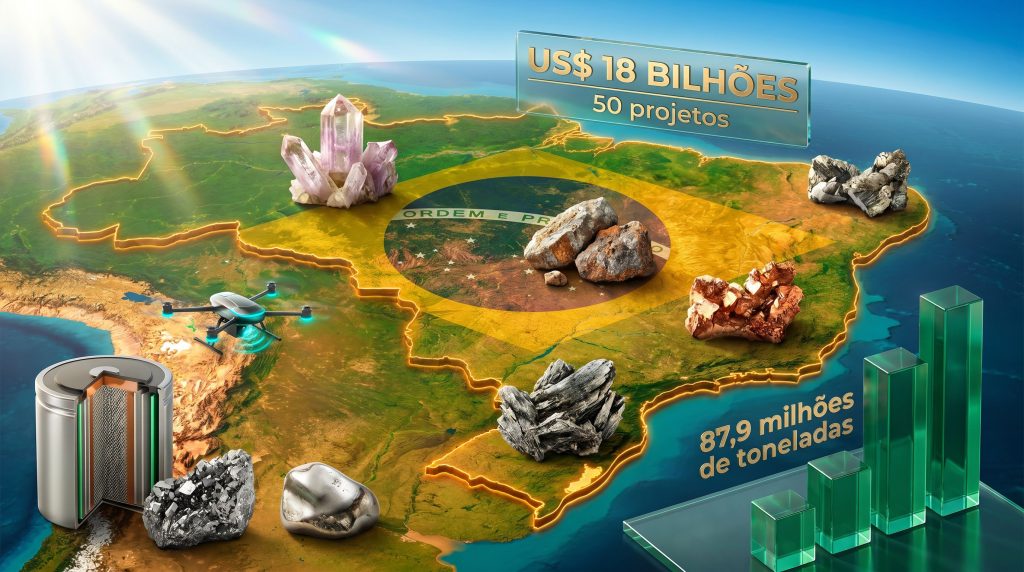
Brazil recorded 87.9 million tonnes of mineral products exported in the first quarter of 2026 alone, underscoring the existing scale of the national mining sector even before the critical minerals expansion reaches full momentum.
The Brejo Seco Deposit: Five Decades of Geological Knowledge in Action
One of the most instructive case studies presented at SIMEXMIN 2026 was the Brejo Seco nickel laterite deposit in Piauí state, discussed by Gabriel Sepulveda, coordinator of geology at Brazilian Nickel. The deposit represents something that is frequently underappreciated in mining investment discussions: the extraordinary value created by persistent, long-term geological research.
Nickel laterite deposits form through prolonged tropical weathering of ultramafic rocks, a process that concentrates nickel in the upper weathered horizon over geological timescales. Unlike hard-rock sulphide deposits, laterites cannot be upgraded through conventional flotation and require hydrometallurgical processing routes such as high-pressure acid leaching (HPAL) or atmospheric heap leaching.
The progression at Brejo Seco illustrates a model applicable to many underexplored Brazilian mineral provinces:
- Initial discovery and characterisation of the laterite profile and its nickel tenor.
- Progressive refinement of geological models through additional drilling and geochemical analysis over multiple decades.
- Systematic reduction of geological uncertainty, moving resources from inferred to indicated to measured categories.
- Consolidation of the deposit as a strategically relevant asset for nickel supply into battery-grade refining pathways.
The five-decade knowledge arc at Brejo Seco demonstrates that world-class deposits are rarely recognised immediately upon discovery. The geological understanding required to confidently estimate grade distribution, metallurgical behaviour, and economic parameters accumulates incrementally. This has direct implications for how investors should evaluate early-stage exploration assets in Brazil's emerging critical mineral jurisdictions.
Graphite and Lithium in Hard Rock: Brazil's Underappreciated Battery Mineral Potential
Antonio Carlos Pedrosa Soares of UFMG and CNPq presented at SIMEXMIN 2026 on the geological controls and prospective exploration models for graphite and hard-rock lithium in Brazil, a topic that receives considerably less international attention than the country's better-known mineral exports.
Natural graphite exists in two primary forms relevant to battery manufacturing: flake graphite, which is processed into spherical graphite for anode material, and vein graphite, which occurs in limited global locations and can achieve exceptionally high purity. Brazil's graphite occurrences are predominantly of the crystalline flake variety, requiring understanding of the metamorphic grade and carbon content of host sequences to evaluate economic potential.
Hard-rock lithium in Brazil is hosted primarily in pegmatitic systems where spodumene lithium extraction, lepidolite, and petalite carry lithium values. The exploration models for these systems differ fundamentally from the brine lithium exploration that dominates South American lithium discourse. Pegmatite-hosted lithium extraction technologies require geological mapping of zoning patterns within individual intrusions, understanding of the regional tectonic setting that controlled emplacement, and careful geochemical sampling programmes designed around the highly heterogeneous nature of pegmatite bodies.
A key insight from the SIMEXMIN 2026 discussions was that existing geological knowledge of Brazilian pegmatite belts, accumulated primarily through historical gemstone and industrial mineral exploration, provides a substantially richer foundation for lithium exploration than is commonly recognised internationally.
The next major ASX story will hit our subscribers first
Geophysics in the Energy Transition Era: What Is About to Change?
Yaoguo Li of the Colorado School of Mines brought an international perspective to SIMEXMIN 2026, addressing the evolving role of applied geophysics in the critical minerals exploration cycle. The methodological advances underway in geophysics are particularly consequential for jurisdictions like Brazil, where vast areas of prospective geology remain inadequately surveyed. In addition, downhole geophysics techniques are increasingly integrated into modern exploration workflows to improve subsurface resolution.
Several technical developments are converging to transform exploration economics:
- Machine learning-driven inversion of electromagnetic and gravity datasets is dramatically accelerating the interpretation of subsurface structure, reducing the human processing time required for large regional surveys.
- High-resolution drone-based magnetics and electromagnetics are enabling cost-effective coverage of terrain that was previously accessible only through expensive fixed-wing or helicopter surveys.
- Integration of multiphysics datasets combining magnetics, gravity, seismic, and induced polarisation is improving target discrimination and reducing the proportion of drill targets that fail to encounter economic mineralisation.
- Spectral remote sensing at increasing resolution is allowing surface mineralogy to be mapped across large areas, identifying hydrothermal alteration assemblages and secondary enrichment patterns indicative of deeper mineralisation.
The resumption of national airborne geophysical surveys by the Geological Survey of Brazil, following more than a decade of inactivity, is directly relevant to these methodological advances. The Tocantins survey, completed in March 2026 with approximately R$11 million in investment, represents the first deliverable of what the Survey intends to develop into a systematic national coverage programme.
The National Critical Minerals Policy: Framework, Priorities, and What It Means for Investment
Brazil's Política Nacional de Minerais Críticos e Estratégicos (PNMCE) represents the regulatory architecture within which the country's critical minerals ambitions will be organised. The Ministry of Mines and Energy has identified at least 50 projects linked to the energy transition mineral chain, with planned investments exceeding US$18 billion, reflecting the scale of capital mobilisation that the policy framework is intended to attract and facilitate.
The PNMCE's strategic pillars address the full value chain rather than focusing exclusively on upstream extraction:
- Geological knowledge expansion through systematic surveying and mapping in high-potential regions currently lacking adequate coverage.
- Domestic processing and beneficiation incentives designed to ensure that value addition occurs within Brazil rather than raw mineral exports being refined elsewhere.
- Import substitution across industrial sectors that currently depend on internationally sourced mineral inputs.
- Technological sovereignty in supply chains relevant to defence, energy, and advanced manufacturing.
- Responsible ESG management as a prerequisite for accessing premium markets and institutional financing.
José Luis Ubaldino de Lima, Director of Geology and Mineral Production within the Ministry's National Secretariat, emphasised at SIMEXMIN 2026 that three foundational enablers must advance in parallel for Brazil to convert geological potential into actual market leadership: the expansion and modernisation of geological research programmes, innovation in extraction and processing technologies, and the development of a specialised technical workforce capable of operating in complex geological and metallurgical environments.
Structural Challenges That Could Limit Brazil's Critical Minerals Ambition
A realistic assessment of Brazil's critical minerals opportunity must account for the structural gaps that separate geological endowment from delivered supply. The following challenges represent material constraints on the speed and scale of development:
| Challenge | Consequence | Potential Resolution Pathway |
|---|---|---|
| Incomplete national geological mapping | Underestimation of reserves and delayed discovery | Systematic expansion of SGB survey programmes |
| Specialist workforce deficit | Operational bottlenecks in technically complex projects | University and vocational training reform focused on geosciences |
| Environmental licensing complexity | Extended project timelines and cost uncertainty | Regulatory modernisation with integrated ESG frameworks |
| Limited domestic processing capacity | Export of low-value raw minerals instead of refined products | Industrial policy supporting beneficiation and refining |
| Remote area logistics deficits | Economic unviability of deposits in poorly connected regions | Public-private investment in mineral corridor infrastructure |
Beyond these operational constraints, the global market context adds a layer of complexity. Premium mineral markets in Europe, Japan, and North America are increasingly requiring documentation of the full provenance chain, environmental performance metrics, and evidence of community consent processes before sourcing agreements are formalised. Brazilian producers will consequently need to build traceability systems and ESG reporting capabilities that meet international due diligence standards, an investment that smaller operations may find difficult to absorb without industry coordination or financing support.
What the SIMEXMIN 2026 Agenda Reveals About Brazil's Mineral Priorities
Mining's Strategic Role in the Energy Transition
Reading the thematic structure of the SIMEXMIN 2026 programme itself provides insight into where Brazilian geological and technical expertise is concentrating. The combination of a laterite nickel case study, graphite and hard-rock lithium exploration modelling, and a forward-looking geophysics perspective was not accidental. These topics collectively represent the intersection of Brazil's proven geological endowment with the specific mineral demands of the global energy transition.
The event reinforced a broader narrative that has been building within the Brazilian mineral sector: that the country is transitioning its identity from a producer of bulk commodities such as iron ore and bauxite toward a recognised supplier of the speciality minerals that advanced economies are urgently seeking to diversify. Furthermore, growing interest in rare earth supply chains underscores just how strategically significant Brazil's mineral diversity has become in this context.
Converting Potential Into Market Reality
Whether that transition materialises at the scale and speed the Simexmin transição energética e mineração discussions envision will depend on consistent policy execution, private sector investment at the project level, and geological knowledge that converts exploration targets into drillable resources. In addition, the development of processing infrastructure capable of meeting the purity and consistency standards that battery and technology manufacturers demand remains essential.
The foundations being built through events like SIMEXMIN, the resumption of national geophysical surveys, and the formalisation of the PNMCE framework represent meaningful progress. However, the distance between that progress and actual market delivery remains substantial, and investors and policymakers alike would do well to maintain a clear-eyed view of both the opportunity and the timeline realism required to capture it.
This article contains forward-looking observations regarding mineral supply, policy frameworks, and investment pipelines. These involve inherent uncertainty and should not be construed as financial advice or guarantees of future outcomes. Readers conducting investment due diligence should consult qualified professionals and primary source documentation.
Want to Track the Next Major Critical Minerals Discovery Before the Market Does?
Discovery Alert's proprietary Discovery IQ model delivers real-time alerts on significant ASX mineral discoveries — instantly translating complex geological data into actionable investment insights across lithium, nickel, graphite, and rare earths. Explore historic examples of exceptional discovery returns and begin your 14-day free trial today to position yourself ahead of the market.