May 22, 2026
The End of Cheap, Abundant Aluminium: Why 2026 Marks a Structural Turning Point
For most of the past two decades, aluminium occupied an unusual position among industrial metals: a material simultaneously critical to modern manufacturing and structurally prone to oversupply. Smelter expansions in China, cheap hydroelectric power in the Middle East and Gulf Cooperation Council states, and the reliable availability of bauxite feedstock created a market that buyers could count on for consistent, relatively low-cost supply. That era is ending.
The global aluminium supply squeeze now gripping markets in 2026 is not a temporary disruption that resolves when shipping routes reopen or geopolitical tensions cool. It is the culmination of at least five years of compounding structural changes, arriving simultaneously and with enough combined force to potentially produce the largest aluminium supply deficit in approximately 20 years, according to analysis from Citi. Understanding why this moment is categorically different from previous tightness cycles requires examining each pressure point individually before appreciating how they interact.
When big ASX news breaks, our subscribers know first
What the Current Squeeze Actually Means: Structural Constraint vs. Cyclical Price Spike
Distinguishing between a cyclical price rally and a structural supply constraint matters enormously for procurement strategy, investment positioning, and policy planning. A cyclical rally typically reflects a demand surge that temporarily outpaces supply capacity, with prices self-correcting as producers expand output or demand normalises. A structural constraint, however, is something fundamentally different: it reflects a situation where the capacity to increase supply is either physically limited, politically constrained, or economically unviable at current investment timelines.
The current global aluminium supply squeeze satisfies the structural definition on multiple dimensions simultaneously:
- Production capacity ceilings have been reached in the world's dominant producing nation
- Exchange inventory buffers have declined from historically elevated levels to critically thin positions, removing the market's traditional shock absorber
- Geopolitical disruption has severed or threatened access to supply corridors that account for a meaningful share of globally traded primary metal
- Sanctions-related rerouting has permanently altered the accessibility of Russian primary aluminium for Western consumers
- Secondary supply constraints mean that recycled metal cannot scale quickly enough to compensate
The table below captures how key market indicators have shifted from their previous baseline positions:
| Indicator | Previous Baseline | Current Status (2026) |
|---|---|---|
| LME Aluminium Inventories | Historically elevated | Sharply reduced, below comfortable buffer levels |
| China Production Headroom | Significant growth capacity | Approaching self-imposed national output cap |
| Middle East Share of Global Output | ~9% of global supply | Active geopolitical risk variable |
| Analyst Price Target (Citi) | Below USD 2,500/t | Potential to exceed USD 3,000/t if disruptions deepen |
| European Import Exposure | Diversified including Russian supply | Concentrated and increasingly vulnerable |
China's Production Ceiling: The Variable That Changes Everything
China produces more than half of the world's primary aluminium, a concentration of output that has no parallel among major industrial commodities. For most of the past decade, this dominance provided a global safety valve: when demand surged elsewhere, Chinese production could theoretically expand to absorb it. That dynamic no longer holds, and China's industrial demand outlook adds further complexity to how global markets must now adapt.
Beijing has maintained a self-imposed annual production cap on primary aluminium, driven by energy consumption targets and carbon reduction commitments embedded in its broader climate policy framework. The cap sits at approximately 45 million tonnes per year, and Chinese smelters have progressively moved toward that ceiling. This is not a temporary constraint tied to power shortages or regulatory enforcement cycles. It reflects a deliberate policy architecture designed to hold, and the likelihood of a material relaxation in the near term is low given China's international climate commitments.
The consequence for global markets is profound. When supply tightens anywhere else in the world, there is no longer a Chinese expansion response to cushion the shock. The market must absorb disruptions without its historical backstop, which fundamentally changes how price responds to even modest supply interruptions.
Inventory Erosion and the Amplification Problem
When aluminium inventories on the London Metal Exchange and other exchanges were running at elevated levels, even significant supply disruptions could be absorbed before prices moved sharply. Available metal in warehouses functioned as a buffer between physical supply shocks and end-user markets. That buffer, however, has been substantially depleted.
The drawdown occurred across multiple phases:
- Post-pandemic demand recovery created sustained consumption growth across automotive, construction, and packaging sectors
- The energy crisis in Europe from 2021 onwards forced curtailments at energy-intensive smelters, reducing regional output materially
- Trade flow disruptions following Western sanctions on Russia redirected large volumes of primary metal away from accessible Western markets
- The Strait of Hormuz closure following the outbreak of the US-Iran war in 2026 added a further acute supply shock on top of already thin inventory positions
The feedback dynamic created by low inventories is particularly important to understand. Thin stocks amplify the price impact of any new disruption because there is no buffer available to absorb it. Higher prices then trigger premium escalation as buyers compete for available units. This feedback loop is now active in both the US and European markets, as detailed in recent analysis of the supply squeeze.
The Geopolitical Trigger: The Strait of Hormuz and Middle Eastern Aluminium
The Middle East accounts for approximately 9% of global primary aluminium production, with Gulf Cooperation Council nations having invested heavily in smelting capacity over the past two decades. The competitive advantage underpinning these investments is access to low-cost natural gas feedstock, which significantly reduces the energy cost component that typically represents 30–40% of primary aluminium production costs.
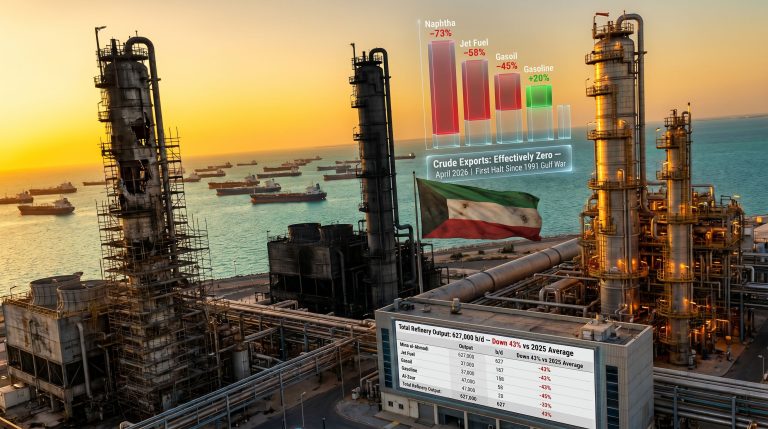
The US-Iran conflict and the resulting closure of the Strait of Hormuz has transformed this regional production base from a structural advantage into a vulnerability. The Strait is not merely a transit route for aluminium exports; it is also the corridor through which critical smelter inputs, including petroleum coke and other industrial materials, must travel.
"The Strait of Hormuz disruption matters to aluminium markets through at least three channels simultaneously: direct export restriction for finished metal, input supply disruption for operating smelters, and freight cost amplification that compounds already elevated regional premiums."
The scenario modelling below illustrates how different disruption durations translate to market outcomes:
| Scenario | Duration | Supply Impact | Price Response | Most Exposed Region |
|---|---|---|---|---|
| Brief disruption (under 30 days) | Short-term | Moderate; partially covered by stocks | Premiums spike, LME elevated | Europe, Japan, South Korea |
| Extended closure (30 to 90 days) | Medium-term | Significant; inventory buffers exhausted | LME potentially above USD 3,000/t | Europe, Southeast Asia |
| Prolonged escalation | Long-term | Structural; smelter output directly at risk | Sustained high prices; demand destruction begins | Global, especially ex-China |
| Rapid resolution with stockpile release | Near-term | Temporary oversupply | Price correction; premiums compress | All regions |
Russian Supply, Western Sanctions, and the Trade Flow Fracture
Before 2022, Russia was among the world's top three primary aluminium producers, with Rusal supplying a significant share of the metal consumed in European and global markets. Progressive Western sanctions have effectively removed the majority of this supply from accessible Western markets, forcing it to reroute toward China and other non-sanctioned buyers.
The rerouting effect is frequently underappreciated in mainstream market analysis. Russian aluminium has not disappeared from global supply totals; it has simply moved to markets where Western buyers cannot access it. For European consumers specifically, this has created a permanent sourcing gap that was partially filled by Middle Eastern supply, precisely the supply source now under threat from the Strait closure.
Europe consequently faces a double exposure problem: Russian supply constrained by sanctions and Middle Eastern supply constrained by geopolitical disruption. The alternatives — Canadian, Norwegian, and Australian primary metal — exist but are finite, already committed under long-term contracts, and priced at significant premiums above historical norms.
The next major ASX story will hit our subscribers first
How US and European Premiums Are Responding
Regional aluminium premiums function as the market's real-time stress indicators, revealing where supply tightness is most acute and where buyers are competing most intensely for available units. Both the US Midwest premium and the European duty-paid premium have moved into sustained upward trajectories in 2026, reflecting the structural nature of the tightness rather than speculative positioning.
In the US market, furthermore, the picture is complicated by tariff architecture. US aluminium tariffs and their subsequent modifications have created a layered cost structure for imports that distorts traditional trade flow economics. US buyers are now competing with European and Asian consumers for the same constrained pool of non-Russian, non-Middle Eastern primary metal, driving both volume competition and premium escalation simultaneously.
The consequence for procurement strategy is significant. Buyers who historically relied on spot market purchases to complement long-term contract volumes are finding spot availability increasingly limited and spot premiums increasingly punishing. Supply security has overtaken price optimisation as the dominant procurement priority for major aluminium consumers.
Why Demand Destruction Has Remained Limited Despite Record Prices
One of the more counterintuitive dynamics in the current global aluminium supply squeeze is how resilient consumption has remained despite historically elevated prices. The explanation lies in the structural composition of current aluminium demand, which is dominated by applications where substitution is either technically impossible, economically prohibitive, or strategically unacceptable.
| Sector | Demand Sensitivity to Price | Likely Response at USD 3,000 per tonne |
|---|---|---|
| Automotive EV lightweighting | Low to Medium | Absorb; aluminium is structurally required |
| Aerospace | Low | Absorb; long-term contracts insulate buyers |
| Construction and Infrastructure | Medium | Partial substitution possible |
| Packaging including beverage cans | Medium to High | Potential downgauging or material switching |
| Industrial manufacturing | High | Demand rationing or substitution likely |
Electric vehicle manufacturers cannot substitute steel for aluminium in battery enclosures and structural components without unacceptable weight penalties that reduce range performance. Aerospace manufacturers operate under multi-year contracts with specified material requirements that cannot be altered unilaterally. These demand anchors help explain why price-induced demand destruction has so far been slower to materialise than historical analogies might suggest.
The Secondary Aluminium Option: Promising but Limited
Recycled and scrap-derived aluminium has attracted significant attention as primary supply tightens, and for good reason. Secondary aluminium production uses approximately 95% less energy than primary smelting from bauxite ore, giving it a compelling cost and sustainability profile in an environment where energy costs are elevated and carbon constraints are tightening. In addition, global bauxite supply dynamics are further tightening the outlook for primary metal availability.
However, the secondary market faces its own structural constraints that limit how quickly it can compensate for primary supply shortfalls:
- High-grade alloy scrap, essential for automotive and aerospace applications, is in tight supply and commands premiums that compress the cost advantage over primary metal
- End-of-life vehicle scrap availability is constrained by vehicle fleet age cycles; the surge in electric vehicle production means the high-aluminium-content vehicles of today will not reach end-of-life for recycling for another decade
- Sorting and processing technology capacity limits how quickly available mixed scrap can be upgraded to specification-grade material
- Collection infrastructure in many markets remains underdeveloped relative to the volume of recyclable aluminium embedded in the existing building stock and industrial base
The scrap market will play an increasing role over the medium term, but it cannot serve as a near-term substitute for the volumes at risk from Middle Eastern disruption and Russian sanctions constraints.
Three Scenarios for Aluminium Markets Through End-2026
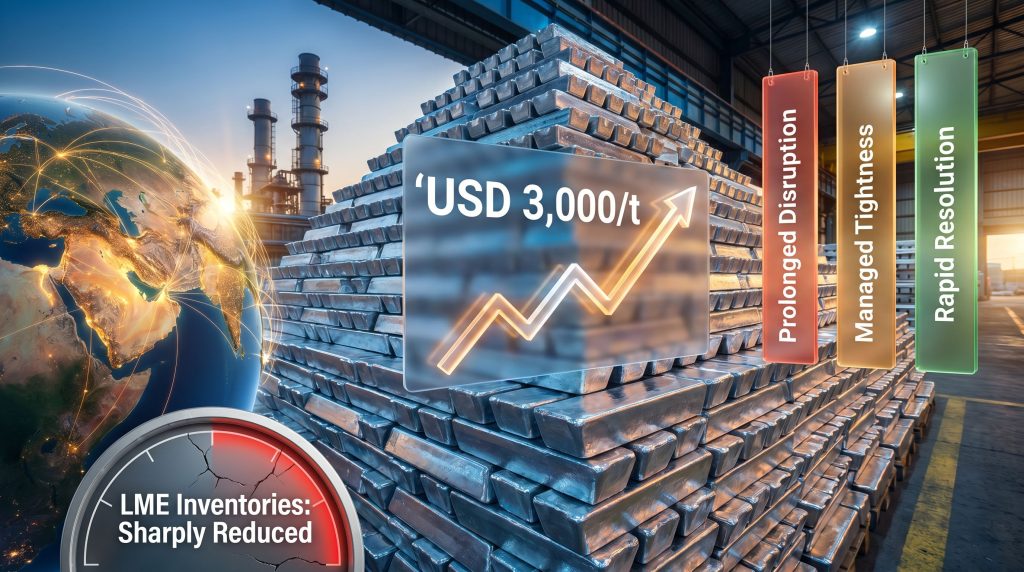
Will prolonged disruption drive prices above USD 3,000 per tonne?
Scenario 1: Prolonged Disruption
The Strait of Hormuz closure extends beyond 90 days, with Middle Eastern smelter output materially impacted. LME prices sustain above USD 3,000 per tonne. Demand destruction begins in price-sensitive sectors including packaging and industrial manufacturing. Long-term contract structures come under renegotiation pressure as buyers seek price relief. Alumina market pressures intensify further under this scenario, compounding costs across the supply chain.
Scenario 2: Managed Tightness (Most Likely Base Case)
Disruption is contained but not resolved. Inventories remain thin throughout the year. China's production ceiling prevents any meaningful supply response from the world's largest producer. Scrap markets tighten further as secondary aluminium commands a narrowing discount to primary. Premiums remain elevated but stable, and procurement teams shift permanently toward longer contract tenors and diversified sourcing.
Scenario 3: Rapid Resolution
The Strait reopens within 30 days. Stockpiled metal floods back into accessible markets, triggering a short-term price correction and premium compression across all regions. However, the structural vulnerabilities that created the squeeze — China's production ceiling, depleted inventories, and sanctions-constrained Russian supply — do not disappear. Tightness reasserts itself within six to twelve months as the underlying fundamentals remain unchanged.
"Across all three scenarios, the era of structurally abundant, low-risk aluminium supply appears to be over. The squeeze may ease tactically, but the conditions that produced it are permanent features of the market landscape, not temporary aberrations."
Furthermore, leading aluminium producers are already adjusting their strategic planning horizons in response to this new reality, with capital allocation decisions increasingly reflecting structural tightness rather than cyclical assumptions. According to S&P Global's market outlook, the global aluminium market is bracing for continued supply disruptions, volatility, and margin pressure well into the medium term.
Key Takeaways: What the Global Aluminium Supply Squeeze Means for Buyers, Traders, and Investors
- Supply security has replaced price optimisation as the dominant procurement objective for major aluminium consumers in 2026
- China's production ceiling is permanent in any policy-relevant timeframe, eliminating the historical buffer that absorbed global demand shocks
- Dual European exposure to both Russian sanctions and Middle Eastern disruption creates the most acute regional vulnerability in the current cycle
- Secondary aluminium cannot scale fast enough to compensate for primary supply shortfalls in the near term, despite its structural advantages
- Citi's USD 3,000 per tonne threshold represents a credible outcome if disruptions deepen, a price level that would drive meaningful demand destruction in price-sensitive sectors
- The premium signal matters as much as the LME price: elevated and rising regional premiums confirm that physical tightness is real, not speculative
- Aluminium is increasingly being treated by sophisticated consumers and policymakers as a strategically critical material, not a commodity with unlimited supply elasticity
Disclaimer: This article contains forward-looking analysis, scenario projections, and market commentary based on publicly available information as of May 2026. It does not constitute financial advice. Commodity markets involve significant uncertainty, and actual outcomes may differ materially from the scenarios described. Readers should conduct independent research and seek professional advice before making investment or procurement decisions.
Want to Stay Ahead of the Next Major Commodity Discovery?
Discovery Alert's proprietary Discovery IQ model delivers real-time alerts on significant ASX mineral discoveries — cutting through complex market data to surface actionable opportunities the moment they're announced. Explore historic examples of exceptional discovery returns and begin your 14-day free trial today to position yourself ahead of the market in commodities like aluminium and beyond.