
July 24, 2026
When Energy Chokepoints Become Weapons: Understanding Kuwait's 2026 Supply Collapse
The global energy system has long operated on an uncomfortable assumption: that the Strait of Hormuz, despite its well-documented fragility, would remain functionally open. Strategic planners, commodity traders, and national procurement offices have modelled disruption scenarios for decades, yet few anticipated the speed and severity with which a combined infrastructure assault and maritime blockade could simultaneously neutralise one of the Gulf's most sophisticated refining economies. Kuwait oil products output and exports halved by war in March 2026 offers a case study in how concentration risk, when triggered, does not unfold gradually. It collapses overnight.
When big ASX news breaks, our subscribers know first
Kuwait's Refining Architecture: Why Three Facilities Determined a Nation's Economic Fate
Kuwait's economic structure is among the most petroleum-dependent of any sovereign nation. Oil revenues have historically accounted for the vast majority of the country's export earnings, with Kuwait Petroleum Corporation (KPC) functioning as the backbone of government finance and foreign exchange generation. Within that structure, three major refining complexes carry essentially all of the country's downstream processing capacity:
- Mina al-Ahmadi (346,000 b/d): one of Kuwait's oldest and most strategically significant facilities, located on the eastern coastline
- Mina Abdullah (454,000 b/d): a mid-coast complex handling a substantial share of middle distillate production
- Al-Zour (615,000 b/d): Kuwait's newest and most modern facility, commissioned to position Kuwait as a major exporter of higher-value refined products to Asian markets
Together, these three facilities represent a combined design capacity exceeding 1.4 million barrels per day. Their geographic concentration along Kuwait's coast, while operationally logical, creates a structural vulnerability that conflict planners have understood for years. South Korea, India, and China are among the primary destination markets for Kuwaiti refined products, making any sustained disruption to refinery throughput a procurement crisis for importers across Asia.
Historical precedent illustrates how devastating these disruptions can be. The 1973 Arab oil embargo demonstrated that politically motivated supply constraints could reshape global energy markets within weeks. The 1991 Gulf War, when Kuwait's oil infrastructure was deliberately destroyed by retreating Iraqi forces, required years of reconstruction investment and served as the original template for understanding the country's supply fragility. Furthermore, the 2026 crisis has now created a new reference point that may prove more instructive for future risk modelling.
The Scale of Production Collapse Recorded in March 2026
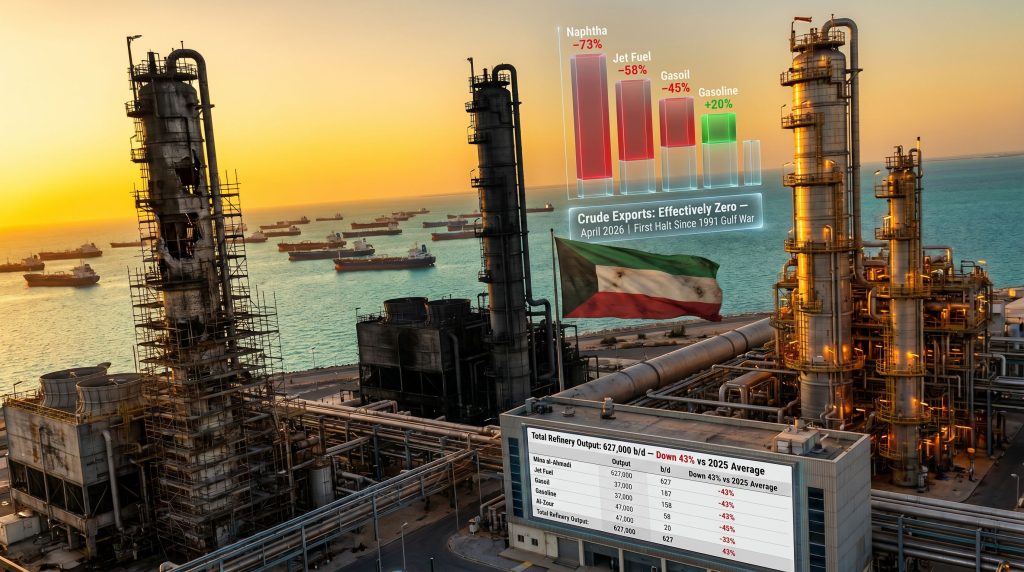
Joint Organisations Data Initiative (JODI) data provides the clearest quantitative picture of what happened to Kuwait's refinery throughput in March 2026. Total output, excluding LPG, fell to approximately 627,000 b/d, the lowest level recorded since at least October 2022. To contextualise the severity of this reversal, Kuwait had reached an all-time production high of approximately 1.31 million b/d in February 2026, just weeks before the conflict began on 28 February.
JODI data extends to 2002, meaning this represents one of the sharpest single-month contractions in Kuwait's recorded refining history. Monitoring current crude oil prices alongside these output figures reveals just how severely this collapse has reverberated through global commodity markets.
Product-by-Product Breakdown: Where the Damage Concentrated
The product-level data reveals a highly uneven distribution of losses, with complex hydroprocessing-intensive streams suffering the most severe declines:
| Oil Product | March 2026 Output (000 b/d) | 2025 Average (000 b/d) | Change (%) |
|---|---|---|---|
| Gasoline | 78 | 65 | +20% |
| Naphtha | 53 | 194 | -73% |
| Jet Fuel / Kerosene | 110 | 262 | -58% |
| Gasoil | 180 | 327 | -45% |
| Fuel Oil | 206 | 249 | -17% |
| Total Output | 627 | 1,096 | -43% |
Source: JODI. Excludes LPG.
Naphtha experienced the most catastrophic contraction at -73%, a particularly significant outcome given that naphtha feeds petrochemical crackers across East Asia. Its loss ripples far beyond the refining sector into polymer and plastics supply chains. Jet fuel fell by -58% and gasoil by -45%, while fuel oil showed relative resilience at -17%, likely reflecting the continued operation of basic atmospheric distillation units even as more complex secondary processing was taken offline.
The Gasoline Anomaly: Why Did One Product Buck the Trend?
The +20% increase in gasoline production against the 2025 average represents one of the most analytically interesting features of the March data. Several factors may explain this counterintuitive outcome:
- Surviving refinery units were likely reconfigured toward simpler, less process-intensive yield slates, favouring gasoline-compatible streams over complex hydrocracker or catalytic reformer products
- Wartime governments frequently prioritise motor fuel availability as a strategic asset, maintaining civilian mobility and emergency response logistics
- Al-Zour refinery, operating at approximately 50% capacity with no confirmed direct strikes, may have skewed its yield configuration toward gasoline streams where processing requirements are less technically demanding than naphtha reforming or kerosene hydrotreating
This dynamic reflects a well-documented wartime refinery behaviour pattern: operators under duress simplify their processing configurations, accepting lower-value product slates in exchange for operational continuity. The complexity premium that normally justifies running hydrocrackers and reformers disappears when infrastructure integrity is uncertain.
Infrastructure Under Attack: The Strike Timeline at Mina al-Ahmadi and Mina Abdullah
The physical damage to Kuwait's refining estate unfolded across a compressed six-week window, with Iranian drone strikes targeting the two older facilities repeatedly:
- 2 March 2026: First confirmed strike on the Mina al-Ahmadi refinery (346,000 b/d)
- 19 March 2026: Simultaneous strikes on both Mina al-Ahmadi and Mina Abdullah (454,000 b/d)
- 20 March 2026: Additional strike event at Mina al-Ahmadi
- 3 April 2026: Further confirmed hit on Mina al-Ahmadi
The cumulative impact of these strikes left Mina Abdullah fully offline by late March. Its return to operations is projected no earlier than 30 June 2026, subject to no further attacks and successful completion of damage repairs. At the same time, partial unit shutdowns were confirmed at Mina al-Ahmadi, though the precise scope of physical damage across both facilities has not been independently verified.
Al-Zour, Kuwait's newest and largest refinery at 615,000 b/d, recorded no confirmed direct hits. Its reduction to approximately 50% capacity therefore likely reflects a combination of precautionary operational reductions, feedstock supply disruption caused by Hormuz blockade constraints, and the commercial disincentive to process crude when export pathways are closed.
The opacity surrounding infrastructure damage assessments is itself a market-moving variable. When physical damage cannot be independently confirmed, commodity traders apply risk premiums that may overstate or understate actual supply loss, distorting downstream pricing signals in both spot and forward markets.
The Hormuz Blockade as the Compounding Variable
Understanding Kuwait's output collapse in isolation from the Strait of Hormuz blockade produces an incomplete picture. Under normal conditions, approximately 20 to 21 million barrels of oil per day transit Hormuz, making it the single most consequential maritime energy corridor on the planet. The effective closure of this passage created a second-order constraint that compounded physical refinery damage in a structurally distinct way: even partially operational refineries lost any commercial incentive to run crude through their units when no export pathway existed.
Kuwait's dependency on Hormuz is near-total. Unlike Saudi Arabia, which operates the East-West Pipeline as a bypass route, or the UAE, which has a Habshan-Fujairah pipeline that circumvents the strait, Kuwait possesses no comparable bypass infrastructure. Consequently, OPEC's market influence over collective output decisions matters little when a member state's export routes are physically blocked. The IEA's assessment of Middle East energy markets further underscores how this kind of chokepoint dependency amplifies regional instability into global supply shocks.
KPC's invocation of force majeure formalised this reality in contractual terms. The declaration notified counterparties that Kuwait could not fulfil delivery obligations due to circumstances outside its control, specifically the near-total disruption of Hormuz shipping. Legally, this shields Kuwait from breach of contract claims. Commercially, it signals to South Korean, Indian, and Chinese buyers that they must secure alternative supply arrangements, potentially restructuring procurement portfolios that have depended on Kuwaiti crude for years.
Export Collapse: The 60% Reduction in Kuwait's Contribution to Global Supply
While production data captures what happened inside Kuwait's refineries, export data reveals the market impact experienced by the rest of the world. The aggregate picture is stark.
| Oil Product | March 2026 Exports (000 b/d) | 2025 Average (000 b/d) | Change (%) |
|---|---|---|---|
| Gasoline | 17 | 29 | +63% |
| Naphtha | 67 | 165 | -59% |
| Jet Fuel / Kerosene | 57 | 260 | -78% |
| Gasoil | 106 | 289 | -63% |
| Fuel Oil | 87 | 127 | -32% |
| Total Exports | 334 | 843 | -60% |
Source: JODI. Excludes LPG.
Jet fuel exports recorded the most severe contraction at -78%, consistent with the dual pressures of production losses and the collapse of regional aviation demand. Gasoil exports fell by -63%, with meaningful consequences for Asian refiners and industrial buyers dependent on Kuwaiti middle distillate supply. Gasoline again registered a counterintuitive export increase of +63%, confirming that the production surplus identified in refinery data was being directed toward external markets where shipment remained at least partially possible.
On the crude side, ship-tracking data confirms that Kuwait's seaborne crude exports effectively reached zero during April 2026, the first complete export halt since the 1991 Gulf War. Rather than shutting in upstream production entirely, Kuwait appears to have diverted crude barrels into onshore tankage and toward domestic refinery throughput, accumulating inventory without generating export revenue. This strategy carries compounding risks including finite tank capacity, product quality degradation over extended storage periods, and the financial burden of holding growing inventory positions with no near-term sale date.
The Aviation Dimension: Kuwait's Jet Fuel Demand Collapse
Kuwait's domestic jet fuel consumption in March 2026 fell to approximately 1,000 b/d, measured against a 2025 average of roughly 19,000 b/d. This represents a demand reduction of approximately 95%, driven entirely by the closure of Kuwaiti airspace from late February. Kuwait was the final country in the region to announce airspace reopening, doing so on 24 April 2026, nearly two months after the initial closure. Full airport operational resumption is not expected until 1 June 2026.
This complete suspension of aviation sector activity has produced cascading effects across regional airline connectivity and fuel procurement chains. The dual collapse of both jet fuel production and domestic consumption reflects a near-total freeze on civil aviation that is without modern precedent in scale and duration within the Gulf region.
The next major ASX story will hit our subscribers first
The Global Supply Response: Western Refiners Filling the Gap
The vacuum created by Kuwaiti and broader Mideast Gulf supply disruptions triggered a significant production response from refiners operating outside the conflict zone. According to data from the US Energy Information Administration (EIA), US jet fuel output exceeded 2 million b/d in recent weeks, approaching the all-time weekly record of approximately 2.1 million b/d set in July 2024. Production has increased by approximately 290,000 b/d since the conflict began on 28 February 2026.
Individual refiner responses illustrate the flexibility of Western refining infrastructure when margin incentives are sufficiently strong:
- Marathon Petroleum added 30,000 b/d of jet fuel capacity at its 606,000 b/d Garyville refinery in Louisiana in March and plans a further 10,000 b/d increase at its Robinson, Illinois facility in the third quarter
- Valero increased jet fuel yields to more than 30% of total distillates in March, up from a 26% average, and is moving additional refineries into dedicated jet production configurations
- HF Sinclair commissioned a project at its 145,000 b/d Puget Sound refinery enabling approximately 7,000 b/d of swing capacity between diesel and jet fuel, supplying the US West Coast and Latin America
- Suncor Energy in Canada began producing jet fuel at its 137,000 b/d Montreal refinery in December 2024 and sold cargoes into Rotterdam in early 2026, a historically unusual transatlantic trade flow that reflects the severity of the European supply deficit
US Gulf Coast jet fuel prices reached an all-time high of $4.73 per US gallon on 2 April 2026, the highest level recorded since Argus launched its price assessment in 1994. The EIA's May 2026 Short-Term Energy Outlook projected average US jet fuel prices of approximately $3.33/USG for full-year 2026, a figure representing a 74% increase over pre-war estimates.
The airline industry is absorbing these costs with significant difficulty. US airlines paid an average of $3.13/USG for jet fuel in March 2026, up 30% year-on-year according to Bureau of Transportation Statistics data. United Airlines announced a 5 percentage point reduction in 2026 flight capacity, while Delta Air Lines is holding capacity flat year-over-year pending fuel price improvement. American Airlines projected an additional $4 billion in fuel costs against previous plans. The most extreme consequence: US low-cost carrier Spirit Airlines permanently ceased operations on 2 May 2026, citing jet fuel costs as a contributing factor after two bankruptcy filings since 2024.
If Kuwaiti refinery capacity returns to 80% by late Q3 2026 and Hormuz shipping partially resumes, global jet fuel markets could face a rapid price correction as Middle Eastern supply re-enters simultaneously with elevated Western output. This potential oversupply scenario in late 2026 represents a meaningful risk for refiners that have made significant capital commitments to expanded jet production.
Placing 2026 in Historical Perspective: Kuwait's Oil Disruption Chronology
| Event | Period | Nature of Disruption | Export Impact |
|---|---|---|---|
| 1973 Arab Oil Embargo | Oct 1973 to Mar 1974 | Politically motivated export restriction | Voluntary curtailment to Western nations |
| 1990-91 Gulf War | Aug 1990 to Feb 1991 | Iraqi occupation and infrastructure destruction | Near-total export cessation |
| 2026 US-Iran War | Feb 2026 to present | Infrastructure strikes and Hormuz blockade | Crude exports to zero; products down approximately 60% |
The 1991 Gulf War remains the closest structural analogue, yet the 2026 disruption differs in a critical dimension: Kuwait oil products output and exports halved by war represents a situation where the country remains a sovereign state with intact, if damaged, refining capacity. The 1991 scenario required physical reconstruction of destroyed infrastructure before any export recovery was possible. In 2026, the bottleneck is geopolitical rather than purely engineering-based. Refineries can be repaired on engineering timelines; the Hormuz corridor cannot be reopened through engineering alone.
ADNOC's chief executive Sultan al-Jaber stated publicly in May 2026 that even if the conflict concluded immediately, restoring 80% of pre-conflict energy flows across the Gulf would require a minimum of four months, with full flow restoration not anticipated before Q1 or Q2 of 2027. His assessment highlights a structural insight with broader applicability: energy security is no longer simply a function of production capacity. It depends equally on routes, storage depth, and systemic redundancy.
Global spare capacity currently sits at approximately 3 million b/d, roughly half the 5 million b/d buffer that industry executives consider adequate for meaningful supply security. Furthermore, global petroleum inventory coverage of approximately 30 to 35 days falls well short of the 60-day minimum that risk frameworks recommend for genuine energy security buffers. These figures, viewed alongside crude oil price trends and the broader context of oil market disruption stemming from geopolitical conflict, paint a deeply concerning picture for energy planners worldwide. In addition, sanctions on oil trade imposed on other producers have further reduced the buffer capacity available to offset Kuwaiti losses.
What Kuwait's Crisis Reveals About Global Energy System Fragility
The March 2026 data from JODI does more than document a single country's production collapse. It exposes a set of structural vulnerabilities embedded in the global energy architecture that policy discussions have acknowledged for years without resolving:
- Chokepoint concentration is systemic, not incidental: Too much of global energy trade still moves through too few maritime corridors. Hormuz alone handles approximately 20% of global oil supply, and no credible bypass infrastructure exists for most Mideast Gulf producers
- Infrastructure damage and maritime blockade create non-linear disruption: The combination of both variables simultaneously produces disruption severity that vastly exceeds what either factor would generate independently, invalidating most single-variable risk models
- Recovery timelines are determined by geopolitics, not engineering: Fully repaired refineries contribute nothing to global supply while export corridors remain closed. Market re-entry depends on diplomatic and military outcomes, not construction schedules
- Asian import market diversification is now a strategic imperative: South Korean, Indian, and Chinese buyers who built procurement portfolios around Kuwaiti crude and middle distillates are now evaluating whether long-term supply relationships with Hormuz-dependent producers can be maintained at acceptable risk levels
- Western refining elasticity has real limits: The US and Canadian production response has been substantial, but it has not replaced lost Mideast supply at pre-conflict price levels. The near-record US jet fuel output has come at the cost of record-high consumer prices and airline industry distress
This article presents factual reporting and analysis based on publicly available data from JODI, the EIA, and industry sources. References to forward production timelines, price forecasts, and recovery scenarios are inherently uncertain and should not be interpreted as investment advice. Commodity markets remain highly sensitive to geopolitical developments, and actual outcomes may differ materially from any projections or scenarios discussed.
Want To Stay Ahead of the Next Major Commodity Disruption?
Discovery Alert's proprietary Discovery IQ model delivers real-time alerts on significant ASX mineral discoveries, instantly cutting through market complexity to surface actionable opportunities before the broader market reacts — explore historic discovery returns to understand the scale of what early positioning can achieve, then begin your 14-day free trial at Discovery Alert to secure your market-leading edge.