
June 10, 2026
The Invisible Hand Behind Global Coal Prices: How One Nation Controls Half the Market
Few commodity markets carry as much structural dependency on a single supplier as seaborne thermal coal does on Indonesia. When roughly half of all electricity-grade coal traded internationally flows from a single archipelago nation, any shift in its export architecture sends tremors through power grids from Tokyo to Seoul to Mumbai. The Indonesia coal export shake-up announced by President Prabowo Subianto in May 2026 is not a minor policy adjustment. It represents a fundamental restructuring of how the world's largest thermal coal exporter routes, prices, and controls its most valuable commodity.
Understanding the full weight of this change requires stepping back from the headlines and examining the mechanics of how Indonesian coal actually moves through global markets, and what happens when those mechanics are rewired mid-cycle.
When big ASX news breaks, our subscribers know first
Why Indonesia's Export Architecture Matters More Than Any Other Coal Supplier
Indonesia's dominance in seaborne thermal coal is not simply a function of volume. It reflects a specific coal quality profile that Asian power stations have been engineered around for decades. Indonesian sub-bituminous coal, primarily from Kalimantan, carries relatively low sulphur content and moderate calorific values typically ranging from 4,200 kcal/kg to 5,800 kcal/kg on a gross-as-received basis. These specifications align closely with the combustion tolerances of many regional power plants, particularly older pulverised coal units across Southeast and Northeast Asia.
This engineered dependency means that switching suppliers is not simply a matter of finding alternative volume. Importing utilities must often blend higher-energy Australian coal with lower-rank material or modify burner settings when shifting away from Indonesian product. The technical friction involved in supply chain diversification is one of the most underappreciated constraints facing Asian power generators right now, and it gives Indonesia a degree of pricing leverage that raw market share figures alone do not fully capture.
Three Pillars, One Structural Shift: Breaking Down the New Export Framework
The Indonesia coal export shake-up rests on three interlocking mechanisms that, when considered together, represent the most significant intervention in the country's coal export architecture in modern history.
1. Mandatory State-Channel Routing
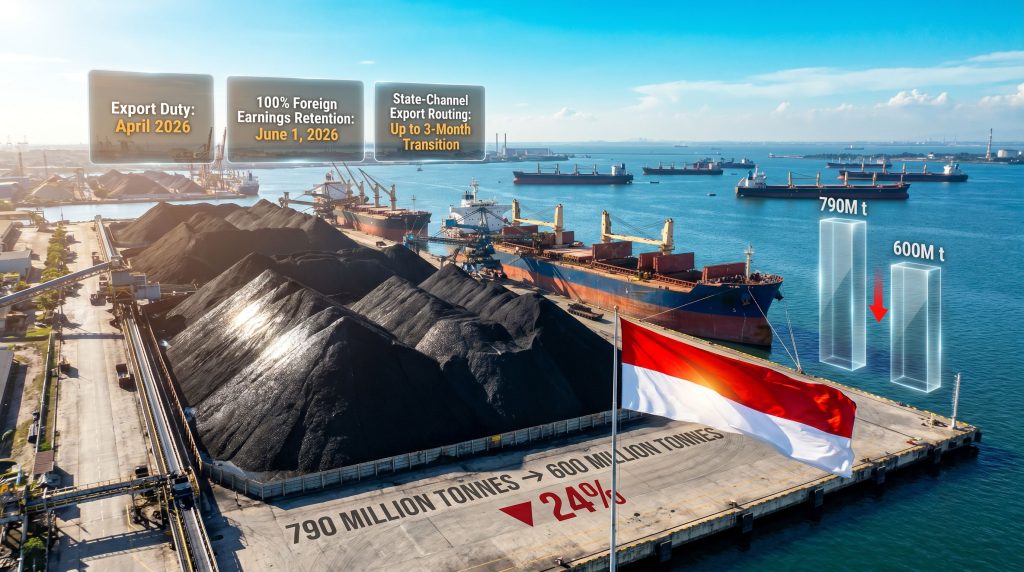
All coal exports must now be conducted through Danantara Sumberdaya Indonesia (DSI), a state-controlled entity operating under the Indonesian sovereign wealth fund structure. This centralises what was previously a fragmented, commercially-driven export ecosystem into a single government-overseen channel.
2. New Export Duty Effective April 2026
A dedicated coal export levy has been introduced, structurally raising the floor cost of Indonesian coal for all international buyers regardless of contract type or relationship history with individual miners.
3. Foreign Earnings Retention Mandate from June 1, 2026
Natural resource exporters are now required to deposit 100% of foreign earnings into Indonesian state banks. This represents a direct intervention in how miners manage their USD-denominated revenue, with significant implications for working capital, hedging strategies, and currency risk management.
The convergence of these three mechanisms is not coincidental. Together they reflect a coherent sovereign strategy to capture more value from commodity exports, stabilise the rupiah during a period of currency volatility, and redirect trade revenue through state-controlled financial infrastructure. Whether execution matches intent is an entirely separate question.
| Policy Mechanism | Previous State | New State | Effective Date |
|---|---|---|---|
| Export Routing | Private/commercial | Mandatory DSI channelling | Announced May 2026 |
| Coal Export Duty | Not active | New levy imposed | April 2026 |
| Foreign Earnings Retention | No requirement | 100% in state banks | June 1, 2026 |
| Production Target | 790 million tonnes | 600 million tonnes | 2026 target |
| Transition Period | N/A | Up to 3 months, DSI oversight | Phased rollout |
The Production Ceiling Signal: Reading the 190 Million Tonne Reduction
Beyond the export routing framework, the Indonesian government's decision to reduce the national coal production target from 790 million tonnes to 600 million tonnes for 2026 carries its own distinct market signal. A 24% reduction in targeted output is not a rounding error. It reflects a deliberate supply-side posture rather than a demand-driven response.
The mechanism enforcing this ceiling is equally important. Indonesia's RKAB system, under which individual mining companies must obtain annual work plan and budget approvals from the government, gives regulators direct gatekeeping authority over production volumes. Domestic Market Obligation compliance, which requires miners to supply a mandated proportion of output to the domestic market at capped prices, is a prerequisite for RKAB approval. Mines that fail to meet their domestic supply commitments risk losing the permits that allow them to produce and export at all.
This creates a structurally tighter export supply picture even before the DSI routing mechanism takes effect. International buyers who previously relied on a relatively open Indonesian export market must now contend with a system where domestic consumption is prioritised by regulatory design. Furthermore, commodity price impacts on mining company performance become far more complex to model when sovereign supply constraints are layered on top of traditional market variables.
Operational Uncertainty: The Questions No One Can Answer Yet
The anxiety among miners and traders following the Indonesia coal export shake-up is not primarily about the policy direction. It is about the implementation gaps that remain unresolved. Industry representatives have publicly noted that fundamental questions around contract status, pricing authority, logistical risk allocation, and compensation currency remain unanswered.
Several critical unresolved issues stand out:
-
Price-setting authority: Whether DSI will set transaction prices, apply a sovereign benchmark, or allow market-derived pricing to persist is not yet codified.
-
Currency of compensation: Given the rupiah's ongoing volatility, whether miners receive USD or rupiah compensation for exported coal has direct implications for revenue stability and hedging capacity.
-
Logistical risk allocation: Who bears liability for demurrage, vessel delays, and cargo quality disputes under the new framework has not been formally addressed.
-
Existing contract treatment: The sovereign wealth fund has indicated that existing export contracts will be honoured, but has simultaneously flagged that contracts priced below global benchmarks may be subject to renegotiation. These two positions are difficult to reconcile.
When the operational rulebook for a policy this consequential remains unwritten, the market cannot function with confidence. Traders and buyers will not wait indefinitely for clarity before beginning to secure alternative supply arrangements.
LNG Disruption as Accelerant: Why the Timing Compounds Everything
The Indonesia coal export shake-up has landed at a particularly sensitive moment for Asian energy markets. LNG supply disruptions linked to the conflict involving Iran have reduced gas availability for power generators across Northeast Asia. Japan and South Korea, both heavily dependent on LNG for baseload and peaking generation, have increased their coal burn to compensate, driving spot demand at the precise moment that Indonesian supply reliability is being questioned.
This intersection of a demand catalyst and a supply uncertainty event is what distinguishes the current situation from previous Indonesian export policy discussions. The compounding effect is straightforward:
-
Gas supply tightening forces Asian utilities toward coal-based generation.
-
Indonesian supply uncertainty reduces confidence in the world's largest coal export source.
-
Competing suppliers face sudden procurement interest from buyers who have historically relied on Indonesian product.
-
Spot price volatility increases as market participants attempt to hedge against a dual supply shock.
The next major ASX story will hit our subscribers first
Alternative Suppliers: Capacity, Constraints, and Cost Premiums
The practical question for Asian utilities and traders is whether alternative seaborne suppliers can absorb displaced Indonesian demand. The honest answer involves significant caveats.
| Alternative Supplier | Competitive Advantage | Key Limitation |
|---|---|---|
| Australia | High thermal coal quality, reliable export infrastructure, established Asian trade routes | Higher cost base, logistics premium for some buyers |
| South Africa | Competitive spot pricing, Richards Bay Coal Terminal capacity | Port congestion history, infrastructure maintenance risks |
| Colombia | Growing Pacific export capability, competitive pricing for some grades | Volume constraints, high freight cost to Asian markets |
| Russia | Price-competitive in spot markets | Sanctions exposure limits buyer universe significantly |
Australia is the most obvious beneficiary of any structural shift away from Indonesian supply. Newcastle benchmark coal prices typically carry a quality premium over Indonesian product, meaning Asian buyers would face a direct cost increase when substituting. However, Australia's resource energy exports face their own structural challenges in 2025 and beyond, meaning supply expansion is not a given even when demand signals are favourable.
For utilities operating under regulated tariff structures, the cost pass-through is not always straightforward, adding a political dimension to what appears to be a purely commercial procurement decision.
Resource Nationalism as a Structural Commodity Theme
Indonesia's coal export overhaul does not exist in isolation. It follows a pattern of export control measures the country has applied across multiple commodity sectors in recent years, including nickel ore export bans and palm oil export restrictions during periods of domestic supply concern. The announcement that DSI routing requirements extend to palm oil and ferroalloys alongside coal confirms that coal is one component of a broader sovereign resource strategy rather than a sector-specific anomaly.
This broader resource nationalism trend carries implications for how investors and commodity analysts should price political risk in emerging market commodity exposure. When a government controls the export channel for a commodity that represents half of global seaborne trade in that material, the risk premium applied to that supply source must expand. This is not unique to Indonesia. Similar dynamics have played out in nickel in the Philippines, in India's critical minerals mission, and in copper across Zambia and the DRC.
The structural lesson is consistent: when commodity prices rise to a level that makes sovereign capture of export revenue politically attractive, export control mechanisms tend to follow. The question is always timing and execution, not whether the impulse will emerge at all.
Short, Medium, and Long-Term Market Implications
The Indonesia coal export shake-up produces different risk profiles depending on the time horizon being assessed.
Short-Term (0 to 6 months):
Shipment uncertainty, spot price volatility, and procurement scrambling among utilities without diversified supply portfolios. The three-month transition period creates a false sense of continuity that masks structural risk accumulation beneath the surface. Furthermore, the US-China trade war impacts on energy procurement are compounding regional supply chain pressures simultaneously.
Medium-Term (6 to 24 months):
Contract renegotiation cycles will accelerate. Asian utilities entering renewal discussions for long-term supply agreements will face a fundamentally different negotiating environment. Some contracts that were previously priced on bilateral commercial terms may now be effectively subject to sovereign benchmark floors, changing the underlying economics of supply agreements that were structured years in advance.
Long-Term (2 years and beyond):
Indonesia's ability to maintain its pricing authority in seaborne coal markets depends on the coherence and consistency of DSI's operational framework. If the system is administered transparently and contractual obligations are honoured, the market will adapt. If enforcement is inconsistent or politically variable, buyers will progressively diversify supply chains — a process already accelerating due to trade war supply chains pressures — potentially triggering a structural shift in seaborne thermal coal trade flows that outlasts the policy transition itself.
Frequently Asked Questions: Indonesia Coal Export Policy
What triggered Indonesia's decision to overhaul its coal export system?
The overhaul reflects multiple converging motivations: a desire to capture greater sovereign revenue from commodity exports, an effort to stabilise the rupiah by channelling foreign earnings through state banks, and a broader resource nationalism agenda being applied across coal, palm oil, and ferroalloys simultaneously.
How does the Domestic Market Obligation affect export volumes?
The DMO requires miners to allocate a set proportion of production to the domestic Indonesian market at regulated prices. Failure to comply risks RKAB permit non-renewal, which directly constrains production and therefore export availability.
Will existing long-term coal supply contracts be honoured?
The sovereign wealth fund overseeing DSI has indicated existing contracts will be respected, whilst simultaneously flagging that contracts priced below global benchmarks may be subject to renegotiation. The practical tension between these two positions remains unresolved.
What is the coal export duty and when does it take effect?
A new export levy on coal came into effect in April 2026. The duty structurally raises the minimum cost floor for Indonesian coal exports, with the increase ultimately passed through to international buyers.
Which Asian countries face the greatest exposure?
Japan and South Korea carry the highest near-term vulnerability given their simultaneous exposure to LNG supply disruptions and their historically high reliance on Indonesian thermal coal for baseload power generation. Asia's shifting power mix illustrates precisely how consequential this disruption could prove for regional energy security.
Key Takeaways
-
Supply volume risk: A 24% production target reduction signals deliberate supply tightening, not a temporary adjustment
-
Price transmission: The export duty creates a structural floor cost increase that will be absorbed by international buyers
-
Contract uncertainty: Existing long-term agreements face renegotiation exposure where prices fall below sovereign benchmarks
-
Currency complexity: Miner compensation currency remains unresolved during a period of rupiah volatility
-
Compounding timing: The policy coincides with LNG supply disruptions, amplifying market impact beyond what either event would generate independently
-
Diversification pressure: Asian utilities will accelerate alternative supply sourcing, potentially reshaping long-run seaborne trade flows in ways that persist beyond the current policy transition
This article contains forward-looking analysis regarding commodity markets, policy implementation scenarios, and supply chain dynamics. These represent informed assessments based on currently available information and should not be construed as investment advice. Commodity markets involve significant risk and actual outcomes may differ materially from projections discussed here.
Want To Stay Ahead of Major Commodity Market Shifts Like This One?
Discovery Alert's proprietary Discovery IQ model delivers real-time alerts on significant ASX mineral discoveries the moment they hit the exchange, transforming complex commodity data into actionable investment insights — explore historic discovery returns to understand the scale of opportunity, and begin your 14-day free trial at Discovery Alert to position yourself ahead of the market.