June 22, 2026
Ghana's pursuit of aluminium value addition exemplifies this economic transformation strategy, positioning the West African nation to capture substantially more revenue from its mineral endowments. The country's approach involves systematic development of processing capabilities that convert low-value bauxite exports into high-value aluminium products for both domestic consumption and international markets. Understanding these industry evolution trends is crucial for implementing effective development strategies.
Economic Multipliers Transform Resource-Based Economies Through Processing
Resource-rich nations worldwide face a fundamental strategic choice: continue exporting raw materials at commodity prices or build domestic processing capabilities that multiply economic returns. This transformation from extraction-focused economies to value-added manufacturing represents one of the most significant wealth creation opportunities available to developing nations. The mathematics are compelling when examining revenue differentials across the aluminium value chain, where processed products command exponentially higher prices than their raw material inputs.
The Economic Multiplier Effect of Processing vs. Raw Material Exports
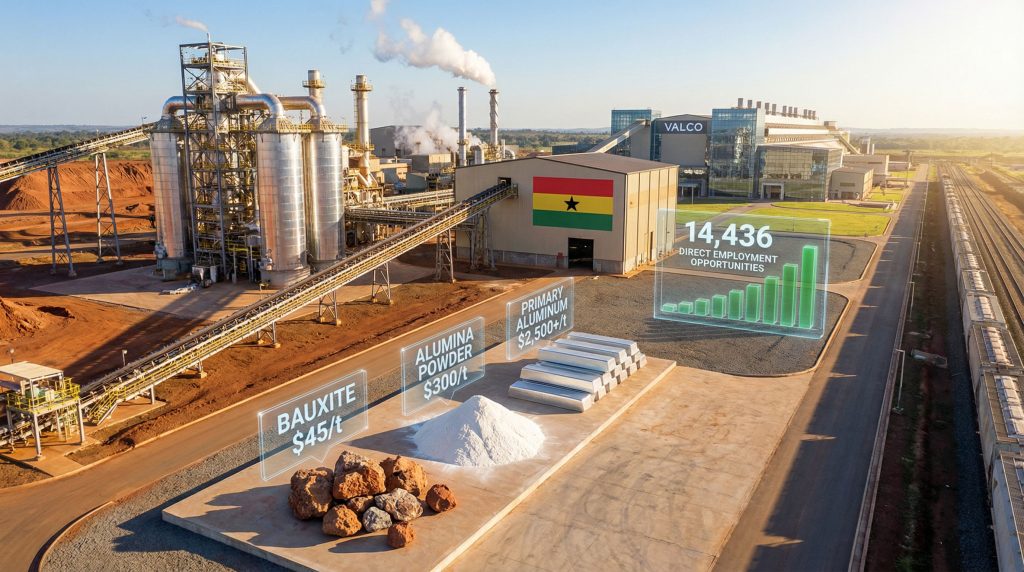
The revenue differential between raw materials and processed aluminium products demonstrates why value addition strategies generate transformational economic impacts. Based on current market dynamics, raw bauxite commands approximately $45 per tonne, while refined aluminium products reach pricing levels exceeding $4,500 per tonne. This 100-fold price differential illustrates the substantial economic opportunity that processing capabilities unlock for resource-rich economies.
| Processing Stage | Revenue Per Tonne | Value Multiple | Processing Requirements |
|---|---|---|---|
| Raw Bauxite | $45 | 1x (baseline) | Mining extraction only |
| Refined Alumina | $300-400 | 7-9x | Chemical refining facilities |
| Primary Aluminium | $2,500-4,500 | 55-100x | Smelting operations |
| Fabricated Products | $5,000-8,000 | 110-180x | Manufacturing integration |
Australia's aluminium sector development provides instructive precedent for value addition strategies. The country systematically developed refining capabilities in the 1960s, followed by smelting operations that leveraged abundant energy resources. This integrated approach enabled Australia to capture multiple revenue streams across the value chain while reducing dependence on commodity price volatility.
Guinea's contrasting approach highlights alternative development pathways. Despite possessing the world's largest bauxite reserves, Guinea has historically focused on raw material exports. Recent infrastructure investments suggest potential shifts toward processing capabilities, creating competitive dynamics within West African aluminium development.
Jamaica's experience demonstrates both opportunities and challenges in value addition pursuits. The country's alumina refining sector generated substantial economic benefits during favorable market conditions, while also illustrating the importance of competitive energy costs and operational efficiency for sustained success.
Industrial Integration Models in Global Aluminium Markets
Successful aluminium value chains require sophisticated integration across multiple processing stages, each demanding specific technical expertise and infrastructure investments. Vertical integration strategies enable companies and nations to capture value at multiple points while reducing supply chain vulnerabilities that affect commodity-dependent economies.
The integrated model encompasses several critical components:
- Mining Operations: Extracting bauxite ore with appropriate quality specifications for downstream processing
- Refining Facilities: Converting bauxite to alumina through chemical processes requiring significant energy inputs
- Smelting Operations: Transforming alumina to primary aluminium using electrolytic reduction processes
- Fabrication Capabilities: Manufacturing finished products for construction, automotive, packaging, and aerospace applications
Supply chain risk mitigation represents a crucial advantage of domestic processing capabilities. Countries with integrated value chains reduce exposure to international price volatility, transportation disruptions, and geopolitical factors affecting global trade. This stability enables more predictable economic planning and industrial development strategies.
Export diversification beyond commodity dependence creates multiple revenue streams that enhance economic resilience. Rather than relying solely on raw material sales, integrated producers can adjust product mix based on market conditions, targeting higher-value applications during favorable periods while maintaining baseline production during market downturns.
When big ASX news breaks, our subscribers know first
Ghana's Strategic Positioning in Global Aluminium Markets
Ghana's geographical and resource advantages provide a foundation for competitive positioning within global aluminium markets. The country's location offers strategic proximity to major consumption markets while abundant natural resources support cost-effective production operations. Furthermore, current industry consolidation strategies across the sector create opportunities for strategic partnerships and joint ventures.
Strategic Resource Assessment and Competitive Advantages
Ghana's bauxite reserves of approximately one billion tonnes, as confirmed by parliamentary sources, represent a substantial resource base for sustained aluminium value addition in Ghana. These deposits span multiple regions including Awaso, Nyinahin, and Kyebi, providing geographical diversification that enhances operational security and logistics optimisation opportunities.
Quality specifications of Ghanaian bauxite deposits demonstrate favourable metallurgical properties for alumina production. The ore's aluminum oxide content and relatively low impurity levels support efficient refining processes, contributing to competitive production economics compared to lower-grade deposits in other regions.
Geographic positioning offers distinct advantages for market access. Ghana's Atlantic coastal location provides efficient shipping routes to European and North American markets, while land-based transportation links enable regional trade within the African Continental Free Trade Area framework.
The country's existing industrial infrastructure, including the Tema Industrial Complex and established port facilities, creates a foundation for expanded processing operations. These assets reduce initial capital requirements compared to greenfield development scenarios in less developed regions.
Institutional Framework: GIADEC's Coordinated Development Approach
The Ghana Integrated Aluminium Development Corporation serves as the primary coordination mechanism for the country's aluminium value addition in Ghana strategy. This institutional framework enables systematic planning and implementation of value chain integration initiatives while facilitating partnerships with international investors and technology providers.
GIADEC's mandate encompasses multiple dimensions of sector development:
- Strategic Planning: Coordinating investment priorities across mining, refining, and manufacturing operations
- Partnership Facilitation: Structuring joint ventures and technology transfer arrangements with international partners
- Infrastructure Development: Aligning transportation, energy, and industrial infrastructure investments
- Regulatory Coordination: Streamlining permitting and compliance processes for integrated operations
State participation strategy balances public sector oversight with private sector efficiency and expertise. This approach enables Ghana to maintain strategic control over natural resource development while accessing international capital and technical capabilities necessary for competitive operations.
Public-private partnership models facilitate infrastructure development that supports multiple industrial users. Rather than requiring individual companies to fund dedicated infrastructure, coordinated development reduces per-unit costs while creating industrial clusters that enhance overall competitiveness.
Investment Architecture for Aluminium Value Chain Development
Ghana's aluminium transformation requires substantial capital deployment across multiple interconnected sectors, with investment timing and sequencing crucial for optimal returns. The integrated nature of aluminium processing demands coordinated infrastructure development that supports operations from mining through final product manufacturing. Effective capital allocation strategies remain essential for successful implementation.
Capital Allocation Across the Value Chain
Investment requirements span multiple sectors with varying risk profiles and return characteristics. Infrastructure investments provide essential foundation capabilities, while processing facilities generate direct revenue streams from value-added production.
Strategic Investment Framework:
| Investment Category | Capital Requirement | Implementation Timeline | Primary Objective |
|---|---|---|---|
| Transportation Infrastructure | $1.2-1.8 billion | 2025-2028 | Enable efficient logistics |
| VALCO Modernisation | $600-1,000 million | 2026-2027 | Restore production capacity |
| Mining Expansion | $200-350 million | 2025-2026 | Secure raw material supply |
| Downstream Manufacturing | $350-500 million | 2027-2029 | Capture fabrication value |
Infrastructure investments serve as strategic enablers that support multiple industrial users rather than generating direct revenue. Railway connectivity between mining regions and processing facilities reduces transportation costs while improving logistics reliability for sustained operations.
VALCO modernisation represents the centrepiece of Ghana's smelting capacity restoration. The facility requires comprehensive technology upgrades, power infrastructure enhancements, and environmental systems implementation to achieve competitive operational performance.
Mining expansion investments focus on developing extraction capabilities that support increased processing volumes. These investments include equipment acquisition, site preparation, and environmental compliance systems necessary for large-scale operations.
Strategic Partnership Models and Foreign Direct Investment
International partnerships provide access to specialised technology, operational expertise, and capital resources necessary for competitive aluminium production. These arrangements typically involve technology transfer components that build domestic capabilities while ensuring operational efficiency.
Chinese partnership negotiations focus on comprehensive development packages that combine capital investment with technical expertise. VALCO is currently exploring investor partnerships that will boost aluminium value addition capabilities across the integrated development chain.
Technology transfer arrangements enable Ghana to acquire advanced production capabilities while building domestic technical expertise. These partnerships typically include training programmes, equipment supply agreements, and ongoing technical support arrangements.
Joint venture structures balance foreign expertise with local ownership, ensuring that economic benefits flow to domestic stakeholders while maintaining operational competitiveness. These arrangements often include graduated ownership transitions that increase local participation over time.
VALCO's Revival as Industrial Catalyst
The Volta Aluminium Company Limited represents Ghana's primary aluminium smelting asset and serves as the focal point for the country's value addition strategy. VALCO's restoration to full operational capacity would establish Ghana as a significant regional aluminium producer while creating substantial employment and economic multiplier effects.
Production Capacity and Market Positioning
VALCO's production potential positions Ghana to serve both domestic and international markets with primary aluminium products. The facility is actively seeking a US$2.3 billion investor to modernise existing infrastructure while expanding overall capacity to meet growing regional demand.
The facility's strategic location near Ghana's primary energy sources provides competitive advantages in power-intensive smelting operations. Proximity to hydroelectric generation facilities enables cost-effective power supply arrangements that support competitive production economics.
Domestic market allocation strategies balance local industrial development with export revenue generation. Parliamentary sources indicate that domestic automotive sector development could absorb significant aluminium production while supporting broader industrial diversification objectives.
Export market positioning leverages Ghana's geographical advantages for efficient access to European and North American markets. The country's established trade relationships and shipping infrastructure support competitive delivery of finished aluminium products to major consumption centres.
Regional competitive positioning within West Africa creates opportunities for serving growing continental markets. As infrastructure development accelerates across the continent, demand for construction materials, automotive components, and packaging products continues expanding.
Energy Infrastructure and Cost Competitiveness
Aluminium smelting operations require substantial electricity inputs, making power costs a critical determinant of operational competitiveness. Ghana's hydroelectric resources provide a foundation for cost-effective electricity supply, while renewable energy integration supports sustainability objectives.
Dedicated power allocation for aluminium production ensures reliable electricity supply while enabling competitive pricing arrangements. These arrangements typically involve long-term contracts that provide pricing stability for both power generators and industrial users.
Power grid stability represents a crucial operational requirement for continuous smelting operations. Investments in transmission infrastructure and backup systems ensure uninterrupted production while minimising quality issues that affect product specifications.
Renewable energy integration aligns with global sustainability transformation trends while potentially accessing carbon credit markets. Solar and wind power supplementation reduces reliance on fossil fuel generation while supporting environmental compliance requirements.
Economic Multiplier Analysis and Employment Creation
Aluminium value addition in Ghana generates substantial economic multipliers that extend far beyond direct production operations. These effects encompass employment creation, skills development, industrial cluster formation, and broader economic diversification benefits.
Employment Creation and Skills Development
Direct employment opportunities span multiple skill levels and technical specialisations, from entry-level production positions to advanced engineering and management roles. Industry estimates suggest that full value chain development could generate over 14,000 direct employment positions across mining, refining, smelting, and fabrication operations.
Employment Distribution by Sector:
- Mining Operations: 3,500-4,500 positions including equipment operators, maintenance technicians, and support staff
- Refining Facilities: 2,000-3,000 positions requiring chemical processing expertise and quality control specialists
- Smelting Operations: 1,500-2,500 positions encompassing furnace operations, materials handling, and technical support
- Downstream Manufacturing: 4,000-6,000 positions in fabrication, finishing, and logistics operations
Technical skills training programmes align workforce development with industry requirements while creating pathways for career advancement. These programmes typically combine classroom instruction with hands-on experience in operational environments.
Youth workforce development initiatives target recent graduates and school leavers with specialised training in aluminium production technologies. These programmes address skills gaps while building a pipeline of qualified workers for sector expansion.
Indirect employment in logistics, services, and supporting industries multiplies direct job creation effects. Economic modelling suggests that each direct aluminium sector job creates approximately 2-3 additional positions in related industries.
Industrial Cluster Development and Manufacturing Ecosystems
The Tema Industrial Park development represents a cornerstone of Ghana's manufacturing ecosystem expansion under the African Continental Free Trade Area framework. This integrated approach creates synergies between aluminium production and downstream manufacturing operations.
Downstream product manufacturing encompasses multiple value-added applications:
- Construction Materials: Aluminium sheets, profiles, and structural components for building applications
- Automotive Components: Engine blocks, body panels, and transmission housings for regional vehicle assembly
- Packaging Products: Food-grade containers, beverage cans, and pharmaceutical packaging materials
- Renewable Energy Components: Solar panel frames, wind turbine parts, and electrical transmission equipment
Rolling plant development enables production of flat-rolled aluminium products for construction and packaging industries. These facilities typically require substantial capital investment but generate high-value products with strong market demand.
Industrial cluster effects reduce production costs through shared infrastructure, specialised service providers, and knowledge spillovers. Companies within clusters benefit from reduced transportation costs, access to specialised suppliers, and collaborative research and development opportunities.
Implementation Challenges and Success Requirements
Ghana's aluminium value addition strategy faces multiple implementation challenges that require systematic solutions and sustained commitment. Success depends on coordinated development across infrastructure, technology, human capital, and regulatory dimensions. Industry experts are closely monitoring innovation expo insights for emerging technologies and best practices.
Infrastructure Development and Logistics Optimisation
Transportation infrastructure represents a critical bottleneck that must be addressed for cost-effective operations. Railway connectivity between mining regions and processing facilities reduces unit transportation costs while improving delivery reliability for both raw materials and finished products.
Infrastructure Priority Areas:
- Rail Network Expansion: Connecting Awaso, Nyinahin, and Kyebi mining areas to Tema processing facilities
- Port Capacity Enhancement: Expanding handling capabilities for both raw material imports and finished product exports
- Power Grid Strengthening: Ensuring reliable electricity transmission to energy-intensive processing operations
- Water Supply Systems: Securing adequate water resources for mining, refining, and cooling operations
Port facility development must accommodate both raw material handling and finished product shipping requirements. These facilities require specialised equipment for different cargo types while maintaining operational efficiency across diverse product streams.
Power grid stability affects all processing operations but is particularly crucial for continuous smelting processes. Grid reliability investments reduce production disruptions while minimising quality issues that affect product marketability.
Water resource management becomes increasingly important as processing volumes expand. Sustainable water supply systems must balance industrial requirements with community needs and environmental protection objectives.
Technology Transfer and Operational Efficiency
Advanced production technology represents a crucial competitive requirement for successful aluminium operations. Ghana's strategy emphasises technology transfer arrangements that build domestic capabilities while ensuring operational competitiveness.
VALCO modernisation requires comprehensive technology upgrades across multiple operational systems. These improvements encompass furnace efficiency, environmental controls, quality management systems, and automated process controls that enhance productivity and product quality.
Environmental compliance systems must meet international standards while supporting sustainable operations. These systems include emissions controls, waste management processes, and environmental monitoring capabilities that ensure regulatory compliance and community acceptance.
Quality control systems enable production of aluminium products that meet international specifications for various end-use applications. These systems encompass raw material testing, process monitoring, and finished product verification procedures.
Technical workforce development programmes build domestic expertise in advanced production technologies. These initiatives combine formal training with on-the-job experience to create a skilled workforce capable of operating sophisticated equipment efficiently.
The next major ASX story will hit our subscribers first
Global Benchmarking and Best Practices Analysis
International experience in aluminium value chain development provides instructive guidance for Ghana's strategic approach. Successful models demonstrate the importance of coordinated infrastructure development, strategic partnerships, and sustained commitment to competitive operations.
Benchmarking Against Successful Value Addition Models
Norway's aluminium industry integration demonstrates how abundant renewable energy resources can support cost-competitive smelting operations. The country's hydroelectric capacity enables some of the world's lowest-cost aluminium production while supporting extensive downstream manufacturing operations.
Key Success Factors from International Models:
- Energy Cost Management: Securing long-term, competitively-priced electricity supplies through strategic partnerships or public sector arrangements
- Technology Leadership: Investing in advanced production technologies that enhance efficiency and product quality
- Infrastructure Coordination: Aligning transportation, energy, and industrial infrastructure development for optimal operational support
- Market Development: Building strong relationships with end-users while developing new applications for aluminium products
Australia's downstream processing incentives demonstrate how government policy can support value addition while maintaining competitive operations. Tax incentives, infrastructure support, and research funding combine to create favourable conditions for aluminium manufacturing development.
Brazil's integrated development approach encompasses mining, refining, smelting, and fabrication operations within coordinated industrial complexes. This model reduces logistics costs while creating economies of scale across multiple processing stages.
Regional Competitive Dynamics in West Africa
West African aluminium development involves multiple countries pursuing different strategic approaches. Guinea's focus on raw bauxite exports contrasts with Ghana's value addition strategy, creating distinct competitive positioning within regional markets.
Guinea's substantial bauxite reserves and established export infrastructure provide strong competition for raw material markets. However, limited processing capabilities create opportunities for Ghana to serve regional markets with value-added products.
The African Continental Free Trade Area framework creates new opportunities for intra-continental trade in aluminium products. Reduced tariff barriers and improved logistics enable competitive serving of regional markets from consolidated production facilities.
Export market diversification strategies reduce dependence on traditional European markets while capturing growing demand in African and Asian markets. These strategies require market development investments but offer substantial long-term growth potential.
Implementation Timeline and Performance Milestones
Ghana's aluminium value addition strategy requires carefully sequenced implementation over multiple phases, with each stage building upon previous achievements while preparing for subsequent expansion.
Phase-Based Development Strategy (2025-2030)
Critical Implementation Phases:
Phase 1 (2025-2026): Foundation Development
Large-scale bauxite extraction capacity expansion, basic infrastructure improvements, and initial partnership agreements establishment. Focus on securing raw material supply chains and preliminary processing capability development.
Phase 2 (2026-2027): Core Processing Development
VALCO modernisation completion, refinery construction initiation, and advanced infrastructure implementation. Emphasis on establishing primary processing capabilities and quality control systems.
Phase 3 (2027-2029): Manufacturing Integration
Downstream manufacturing facility development, industrial park expansion, and product diversification initiatives. Priority on capturing value-added manufacturing opportunities and market development.
Phase 4 (2029-2030): Full Integration Optimisation
Complete value chain integration, export optimisation, and advanced product development. Focus on operational efficiency maximisation and market leadership establishment.
Implementation success requires maintaining momentum across multiple simultaneous development tracks while ensuring adequate resource allocation for each phase. Coordination mechanisms must balance competing priorities while maintaining focus on long-term strategic objectives.
Partnership development timelines align with technical implementation schedules to ensure adequate financing and expertise availability. Memorandums of understanding and formal agreements provide frameworks for sustained collaboration throughout development phases.
Performance Metrics and Success Indicators
Quantitative performance metrics enable objective assessment of implementation progress while identifying areas requiring additional attention or resource allocation.
Key Performance Indicators:
| Metric Category | 2026 Target | 2028 Target | 2030 Target |
|---|---|---|---|
| Bauxite Production | 2.5 million tonnes | 4.0 million tonnes | 6.0 million tonnes |
| Alumina Production | 0.5 million tonnes | 1.2 million tonnes | 2.0 million tonnes |
| Primary Aluminium | 50,000 tonnes | 150,000 tonnes | 250,000 tonnes |
| Direct Employment | 4,000 positions | 8,500 positions | 14,500 positions |
Export revenue growth from value-added products represents the ultimate success measure for Ghana's strategy. This metric captures the economic value creation that justifies substantial infrastructure and technology investments.
Employment creation benchmarks ensure that industrial development generates broad-based economic benefits while building domestic technical capabilities. Skills development outcomes support long-term competitiveness and continued industrial expansion.
Production efficiency metrics track operational performance improvements that maintain cost competitiveness while supporting quality standards. These metrics encompass energy consumption, yield rates, and product quality consistency measures.
Frequently Asked Questions About Ghana's Aluminium Value Addition
What Makes Ghana's Approach Different from Other African Countries?
Ghana's integrated value chain strategy contrasts sharply with the raw material export focus prevalent among other African mineral producers. While many countries prioritise maximising extraction volumes, Ghana emphasises capturing multiple value creation points from mining through finished product manufacturing.
The coordinated institutional framework through GIADEC enables systematic development across multiple sectors simultaneously. This approach reduces development timelines while ensuring compatibility between different value chain components.
Strategic partnership models balance international expertise with domestic ownership, ensuring that economic benefits flow to local stakeholders while maintaining operational competitiveness. This approach differs from purely foreign-owned operations or state-controlled development models.
How Will This Impact Global Aluminium Pricing and Supply?
Ghana's entry into aluminium production markets will contribute to global supply expansion, potentially moderating price levels during periods of strong demand. However, the country's production volumes represent a relatively small percentage of global capacity, limiting direct price impact.
Regional market dynamics may experience more significant effects as Ghana's production reduces West Africa's dependence on imported aluminium products. This shift could alter trade flows and competitive positioning within African markets.
Quality improvements in regional supply chains may enable premium pricing for Ghanaian products that meet international specifications. This positioning supports sustainable operations while generating competitive returns for investors.
What Role Do International Partnerships Play in Success?
Technology transfer represents the most critical contribution of international partnerships, enabling Ghana to access advanced production capabilities without lengthy independent development timelines. These arrangements accelerate implementation while ensuring competitive operational performance.
Capital access through international partnerships reduces financing constraints that could delay or limit project scope. Strategic investors bring both financial resources and operational expertise that enhance project success probability.
Market access facilitation through established international partnerships enables competitive entry into global markets. These relationships provide distribution channels and customer relationships that support revenue generation from the outset of operations.
How Does This Align with Ghana's Broader Economic Development Goals?
Aluminium value addition supports multiple national development objectives simultaneously, including industrial diversification, employment creation, export revenue enhancement, and technological capability building. This alignment ensures that sector development contributes to broader economic transformation goals.
Infrastructure investments required for aluminium operations benefit multiple industrial sectors while improving overall economic competitiveness. Transportation, energy, and communications improvements support broader industrial development beyond aluminium-specific applications.
Skills development initiatives create transferable capabilities that support various manufacturing sectors while building domestic technical expertise. These investments in human capital generate long-term economic benefits that extend beyond aluminium operations.
Disclaimer: This analysis contains forward-looking statements and projections based on currently available information. Actual results may differ materially from projections due to various factors including market conditions, regulatory changes, and implementation challenges. Investment decisions should be based on comprehensive due diligence and professional financial advice.
Ready to Capitalise on Africa's Industrial Transformation?
Ghana's aluminium value addition strategy demonstrates how resource-rich nations can multiply economic returns through strategic processing capabilities, while similar opportunities are emerging across ASX-listed companies engaged in African mineral development. Discovery Alert's proprietary Discovery IQ model delivers real-time alerts on significant mineral discoveries, instantly empowering subscribers to identify actionable opportunities in expanding industrial value chains ahead of the broader market. Discover how major mineral discoveries drive exceptional returns by visiting Discovery Alert's dedicated discoveries page and begin your 14-day free trial today to position yourself ahead of the market.