May 21, 2026
The global aluminium wire market represents one of the most strategically significant segments within the broader metals infrastructure ecosystem. As electrical transmission networks undergo unprecedented modernisation and renewable energy installations accelerate worldwide, the competitive dynamics among leading export nations reveal complex interplays between resource advantages, manufacturing capabilities, and market access strategies. Understanding these patterns provides critical insights into how regional powerhouses establish and maintain their positions in this essential industrial supply chain.
Modern electrical infrastructure demands have fundamentally reshaped the competitive landscape for aluminium wire production and distribution. The intersection of technological advancement, sustainability mandates, and geopolitical trade policies creates a multifaceted environment where traditional cost advantages must be balanced against quality standards, delivery reliability, and environmental credentials.
Understanding Market Dynamics Beyond Export Volumes
The global aluminium wire market encompasses far more than simple tonnage metrics, requiring sophisticated analysis of value chain positioning and competitive differentiation strategies. According to comprehensive trade data collected through October 2025, the ten leading exporters collectively shipped approximately 623,430 tonnes valued at roughly USD 2.19 billion, demonstrating the substantial economic scale of this specialised market segment.
Market leadership in aluminium wire exports reflects a complex blend of upstream production capabilities, downstream processing expertise, and strategic geographic positioning. The distinction between primary aluminium production and specialised wire manufacturing creates opportunities for different competitive models, from vertically integrated operations to focused processing specialists.
Competitive Metrics and Value Creation Patterns
Analysis of per-tonne export values reveals significant variations among leading exporters, indicating distinct positioning strategies and market segments:
| Country | Export Volume (Tonnes) | Export Value (USD Million) | Value per Tonne (USD) |
|---|---|---|---|
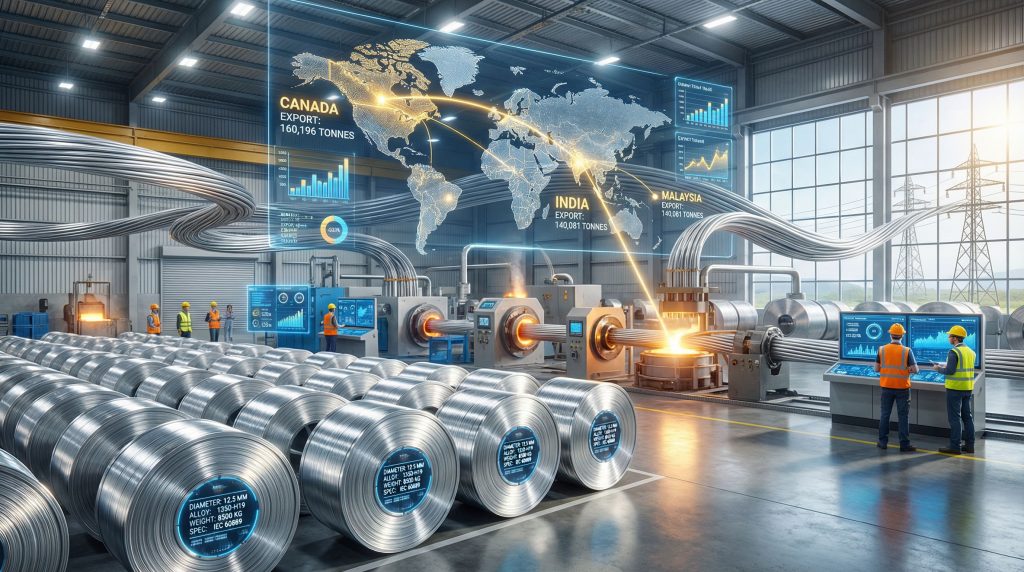
| Canada | 160,196 | 546.4 | 3,410 |
| India | 140,081 | 451.8 | 3,228 |
| Malaysia | 105,066 | 303.0 | 2,884 |
| Netherlands | 78,064 | 302.81 | 3,878 |
| Italy | 34,796 | 147.07 | 4,227 |
| Poland | 32,189 | 119.09 | 3,700 |
| Hungary | 18,731 | 72.0 | 3,838 |
| Turkey | 30,148 | 101.6 | 3,369 |
| Indonesia | 30,809 | 93.0 | 3,019 |
These value differentials reflect various factors including product specifications, quality certifications, delivery terms, and customer relationships. Italy's premium positioning at USD 4,227 per tonne suggests focus on high-specification applications, whilst Malaysia's USD 2,884 per tonne indicates competitive positioning in volume markets.
Strategic Positioning Framework
Cost advantage drivers in the global aluminium wire market extend beyond raw material prices to encompass energy costs, manufacturing efficiency, and logistics optimisation. Countries with abundant renewable energy sources, particularly hydroelectric power, maintain structural advantages in primary aluminium production that translate into downstream competitive positioning.
Market access strategies increasingly emphasise trade relationship stability, geographic proximity to major consumption centres, and compliance with evolving sustainability standards. Furthermore, the ability to maintain export flows despite trade policy disruptions has become a critical competitive differentiator.
When big ASX news breaks, our subscribers know first
Regional Supply Chain Architecture
North American Market Leadership
Canada's position as the leading global aluminium wire exporter, with 160,196 tonnes shipped valued at USD 546.4 million in October 2025, demonstrates the competitive advantages of integrated primary production and downstream processing capabilities. This leadership persists despite facing potential challenges from us steel–aluminum tariffs 2025 policies, highlighting the strength of established trade relationships and product quality positioning.
The Canadian advantage stems from several structural factors:
• Low-carbon production capabilities utilising abundant hydroelectric power
• Vertical integration from primary smelting through wire manufacturing
• Established customer relationships providing market resilience
• Quality certifications meeting demanding technical specifications
Major companies including Rio Tinto global taxes & royalties and Alcoa maintain significant Canadian operations, contributing to the country's technological leadership and production capacity. The emphasis on low-carbon aluminium production aligns with growing customer demands for environmentally responsible sourcing.
However, Canada's energy transition challenges present both opportunities and risks for the sector's future competitiveness in evolving global markets.
Asia-Pacific Manufacturing Hub Development
India's Export Transformation Strategy
India's emergence as the second-largest exporter with 140,081 tonnes valued at USD 451.8 million reflects the country's strategic transition from domestic-focused to export-oriented aluminium production. This transformation has been driven by capacity expansion programmes led by major producers including National Aluminium Company (NALCO), Hindalco Industries, and Vedanta Aluminium.
The Indian strategy emphasises:
• Domestic infrastructure development creating local demand for testing and refinement
• Manufacturing competitiveness initiatives supported by government policy frameworks
• Export diversification programmes reducing dependence on traditional markets
• Renewable energy integration supporting both domestic consumption and export positioning
India's rapid renewable energy infrastructure development has created substantial domestic demand for aluminium wiring products, providing manufacturers with opportunities to optimise production processes and quality systems before targeting export markets.
Malaysia's Regional Hub Strategy
Malaysia has established itself as a critical manufacturing centre in Southeast Asia, with 105,066 tonnes of exports valued at USD 303 million. The country's strategy focuses on secondary aluminium production and recycling capabilities, supporting downstream industries including wire manufacturing.
Press Metal Aluminium Holdings represents the flagship of Malaysia's aluminium sector, with investments in recycling facilities and secondary production capabilities. The company's joint ventures, including the Press Metal Solarvest partnership, demonstrate integration between aluminium production and renewable energy infrastructure.
Malaysia's competitive positioning leverages:
• Regional manufacturing hub status in Southeast Asia
• Secondary aluminium and recycling capabilities reducing raw material costs
• Strategic geographic location providing access to multiple regional markets
• Investment in modern processing technologies supporting quality and efficiency
Indonesia's Value Chain Integration
Indonesia's aluminium wire exports of 30,809 tonnes worth USD 93 million reflect the country's systematic development of integrated aluminium value chains. Government policies restricting raw material exports whilst encouraging domestic processing have accelerated investment in downstream manufacturing capabilities.
The Indonesian approach emphasises:
• Bauxite mining expansion providing feedstock security
• New alumina refining capacity supporting value chain integration
• Policy frameworks encouraging domestic processing over raw material exports
• Investment incentives for downstream metal processing facilities
This value chain development strategy creates opportunities for producing aluminium-based products used in electrical and industrial applications, positioning Indonesia for long-term growth in export markets.
European Processing and Distribution Networks
Netherlands as Trading Gateway
The Netherlands has established itself as a major European trading hub for aluminium products, with 78,064 tonnes of wire exports valued at USD 302.81 million. Despite limited primary aluminium production, the country leverages its strategic location and distribution infrastructure to serve intra-European markets.
The Dutch model emphasises:
• Distribution hub capabilities leveraging European market access
• Re-export operations serving regional demand patterns
• Logistics infrastructure supporting efficient product movement
• Trade finance expertise facilitating complex international transactions
This trading gateway model demonstrates how countries can achieve significant export volumes through strategic positioning in global supply chains, even without substantial primary production capabilities.
Norway's Sustainability Premium
Norway's 54,015 tonnes of exports valued at USD 54 million reflect the country's focus on premium, low-carbon aluminium production utilising abundant renewable hydropower. Norsk Hydro's investments in recycling technologies and decarbonised aluminium solutions position Norwegian producers at the forefront of sustainability trends.
The Norwegian advantage includes:
• Renewable energy abundance enabling low-carbon production
• Technology leadership in recycling and sustainability solutions
• Premium market positioning targeting environmentally conscious customers
• Long-term customer relationships built on quality and reliability
Italy's Manufacturing Excellence
Italy's position as a leading European downstream aluminium manufacturer is reflected in 34,796 tonnes of wire exports valued at USD 147.07 million, achieving the highest per-tonne value among major exporters at USD 4,227. This premium positioning reflects the country's advanced capabilities in extrusion, rolling, and conductor production.
Italian competitive advantages include:
• Integration with automotive and construction sectors across Europe
• Advanced manufacturing technologies supporting high-specification products
• Quality standards meeting demanding technical requirements
• Innovation capabilities in product design and process optimisation
The country's aluminium sector benefits from increasing investments in European energy infrastructure and renewable power transmission projects, creating sustained demand for specialised wiring products.
Poland's Central European Hub
Poland has developed into a significant aluminium processing centre in Central Europe, with 32,189 tonnes of exports valued at USD 119.09 million. The country's strategic location provides proximity to major EU automotive and industrial markets, whilst manufacturing capabilities support diverse end-user applications.
Polish competitive positioning emphasises:
• Geographic proximity to major European consumption centres
• Diversified manufacturing capabilities serving automotive and electrical sectors
• EU market access without trade barriers or complications
• Investment in processing technologies supporting capacity expansion
Growth in automotive manufacturing, electrical equipment production, and construction activities across Central Europe continues to support demand for Polish-produced aluminium wire products.
Market Forces Driving Competitive Evolution
Demand-Side Growth Catalysts
The global aluminium wire market benefits from multiple synchronised growth drivers across different end-user sectors. Power transmission infrastructure modernisation represents a foundational demand source, as ageing electrical grids require replacement and upgrade programmes worldwide.
Renewable energy integration creates additional demand through several mechanisms:
• Solar and wind installation requirements for transmission and distribution systems
• Grid modernisation projects supporting intermittent energy source integration
• Energy storage system connections requiring specialised conductor products
• Smart grid infrastructure demanding advanced electrical components
The electric vehicle ecosystem generates expanding demand for aluminium wiring through charging infrastructure development and automotive applications. Construction sector demand continues growing through residential and commercial electrical system installations.
Supply-Side Competitive Dynamics
Energy cost structures fundamentally influence competitive positioning in aluminium production and processing. Countries with access to low-cost renewable energy maintain structural advantages, particularly in primary aluminium production where energy represents a major cost component.
Raw material access patterns are evolving as recycling capabilities expand and sustainability requirements increase. Secondary aluminium production requires different resource strategies compared to primary production, creating opportunities for countries to develop competitive positions through recycling infrastructure investments.
Manufacturing capability differentiation increasingly focuses on:
• Processing technology sophistication supporting product quality and consistency
• Production flexibility enabling customisation for specific applications
• Quality certification systems meeting international standards and customer requirements
• Innovation capabilities developing new products and process improvements
Trade Policy and Regulatory Frameworks
Trade policy environments significantly impact competitive positioning and market access opportunities. The persistence of Canadian export leadership despite facing potential challenges from trump tariffs global trade impact demonstrates how established customer relationships and product differentiation can overcome policy barriers.
Sustainability regulations are reshaping competitive dynamics through low-carbon aluminium requirements and certification systems. Countries with renewable energy advantages gain market access benefits as customers increasingly prioritise environmental credentials in supplier selection.
Export promotion policies and government manufacturing competitiveness initiatives influence investment patterns and capacity development across different regions. Moreover, the decarbonisation mining benefits are becoming increasingly recognised as competitive advantages in global markets.
Production Models and Technology Differentiation
Integrated versus Specialised Strategies
Vertical integration from primary aluminium production through wire manufacturing provides advantages in cost control, quality assurance, and supply chain coordination. Countries like Canada and Norway leverage this model effectively, combining upstream resource advantages with downstream processing capabilities.
Specialised processing models focus on technological leadership in specific applications, operational efficiency through specialisation, and market responsiveness. The Netherlands exemplifies how specialisation in trading and distribution can create competitive advantages without substantial primary production.
Innovation and Technology Leadership
Product specification leadership becomes increasingly important as electrical infrastructure applications demand higher performance standards. Advanced conductor designs, specialised alloy compositions, and precision manufacturing processes create differentiation opportunities.
Manufacturing process innovation focuses on efficiency improvements, quality consistency, and flexibility to meet customer requirements. In addition, sustainability technology development, including recycling capabilities and low-carbon production methods, provides competitive advantages in environmentally conscious markets.
Regional Development Patterns
Infrastructure Investment Trends
Asia-Pacific infrastructure investment continues driving demand growth through urbanisation, industrialisation, and electrical grid expansion. Government infrastructure spending programmes and private sector development projects create sustained market opportunities.
European modernisation initiatives focus on grid upgrades, renewable energy integration, and electrical system efficiency improvements. These programmes support demand for advanced aluminium wire products meeting stringent technical specifications.
North American supply chain resilience initiatives emphasise domestic sourcing preferences and trade relationship diversification, influencing market access patterns and competitive positioning strategies.
Sustainability Integration
Carbon footprint requirements increasingly influence supplier selection and market access opportunities. Low-carbon aluminium certification systems create premium market segments for producers with renewable energy advantages.
Circular economy initiatives support growth in secondary aluminium production and recycling capabilities, creating opportunities for countries to develop competitive positions through resource efficiency rather than primary production.
The next major ASX story will hit our subscribers first
Strategic Implications and Future Outlook
Investment Priority Framework
Market leaders must balance capacity expansion with profitability optimisation, ensuring that volume growth supports rather than undermines value creation. Technology advancement investments in processing capabilities, quality systems, and innovation capacity provide sustainable competitive advantages.
Market access expansion through geographic diversification and application development reduces dependency on individual markets and creates growth opportunities. Consequently, investment in customer relationship development and service capabilities supports premium positioning strategies.
Competitive Response Strategies
Cost leadership strategies emphasising operational excellence and scale advantages remain viable for high-volume market segments. Differentiation strategies focusing on premium products, specialised applications, and superior customer service create sustainable competitive positions.
Market access development through distribution networks, trade relationship management, and regulatory compliance capabilities provides foundations for long-term growth.
What are the long-term positioning considerations?
Sustainability leadership through low-carbon production and circular economy integration will become increasingly important as environmental regulations expand and customer preferences evolve. Technology evolution adaptation capabilities ensure continued relevance as electrical infrastructure requirements advance.
Supply chain resilience through diversification and risk management capabilities provides stability in uncertain policy and market environments. Furthermore, according to market analysis, the market is expected to experience significant growth driven by renewable energy adoption and grid modernisation projects.
Companies and countries that successfully navigate these multifaceted competitive dynamics whilst maintaining operational excellence will secure leading positions in the evolving global aluminium wire market.
Investment Disclaimer: The analysis presented here is for informational purposes only and should not be considered as investment advice. Market conditions, trade policies, and competitive dynamics in the aluminium industry can change rapidly. Investors should conduct their own research and consult with qualified financial advisors before making investment decisions related to aluminium companies or commodities.
Looking to Capitalise on Metal Infrastructure Opportunities?
Discovery Alert's proprietary Discovery IQ model delivers real-time alerts on significant ASX mineral discoveries across all commodities, including aluminium and base metals driving global infrastructure development. Subscribers gain immediate access to actionable investment insights, ensuring they can position themselves ahead of major market movements in the evolving metals sector. Begin your 14-day free trial today to secure your market-leading advantage with instant discovery notifications.