June 27, 2026
The Hidden Architecture of Aluminum's Four-Week Collapse
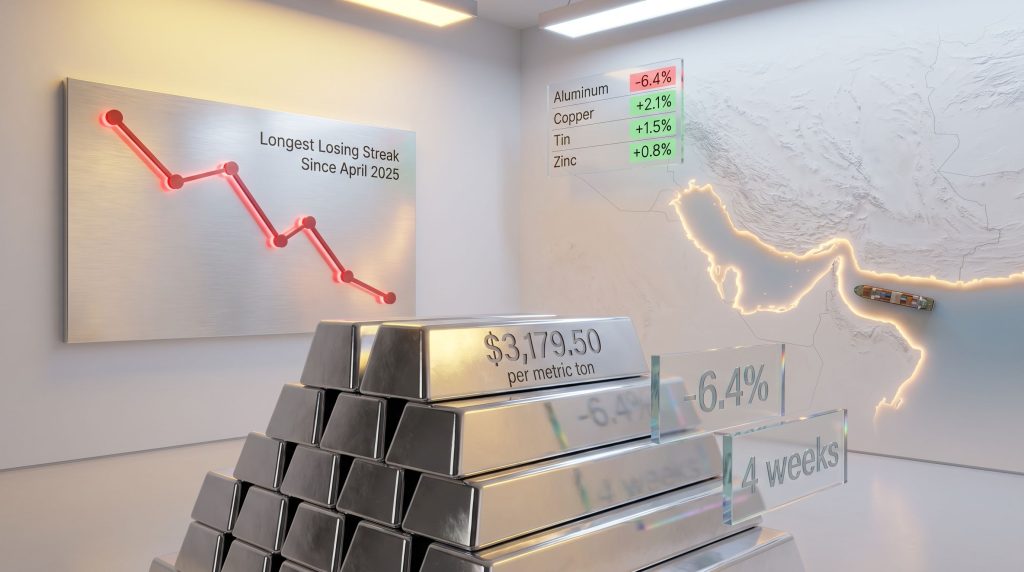
Commodity markets have a long memory, but they also react violently to short-term shocks. When a single maritime chokepoint controls the movement of millions of metric tons of industrial metal, a ceasefire agreement halfway around the world can reprice global aluminum futures faster than most investors can reposition. That is precisely what has unfolded over the past month, as the aluminum price decline on Mideast supply return compressed prices through four consecutive weeks of losses, the longest such streak since April 2025.
Understanding why this decline has been so sharp, and why it may not be finished, requires examining the structural mechanics of how aluminum is produced, transported, and priced, not just the headline geopolitical news. Furthermore, the interplay between US aluminium tariffs and geopolitical disruption has added another layer of complexity to an already volatile pricing environment.
When big ASX news breaks, our subscribers know first
The Energy-Intensity Factor: Why Aluminum Is Uniquely Vulnerable
Among the major base metals, aluminum carries a distinctive vulnerability that most casual market observers overlook. Smelting aluminum from alumina is one of the most electricity-intensive industrial processes in existence, consuming roughly 13 to 15 megawatt-hours of electricity per metric ton of finished metal produced. This energy dependency creates a double-exposure to Middle Eastern geopolitical cycles that copper, zinc, or tin simply do not share.
When conflict disrupted smelter operations across Gulf Cooperation Council states and constrained Strait of Hormuz shipping, the impact on aluminum was simultaneously a supply-volume shock and an energy-cost disruption. The region supplies both refined metal and the natural gas feedstock that powers smelting operations across parts of Asia and Africa that depend on Middle Eastern energy imports.
This dual sensitivity explains why aluminum's four-week decline has been more severe and sustained than movements in comparable base metals during the same period. It also explains why any peace agreement creates an amplified repricing signal: traders are not just anticipating more aluminum, they are anticipating cheaper energy for smelters that had been operating at elevated cost structures. Shifts in aluminum and alumina markets have historically confirmed this pattern during previous geopolitical cycles.
What the Middle East Actually Contributes to Global Aluminum Supply
The region's roughly 10% share of global aluminum production understates its marginal importance to price formation. In commodity markets, marginal supply is what sets the price, and the Gulf states, particularly the UAE through Emirates Global Aluminium and Bahrain through Alba (Aluminium Bahrain), operate some of the world's most cost-competitive smelters.
Several characteristics make Gulf aluminum production strategically significant beyond raw tonnage:
- Gulf smelters benefit from subsidised energy inputs, enabling some of the lowest cash production costs globally
- Regional output skews toward high-purity primary aluminum, which commands premiums in electronics and aerospace applications
- Middle Eastern producers are net exporters by a wide margin, meaning their output feeds European, Asian, and North American downstream manufacturers rather than regional consumption
- Shipping routes through the Strait of Hormuz connect Gulf aluminum directly to Indian Ocean trade lanes, making the strait a genuine chokepoint with no cost-competitive alternative routing
During the conflict period, regional output is estimated to have contracted by approximately 35% year-on-year in April as smelter attacks and shipping disruptions compounded each other. Vitol Group's successful transit of a stranded aluminum cargo through the strait in late June represented the first tangible confirmation that supply normalisation had begun, triggering the immediate repricing visible in LME settlement data.
Breaking Down the Four Simultaneous Headwinds
The aluminum price decline on Mideast supply return cannot be attributed to a single factor. Four distinct forces converged within the same weekly window, each applying independent downward pressure.
Supply Normalisation: The Primary Driver
Expectations of resumed Middle Eastern exports functioned as the dominant catalyst. Market pricing during the conflict had embedded a significant war premium, reflecting the genuine risk that up to an estimated 600,000 metric tons of aluminum could remain inaccessible if the strait stayed closed. As ceasefire terms took hold, that premium deflated rapidly.
Bank of America analysts characterised aluminum as vulnerable near-term, noting that supply risk premiums were unwinding faster than demand conditions could absorb returning volumes.
The core repricing logic is straightforward: markets over-price scarcity during conflict and over-price abundance during peace. The transition between these two states is where the sharpest price movements occur.
Dollar Strength: The Amplifier
A US Dollar Index gain of approximately 0.5% over the week, with a seven-month high struck mid-week, structurally disadvantaged aluminum by making dollar-denominated metal more expensive for buyers operating in weaker currencies. This dynamic is a standing headwind for all base metals during dollar-strength episodes, but it landed with particular force on aluminum given the concurrent supply-side repricing.
Federal Reserve Signalling: The Macro Overlay
Policymakers at the US Federal Reserve signalled growing internal consensus toward interest rate increases in coming months. Higher rates reduce the attractiveness of non-yielding industrial metals relative to yield-bearing instruments such as US Treasuries. This is a well-established mechanism in commodity markets and applies across the entire base metals complex, not just aluminum.
Technology Sector Spillover: The Sentiment Correlator
A broad selloff in technology equities created correlated pressure on industrial metals. This correlation, once considered incidental, has become structurally embedded as aluminum, copper, and related metals have grown increasingly tied to technology demand through data centre construction, electric vehicle components, and advanced electronics manufacturing. When risk sentiment deteriorates in equity markets, metals that serve these sectors trade partly as tech-adjacent assets.
Weekly Price Performance Across the Base Metals Complex
The week's price action revealed that aluminum's decline was not a uniform base metals story. The table below illustrates the divergence in performance across the complex during the same Friday session.
| Metal | Session Direction | Context |
|---|---|---|
| Aluminum | Gained 0.5% (settled at $3,179.50/t) | Friday recovery after four-week slide |
| Copper | Gained | Positive Friday session |
| Tin | Gained | Positive Friday session |
| Zinc | Gained | Positive Friday session |
| Nickel | Declined | Negative Friday session |
| Lead | Declined | Negative Friday session |
The Friday partial recovery in aluminum, from an intraweek low of $3,379.50 per metric ton, was directly attributable to President Trump's public accusation that Iran had violated ceasefire terms, which immediately revived conflict risk premiums. Reports of a vessel struck by an unidentified projectile in the strait, with at least four one-way attack drones targeting shipping, reinforced the view that the supply normalisation narrative remained fragile. Analysts at Fastmarkets have noted that these disruption risks continue to create volatile pricing floors across the complex.
The Residual Squeeze Debate: A Division Among Market Participants
One of the more nuanced analytical arguments circulating among commodity traders is that the market is underestimating the time lag between export resumption and actual inventory replenishment. This perspective deserves careful unpacking.
During the conflict period, global aluminum inventories were aggressively drawn down across multiple consumer markets, including European automotive parts suppliers and Asian electronics manufacturers, that had been absorbing supply shortfalls from the Gulf. Restoring those inventory buffers is not an instantaneous process, even after shipping lanes reopen. The sequence runs as follows:
- Strait of Hormuz reopens to commercial shipping
- Stranded cargoes begin moving (Vitol's transit was an early example)
- New production ramps up at smelters that reduced output during the conflict
- Metal moves through shipping, customs, and warehouse receipt processes
- Physical inventory levels at end-consumer facilities begin normalising
Each step in this chain carries a time lag measured in weeks to months, not days. Traders who foresee a residual supply squeeze argue that the futures market is pricing in step one while ignoring the friction involved in steps two through five.
Conversely, those expecting rapid export acceleration point to the operational readiness of Gulf smelters, many of which maintained structural integrity even when output was curtailed, meaning restart timelines may be shorter than historical precedent for conflict-damaged facilities.
Jinrui Futures Co. analysts characterised the near-term environment as one where aluminum will continue trading at weak levels, held down by bearish macro sentiment that is unlikely to dissipate quickly regardless of how the supply picture evolves.
The next major ASX story will hit our subscribers first
Alternative Supply Buffers and Their Limitations
China, the world's largest aluminum producer at roughly 57-58% of global output, and Indonesia, a growing secondary supplier, provide theoretical alternatives if Middle Eastern supply remains constrained. However, these buffers come with their own structural constraints. In addition, China industrial demand trends suggest that domestic absorption of primary metal is intensifying, further limiting export availability.
- Chinese aluminum production faces carbon emission limits under Beijing's dual-control energy policies, which cap capacity additions at many smelters
- Indonesian capacity is still scaling and cannot bridge a 600,000-metric-ton gap on short notice
- Chinese primary aluminum is increasingly absorbed by domestic demand, particularly from the electric vehicle and renewable energy sectors, reducing the volume available for export
- Logistics costs for routing Chinese aluminum to European and Middle Eastern consumer markets are significantly higher than Gulf-origin supply
These constraints suggest that Middle Eastern supply is not easily substituted, which partially supports the residual squeeze argument while also explaining why any durable ceasefire matters so substantially to global price formation. Among the largest global aluminium producers, those with Middle Eastern exposure face the most acute repricing dynamics under current conditions.
Positioning Framework: How Different Investors Should Read This Moment
The appropriate response to this price environment depends heavily on investment timeframe and risk tolerance.
| Timeframe | Dominant Market Force | Price Bias | Key Risk to Thesis |
|---|---|---|---|
| Immediate (1-2 weeks) | Supply return expectations + dollar strength | Bearish | Ceasefire collapse revives war premium |
| Near-term (1-3 months) | Fed rate trajectory + inventory restocking pace | Volatile / Uncertain | Inventory restocking faster or slower than expected |
| Medium-term (3-6 months) | Structural demand recovery + geopolitical stability | Conditionally Bullish | Dollar remains at multi-year highs |
Disclaimer: The analysis above represents a framework for understanding market dynamics and does not constitute financial advice. Commodity markets carry substantial risk, and forward-looking price assessments involve significant uncertainty. Investors should conduct independent research before making any investment decisions.
For traders with shorter horizons, the ceasefire fragility alone justifies maintaining reduced net long exposure. A single confirmed Strait of Hormuz closure, even temporary, could rapidly restore a portion of the war premium that has been unwinding over four weeks. Furthermore, the broader context of steel and aluminum tariffs continues to shape how global buyers position themselves against supply uncertainty.
For investors with medium-term perspectives, the underlying demand fundamentals for aluminum, driven by electric vehicle manufacturing, grid infrastructure buildout, and packaging applications, remain structurally supportive once the macro headwinds from dollar strength and rate expectations begin to moderate.
Frequently Asked Questions
What triggered the four consecutive weeks of aluminum price declines?
The aluminum price decline on Mideast supply return was driven by an interim US-Iran peace agreement that raised expectations of resumed Gulf aluminum exports, compounded by US dollar appreciation to a seven-month high, Federal Reserve signals of forthcoming interest rate increases, and correlated selling pressure from a technology equity sector selloff. These forces converged simultaneously rather than sequentially.
Why is the Strait of Hormuz so critical to aluminum markets specifically?
The strait is the only practical maritime exit route for aluminum produced in the UAE, Bahrain, and Oman. These producers operate among the world's most cost-competitive smelters and are almost entirely export-oriented. Unlike most commodities where supply disruptions in one region can be partially offset by alternatives at moderate cost, Gulf aluminum's cost advantage means it cannot be straightforwardly replaced by higher-cost Canadian, Australian, or Norwegian output.
How much aluminum could return to global markets if the ceasefire holds?
Analyst estimates suggest up to 600,000 metric tons of refined aluminum could re-enter accessible global supply chains if the Strait of Hormuz remains fully operational. This figure includes both stranded inventory awaiting shipment and production that had been curtailed during the conflict period.
Could the price recover quickly if the ceasefire breaks down?
Historically, conflict-driven supply premiums can be restored within days when concrete shipping disruptions are confirmed. The partial recovery in Friday's session following Trump's ceasefire violation accusations illustrates exactly this dynamic. A sustained closure of the strait would likely reverse a meaningful portion of the four-week decline within a compressed timeframe.
What does the LME settlement price of $3,179.50 per metric ton represent in historical context?
The settlement price represents the lowest level since March 27, marking a meaningful correction from the conflict-elevated levels that had prevailed throughout the war period. Whether this represents a floor or an intermediate level depends primarily on how the supply normalisation timeline unfolds relative to macro headwinds.
Want to Stay Ahead of the Next Major Commodity Price Shift?
Discovery Alert's proprietary Discovery IQ model delivers real-time alerts on significant ASX mineral discoveries, instantly translating complex commodity data into actionable investment insights — explore historic discoveries and their market returns to understand the scale of opportunity, then begin your 14-day free trial at Discovery Alert to position yourself ahead of the next major market move.