August 6, 2026
The Energy Security Calculus Reshaping Asia's Fuel Mix
When a single geopolitical event disrupts roughly one-fifth of the world's liquefied natural gas supply, the ripple effects move faster than any policy framework can absorb. The closure of the Strait of Hormuz in early 2026 created precisely that kind of structural shock, and the immediate response from Asia's largest energy importers reveals something important about how modern power systems actually behave under stress: when price signals become extreme enough, fuel flexibility becomes a survival mechanism rather than an operational preference.
What makes the current surge in Asia thermal coal imports particularly instructive is that it is not a single-cause phenomenon. China, Japan, and South Korea are each buying more seaborne thermal coal in June 2026, yet the forces driving each country's procurement decisions are structurally distinct and largely independent of one another. Understanding why each economy is behaving differently is essential for interpreting what this demand surge means for global coal trade flows and how long it might last.
When big ASX news breaks, our subscribers know first
June 2026: A Six-Month High With Three Separate Demand Stories
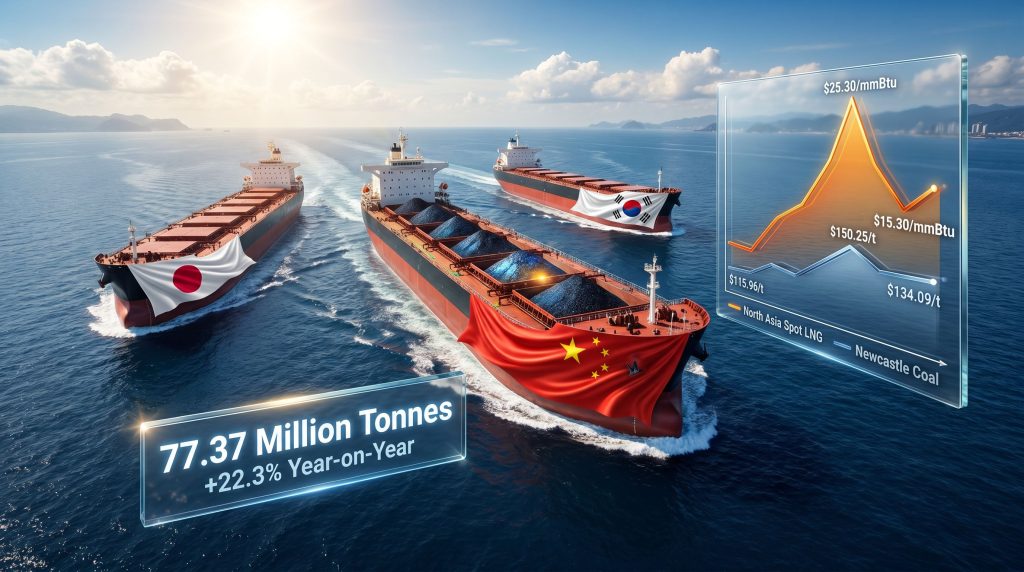
Asia's seaborne thermal coal imports are tracking toward 77.37 million tonnes in June 2026, according to data from commodity analytics firm Kpler. That figure represents a 22.3% year-on-year increase from the 63.24 million tonnes recorded in June 2025 and a meaningful step up from May 2026's 68.39 million tonnes. Furthermore, Asia's thermal coal imports have drawn considerable analyst attention given the scale and speed of the acceleration.
The scale of this acceleration becomes clearer when examined across individual importing nations:
| Country | June 2026 Forecast (Mt) | June 2025 Actual (Mt) | Year-on-Year Change |
|---|---|---|---|
| China | 27.65 | 18.62 | +48.4% |
| Japan | 7.82 | 5.89 | +32.8% |
| South Korea | 7.30 | 5.16 | +41.5% |
| India | 12.32 | 14.14 | -12.9% |
The critical insight here is that three of Asia's largest energy economies are simultaneously increasing coal procurement for entirely different structural reasons. Treating this as a monolithic demand event would lead to fundamental misreading of how long each demand impulse is likely to persist.
How the Strait of Hormuz Closure Rewired Asian Energy Procurement
The LNG Price Shock That Made Coal Competitive Again
The catalyst for Japan and South Korea's coal buying surge traces directly to the military conflict involving the United States and Israel against Iran, which began on February 28, 2026. Tehran's effective closure of the Strait of Hormuz had an immediate and devastating consequence for North Asian gas markets: Qatar's LNG production, which serves as a cornerstone of Japanese and South Korean energy supply, became functionally stranded. The broader LNG supply implications of this disruption continue to reverberate across global energy markets.
Approximately 20% of global LNG supply either transits through or originates near the Strait of Hormuz, making the closure a supply shock with few historical parallels. The market response was swift and severe:
- North Asia spot LNG prices were trading at $10.40 per mmBtu in the week ending February 27, 2026
- By March 20, prices had surged to $25.30 per mmBtu, a 143% increase in fewer than three weeks
- As of mid-June 2026, prices had pulled back to approximately $15.30 per mmBtu, but remained 47% above pre-conflict levels
Analysts have estimated a global LNG shortfall of approximately 35 million tonnes in 2026 under the current market configuration, a volume that cannot easily be replaced through alternative sources in the short term given the long lead times associated with LNG infrastructure development.
The Thermal Coal Price Response: Significant But Proportionally Smaller
Seaborne thermal coal prices rose in response to the conflict, but the magnitude of the move was far smaller than what LNG markets experienced. This pricing divergence is the core economic mechanism that triggered fuel-switching across Northeast Asia. Consequently, this oil market disruption dynamic has added further complexity to the region's energy procurement strategies.
| Metric | Pre-Conflict | Peak Level | June 2026 | Premium Above Pre-Conflict |
|---|---|---|---|---|
| Newcastle High-Grade Coal (AUD/t) | $115.96 | $150.25 | $134.09 | +15.7% |
| North Asia Spot LNG ($/mmBtu) | $10.40 | $25.30 | $15.30 | +47.1% |
When LNG prices rise three times faster than coal prices, the economics of fuel substitution become too compelling for utility operators to ignore. Japan and South Korea's power generators did not switch because of ideology or policy mandates. They switched because the numbers demanded it.
A subtlety worth noting is that high-grade Australian coal from Newcastle Port is the specific specification preferred by Japanese and South Korean utilities. The thermal content and ash characteristics of Newcastle benchmark coal are well-matched to the boiler designs used in Northeast Asian power plants, meaning that switching from LNG to coal is not simply a question of price — it also requires access to the right coal grade at the right volume. The fact that Newcastle coal at $134.09 per tonne remained accessible and cost-competitive against LNG at $15.30 per mmBtu on an energy-equivalent basis was a critical enabler of the fuel switch.
Japan's Coal Import Acceleration: Energy Security in Action
Three Consecutive Months of Rising Arrivals
Japan's thermal coal procurement trajectory in 2026 reflects a deliberate and sustained response rather than a one-off emergency purchase. June 2026 arrivals are forecast at 7.82 million tonnes, representing a 33% increase from the 5.89 million tonnes imported in June 2025 and marking the third consecutive month of rising import volumes.
Japan holds a structural advantage that shapes its response to LNG supply shocks: one of the world's most flexible utility fleets, capable of switching fuel sources at relatively short notice without requiring major capital investment. This flexibility, built over decades as a hedge against import dependency, is now functioning exactly as intended.
Several factors make Japan's coal demand durable in the current environment:
- LNG price levels remain elevated at nearly 50% above pre-conflict benchmarks, maintaining coal's cost advantage for baseload generation
- Qatar supply remains disrupted, meaning the primary source of Japanese LNG imports has not fully normalised
- Australian coal supply chains are functioning, with Newcastle Port shipments flowing reliably to Japanese buyers
- Energy security strategy now explicitly favours maintaining diversity across fuel sources, making procurement managers reluctant to reduce coal purchases even if LNG prices ease further
South Korea's Surge: The Region's Most Aggressive Procurement Shift
The Highest Proportional Increase Among Major Importers
South Korea's thermal coal import growth rate in June 2026 is the most aggressive of any major Asian economy, with forecast arrivals of 7.30 million tonnes representing a 41% year-on-year increase from the 5.16 million tonnes recorded in June 2025. This also marks the highest monthly import volume since January 2026.
South Korea's response to the LNG shock shares structural similarities with Japan's but reflects some distinct policy and procurement choices:
- South Korea lifted coal-fired power capacity constraints to protect domestic electricity supply adequacy during the LNG shortage
- Russian coal imports increased by approximately 107.5% in the first four months of 2026, reflecting a deliberate geographic diversification of supply sources
- South Korean utilities, like their Japanese counterparts, operate dual-fuel capable generation assets that can pivot between LNG and coal inputs
The 41% import growth rate versus Japan's 33% suggests South Korea either faced greater LNG exposure in its procurement portfolio or made more aggressive operational decisions to shift generation toward coal during the crisis period. Both economies are responding rationally to the same price signal, but the scale of South Korea's adjustment indicates a higher degree of vulnerability to the original LNG price spike.
China's Import Surge: A Completely Different Problem
Why China Is Buying More Coal Despite Not Being Exposed to the LNG Crisis
China's 48.4% year-on-year increase in thermal coal imports during June 2026 is the largest absolute volume gain among all Asian importers, with Kpler forecasting arrivals of 27.65 million tonnes, a six-month high. Critically, however, China's buying surge has nothing to do with the LNG market dislocation affecting Japan and South Korea. The broader China commodity outlook provides useful context for understanding Beijing's domestic supply pressures.
Beijing is responding to a domestic supply-demand imbalance that would have driven import growth regardless of events in the Middle East. The sequence of events is worth tracing carefully:
- China's thermal electricity output rose 2.1% in May 2026 alone, with cumulative growth for the January-to-May period reaching 3.4%, reflecting robust industrial and residential electricity demand
- Domestic coal production fell 1.7% year-on-year in May 2026 to 397.22 million tonnes, and cumulative output for the first five months declined 0.3% to 1.98 billion tonnes
- A major mine disaster claiming 82 lives triggered nationwide safety inspections across China's coal sector, directly constraining production capacity at a time when demand was accelerating
- Domestic thermal coal prices at Qinhuangdao climbed to 860 yuan per tonne (approximately $126.28), the highest level since October 2024
- At that domestic price point, both Indonesian lower-grade coal and mid-grade Australian coal became economically competitive against Chinese domestic supply on a landed-cost basis
China's import acceleration is structurally independent from the geopolitical energy dynamics driving Northeast Asian buying. It is a supply-side failure story, not a fuel-switching story. This distinction matters enormously for forecasting how long the import demand will persist.
Which Coal Origins Benefit From China's Demand?
The economics of Chinese import competitiveness at current Qinhuangdao benchmark prices create opportunities for multiple exporting nations:
- Indonesian lower-grade coal has become price-competitive against Chinese domestic supply, capturing incremental volume from utilities willing to blend lower-calorific product to reduce input costs
- Australian mid-grade coal is increasingly viable for Chinese procurement, offering a quality step-up from Indonesian product at landed costs that still undercut domestic benchmarks
- Both origins are positioned to sustain elevated export volumes into China through the remainder of 2026 as long as Qinhuangdao prices remain at current levels
A less commonly understood aspect of China's coal import mechanics is the role that port inventory management plays in procurement decisions. Chinese utilities and trading houses tend to rebuild port stockpiles aggressively when import prices are competitive, creating demand amplification during price dislocation events that can exceed the underlying consumption need. This inventory rebuilding dynamic may be contributing to the June import surge beyond what electricity demand growth alone would suggest.
The next major ASX story will hit our subscribers first
India: The Structural Outlier That Tells Its Own Story
Why India Is Moving in the Opposite Direction
India's thermal coal import trajectory in 2026 stands in sharp contrast to every other major Asian importer. Seaborne arrivals are forecast at 12.32 million tonnes in June, essentially flat compared to May's 12.27 million tonnes but down 12.9% from the 14.14 million tonnes recorded in June 2025.
Three factors explain India's divergence from the regional trend:
- Price sensitivity: Elevated global coal prices are deterring Indian power generators from increasing spot purchases, reflecting a procurement discipline shaped by tighter margins in the Indian electricity market
- Inventory drawdown: Rather than buying at elevated prices, Indian utilities are running down existing coal stockpiles, a strategy that defers procurement costs but creates future restocking risk if inventories deplete
- Renewable generation milestone: India's renewable electricity output surged 29.3% year-on-year in May 2026, reaching a record 17.9% share of total national electricity generation
India's renewable generation reaching nearly 18% of total national output represents a qualitatively different energy system response to supply shocks. Unlike Japan and South Korea, which lack the installed renewable capacity to absorb an LNG shortfall, India has developed enough clean energy infrastructure to provide a genuine demand buffer against fossil fuel price spikes.
This structural difference is significant for long-term market forecasting. India may be transitioning from a reliable swing buyer in the seaborne thermal coal market toward a more price-selective purchaser whose import appetite is increasingly conditioned by the availability and cost of domestic renewable alternatives. In addition, the broader energy transition demand dynamics reshaping Asia's power mix will only intensify this shift over the medium term.
What the Supply Side Looks Like Under Sustained Demand Pressure
Exporter Positioning in a Tight Market
The demand surge across China, Japan, and South Korea is creating differentiated opportunities for the key coal-exporting nations. Australia energy exports are particularly well-positioned to capture incremental demand from multiple concurrent buying streams. Furthermore, seaborne coal trade data confirms the breadth of this regional procurement shift:
- Australia is positioned to benefit from dual demand streams: high-grade Newcastle coal meeting the fuel-switching needs of Japanese and South Korean utilities, while mid-grade product captures incremental Chinese import demand
- Indonesia is gaining market share in China as its lower-grade thermal coal becomes economically competitive against elevated Chinese domestic benchmark prices
- Russia has emerged as a significant South Korean supply source, with volumes rising approximately 107.5% in early 2026, reflecting geopolitical and logistical diversification by Korean buyers
Under a scenario where LNG prices remain materially above pre-conflict levels through the remainder of 2026, analysts project that Asia's incremental thermal coal consumption could increase by approximately 70 million tonnes across the full year. This projection carries meaningful uncertainty, as it depends on LNG market normalisation timelines, the pace of Chinese domestic production recovery following safety inspections, and the extent to which South Korean and Japanese utilities sustain elevated coal burn rates as the year progresses.
The Broader Implication: Energy Transition Under Stress
When Security Overrides Decarbonisation
The 2026 Asian coal import surge offers a sobering lesson about the practical limits of energy transition timelines during supply shocks. Japan and South Korea have both made public commitments to reduce coal's role in their electricity systems, yet within weeks of a geopolitical disruption to LNG markets, both countries were rapidly scaling up coal procurement.
This behaviour is economically rational and arguably strategically prudent, but it reveals an important vulnerability in transition planning: economies that have reduced coal capacity faster than they have developed alternative baseload generation are structurally exposed to exactly this kind of supply shock. The fuel-switching flexibility that Japan and South Korea are currently exercising exists precisely because they retained coal-fired generation capacity through the transition period — a decision that has proven its value in 2026.
For investors and market participants, the key takeaway is that the current demand environment favours Australian coal producers with access to Newcastle benchmark-grade product and Indonesian producers with established Chinese customer relationships. The confluence of three independent demand drivers simultaneously supporting Asia thermal coal imports is unusual and is unlikely to persist indefinitely, but the structural pressures underpinning each demand stream have their own timelines and resolution pathways.
Disclaimer: This article contains forward-looking projections and market analysis sourced from publicly available data and commentary. Commodity price forecasts and import volume projections are inherently uncertain and should not be construed as financial advice. Readers should conduct independent research before making investment decisions.
Want to Stay Ahead of the Next Major Commodity Discovery?
When energy markets shift as rapidly as the 2026 Asian coal surge demonstrates, identifying actionable investment opportunities ahead of the broader market becomes critical. Discovery Alert's proprietary Discovery IQ model delivers real-time alerts on significant ASX mineral discoveries — including coal and energy commodities — turning complex market data into clear, actionable insights; explore historic discovery returns on Discovery Alert's discoveries page and begin your 14-day free trial to position yourself ahead of the next major market move.