June 27, 2026
When a Single Waterway Controls 10% of the World's Aluminum
Global commodity markets have a structural vulnerability that rarely surfaces in normal times but becomes impossible to ignore when geopolitical conditions deteriorate: chokepoint dependency. The world's major bulk shipping lanes were not designed with redundancy in mind. They were built around the most efficient routes, and efficiency, it turns out, creates concentration risk. The Strait of Hormuz is perhaps the most consequential example of this phenomenon in the metals market today.
The Vitol stranded aluminum cargo out of Strait of Hormuz situation that unfolded across late February through late June 2026 has crystallised exactly how fragile modern industrial supply chains become when a critical maritime corridor goes dark. This is not simply a story about one trading house moving one vessel. It is a stress test of the entire architecture that connects Middle Eastern smelters to global consumers, and the results reveal fault lines that will reshape how producers, traders, and manufacturers think about supply chain resilience for years to come.
When big ASX news breaks, our subscribers know first
The Gulf's Structural Position in Global Aluminum Supply
Why Middle Eastern Smelters Are Uniquely Exposed
The Gulf Cooperation Council region has quietly become one of the world's most concentrated aluminum production zones, accounting for approximately 10% of global output. This is a remarkable figure for a region without bauxite deposits of its own. Gulf smelters, most notably Emirates Global Aluminium in the UAE, have been built around a different competitive logic: cheap energy. Aluminum smelting is extraordinarily electricity-intensive, consuming roughly 13 to 14 megawatt-hours per metric ton of finished metal. In a region with abundant and low-cost energy, this creates a structural cost advantage that has drawn billions in capital investment over the past two decades.
The trade-off, however, is geographic. Unlike diversified global aluminium producers that can route product through multiple ports across different geopolitical zones, Gulf aluminum production sits behind a single maritime exit point. The region has limited overland export infrastructure capable of handling full industrial bulk volumes, which means that disrupting the strait is, in practical terms, equivalent to disrupting the production itself.
The Strait as an Industrial Bottleneck
The Strait of Hormuz connects the Persian Gulf to the Gulf of Oman and represents the only viable bulk shipping corridor for UAE, Bahraini, and broader Gulf aluminum production. When the Iran war triggered a near-complete suspension of commercial bulk shipping through the strait beginning in late February 2026, producers faced an immediate and stark choice: find alternative logistics or watch finished metal accumulate with nowhere to go.
Furthermore, the supply chain disruption that materialised is difficult to overstate. More than 3,200 vessels became stranded or significantly delayed in Gulf waters, with approximately 20,000 crew members effectively trapped in the Persian Gulf region. For aluminum specifically, a commodity that is bulky, heavy, and economically inefficient to move in small containerised parcels at scale, the closure created a supply bottleneck with no clean workaround.
As Lloyd's List reported, Strait of Hormuz transits collapsed entirely as shipping's risk appetite was tested to its limits, underlining just how severe the commercial paralysis became across the region.
The Strait of Hormuz functions not merely as a geopolitical flashpoint but as an embedded structural vulnerability within the global aluminum supply chain, one for which no immediate industrial-scale substitute exists.
Anatomy of the Vitol Transit: What Made This Shipment Historic
The Lowlands Corso and Its Cargo
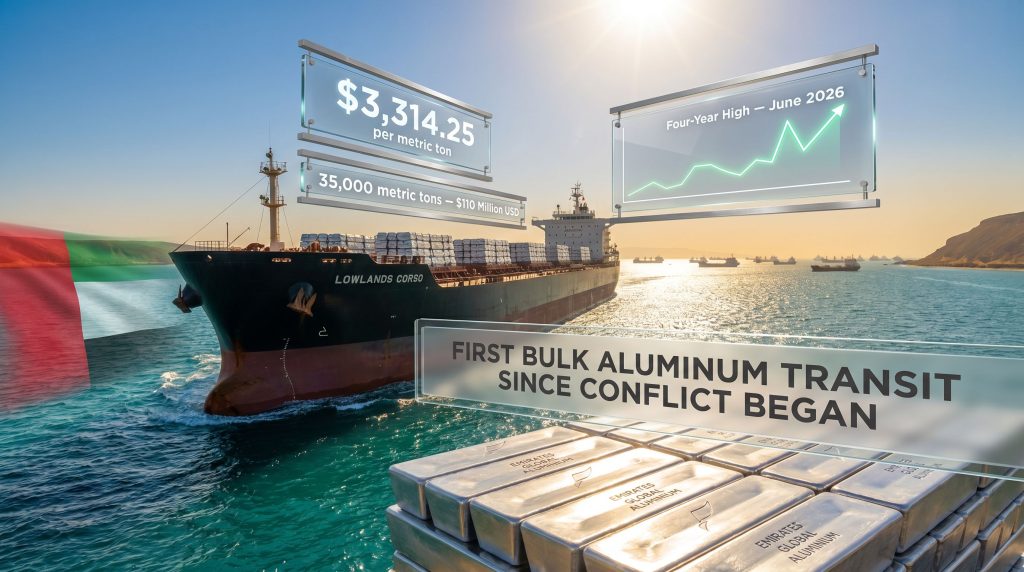
The bulk carrier Lowlands Corso, operating within Vitol Group's trading umbrella, loaded approximately 35,000 metric tons of aluminum at Abu Dhabi in late February 2026. At current futures prices of $3,314.25 per metric ton, the cargo represents a value of roughly $110 million USD, making it an unusually large single-parcel physical aluminum trade.
Following the outbreak of hostilities, the vessel spent approximately four months anchored in various locations off the UAE's western coast, unable to proceed. The cargo's destination is New Orleans, a routing decision that is commercially deliberate rather than logistically incidental. US manufacturers are currently paying the highest aluminum prices anywhere in the world, a function of US aluminium tariffs compounding an already acute war-driven supply shortage.
Why This Transit Is a Market Signal, Not a Market Solution
The Lowlands Corso is confirmed to be the first bulk carrier to successfully transit aluminum through the strait since the conflict began. This distinction matters considerably in market terms. Containerised aluminum shipments had been finding alternative routes through Oman and Saudi Arabian ports via trucking corridors, but these workarounds can handle only approximately one-third of the cargo volume that normal strait transit supports, and they add between 9 and 15 days of additional transit delay. For bulk shipments of 35,000 metric tons, containerised rerouting is not a realistic substitute.
The following table summarises the key dimensions of the supply disruption and where the Vitol transit sits within that context:
| Metric | Data Point |
|---|---|
| Vessels stranded or delayed in Gulf waters | Over 3,200 ships |
| Crew members stranded in the Persian Gulf | Approximately 20,000 individuals |
| Gulf region share of global aluminum output | ~10% |
| Aluminum price peak (early June 2026) | Four-year high |
| Aluminum futures price (as reported) | $3,314.25 per metric ton |
| Land bridge cargo capacity vs. normal sea freight | Approximately one-third of typical volume |
| Land bridge transit delay | 9 to 15 days additional |
| Lowlands Corso cargo volume | 35,000 metric tons |
| Estimated cargo value | ~$110 million USD |
How Smelters Kept Running: The Dark Transit Mechanism
Raw Material Inflows Under Non-Standard Arrangements
One of the least-discussed but most consequential developments during the strait closure has been the continuation of raw material inflows to Gulf smelters through what the industry broadly refers to as dark transit arrangements. These involve vessels operating outside normal tracking and commercial insurance frameworks, maintaining the supply of alumina, caustic soda, and other smelter inputs necessary to sustain production.
This is an important nuance that mainstream coverage frequently overlooks. The risk to the aluminum market was not only about finished metal being unable to exit the region. It was equally about the risk that smelters would lose access to the raw materials needed to continue operating. An aluminum smelter cannot simply pause and restart cleanly. The electrolytic reduction cells that convert alumina into aluminum metal must be maintained at operating temperature continuously. A cold shutdown is an extraordinarily costly and time-consuming event, sometimes requiring months and tens of millions of dollars to remediate.
In addition, alumina market pressures were already weighing on producers before the strait closure, meaning that any further interruption to raw material supply would have compounded an already strained procurement environment.
Unexpectedly large volumes of raw materials were shipped into regional smelters through non-standard arrangements during the strait closure, a development that analysts credit with averting the widespread production curtailments that had been viewed as a genuine threat to global supply stability.
Why This Matters for Price Trajectory
The successful maintenance of smelter production rates through dark transit raw material supply means that when the strait does fully reopen, the region will not be facing a production restart delay. Finished metal that has been accumulating can begin moving immediately, rather than waiting for production to ramp back up from reduced operating rates. This compressed recovery timeline is actually a bearish factor for aluminum prices in a normalisation scenario, since the market could see a relatively rapid re-emergence of GCC export volumes once commercial shipping confidence is restored.
The Insurance Barrier: Why Commercial Confidence Lags Military Ceasefire Progress
War-Risk Coverage and the Stranded Fleet Problem
A factor that receives insufficient attention in commodity market analysis is the role of war-risk insurance in determining when commercial shipping resumes, regardless of what the security situation on the water actually looks like. Even as US-Iran negotiations toward a permanent ceasefire have advanced, a significant proportion of the 3,200-plus stranded vessels remain commercially unable to transit the strait because their insurance coverage has been suspended or cancelled.
War-risk insurance operates as a distinct layer of maritime coverage that underwriters can cancel on short notice, often within 48 hours, when a waterway is designated as a high-risk zone. Reinstating that coverage requires underwriters to reassess their risk models and agree on commercially viable premium structures, a process that does not happen simultaneously with diplomatic developments.
The Lowlands Corso transit functions as a critical proof-of-concept in this context. If the cargo arrives in New Orleans without incident, it provides underwriters with empirical evidence that the southern corridor of the strait is operationally viable under current conditions. That data point could meaningfully accelerate the premium repricing process, which is the practical prerequisite for unlocking the broader stranded fleet.
The Projectile Incident: Why Caution Remains Warranted
One day before the Vitol transit, a vessel was struck by an unidentified projectile in Gulf waters. This incident serves as a live reminder that the security environment has not been formally resolved. Analysts and trading houses monitoring the situation are therefore making a probabilistic judgement about acceptable risk rather than operating in a confirmed safe environment. The divergence between those who expect rapid export normalisation and those who foresee a residual squeeze persisting for months is, at its core, a disagreement about the pace and permanence of diplomatic progress.
Aluminum Price Dynamics: From Shortage Premium to Normalization
How the Four-Year High Was Built
Aluminum prices reached a four-year high in early June 2026 as the accumulated impact of effective GCC export exclusion filtered through to exchange-monitored inventories and spot markets. The mechanics are straightforward: the GCC contributes roughly 10% of global aluminum supply, and when that supply was effectively removed from accessible markets for approximately four months, inventories were drawn down aggressively whilst demand continued at normal industrial rates across automotive, aerospace, construction, and packaging sectors.
US buyers were disproportionately affected because import tariff structures raised their baseline acquisition cost before any war premium was applied. The compounding of a tariff overlay with a geopolitical supply shock created the world's highest regional aluminum premium, which is precisely why New Orleans was chosen as the destination for the Lowlands Corso cargo. Consequently, commodity volatility hedging has become an increasingly urgent consideration for procurement teams and investors exposed to aluminum price swings.
Three Scenarios for the Path Forward
The market's trajectory from here depends on several interdependent variables operating in parallel. The following scenarios represent the range of credible outcomes:
Scenario 1: Rapid Normalisation
- Multiple vessels follow the Vitol precedent within days of the successful transit
- War-risk insurance underwriters reprice premiums for the southern corridor
- GCC smelter output reaches full export flow within weeks
- Global inventories rebuild within 6 to 8 weeks
- Aluminum futures retreat meaningfully from four-year highs toward pre-war price levels
Scenario 2: Gradual, Fragmented Recovery
- Sporadic transits resume but isolated security incidents create stop-start shipping dynamics
- Insurance markets remain cautious, limiting the number of vessels able to proceed
- Prices remain elevated for 3 to 6 months as inventory rebuilding progresses slowly
- The US regional premium persists due to the continuing interaction of tariff policy and delayed supply normalisation
Scenario 3: Re-escalation
- A major shipping attack or diplomatic breakdown disrupts the nascent recovery
- The 3,200-plus stranded vessels remain locked in place for an extended period
- Smelter raw material pipelines are eventually threatened, introducing production curtailment risk
- Aluminum prices establish a new elevated price floor rather than mean-reverting
The next major ASX story will hit our subscribers first
The Role of Physical Trading Houses in Geopolitical Supply Crises
Why Vitol's Position Matters Beyond This Single Cargo
Global commodity trading houses occupy an institutional position that most market commentary underestimates. Firms of this scale simultaneously hold physical inventory, control shipping logistics across multiple vessel types, maintain producer relationships, and have the financial capacity to absorb the commercial risk of moving stranded cargoes that neither producers nor end-users can directly manage. In a supply disruption of this magnitude, these firms effectively become the market's connective tissue.
The decision to move the Lowlands Corso cargo when it did reflects a specific commercial and risk calculus: the value of being first to establish a viable transit route is substantially higher than the value of waiting for the route to be fully de-risked by someone else. The $110 million cargo, in this context, is both a commercial transaction and a strategic market action. As Bloomberg reported, Vitol's decision to sail the stranded aluminum cargo out of the Strait of Hormuz represents a landmark moment in the market's gradual recovery from the crisis.
What Dark Transits Tell Us About Supply Chain Resilience
The broader lesson of the raw material dark transit arrangements that kept Gulf smelters operational during the strait closure is that the global aluminum supply chain has more embedded resilience than a simple chokepoint analysis would suggest. When legitimate commercial channels close, market participants develop informal parallel networks that absorb a portion of the disruption. These networks are structurally inefficient and commercially costly, but they prevent the worst-case outcome of widespread smelter closures.
This dynamic has direct implications for how investors and procurement teams should think about supply chain risk. Total reliance on exchange-listed price signals as a proxy for supply availability is insufficient during a geopolitical disruption. The premium above exchange prices that end-users are paying reflects not just spot scarcity but also the embedded cost of the informal logistics architecture that has been assembled to partially bridge the gap.
Key Takeaways for Market Participants
The following points summarise the most operationally relevant insights from this situation for aluminum buyers, investors, and supply chain professionals:
- Chokepoint geography creates non-linear risk: A single waterway controlling 10% of global aluminum supply means disruption events have outsized and rapid price consequences
- Smelter cold shutdown risk is asymmetric: The cost of restarting a cold aluminum reduction cell far exceeds the cost of maintaining it under reduced throughput, which is why dark transit raw material supply was prioritised above almost all other considerations
- Insurance markets, not security conditions, are the practical gating factor for shipping resumption once diplomatic progress begins
- The US tariff-plus-war-premium combination created a uniquely acute pricing environment for American manufacturers, making New Orleans the commercially optimal destination for the first normalisation cargo
- Physical trading houses absorb crisis risk that producers and end-users cannot, making their operational decisions early market signals of normalisation trajectories
- The Lowlands Corso transit is a signal, not a solution: sustained multi-vessel resumption under commercially insurable conditions is required before the global aluminum market can genuinely rebalance
Disclaimer: This article contains forward-looking analysis and scenario projections based on publicly available market data and reported developments as of late June 2026. Commodity market conditions, geopolitical developments, and shipping risk assessments can change rapidly. Nothing in this article constitutes financial or investment advice. Readers should conduct their own due diligence before making any investment or procurement decisions.
Want To Stay Ahead of the Next Major Commodity Supply Shock?
Discovery Alert's proprietary Discovery IQ model delivers real-time alerts on significant ASX mineral discoveries, transforming complex market developments into actionable investment insights before the broader market catches on — explore historic discoveries and their returns to understand the opportunity, then start your 14-day free trial at Discovery Alert to position yourself ahead of the next major market move.