August 7, 2026
The Hidden Geography of a Metal the World Cannot Afford to Lose
Every major industrial transition of the past century has been underwritten by aluminum. From the fuselages of commercial aircraft to the battery enclosures of electric vehicles, from beverage cans rolling off production lines by the billion to the structural frames holding solar panels against wind and weather, aluminum is the backbone of modern manufacturing. It is the second most-used metal on earth after steel, and for decades its markets were defined by one chronic condition: too much of it.
That reality has now inverted with startling speed. The aluminum squeeze in the Strait of Hormuz has transformed a market once burdened by oversupply into one facing its most acute physical shortage in a generation. Understanding how that happened, and what it means for industries, investors, and global supply chains, requires looking past the daily price ticker and into the structural geography of where aluminum actually comes from.
When big ASX news breaks, our subscribers know first
Why the Gulf Became the World's Aluminum Heartland
The rise of the Middle East as a dominant aluminum-producing region was not accidental. It was the product of deliberate industrial policy built around one critical input: cheap, abundant energy. Aluminum smelting is among the most electricity-intensive industrial processes on the planet. Producing a single tonne of primary aluminum requires roughly 13 to 15 megawatt-hours of electricity, making energy cost the single largest variable in the economics of any smelter operation.
Gulf nations, particularly the UAE and Bahrain, recognised this structural advantage decades ago. Access to low-cost natural gas allowed them to generate electricity at a fraction of the cost faced by European or North American smelters. Over approximately two decades, that advantage was systematically converted into smelting capacity, turning the region into a major supplier of primary aluminum to buyers across Asia, Europe, and the Americas.
By the time the 2026 Gulf conflict began, the region collectively accounted for close to 10% of global aluminum output — a concentration that few outside the industry fully appreciated until supply chains began fracturing under pressure.
The Strait as a Single Point of Failure
The Strait of Hormuz is a narrow maritime corridor connecting the Persian Gulf to the Gulf of Oman and the broader Indian Ocean. It carries an extraordinary volume of global commodity trade, most visibly crude oil, but also liquefied natural gas, petrochemicals, and, critically, primary aluminum. For Gulf smelters, it is not merely a preferred export route. It is the only meaningful one.
When the strait closes, Gulf aluminum does not simply find a longer path to market. It stops moving entirely. This geographic reality transformed what might otherwise have been a regional conflict into a global commodity event, triggering the aluminum squeeze in the Strait of Hormuz that is now reshaping pricing dynamics across three continents.
The disruption has operated on two levels simultaneously. First, the physical blockage of the strait has prevented finished aluminum from reaching buyers. Second, direct attacks on smelter infrastructure within the region have curtailed production itself. This dual compression — hitting both output and delivery at the same time — is what distinguishes the 2026 crisis from most previous commodity supply shocks. Heatmap News provides a detailed breakdown of how this chokepoint has reshaped global energy and metals markets.
Commodity markets have absorbed logistics disruptions before, and they have absorbed production disruptions before. What they rarely face is both at once, sustained over months, affecting a metal with effectively no short-term substitute in its core applications.
Estimates suggest that cumulative inventory drawdown attributable to the crisis reached approximately 3 million tonnes removed from effective global supply over the course of 2026, a figure that contextualises just how severe the physical shortage has become.
What Does an Aluminum Squeeze Actually Mean for Global Markets?
Understanding Backwardation: The Market's Distress Signal
Futures markets for metals are designed to offer price discovery across time. Under normal conditions, the price of aluminum for delivery three months from now exceeds the spot price for immediate delivery. This reflects the cost of storage, insurance, and capital tied up in inventory — a condition known as contango. When this relationship inverts, when buyers will pay a premium to secure metal right now over metal promised later, the market is signalling something is genuinely wrong with available supply.
This inversion is called backwardation, and its magnitude functions as a real-time stress indicator for physical scarcity.
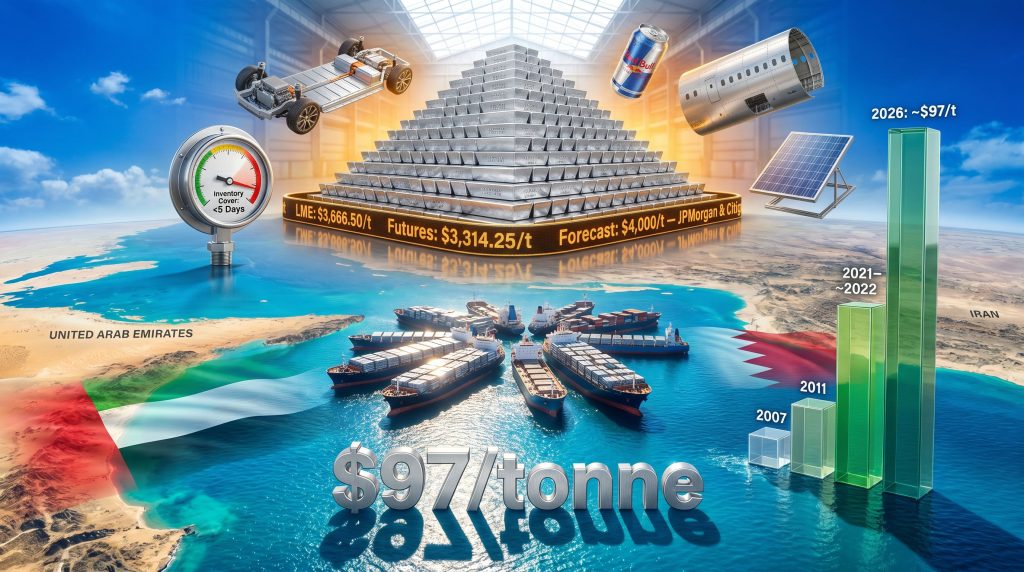
By late May 2026, spot aluminum on the London Metal Exchange was trading at a $97-per-tonne premium over three-month futures, the widest cash-to-forward spread recorded since 2007. That number is not an abstraction. It represents industrial buyers paying a meaningful surcharge simply to secure metal they need today, because the alternative — waiting for future delivery — carries genuine supply risk.
The historical context matters here:
| Period | Cash Premium Over 3-Month Futures | Primary Trigger |
|---|---|---|
| 2007 | Comparable levels | Smelter disruptions |
| 2011 | Elevated | Post-GFC demand recovery surge |
| 2021-2022 | Moderate | European energy crisis curtailments |
| 2026 (current) | ~$97/tonne | Strait of Hormuz closure + smelter attacks |
What makes the 2026 reading particularly striking is that previous backwardation episodes typically reflected either a logistics problem or a production problem. The current crisis reflects both, simultaneously and in a sustained manner.
Inventory Collapse: When Exchange Stockpiles Hit a Danger Zone
The LME, CME Group, and Shanghai Futures Exchange warehouses collectively function as the world's aluminum reserve system. When producers have surplus metal, it accumulates in these facilities. When demand outpaces supply, it drains from them. For most of aluminum's modern history, these stockpiles were generous — sometimes embarrassingly so — with years of chronic oversupply creating warehouses stacked with metal that buyers did not want at prevailing prices.
That era is over. Combined aluminum stockpiles across all three major exchanges now provide less than five days of global supply cover, the lowest coverage ratio among the six primary metals traded on the LME. To put that in perspective, five days of buffer is essentially no buffer at all for a metal consumed continuously by automotive plants, aerospace manufacturers, construction firms, and packaging facilities running around the clock.
Sub-five-day inventory cover across three major exchanges simultaneously represents an extreme outlier condition. Industry veterans describe the current aluminum shortage environment as without parallel in recent decades — not merely tight, but structurally exposed to any further disruption.
The shift from chronic oversupply to critical shortage did not happen in isolation. It reflects years of investment underperformance in new smelting capacity outside the Gulf, growing demand from electrification and renewable energy buildout, and now the acute supply shock of the Hormuz crisis compressing both production and distribution simultaneously. Furthermore, US aluminium tariffs had already been straining global trade flows well before the Gulf conflict escalated.
How Far Have Aluminum Prices Climbed, and Where Are They Headed?
Price Performance Since the Conflict Began
Three-month LME aluminum prices have risen more than 16% since the onset of Gulf hostilities, a rally that has accelerated as the market digested the full scope of both the shipping disruption and the damage to regional smelting infrastructure.
Prices briefly exceeded $3,700 per tonne earlier in the week of the late-May 2026 report, representing a four-year high. The LME settlement price stood at $3,666.50 per tonne at the close of trading, while broader aluminum futures markets were pricing the metal at $3,314.25 per tonne, reflecting different contract specifications and market segments.
What Major Financial Institutions Are Forecasting
Both JPMorgan and Citigroup have published price targets pointing toward $4,000 per tonne for LME aluminum. The analytical rationale underpinning these forecasts rests on three pillars:
- Inventory depletion continuing at pace, with no credible near-term mechanism for rebuilding exchange stockpiles while the strait remains closed.
- No clear smelter restart timeline for the Gulf facilities that have been attacked or curtailed, given that recommissioning a modern aluminum smelter after forced shutdown is a complex, months-long process even under favourable conditions.
- Ongoing shipping disruptions creating a persistent physical disconnect between where metal exists and where buyers need it to be.
The scenario in which prices retreat materially requires at least one of three developments: a credible diplomatic resolution to the Gulf conflict, the establishment of viable alternative shipping routes around the strait, or coordinated emergency stockpile releases by major consuming nations. None of these appears imminent as of late May 2026.
Investors should note that price forecasts from financial institutions represent analytical projections rather than guaranteed outcomes. Commodity markets are subject to rapid reversals based on geopolitical developments, and positions in aluminum-linked assets carry meaningful risk in both directions.
Which Industries Face the Greatest Exposure?
Sector-by-Sector Vulnerability Assessment
The downstream consequences of the aluminum squeeze in the Strait of Hormuz are not evenly distributed. Industries with high aluminum intensity and limited substitution options face the sharpest cost exposure:
- Electric vehicles and automotive: Modern EV platforms use aluminum extensively for body structures, battery enclosures, and thermal management components. A significant price spike feeds directly into bill-of-materials costs at a time when automakers are already managing thin margins on electrification investments.
- Aerospace and defence: Airframe construction relies on primary aluminum alloys with tight metallurgical specifications. Unlike commodity-grade applications, aerospace-grade aluminum cannot simply be substituted with alternative materials without extensive recertification processes.
- Packaging and consumer goods: Beverage cans, food containers, and flexible packaging consume enormous volumes of aluminum annually. These are cost-sensitive, high-volume applications where margin compression from input price spikes is transmitted rapidly through supply chains.
- Construction and infrastructure: Curtain wall systems, structural framing, and roofing rely on aluminum for its combination of strength, corrosion resistance, and workability. Large infrastructure projects committed at earlier cost assumptions face material budget overruns.
- Renewable energy: Solar panel frames and wind turbine components represent a rapidly growing demand category. The irony of a green energy buildout being constrained by aluminum supply disruption is not lost on industry observers.
How Downstream Manufacturers Are Responding
Industrial buyers are not passive in a supply squeeze. Several behavioural responses have become visible across markets:
- Accelerated spot purchasing and aggressive locking of forward contracts as procurement teams attempt to secure supply ahead of anticipated further price increases.
- Inventory accumulation by major manufacturers — a rational individual response that collectively amplifies the drawdown on exchange stockpiles, creating a self-reinforcing feedback loop.
- Geographic arbitrage, with buyers redirecting sourcing inquiries toward smelters in Canada, Norway, Iceland, and Australia that operate outside the affected region.
The substitution option is more limited than it might appear. Steel can replace aluminum in some structural applications, and certain plastics can substitute in packaging, but neither offers the same strength-to-weight ratio in aerospace and automotive contexts. Neither can be deployed at scale without significant retooling of manufacturing processes.
Is the Supply Disruption Structural or Temporary? Scenario Analysis
Scenario 1: Rapid Diplomatic Resolution
A ceasefire and reopening of the Strait of Hormuz would not immediately normalise aluminum markets. Smelter restart timelines typically run 8 to 12 weeks even under favourable conditions, and exchange inventory rebuilding from sub-five-day cover would require sustained above-demand production for months. Insurance and shipping cost premiums may persist even after physical reopening, as underwriters reprice Gulf route risk.
Scenario 2: Prolonged Disruption of 3 to 6 Months
If the current conditions extend through late 2026, cumulative inventory depletion across all three major exchanges could reach historically unprecedented levels. The institutional price forecast of $4,000 per tonne becomes a floor rather than a ceiling in this scenario, with demand destruction risk emerging as the limiting factor. At some price point — typically estimated in the range above $4,500 per tonne based on historical analogues — downstream manufacturers begin deferring purchases and scaling back aluminum-intensive production runs.
Scenario 3: Permanent Capacity Relocation
The most structurally significant long-term outcome would be irreparable or extended damage to Gulf smelting capacity, accelerating investment in alternative regions. This scenario is already visible in embryonic form. Rio Tinto has announced a $1.5 billion expansion of its AP60 aluminum smelter in Quebec, one of the most energy-efficient and lowest-carbon smelting technologies operating at commercial scale globally.
The Quebec facility benefits from abundant hydroelectric power, a stable political jurisdiction, and proximity to North American automotive and aerospace supply chains. In addition, Rio Tinto's Gladstone aluminium operations in Australia represent another critical pillar of the company's strategy to diversify production away from geopolitically vulnerable regions.
Rio Tinto's AP60 expansion in Quebec positions low-carbon, hydro-powered smelting as both an environmental and a supply-security proposition. In a world where Gulf production is structurally impaired, the geography of aluminum production may shift more permanently toward jurisdictions offering both clean energy and geopolitical stability.
The next major ASX story will hit our subscribers first
How Does This Compare to Previous Commodity Choke-Point Events?
Commodity markets have been disrupted by geography before. The 2011 Libyan civil war removed a meaningful share of light crude oil from Mediterranean markets. The 2021-2022 European energy crisis forced aluminum smelter curtailments across France, Germany, and the Netherlands as power prices spiked to levels that made production economically unviable. China's 2021 power rationing temporarily suppressed domestic aluminum output, tightening the market in the second half of that year.
Each of these events created significant price volatility. However, none combined simultaneous production curtailment and complete export route closure at the scale of the current Hormuz crisis. SMM Analysis has further examined how a prolonged blockade could reshape the entire global aluminium market structure.
| Event | Price Impact | Duration | Inventory Impact |
|---|---|---|---|
| 2011 EU Energy Crisis | ~15% output decline | 6-12 months | Moderate drawdown |
| 2021 European Power Crisis | ~30% price rally | 4-6 months | Significant drawdown |
| 2022 Russia-Ukraine Conflict | Nickel +250% spike; aluminum elevated | Weeks to months | Severe short-term disruption |
| 2026 Hormuz Crisis | +16% and rising, $97/t backwardation | Ongoing | Sub-5-day exchange cover |
The 2022 nickel episode on the LME provides a cautionary precedent. That event, triggered by a short squeeze rather than a physical supply crisis, nevertheless demonstrated how quickly exchange-traded metal markets can move to extremes when physical availability and financial positioning interact. The 2026 aluminum situation is driven by genuine physical scarcity, which market participants generally view as a more durable and harder-to-reverse condition.
The Broader Geopolitical and Macro-Economic Implications
Commodity Markets as Conflict Indicators
Aluminum pricing has effectively become a real-time probability indicator for Gulf conflict resolution. Each diplomatic development — whether positive or negative — is now being immediately priced into the cash-to-futures spread and exchange inventory expectations. This dynamic links industrial input cost inflation directly to geopolitical negotiating outcomes in a manner that few commodity markets have exhibited so transparently.
The interaction with oil markets adds another layer of complexity. With Brent crude trading at approximately $104 per barrel, energy costs for aluminum smelters operating outside the Gulf are also elevated, partially limiting the cost advantage of producers in regions that use gas-fired or grid-sourced electricity. Hydropower-based smelters in Canada, Norway, and Iceland are significantly insulated from this dynamic, adding further competitive advantage to their output.
The Long-Term Energy-Aluminum Nexus
There is a deeper structural argument embedded in the current crisis that extends beyond the immediate supply shock. Aluminum produced using hydroelectric power carries a dramatically lower carbon footprint than aluminum smelted using fossil fuel-derived electricity. As industrial buyers face increasing pressure to demonstrate scope 3 emissions reductions across their supply chains, the provenance of aluminum is becoming a procurement consideration, not just its price.
The Gulf's historical cost advantage was built on cheap fossil fuels. That advantage is not just operationally disrupted by the current conflict. It is also being slowly eroded by the structural premium that low-carbon aluminum is beginning to command. Consequently, progress in low-carbon metals production is increasingly shaping where long-term smelting investment flows. Green aluminum from hydro-powered smelters in politically stable jurisdictions may represent not just a crisis-era alternative, but the long-term competitive benchmark against which all primary aluminum production will eventually be measured.
Frequently Asked Questions: Aluminum Squeeze and the Strait of Hormuz
What is the aluminum squeeze in the Strait of Hormuz?
The aluminum squeeze in the Strait of Hormuz describes the severe tightening of global aluminum supply caused by the closure of this critical maritime corridor. Gulf-region smelters collectively producing close to 10% of global output have been cut off from export markets, while smelter attacks have curtailed production itself. The combined effect has driven exchange inventories to critically low levels and pushed spot prices to multi-year highs.
Why does the Strait of Hormuz matter for aluminum supply?
The strait is the only practical maritime exit route for aluminum produced in the UAE, Bahrain, and surrounding nations. When it is closed or restricted, Gulf-produced metal cannot reach buyers in Europe, Asia, or the Americas, creating an immediate and growing physical shortage regardless of what happens to smelter output levels.
What is LME backwardation and why does it signal a supply squeeze?
Backwardation occurs when the price for immediate aluminum delivery exceeds the price for future delivery. The cash-to-three-month spread on the LME reached approximately $97 per tonne in late May 2026, the widest since 2007. This signals that buyers are paying a meaningful premium to secure metal now, reflecting genuine scarcity in immediately available physical supply rather than speculative positioning.
How low are aluminum inventories in 2026?
Combined stockpiles across the LME, CME Group, and Shanghai Futures Exchange have fallen to levels covering less than five days of global supply — the lowest coverage ratio among all six major LME-traded base metals and a dramatic reversal from aluminum's historical tendency toward surplus conditions.
What is the aluminum price forecast for 2026?
Major investment banks including JPMorgan and Citigroup have set price targets of $4,000 per tonne for LME aluminum, compared to the late-May 2026 settlement price of $3,666.50 per tonne. These forecasts are contingent on continued supply disruption and reflect the current trajectory of inventory depletion and backwardation widening.
Which regions could benefit from Gulf aluminum supply disruptions?
Nations with large, energy-efficient smelting capacity outside the Gulf — particularly Canada, Norway, Australia, and Iceland — stand to benefit from redirected demand, higher realised prices, and potentially accelerated long-term investment in their smelting infrastructure. The top aluminium companies operating in these regions are already seeing increased buyer interest. Rio Tinto's $1.5 billion Quebec expansion is the most concrete current example of this capital reallocation dynamic in action.
Furthermore, the ongoing shifts in aluminum and alumina markets suggest that producers with diversified geographic footprints are best positioned to capture the premium that supply-chain reliability now commands.
Key Takeaways: The Aluminum Market at an Inflection Point
- The aluminum squeeze in the Strait of Hormuz has created a simultaneous production and logistics shock with no direct precedent in modern commodity market history
- Exchange inventories covering less than five days of global demand represent an extreme stress condition across LME, CME, and SHFE warehouses simultaneously
- LME backwardation reaching its widest level since 2007 at approximately $97 per tonne confirms that physical scarcity, not speculative positioning, is driving the price rally
- Three-month LME prices have risen more than 16% since the conflict began, with the metal briefly exceeding $3,700 per tonne and settling at $3,666.50 per tonne in late May 2026
- Institutional forecasts from JPMorgan and Citigroup point toward a $4,000-per-tonne price target under sustained disruption conditions
- Industries with the highest aluminum intensity — including electric vehicles, aerospace, packaging, and renewable energy — face the greatest near-term cost exposure
- Long-term structural beneficiaries include low-carbon, hydro-powered smelters in politically stable jurisdictions, with Rio Tinto's $1.5 billion Quebec expansion representing the clearest early signal of geographic supply chain reorientation
This article contains forward-looking statements and price forecasts based on publicly available information as of late May 2026. Commodity markets are subject to rapid and unpredictable changes driven by geopolitical, macroeconomic, and supply-demand factors. Nothing in this article constitutes financial or investment advice. Readers should conduct their own due diligence and consult qualified financial advisers before making investment decisions related to commodity markets or aluminum-linked assets.
Want to Stay Ahead of Major Commodity Discoveries Driving the Next Market Move?
As aluminium supply chains fracture and commodity markets reach historic inflection points, Discovery Alert's proprietary Discovery IQ model delivers real-time ASX mineral discovery alerts — instantly translating complex market signals into actionable investment insights for both traders and long-term investors. Explore how significant mineral discoveries have historically generated substantial returns and begin your 14-day free trial today to secure a market-leading edge before the next major discovery is announced.