
August 7, 2026
India's Monsoon Season Exposes a Fundamental Flaw in Coal-Dependent Power Grids
Every year, the southwest monsoon arrives in India carrying the promise of relief, replenished reservoirs, and reduced agricultural stress. Yet for coal-dependent power utilities, the same seasonal transition introduces a compounding set of operational risks that rarely receive the analytical attention they deserve. The Karnataka coal supply disruption due to rain in August 2026 is not simply a weather story. It is a case study in how interconnected vulnerabilities across mining, logistics, and electricity demand can converge into a systemic stress event with consequences for millions of electricity consumers.
Understanding why this happens, how utilities manage it in real time, and what it reveals about the structural limitations of India's thermal power infrastructure requires going well beyond the surface-level headline. Furthermore, broader coal supply challenges facing energy markets globally provide important context for understanding why these disruptions matter far beyond Karnataka's borders.
When big ASX news breaks, our subscribers know first
Why Karnataka's Energy Mix Creates a Seasonal Pressure Point
Karnataka occupies an unusual position among Indian states when it comes to electricity generation. Unlike states that sit adjacent to major coal basins, Karnataka is geographically distant from its primary fuel sources. Its coal supply chains run through Telangana and parts of Maharashtra, traversing rail corridors that cross some of the subcontinent's most rainfall-intensive zones during the monsoon season.
At the same time, Karnataka has a significant hydropower endowment that is theoretically well-suited to a monsoon climate. The structural paradox is this: the very rainfall that should be filling Karnataka's reservoirs and boosting hydropower output first devastates the coal supply chain before reservoir inflows translate into meaningful generation uplift. There is an unavoidable lag between the onset of monsoon rains and the point at which hydropower stations can ramp back to full capacity.
During that lag window, typically several weeks in duration, thermal plants must carry the load almost alone. This seasonal pressure point becomes acute when demand-side variables also move in an unfavourable direction, as occurred in August 2026.
Understanding Karnataka's Thermal Power Dependency
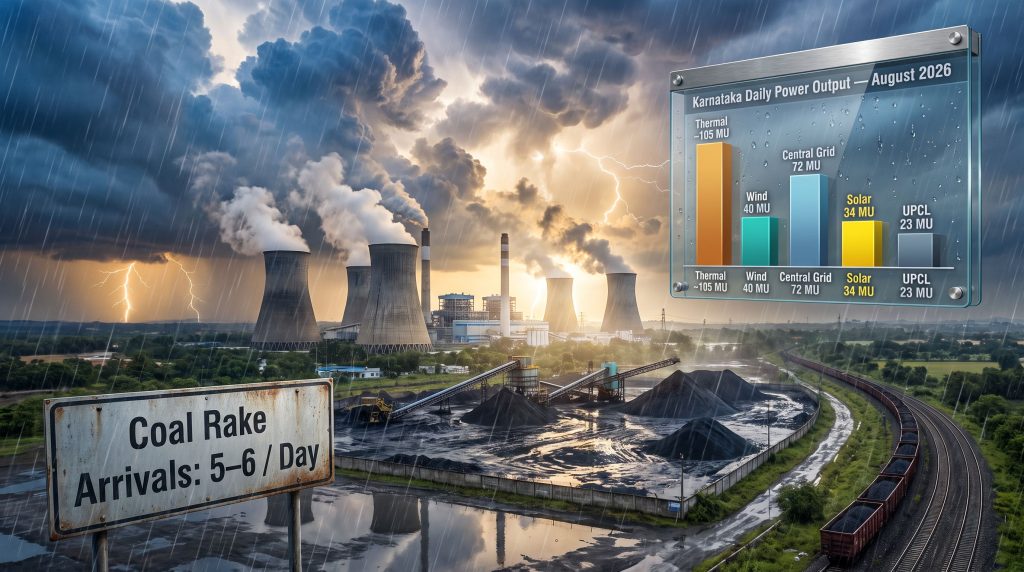
To appreciate the scale of the challenge, consider the daily generation figures recorded at the peak of the August 2026 disruption. Karnataka's three coal-fired thermal stations were collectively producing approximately 105 million units (MU) of electricity per day, representing the single largest contribution to the state's daily power supply. No other generation source came close.
| Source | Daily Output (MU) | Role in Grid |
|---|---|---|
| Thermal Power Stations (3 plants) | ~105 MU | Primary baseload supplier |
| Central Grid Allocation | 72 MU | Supplementary federal support |
| Wind Power | 40 MU | Weather-dependent renewable |
| Solar Power | 34 MU | Daytime peak shaver |
| Udupi Power Corporation (UPCL) | 23 MU | Private sector contribution |
| Hydropower | Reduced (seasonal) | Monsoon-dependent; below capacity |
Wind contributed 40 MU and solar added 34 MU, but both are intermittent by nature. The central grid allocation of 72 MU provided meaningful support, yet this figure reflects allocated entitlements rather than a flexible buffer that can be increased on short notice. Udupi Power Corporation's contribution of 23 MU rounded out the picture.
The critical insight is that with hydropower still ramping up after the delayed 2026 monsoon onset, there was no readily available generation asset capable of substituting for thermal output if coal supply faltered. These dynamics also reflect wider energy export challenges that are reshaping how nations think about fuel security and supply chain resilience.
Why Thermal Plants Cannot Be Quickly Replaced During Monsoon Transitions
Coal-fired boilers operate within specific combustion parameters. Unlike gas turbines, they cannot be quickly cycled up or down in response to fuel supply fluctuations, and the quality of the coal entering the boiler directly affects plant efficiency, emissions output, and equipment longevity. This technical rigidity means that any disruption to coal supply is not simply a fuel procurement problem — it is an operational problem that propagates through the entire generation system.
Hydropower stations, by contrast, can theoretically respond to dispatch signals within minutes, but they require sufficient water in storage behind their dams. When reservoir inflows are still building during early monsoon, operators must manage drawdown carefully to avoid depleting reserves needed for later in the season. This constraint removes hydropower as a reliable short-term backup precisely when coal supply is most vulnerable.
What Is Causing the Karnataka Coal Supply Disruption Due to Rain?
The mechanics of the disruption are worth examining in detail because they reveal how a single weather event creates cascading failures across multiple systems simultaneously.
The Three Compounding Failure Points
Heavy monsoon rainfall across Telangana and parts of Maharashtra triggered three distinct disruption pathways that converged to reduce Karnataka's coal intake by more than half:
-
Mining site saturation: Open-cut coal extraction in these regions becomes unsafe and operationally impractical when mining floors accumulate standing water. Equipment mobility is restricted, blast patterns are disrupted, and extraction rates fall sharply. This is not merely a matter of worker discomfort; waterlogged overburden becomes unstable in ways that create genuine safety risks.
-
Stockpile moisture contamination: Surface coal reserves held at mine heads absorb rainfall, increasing moisture content and reducing calorific value. In thermal power generation, the energy content of coal is measured in kilocalories per kilogram, and even a modest increase in moisture content can meaningfully reduce the amount of electricity generated per tonne burned. This phenomenon, operationally described as wet coal performance degradation, forces plant operators to either burn more fuel to achieve the same output or accept reduced generation efficiency.
-
Rail corridor disruption: Flooded rail lines, waterlogged ballast, and compromised track conditions reduce the frequency and reliability of coal rake movements. Rail is the dominant mode of inter-state coal transport in India, and there is no practical substitute for bulk coal movement at the volumes thermal power stations require.
The Coal Rake Collapse: From 11 to 5–6 Per Day
The most striking single metric from the August 2026 event is the collapse in coal rake deliveries. Under normal operating conditions, Karnataka receives approximately 11 coal rakes per day across its thermal stations. During the height of the disruption, this figure fell to just 5 to 6 rakes per day, according to KPCL officials, representing a reduction of more than 50% in daily fuel intake capacity.
This level of supply compression is not a minor operational inconvenience. At 11 rakes per day, Karnataka's thermal stations can maintain generation at design capacity while gradually rebuilding stockpile buffers. At 5 to 6 rakes, operators are drawing down existing reserves with no meaningful replenishment, creating a countdown scenario where the available coal buffer shrinks daily until supply recovers.
Plant-Level Impacts Across Karnataka's Thermal Stations
| Power Station | Location | Reported Impact |
|---|---|---|
| Raichur Thermal Power Station (RTPS) | Raichur | Multiple units affected; coal blending protocols activated |
| Ballari Thermal Power Station (BTPS) | Ballari | Two of three units reported shut during peak disruption |
| Yermarus Thermal Power Station (YTPS) | Raichur district | One unit undergoing scheduled annual maintenance; additional disruption reported |
How Serious Is Karnataka's Power Shortfall?
The demand side of this equation complicates the picture considerably. Karnataka's daily electricity consumption was approaching 300 million units per day during the disruption period, a level more typical of peak summer than early monsoon season.
The Agricultural Demand Paradox
The explanation lies in the delayed onset of the 2026 southwest monsoon. When rains arrive late, farmers face a difficult decision: without adequate soil moisture, standing crops face stress or failure. To protect their investment, they keep irrigation pumpsets running for extended periods beyond the dates when natural rainfall would normally have taken over.
These agricultural electrical loads are enormous in aggregate across Karnataka's farming districts, and they kept grid demand elevated at near-summer levels well into August. This creates a scenario that energy planners describe as a demand-supply double bind. Independent reporting during the period indicated Karnataka was experiencing a daily power shortfall in the range of 1,500 to 2,000 MW, with wet coal and reduced unit availability at thermal stations identified as primary contributing factors.
Why Hydropower Cannot Immediately Compensate
Reservoir-based hydropower stations operate on inflow dynamics that introduce an inherent lag into their generation ramp-up. Even after heavy rainfall commences, it takes time for catchment runoff to reach reservoirs, for water levels to rise to generation-viable thresholds, and for operators to begin increasing discharge through turbines. During this lag period, which in Karnataka's geography can extend several weeks into the monsoon season, thermal plants remain the only reliable dispatchable generation resource available at scale.
How KPCL Is Managing the Disruption
Coal Blending as a Front-Line Operational Response
The primary technical mitigation deployed at Karnataka's thermal stations during the disruption involves a practice known as coal blending. This involves combining freshly received coal from the disrupted supply chain — which carries elevated moisture content and reduced calorific value — with older stockpile material that has dried over time.
KPCL's Managing Director Rajendra Cholan confirmed that blending newly received coal with existing reserves is standard operational practice at Raichur Thermal Power Station. He noted that coal held in stockpiles for extended periods experiences gradual calorific value degradation, making the combination of fresh and aged stock a continuous discipline rather than an emergency response. During supply disruptions, however, the urgency of this practice intensifies considerably.
Steps in KPCL's Coal Blending Protocol
-
Assess the moisture content and calorific value of incoming coal deliveries from disrupted supply corridors.
-
Identify stockpile segments with the highest residual energy density, typically material stored in covered or partially protected conditions.
-
Calculate optimal blending ratios to sustain minimum combustion efficiency thresholds across operating boiler units.
-
Monitor combustion performance in real time and adjust blending proportions as stockpile composition evolves.
-
Escalate procurement of additional rake allocations through Coal India subsidiary channels if stockpile drawdown exceeds predetermined trigger thresholds.
Pre-Monsoon Stockpiling: A Buffer, Not a Solution
Anticipating both the delayed monsoon and the sustained demand environment it would create, Karnataka's government proactively accumulated coal reserves at its thermal stations ahead of the season. This foresight has provided a meaningful buffer against the supply disruption, buying time for rail corridors to recover and mining operations to resume normal extraction rates.
However, pre-positioned stockpiles are a finite resource. If daily rake deliveries do not recover to levels approaching 11 per day within a reasonable timeframe, the buffer will erode to a point where generation continuity becomes genuinely uncertain.
The next major ASX story will hit our subscribers first
What This Disruption Reveals About India's Coal Logistics Vulnerability
Structural Weaknesses in India's Inter-State Coal Supply Chain
The Karnataka situation reflects a set of systemic vulnerabilities that affect multiple coal-dependent Indian states. Consequently, the following structural weaknesses warrant urgent attention:
-
India's thermal power sector relies overwhelmingly on rail transport for inter-state coal movement, with virtually no redundant logistics pathways available during flood events.
-
Surface stockpile storage at mine heads across Telangana and Maharashtra lacks adequate weatherproofing infrastructure, leaving substantial coal volumes exposed to moisture degradation during monsoon season.
-
Many major thermal power stations are located in states geographically and logistically distant from primary coal production basins, meaning supply chains cross multiple state boundaries and climate zones.
-
Real-time coordination between Coal India subsidiaries, railway operators, and state electricity utilities during extreme weather events remains operationally immature, with no standardised rapid-response protocol to prioritise allocations during disruption periods.
The Renewable Energy Gap During Monsoon Peaks
Solar generation is effectively unavailable during heavy monsoon cloud cover, which is precisely when coal logistics disruptions tend to be at their worst. Wind power output is variable and cannot be dispatched on demand. Battery storage capacity in Karnataka's grid remains insufficient to bridge multi-day generation shortfalls.
This combination means that for the foreseeable future, thermal coal retains an indispensable role as the only reliably dispatchable baseload resource available to Karnataka's grid operators. The global steel demand outlook and broader industrial energy consumption patterns further reinforce why coal demand is unlikely to contract as quickly as some forecasts suggest.
Karnataka's Long-Term Energy Resilience: Strategic Questions
The Case for Weather-Resilient Coal Infrastructure
In the near term, the most practical investment Karnataka's power sector can make is in weatherproofing coal storage infrastructure at thermal station sites. Covered or enclosed stockpile facilities would significantly reduce moisture uptake during rain events, preserving calorific value and reducing the operational burden on blending protocols.
Similarly, investment in dedicated coal logistics monitoring systems could provide earlier warning of supply corridor disruptions, allowing utilities to pre-position additional reserves before rake deliveries fall to critical levels.
Karnataka's Renewable Capacity: Current State
| Renewable Source | Current Contribution (Aug 2026) | Strategic Role |
|---|---|---|
| Solar | ~34 MU/day | Daytime demand management |
| Wind | ~40 MU/day | Seasonal supplement |
| Hydropower | Below seasonal capacity | Primary monsoon-season source when available |
| Thermal (coal) | ~105 MU/day | Indispensable baseload, no near-term replacement |
The data is unambiguous. Even with meaningful solar and wind contributions, thermal coal accounts for roughly 38% of Karnataka's total daily electricity supply when central grid allocations and private sector sources are included in the denominator. Until battery storage technology reaches grid-scale viability at competitive cost, coal will remain the foundation of the state's electricity security.
In addition, the evolving dynamics of steel and iron ore markets illustrate how energy inputs like coal remain tightly coupled to industrial production cycles, further underlining the strategic importance of supply chain resilience.
Demand-Side Management as an Underutilised Tool
One dimension of the Karnataka power challenge that deserves greater policy attention is demand-side management for agricultural electricity consumption. Irrigation pumpsets represent a large, concentrated, and relatively schedulable load. Programmes that incentivise farmers to shift pumping activity to periods of lower grid stress, or that provide more accurate monsoon forecasting to inform irrigation scheduling decisions, could meaningfully reduce peak demand during the critical early-monsoon window when supply-demand mismatches are most acute.
Furthermore, as India's energy transition minerals agenda accelerates, building more adaptive and weather-resilient grid infrastructure will become increasingly important alongside the expansion of renewable capacity.
Frequently Asked Questions: Karnataka Coal Supply Disruption Due to Rain
What caused the Karnataka coal supply disruption in August 2026?
Heavy monsoon rainfall across mining regions in Telangana and parts of Maharashtra simultaneously slowed open-cut extraction, degraded surface stockpile quality through moisture saturation, and impaired rail transport corridors, reducing coal rake deliveries to Karnataka's thermal stations by more than half compared to normal operating levels.
Which thermal stations were most affected?
Raichur Thermal Power Station, Ballari Thermal Power Station, and Yermarus Thermal Power Station all experienced varying degrees of impact. Ballari reportedly saw two of its three units shut during the peak disruption period, while Yermarus had one unit already offline for scheduled annual maintenance.
How many coal rakes does Karnataka normally receive per day?
Under normal conditions, approximately 11 coal rakes per day arrive at Karnataka's thermal stations. During the August 2026 disruption, this dropped to 5 to 6 rakes per day, a reduction exceeding 50%.
What is coal blending and why does it matter during supply disruptions?
Coal blending is the practice of combining coal from different stockpile batches to achieve a consistent calorific value and maintain stable boiler combustion. During disruptions when incoming coal carries elevated moisture content, blending with drier stockpile material preserves generation efficiency and reduces the risk of boiler performance degradation. KPCL confirmed this practice was actively deployed at Raichur Thermal Power Station during the August 2026 event.
Is there an immediate risk of power cuts in Karnataka?
KPCL officials indicated that existing coal stockpiles provide a near-term buffer, and blending protocols have been activated to sustain output. However, the risk of load management measures escalates materially if fresh rake deliveries do not recover and hydropower reservoir inflows remain insufficient to meaningfully supplement thermal generation.
Why did electricity demand remain so high during monsoon season?
The delayed onset of the 2026 southwest monsoon meant irrigation pumpsets continued operating at near-peak levels to protect standing crops. This agricultural load kept daily electricity consumption close to 300 MU, a level more characteristic of summer peak season, at precisely the time coal supply was most constrained.
Key Takeaways
-
The Karnataka coal supply disruption due to rain in August 2026 illustrates how monsoon weather simultaneously compresses fuel supply and elevates electricity demand, creating a dual-stress scenario that pre-positioned stockpiles can buffer but not fully resolve.
-
A greater than 50% decline in daily coal rake arrivals represents a severe operational test for KPCL's fuel management systems, and the resilience demonstrated through proactive stockpiling and blending protocols offers a model for other state utilities facing similar seasonal risks.
-
Coal blending is a technically sophisticated and underappreciated operational discipline that plays a central role in maintaining generation continuity when supply quality and quantity are both compromised.
-
The structural vulnerabilities exposed by this event — including rail logistics concentration, inadequate stockpile weatherproofing, and the absence of real-time inter-agency coordination protocols — are shared across multiple Indian states and represent a systemic policy challenge requiring coordinated investment.
-
Until renewable capacity with reliable dispatchability reaches sufficient scale, thermal coal will remain the indispensable backbone of Karnataka's electricity security, making the resilience of its coal supply chain a matter of direct public interest.
Readers seeking further context on India's coal supply chain dynamics and state-level power sector management can explore related coverage via ET EnergyWorld's coal and power sections, which provides detailed ongoing reporting on fuel supply and grid management across Indian states. Additional data on thermal generation performance metrics is available through the Central Electricity Authority of India, which publishes daily generation and fuel stock reports for the country's major power stations.
Want to Stay Ahead of the Next Major ASX Energy Discovery?
Discovery Alert's proprietary Discovery IQ model delivers real-time alerts the moment significant mineral discoveries — including energy commodities central to coal and thermal power supply chains — are announced on the ASX, translating complex data across 30+ commodities into clear, actionable insights. Explore how historic discoveries have generated substantial returns and begin your 14-day free trial today to position yourself ahead of the broader market.