July 28, 2026
Global aluminum supply chains face unprecedented vulnerability through concentrated dependencies on strategic maritime corridors. When critical shipping routes experience disruption, the ripple effects cascade far beyond regional markets, transforming localized geopolitical tensions into worldwide commodity shocks that test the resilience of industrial supply networks. Furthermore, the Strait of Hormuz aluminum supply disruption demonstrates how single chokepoints can trigger cascading effects across multiple industries.
The aluminum industry's reliance on narrow waterways creates systematic risks that compound during periods of international instability. Understanding these vulnerabilities requires examining how geographic chokepoints function as control mechanisms over global trade flows, where single-point failures can trigger market dislocations affecting millions of tons of production capacity.
The Persian Gulf's Strategic Aluminum Corridor
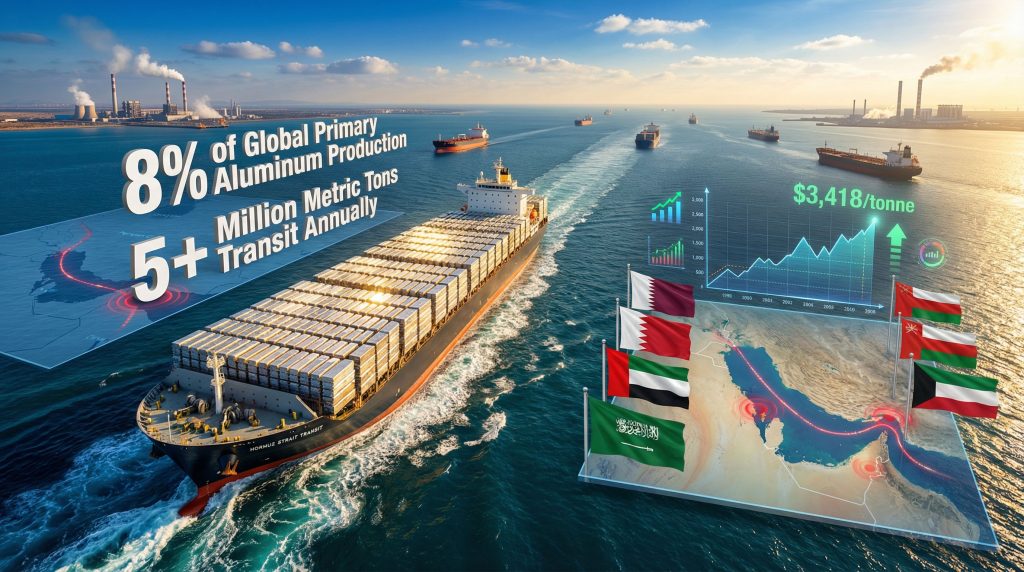
The narrow waterway connecting the Persian Gulf to international waters represents far more than a regional shipping lane. This maritime passage facilitates the movement of approximately 5 million metric tons of aluminum and related raw materials annually, establishing it as a critical nerve center for global aluminum supply chains.
Critical Trade Flow Dependencies:
- Over 75% of Gulf Cooperation Council aluminum exports depend on this single corridor
- 21 million barrels per day of crude oil and petroleum products transit alongside aluminum shipments
- Essential feedstock imports including alumina, petroleum coke, and coal tar pitch flow through the same route
The concentration of smelting capacity within the Persian Gulf region amplifies these dependencies. Aluminum Bahrain operates one of the world's largest primary aluminum smelters outside China, with 1.5 million metric tons of annual capacity. Qatar's Qatalum facility adds another 648,000 metric tons annually, while Iranian facilities contribute an additional 400,000+ metric tons to regional production.
This geographic clustering creates a scenario where approximately 2.548 million metric tons of annual aluminum production capacity relies on a single maritime exit point. The implications extend beyond simple logistics, as regional smelters depend heavily on imported raw materials that flow through the same constrained corridor.
Energy Infrastructure Vulnerabilities
The aluminum-energy nexus creates compounding vulnerabilities during corridor disruptions. Qatalum's operations depend entirely on natural gas feedstock, linking aluminum production directly to Qatar's energy infrastructure. Moreover, the natural gas trends 2025 show how volatile energy markets can impact aluminum production costs significantly.
When gas supply chains face disruption, smelter operations cannot continue regardless of aluminum demand levels. This energy dependency demonstrates how strategic chokepoints affect multiple industrial layers simultaneously.
The same corridor that blocks aluminum exports also constrains energy flows essential for aluminum production, creating a double-impact scenario that extends recovery timelines significantly.
When big ASX news breaks, our subscribers know first
Geopolitical Tensions and Supply Chain Amplification
Regional conflicts transform into global supply disruptions through established market mechanisms that amplify localized instabilities. The Strait of Hormuz aluminum supply disruption exemplifies how geopolitical tensions cascade through interconnected supply networks, creating impacts far exceeding the geographic scope of the original conflict.
Production Capacity Risk Assessment:
| Facility | Annual Capacity (MT) | Disruption Impact | Recovery Timeline |
|---|---|---|---|
| Aluminum Bahrain (ALBA) | 1,500,000 | Export blockade; production continues | 2-4 weeks |
| Qatar's Qatalum | 648,000 | Complete shutdown; gas supply cut | 6-12 months |
| Iranian facilities | 400,000+ | Sanctions plus transit disruption | Indefinite |
Force Majeure Declarations and Market Signals
When major producers declare force majeure on supply contracts, financial markets interpret these actions as early indicators of extended supply shortages. ALBA's announcement specifically cited shipping disruptions through the strategic corridor, clarifying that smelter operations continued but export capabilities had ceased entirely.
This distinction between production capacity and export capability represents a critical market dynamic during chokepoint disruptions. Facilities maintain operational status while inventory accumulates at source locations, reducing available production slots for new orders and creating artificial scarcity in destination markets.
The cascading impact follows predictable patterns:
- Immediate inventory accumulation at affected facilities reduces effective production capacity
- Raw material inflow disruptions affect smelter feed rates within 1-2 weeks
- Alternative routing costs add $45-50 per metric ton surcharges for available alternative pathways
Supply Network Stress Points
European markets face particular vulnerability due to existing supply constraints from reduced Russian imports. The additional disruption of Gulf supplies creates a compound supply shortage requiring immediate alternative sourcing strategies. With inventories already operating at reduced levels, industry observers note that prolonged Gulf shipping disruptions could intensify price volatility and supply pressures across aluminum markets.
Asian markets experience different stress patterns, primarily through increased freight costs and extended transit times. Alternative routing through the Cape of Good Hope adds 10-15 days to standard shipping schedules while imposing significant freight premium increases on available supply.
Financial Market Response Mechanisms
Aluminum markets demonstrate characteristic response patterns during supply disruptions, with price discovery mechanisms reflecting both immediate scarcity and forward-looking supply expectations. The London Metal Exchange serves as the primary price discovery mechanism, where supply disruption information typically incorporates into pricing within 24-48 hours of major announcements.
Documented Price Movement Timeline:
- Day 1-3: Price escalation to $3,418 per metric ton (highest level since April 2022)
- Baseline comparison: Approximately 31% increase from pre-disruption levels
- Forward projections: Analyst estimates reaching $3,600-4,000 per metric ton under extended disruption scenarios
Additionally, the oil price rally analysis indicates that energy sector pressures contribute significantly to these elevated aluminum prices.
Premium Structure Transformation
Regional premium structures undergo rapid transformation as supply certainties evaporate and alternative sourcing becomes necessary. Standard regional premiums of $50-100 per metric ton above LME cash prices escalate to $150-250 per metric ton, representing 100-150% premium increases within days of disruption announcements.
Premium Escalation Patterns by Region:
- European markets: Immediate premium pressure due to 20% supply dependency on affected regions
- Asian markets: Freight cost increases drive premium escalation through alternative routing requirements
- North American markets: Domestic production constraints amplify import premium sensitivity
Trading Volume and Volatility Indicators
Financial markets typically exhibit increased trading volumes during supply disruption events as market participants adjust positions and hedge risk exposures. The contango structure (future prices higher than spot) steepens to 2-3% monthly premiums compared to historical ranges of 0.5-1%, reflecting market expectations of temporary supply deficits followed by eventual normalisation.
Implied volatility in aluminum options markets increases substantially during disruption periods, reflecting uncertainty premiums as traders price in extended periods of supply chain instability and price fluctuation potential.
Energy Sector Interconnections and Compound Effects
The strategic corridor carries approximately 90% of Persian Gulf energy exports, creating compound effects that extend far beyond direct aluminum shipments. When the same waterway that blocks aluminum exports also constrains crude oil and natural gas flows, the resulting energy price increases affect aluminum production costs globally.
Critical Energy Flow Statistics:
- 21 million barrels per day of crude oil and petroleum products
- 20% of global oil and LNG typically transit through the corridor
- 94% reduction in tanker traffic observed during peak tension periods between February 28 and March 1
Production Cost Escalation Mechanisms
Crude oil plays an essential role in aluminum industry operations through multiple pathways. Mining equipment, alumina refining processes, logistics operations, and power generation in oil-dependent regions all experience cost increases when crude prices escalate. These cost pressures compound supply-side constraints by making aluminum production more expensive even where capacity remains available.
European nations including Belgium, Greece, Italy, Spain, and Poland rely on the strategic corridor for oil and LNG imports, representing approximately 15% of European trade flows. When these energy supplies face disruption, European aluminum smelters experience both higher energy costs and potential energy supply constraints simultaneously.
Iranian Energy Export Dependencies
Iran exported $7.7 billion worth of crude and petroleum oils in 2025, primarily to the UAE, China, Oman, Afghanistan, Pakistan, and India. Natural gas exports valued at approximately $1.02 billion primarily served Iraq and Turkey. These energy flows through the same corridor that handles aluminum exports create interdependencies that amplify disruption impacts across multiple commodity sectors.
The concentration of energy exports through a single corridor means that geopolitical tensions affecting aluminum trade simultaneously disrupt energy markets. Consequently, this creates feedback loops that extend disruption duration and intensity beyond what single-sector analysis would predict.
Alternative Transportation Strategies and Economic Constraints
When primary maritime routes become unavailable, aluminum shipments must utilise alternative pathways that impose significant cost and time penalties. The economic viability of these alternatives determines whether supply disruptions remain temporary inconveniences or evolve into extended market dislocations.
Land-Based Rerouting Options:
- Red Sea ports (Jeddah, King Abdullah Port): $45-50 per metric ton additional costs
- Cape of Good Hope routing: 10-15 days additional transit time plus freight premiums
- Air transport: Economically unfeasible for bulk aluminum shipments
Pipeline Infrastructure Limitations
While energy products benefit from pipeline alternatives, aluminum shipments cannot utilise these bypass systems. Saudi Arabia's East-West Pipeline carries approximately 5 million barrels per day from Abqaiq to Yanbu, while the UAE's Abu Dhabi Crude Oil Pipeline handles roughly 1.5 million barrels per day. Iran's Goreh-Jask Pipeline provides 300,000-350,000 barrels per day capacity through the Gulf of Oman.
However, the combined capacity of these alternatives remains insufficient to handle total corridor flows, and aluminum products cannot utilise petroleum pipeline infrastructure. This fundamental limitation means aluminum supply chains lack the backup systems available to energy markets.
Insurance and Risk Premium Impacts
Maritime insurance rates experience dramatic escalation during geopolitical crises, creating additional cost pressures beyond direct logistics challenges. War risk premiums increase substantially for vessels transiting affected regions, while cargo coverage availability becomes more restrictive.
Insurance Impact Factors:
- War risk premiums: 25-40% rate increases for affected routes
- Cargo coverage limitations: Reduced availability of comprehensive coverage policies
- Alternative route requirements: Mandatory rerouting clauses increase operational complexity
Regional Production and Trade Flow Redistributions
Supply disruptions force rapid restructuring of global aluminum trade patterns as buyers seek alternative sources and sellers adapt to changed logistics realities. European markets, already constrained by reduced Russian aluminum imports, face compound supply pressures requiring immediate sourcing strategy modifications.
Trade Flow Adjustment Patterns:
- South American sourcing increases: Higher freight costs but reliable supply chains
- North American market integration: Domestic production prioritisation over exports
- Asian market competition intensification: Premium bidding wars for available supply
Strategic Inventory Management Responses
Industry participants implement strategic inventory adjustments to buffer supply chain uncertainties. Companies accelerate inventory accumulation beyond normal safety stock levels while simultaneously activating force majeure clauses in supply contracts where applicable.
Corporate Response Strategies:
- Immediate inventory expansion: Safety stock increases of 20-30% above normal levels
- Contract renegotiation: Force majeure clause activation across supply chains
- Alternative supplier qualification: Expedited vendor approval and relationship development
These inventory buildups create additional demand pressure on available supply sources, amplifying price increases beyond what pure supply reduction would suggest. The psychological component of supply security concerns drives purchasing behaviour that exceeds immediate consumption requirements.
The next major ASX story will hit our subscribers first
Technology and Supply Chain Visibility Enhancement
Crisis scenarios accelerate adoption of supply chain management technologies as companies seek enhanced visibility and alternative routing capabilities. Real-time tracking systems, predictive analytics, and dynamic logistics optimisation become critical competitive advantages during disruption periods.
Technology Integration Priorities:
- Real-time tracking systems: Comprehensive supply chain monitoring across multiple transportation modes
- Predictive analytics: Early warning systems for disruption scenario identification
- Alternative route optimisation: Dynamic logistics planning capabilities for rapid response
Furthermore, the global resources expo 2025 showcases emerging technologies that could help mitigate future supply chain vulnerabilities.
Investment in Resilience Infrastructure
Long-term supply chain resilience requires infrastructure investments that reduce dependency on single chokepoints. Companies increasingly evaluate geographic diversification strategies, multi-modal transportation capabilities, and strategic inventory positioning in key markets.
Resilience Framework Elements:
- Multi-regional supplier networks: Reducing single-point-of-failure risks through geographic distribution
- Strategic inventory positioning: Pre-positioned stock in key consumption markets
- Alternative transportation modes: Rail and road backup systems for critical supply routes
Investment Strategy Implications and Market Psychology
Supply chain disruptions create immediate investment imperatives for aluminum industry participants across the value chain. Capital allocation priorities shift toward supply chain resilience investments, alternative supplier development, and inventory infrastructure expansion.
Strategic Investment Areas:
- Inventory infrastructure: Expanded storage and distribution capabilities in key markets
- Alternative supplier development: Relationship building and supplier qualification investments
- Technology systems: Enhanced supply chain visibility and management platforms
Market Psychology and Risk Perception
Investor psychology during supply disruptions demonstrates characteristic patterns of risk aversion and safe-haven seeking behaviour. Market participants increase risk premiums for companies with concentrated supply chain dependencies while rewarding those with diversified sourcing strategies.
Behavioural Finance Patterns:
- Flight to quality: Preference for companies with proven supply chain resilience
- Inventory premium valuation: Companies with strategic stockpiles receive valuation premiums
- Geographic diversification rewards: Market recognition of supply chain risk mitigation strategies
The psychological component of supply security extends beyond rational economic calculations, as market participants factor worst-case scenarios into decision-making processes even when statistical probabilities suggest limited likelihood of extended disruptions.
Regulatory Frameworks and Compliance Challenges
Geopolitical disruptions create complex regulatory environments that companies must navigate while maintaining operational continuity. Sanctions frameworks, documentation requirements, and compliance obligations evolve rapidly during crisis periods, adding administrative complexity to supply chain management challenges.
Regulatory Challenge Areas:
- Sanctions navigation: Evolving regulatory landscapes require constant monitoring and compliance updates
- Documentation requirements: Enhanced security and origin verification procedures
- Alternative supplier qualification: Accelerated due diligence processes under time pressure
The global tariff impacts demonstrate how trade policy changes can compound supply chain disruption effects across multiple sectors.
Emergency Regulatory Responses
Government agencies often implement emergency measures during supply chain crises, including expedited permitting for alternative transportation routes, temporary regulatory relief for affected industries, and strategic stockpile releases to stabilise markets.
These regulatory responses can significantly influence disruption duration and market impact severity, making government policy monitoring an essential component of supply chain risk management during crisis periods. In addition, government intervention measures often play crucial roles in stabilising commodity markets during major disruptions.
Future Preparedness and Strategic Planning Frameworks
The Strait of Hormuz aluminum supply disruption provides valuable insights for developing comprehensive supply chain resilience strategies. Organizations that successfully navigate such disruptions typically demonstrate superior preparedness across multiple dimensions including supplier diversification, inventory management, and alternative routing capabilities.
Preparedness Framework Components:
- Scenario planning: Regular assessment of disruption scenarios and response strategies
- Supplier diversification: Geographic and political risk distribution across supply networks
- Inventory optimisation: Balance between carrying costs and supply security requirements
- Technology integration: Systems capable of rapid response to changing logistics requirements
Long-Term Structural Adaptations
Industries that experience repeated supply chain disruptions often undergo structural adaptations that reduce future vulnerability. These adaptations include capacity development in stable political jurisdictions, infrastructure investments in alternative transportation corridors, and supply chain architecture modifications that eliminate single points of failure.
The aluminum industry's response to current disruptions will likely influence long-term strategic planning as companies balance cost efficiency with supply chain resilience. Organizations that successfully integrate these considerations into their operational strategies will be better positioned to maintain competitive advantages during future disruption events.
As global aluminum demand continues expanding, particularly in renewable energy and electric vehicle applications, supply chain resilience becomes increasingly critical for maintaining market position and customer relationships. The lessons learned from strategic chokepoint disruptions will shape industry development for years to come, influencing everything from facility location decisions to supplier relationship strategies.
Investment decisions should always consider multiple risk factors and market conditions. Supply chain disruptions represent one element of comprehensive risk assessment, and historical patterns may not predict future market behaviour with certainty.
Looking to Navigate Volatile Commodity Markets?
Discovery Alert's proprietary Discovery IQ model delivers real-time alerts on significant ASX mineral discoveries, instantly empowering subscribers to identify actionable opportunities when supply disruptions create market volatility. Begin your 14-day free trial at Discovery Alert today and secure your market-leading advantage during these uncertain commodity cycles.