July 28, 2026
The Structural Vulnerability That Changed Everything
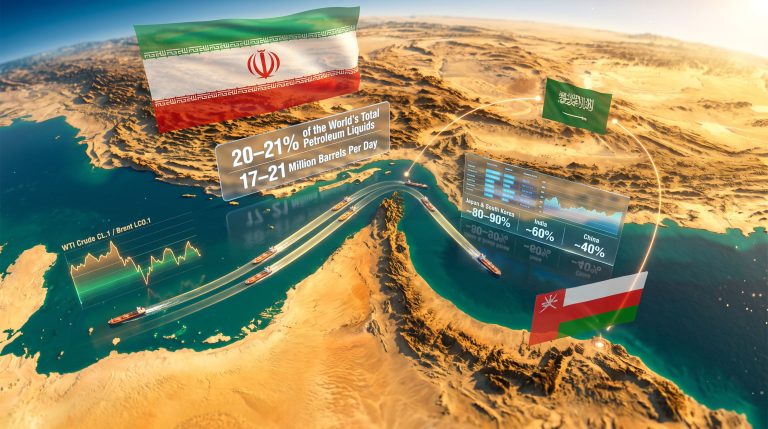
For most of the past decade, energy security analysts warned that India's LPG supply architecture carried a hidden fragility. Nearly all of the country's imported cooking gas flowed through a single maritime corridor — the Persian Gulf — and out through the Strait of Hormuz, a narrow waterway where roughly 20% of the world's traded oil and gas passes daily. The risk was well understood in policy circles. What was less understood was how quickly it could materialise.
The answer arrived in early 2026. Conflict involving Iran triggered the closure of the Strait of Hormuz, and within weeks, India LPG imports from US became a central topic in emergency energy planning. The government invoked emergency protocols to redirect industrial petrochemical feedstocks toward household cooking gas. Consumption fell sharply, imports collapsed, and energy policymakers were left confronting a structural question they could no longer defer: what does a genuinely diversified LPG supply base look like?
The answer, increasingly, points toward the United States.
When big ASX news breaks, our subscribers know first
How Badly Did the Hormuz Closure Hit India's LPG Market?
The scale of the disruption was significant by any measure. India's LPG imports fell by approximately 28% in the first half of 2026, dropping to around 7.5 million metric tons compared to the prior year period. Consumption over the same window declined by roughly 8% year-on-year, settling at approximately 14.7 million metric tons. For the full calendar year, India's LPG consumption is forecast to reach only 30 million metric tons, down from approximately 31 million metric tons in 2025.
To understand why these numbers are politically significant, it helps to know how LPG functions within India's social infrastructure. Unlike in many developed markets where LPG is primarily an industrial or commercial fuel, in India it serves as the primary cooking fuel for hundreds of millions of households. This includes a large share of low-income and rural consumers who rely on subsidised cylinders distributed through state-owned downstream companies. Supply interruptions translate directly into kitchen-level shortages for families with no immediate alternative.
This social dimension explains why the government's response was so rapid and why the strategic rethink that followed was so comprehensive.
India's LPG Import Dependency: The Pre-Crisis Baseline
Before the 2026 disruption, India's sourcing profile looked like this:
| Metric | Figure |
|---|---|
| Total LPG imports (2025) | ~21.85 million metric tons |
| Share sourced from West Asia (2025) | ~90% |
| Imports as share of total LPG consumption | ~66% |
| US LPG share of India imports (pre-2026) | Below 5% |
This level of geographic concentration is exceptional even by the standards of large emerging market energy importers. A 90% supplier concentration from a single region, routed through a single strait, is a textbook example of single-point-of-failure supply chain design. The 2026 disruption did not create this vulnerability. It simply made it undeniable.
Why the United States Is India's Chosen Diversification Partner
The pivot toward the United States as a primary LPG source is driven by two distinct but mutually reinforcing forces: structural supply capability and diplomatic necessity.
On the supply side, the United States has undergone a remarkable transformation in its LPG export capacity over the past decade. As a byproduct of the shale gas revolution, US propane and butane production has grown substantially, creating a large and competitively priced export surplus centred on Gulf Coast terminals. Furthermore, unlike Gulf producers, US LPG export capacity is not constrained by any single transit chokepoint. Understanding how tariffs reshape trade flows helps contextualise why such supply diversification carries strategic weight beyond pure economics.
On the diplomatic side, the US-India trade relationship has entered a period of intense negotiation. Washington has pressed New Delhi to reduce its trade surplus with the United States, and expanded energy purchases have emerged as the most immediate and scalable mechanism for achieving visible progress. The broader US trade tensions impact across Asia has accelerated New Delhi's urgency to secure bilateral energy agreements. India has formally committed to increasing US energy purchases by $10 billion to $25 billion in the near term, with both governments targeting $500 billion in bilateral trade by 2030.
Junior oil minister Suresh Gopi informed parliament that the diversification of LPG imports is being actively pursued as a supply security measure, designed to reduce exposure to the kind of regional disruptions and geopolitical events that caused the 2026 shortage. (Source: ET EnergyWorld, July 28, 2026)
This framing is important. It positions the US LPG shift not as a crisis workaround but as a permanent policy realignment — one that would persist even if Gulf supply routes fully normalise.
Record-Breaking Import Volumes: The 2026 Baseline
India's US LPG procurement is not waiting for 2027 to begin. According to recent reporting on India's LPG import surge, the acceleration through 2026 has already produced historically significant numbers:
- A structured one-year term contract for approximately 2.2 million metric tons of US LPG was signed for 2026
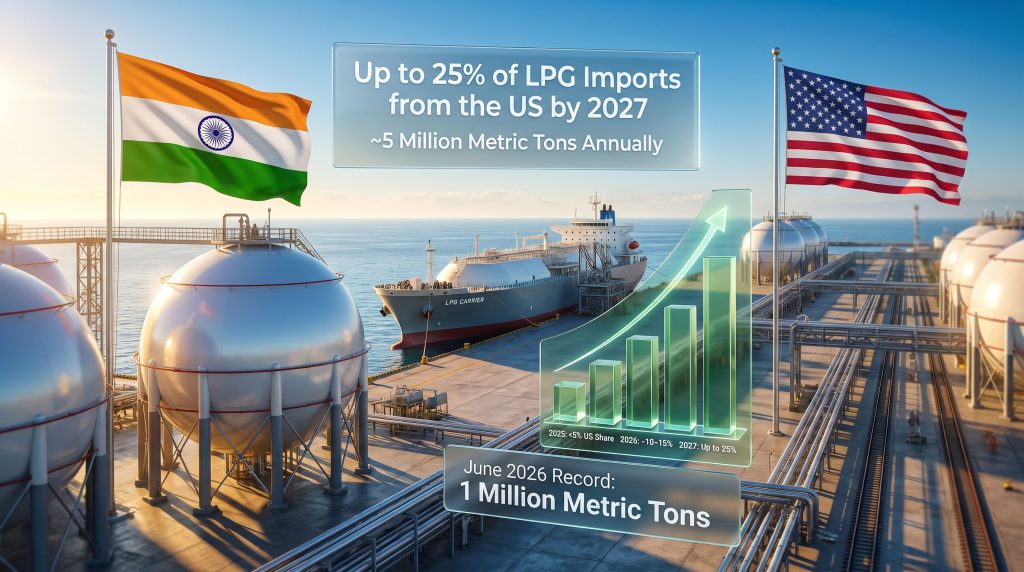
- US LPG deliveries to India surpassed 1 million metric tons in June 2026, a single-month record and the first time India received more than 1 million metric tons from any non-Gulf supplier in a single month
- May 2026 imports from the US reached approximately 648,300 metric tons, with June volumes estimated at 1.1 to 1.2 million metric tons, nearly doubling in a single month
- Full-year 2026 US LPG imports are expected to exceed the 2.2 million metric ton contracted target
- The United States became India's leading LPG supplier in May 2026, displacing Gulf producers for the first time on record
The June milestone deserves particular emphasis. Crossing the 1 million metric ton threshold in a single month from a supplier that barely registered in India's import data before 2024 is a structural inflection point, not merely a statistical outlier.
The 2027 Target: Scaling US LPG to 25% of India's Import Basket
Procurement Timeline and Tender Mechanics
India's three major state-owned downstream refiners are preparing to execute a major procurement expansion for 2027. Indian Oil Corporation (IOC), Bharat Petroleum Corporation (BPCL), and Hindustan Petroleum Corporation (HPCL) are expected to issue formal tenders for US LPG supplies within one to two months. A delegation from all three companies is also anticipated to travel to the United States to engage directly with American suppliers on sourcing frameworks.
The scale of the 2027 ambition is substantial:
- India is targeting up to 25% of its total LPG imports from the US by 2027
- Based on projected 2027 import volumes of approximately 20 million metric tons, a 25% share equates to roughly 5 million metric tons of annual US LPG procurement
- This would represent more than a doubling of the 2026 contracted volume of 2.2 million metric tons
Forward-Looking Demand and Supply Projections
| Year | Projected LPG Consumption | Projected LPG Imports | US Share Target |
|---|---|---|---|
| 2025 (actual) | ~31 million metric tons | ~21.85 million metric tons | Below 5% |
| 2026 (forecast) | ~30 million metric tons | ~15-16 million metric tons | ~10-15% |
| 2027 (forecast) | ~31 million metric tons | ~20 million metric tons | Up to 25% |
The recovery trajectory for 2027 assumes that alternative supply routes are progressively secured and that West Asian flows partially normalise. However, even in a normalisation scenario, India's stated policy is to maintain a structurally higher US share rather than revert to pre-crisis concentration levels.
The Freight Premium Problem: Is the Cost Trade-Off Rational?
One of the less commonly discussed dimensions of India's US LPG pivot is the freight cost penalty it entails. The shipping distance between US Gulf Coast export terminals and Indian receiving ports is roughly 18,000 to 20,000 kilometres, compared to 3,000 to 5,000 kilometres from Gulf producers. Transit times extend from 7 to 14 days on Gulf routes to 25 to 35 days on US routes.
| Dimension | US LPG | Gulf LPG |
|---|---|---|
| Shipping distance to India | ~18,000-20,000 km | ~3,000-5,000 km |
| Transit time | ~25-35 days | ~7-14 days |
| Geopolitical risk | Low | Elevated |
| Supply reliability (2026) | High | Disrupted |
| Trade policy alignment | Supports US-India deficit reduction | Neutral |
The freight premium is real, and it has historically made US LPG economically uncompetitive against Gulf supplies for Indian buyers. However, the 2026 disruption recalibrated this calculus in a fundamental way. The true cost of Gulf dependency — measured in emergency feedstock diversions, consumption shortfalls, and political exposure — proved vastly greater than any freight differential. These commodity price impacts ripple across interconnected markets in ways that simple freight-cost analysis consistently underestimates.
There is also a less visible factor that sophisticated energy buyers are beginning to quantify: inventory and buffer stock implications. Longer transit times require buyers to hold larger buffer stocks to maintain supply continuity, which adds warehousing costs. However, having supply arriving from geographically diversified origins simultaneously creates a natural inventory cushion that single-source procurement cannot replicate.
The next major ASX story will hit our subscribers first
India's Emerging Role as a Global LPG Swing Buyer
A dimension of this story that receives insufficient attention is how India's procurement shift changes its role within global LPG markets. Historically, India has been a price-taker in LPG trading, absorbing supply at prices set largely by Saudi Contract Price (Saudi CP) benchmarks that Gulf producers anchor to their own production economics.
As India moves toward sourcing 5 million metric tons annually from the United States, its purchasing decisions begin to carry meaningful weight in the US propane and butane export market. US LPG is typically priced against Mont Belvieu benchmark pricing, which reflects domestic shale gas processing economics rather than Gulf production costs. India buying at scale in this market introduces a new source of demand pressure that can influence US export pricing.
More broadly, India is transitioning from a passive absorber of Gulf-priced LPG to an active participant across multiple pricing benchmarks simultaneously. This dual-market exposure gives Indian state refiners greater negotiating leverage than they have historically possessed — a shift in market power that will compound as the US share grows.
The Trade Deal Clock: Why Timing Matters
The LPG procurement timeline aligns closely with a separate but related deadline. India is reportedly targeting completion of a bilateral trade agreement with Washington within three to four months. In this context, the tender process expected within the next one to two months carries diplomatic weight that extends well beyond its commercial value.
Visible, large-scale energy procurement commitments serve as tangible evidence of India's seriousness about reducing the trade surplus that has been a central US grievance. Furthermore, India's LNG import tax structure similarly reflects how New Delhi is using energy policy as a diplomatic instrument across multiple fuel types. With LPG tenders expected before trade deal closure, the procurement signals institutional intent to American negotiators at precisely the moment when such signals carry maximum value.
This intersection of energy security policy and trade diplomacy is not accidental. It reflects a calculated approach by New Delhi to use energy purchasing as a multi-functional instrument — simultaneously addressing supply vulnerability, reducing bilateral trade friction, and creating commercial relationships with US suppliers that are difficult to unwind regardless of how geopolitical conditions evolve.
What This Means for Gulf LPG Producers
The implications for Saudi Arabia, the UAE, and Qatar are significant but nuanced. India is not abandoning Gulf LPG. The geographic proximity and existing infrastructure relationships mean Gulf suppliers will retain a substantial share of India's import basket. However, a 25% US share in 2027 represents a structural reduction in Gulf leverage that producers with long memories of India's near-total dependence will note carefully.
For Gulf producers, the risk is not immediate volume loss but pricing power erosion. When India can credibly threaten to shift procurement toward US suppliers, it gains negotiating leverage in Saudi CP-linked contract negotiations that it previously lacked. The more developed India's US LPG supply relationships become, the more competitive pressure Gulf producers face to offer terms that retain Indian custom.
Monitoring oil price trends alongside LPG benchmark movements will be essential for tracking how this competitive pressure evolves through 2026 and into 2027. This dynamic — subtle but consequential — may prove to be one of the more durable effects of the 2026 supply disruption.
Key Facts at a Glance
- India sourced approximately 90% of LPG imports from West Asia in 2025, creating acute Hormuz corridor dependency
- The 2026 Strait of Hormuz closure triggered a 28% decline in LPG imports and an 8% fall in consumption in H1 2026
- US LPG deliveries reached a monthly record of over 1 million metric tons in June 2026
- India contracted approximately 2.2 million metric tons of US LPG under a 2026 term agreement, with full-year volumes expected to exceed that target
- State refiners IOC, BPCL, and HPCL will issue 2027 US LPG tenders within one to two months
- India's 2027 US LPG target of up to 25% of total imports equates to approximately 5 million metric tons annually
- India has pledged to increase US energy purchases by $10 billion to $25 billion, with a bilateral trade target of $500 billion by 2030
- The US became India's top LPG supplier in May 2026, the first time a non-Gulf nation held that position on record
Disclaimer: Forward-looking projections, import volume forecasts, and trade timeline estimates referenced in this article are drawn from provisional government data and industry sources as reported by Reuters and ET EnergyWorld. These figures are subject to revision as conditions evolve. Nothing in this article constitutes financial or investment advice.
Want To Stay Ahead of the Commodity Shifts Reshaping Global Energy Markets?
Discovery Alert's proprietary Discovery IQ model delivers real-time alerts on significant ASX mineral discoveries, instantly translating complex commodity data into actionable investment insights — explore historic discoveries and their market returns to understand the scale of opportunity, then begin your 14-day free trial at Discovery Alert to position yourself ahead of the broader market.