July 28, 2026
## The Hidden Architecture of Global Sulphur Trade and Why India's Policy Shift Changes Everything
The India sulphur export halt highlights how a little-discussed commodity can suddenly become central to global food security. Sulphur underpins fertiliser production, so when a major market redirects supply inward, the effects spread quickly through acid production, phosphate markets, shipping flows, and farm input prices across several continents.
India's decision in July 2026 to halt sulphur exports is not merely a trade restriction. Rather, it signals how governments are increasingly treating essential agricultural inputs with the same strategic urgency seen in energy policy, resource security, and even defence planning.
## Why Sulphur Sits at the Core of India's Food Security Calculus
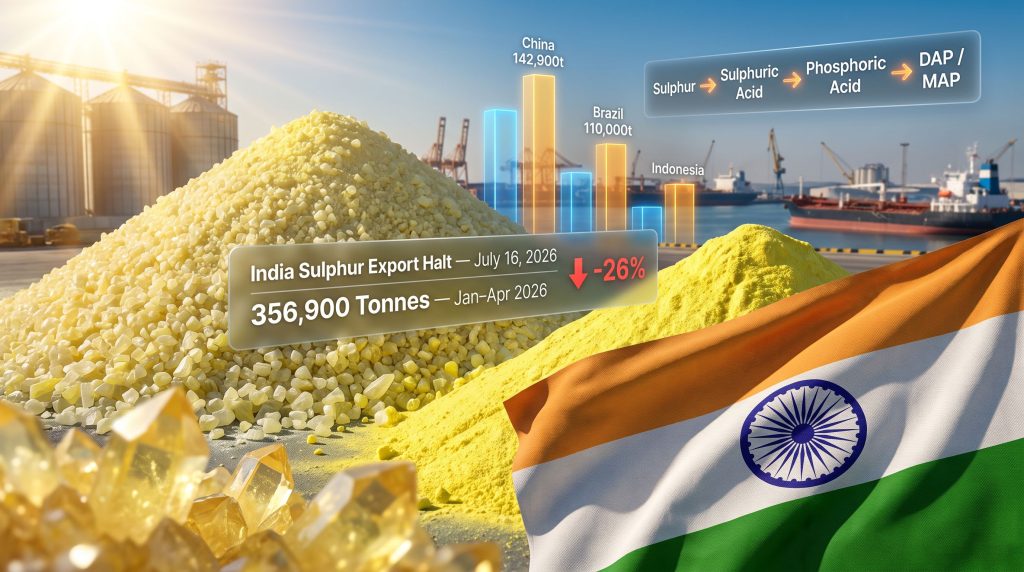
To understand the move, it helps to follow the production chain. Elemental sulphur is used to make sulphuric acid. Sulphuric acid is then needed to process phosphate rock into phosphoric acid, which is essential for fertilisers such as DAP, MAP, and TSP.
Consequently, a shortage at the sulphur stage multiplies through the system:
- Reduced sulphur limits sulphuric acid production
- Lower acid output constrains phosphoric acid manufacture
- That, in turn, tightens DAP and MAP supply
- Fertiliser shortages then raise costs for farmers and importers
India imported 2.25 million tonnes of sulphur in 2025, with about 84% coming from the Middle East. However, the effective closure of the Strait of Hormuz disrupted this flow. Imports fell by 26% year-on-year to 698,200 tonnes in January-May 2026, according to Argus Media reporting.
Faced with falling imports and ongoing domestic fertiliser demand, policymakers had to choose between export earnings and food security. In addition, this decision fits a wider pattern of countries reassessing commodity exposure amid rising geopolitical risk and trade war economic impact.
## The Regulatory Timeline: From Industry Petition to Nationwide Directive
The path to restriction was fast but structured. Each phase shows how policy can tighten before formal paperwork appears.
- April 2026: The Gujarat Chamber of Commerce and Industry requested at least a six-month export ban.
- April-May 2026: Major producers began redirecting sulphur to domestic buyers before a formal order arrived.
- May 2026: Export shipments effectively dropped to zero.
- July 16, 2026: A national directive instructed refiners and traders to stop taking new export contracts.
“The absence of formal published documentation is a deliberate feature, not an oversight.” That insight matters because an informal directive gives the government flexibility to amend or reverse policy quickly, without formally repealing a published order.
Furthermore, this softer mechanism creates uncertainty for traders. They know supply has tightened, yet they do not know exactly when, or under what conditions, normal exports might resume.
## India's Paradoxical Trade Structure: A Net Importer That Also Exports
India is both a major sulphur importer and a meaningful exporter. That seems contradictory at first. However, the explanation lies in its refining system. Sulphur is produced as a by-product of crude oil refining, so refiners can export surplus volumes even while the country remains structurally import-dependent.
The scale of disruption is clear:
- 2025 imports: 2.25 million tonnes
- Middle East share: ~84%
- Jan-Apr 2026 exports: 356,900 tonnes
- Exports to China: 142,900 tonnes
- Exports to Brazil: 110,000 tonnes
- Normal annual exports: roughly 800,000 tonnes
Reliance Industries is the main private exporter, usually loading from Bedi port. As a result, the India sulphur export halt removes a notable source of seaborne supply from already stressed global markets. Public trade data from the World Bank trade database also helps illustrate India's unusual position in regional sulphur flows.
### What is India's sulphur export halt?
It is a policy directive issued on July 16, 2026 telling Indian refiners and traders to stop signing new sulphur export contracts and divert available supply into a domestic allocation framework. The trigger was a sharp import decline caused by Middle East disruption and mounting pressure from India's fertiliser sector.
## The Structural Shock Beneath the Surface: Strait of Hormuz and Kazakhstan
India's restriction did not emerge in isolation. Instead, it was a response to overlapping supply shocks.
The first was the Strait of Hormuz disruption. Since most of India's sulphur imports depend on Middle Eastern supply, any closure of that route immediately creates a structural problem, not just a short-term price spike.
The second was the loss of accessible Kazakh sulphur, which had been viewed as a useful alternative source. With both corridors constrained, the global seaborne market lost flexibility.
These pressures were already visible downstream. OCP, the Moroccan phosphate producer, reportedly operated at only about 50% of capacity through June 2026 because of sulphur shortages. Although it secured enough material for July and August, inventory security remained fragile.
In parallel, wider export restrictions elsewhere have compounded the squeeze. For instance, reports on sulphuric acid export pressures suggest the market is increasingly sensitive not only to elemental sulphur but also to derivative products.
## How the Domestic Allocation Mechanism Works
India's model is simple in principle:
- The ministry directs refiners and traders
- New export bookings stop immediately
- Existing commitments are reviewed
- Available sulphur is placed into a domestic priority pool
- Fertiliser manufacturers receive supply first
- Exports remain frozen until inventories improve
Compared with China's licensing regime, India's approach is more flexible. China relies on documented export controls, while India has chosen a less formal method. Therefore, the practical impact may be similar, but the predictability is not.
That distinction also sits within a broader movement towards industrial strategy, similar to policymaking seen in the EU metals action plan and other commodity security measures.
## Downstream Fertiliser Markets: Who Bears the Greatest Exposure?
The biggest risks are concentrated among former Indian buyers and major phosphate producers.
- China: high exposure
- Brazil: moderate to high exposure
- Indonesia: moderate exposure
- Global phosphate producers: high exposure
Pakistan offers a clear case of downstream stress. DAP inventories rose by 48,000 tonnes in June 2026 to 268,000 tonnes, yet demand dropped to only 48,000 tonnes. That was far below the five-year June average of 122,000 tonnes.
The explanation was price. Ex-Karachi DAP stayed above Rs15,000 per 50kg bag, a level seen as too expensive for many farmers. Consequently, buyers shifted towards cheaper substitutes such as SSP and nitrophos blends.
Industry participants now expect Pakistan's full-year 2026 DAP demand to remain below 1 million tonnes, about 35% lower than the 2021-2025 annual average. This shows how the India sulphur export halt can translate into measurable agricultural consequences far beyond India itself.
Brazil is also vulnerable. As one of the world's largest fertiliser importers, it depends on smooth global supply chains. In addition, tighter sulphur availability adds pressure to phosphate costs already affected by global commodity tariffs.
## The Sulphuric Acid Extension Risk
A growing concern is whether India could extend restrictions from elemental sulphur to sulphuric acid. No formal proposal has been confirmed. However, market participants are watching the risk closely.
Reasons for concern include:
- The current directive sets a policy precedent
- China already applies sulphuric acid export controls
- Domestic fertiliser producers consume both sulphur and acid
- The same protection logic could apply downstream
Therefore, even without an official announcement, precautionary pricing is already influencing market sentiment. The issue also links to broader resource security themes found in critical minerals demand and strategic inputs for industrial systems.
## Scenario Analysis: How Long Could the Restriction Last?
Several paths are possible for the India sulphur export halt:
- Base case: Restrictions are lifted within six months if Hormuz traffic partially normalises
- Extended case: Restrictions continue through 2026-2027 if import channels stay disrupted
- Escalation case: Controls spread to sulphuric acid, intensifying phosphate market stress
Much depends on geopolitics rather than domestic Indian production alone. Similarly, this is why supply-side developments are increasingly being analysed alongside sectors covered in the global crude steel outlook, where strategic raw material reliability has become equally important.
## Key Facts at a Glance
- Trigger date: July 16, 2026
- Mechanism: informal directive
- Main affected exporter: Reliance Industries
- Jan-Apr 2026 exports: 356,900 tonnes
- Largest buyer hit: China
- Import decline: 26% year-on-year
- Root cause: Hormuz disruption and conflict escalation
- Duration: open-ended
- Extension risk: possible, but unconfirmed
## Frequently Asked Questions
### What triggered India's decision to halt sulphur exports?
A mix of shrinking imports, Middle East shipping disruption, and pressure from domestic fertiliser producers pushed India to prioritise local supply over exports.
### Which company is most affected?
Reliance Industries is the largest private-sector sulphur exporter in India, so it is expected to be the most directly affected by the export freeze.
### Will this affect fertiliser prices globally?
Yes. Because sulphur sits at the front of the phosphate fertiliser chain, reduced availability supports firmer prices for DAP, MAP, and TSP, especially in import-dependent markets.
### How does India's approach differ from China's?
China uses formal licensing controls. India, by contrast, has acted through an informal directive, creating more policy flexibility but less certainty for market participants.
Want to Track the Commodity Discoveries That Could Benefit From Supply Shocks Like This?
When geopolitical disruptions reshape global supply chains for sulphur, phosphates, and agricultural inputs, early-mover advantage matters enormously. Discovery Alert's proprietary Discovery IQ model delivers real-time alerts on significant ASX mineral discoveries — instantly identifying actionable opportunities across 30+ commodities before the broader market reacts. Explore historic discovery returns on Discovery Alert's discoveries page and begin your 14-day free trial today to position yourself ahead of the next major market shift.