July 28, 2026
When the World's Swing Buyer Steps Back: India's Thermal Coal Import Collapse and What It Means for Global Markets
Few forces reshape commodity markets more durably than when a dominant swing buyer shifts from price-responsive volume absorption to structural self-sufficiency. For the better part of two decades, India occupied exactly that role in seaborne thermal coal trade, providing a reliable demand floor that exporters from Indonesia to South Africa could count on during periods of softness elsewhere in Asia. The data emerging from FY26 suggests that calculation may need to be revisited entirely.
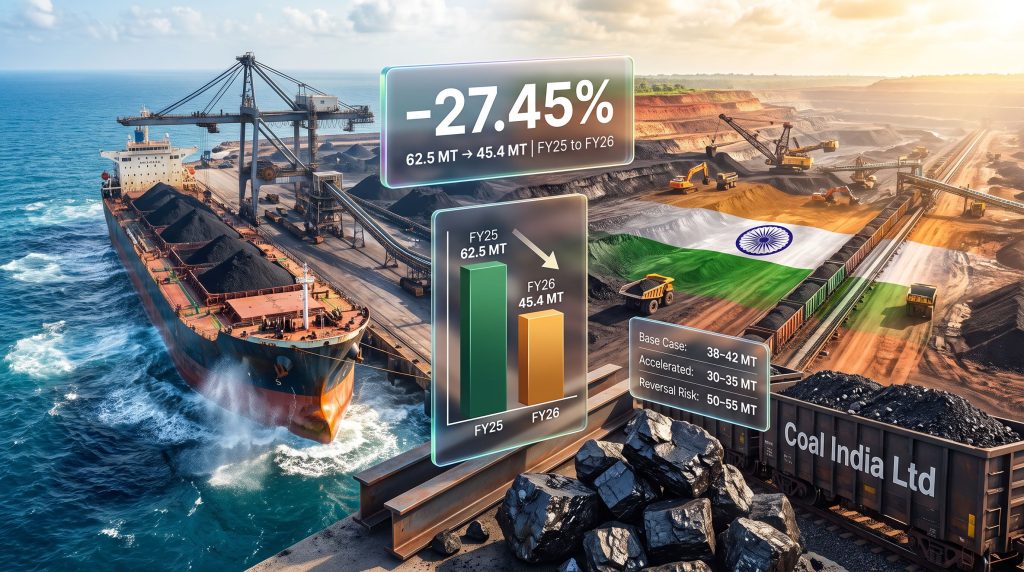
India thermal coal imports fell 27% in FY26, dropping from 62.5 million tonnes (MT) to 45.4 MT across the country's thermal power plant fleet. The scale of this single-year contraction is historically significant, but the more consequential question is not the magnitude of the decline itself. It is whether the forces behind it are durable enough to prevent recovery, and what that means for exporters, pricing benchmarks, and the structure of global seaborne coal trade through the end of the decade.
When big ASX news breaks, our subscribers know first
The Numbers Behind the Shift: FY26 in Statistical Context
Understanding the full picture requires disaggregating the decline across different import categories, because the composition of the fall reveals as much as the headline figure.
| Metric | FY25 | FY26 | Change |
|---|---|---|---|
| Thermal power plant coal imports | 62.5 MT | 45.4 MT | -27.45% |
| ICB plant imports (April comparison) | 3.97 MT | 2.88 MT | -27.45% |
| Dedicated ICB plant total imports (FY26) | ~48.3 MT | ~38.62 MT | -20% YoY |
| Broader non-coking coal imports | ~169 MT | ~160 MT | -5.4% |
The divergence between the 27.45% fall in power-sector thermal coal imports and the comparatively modest 5.4% decline in broader non-coking coal imports is analytically important. It tells us that industrial coal users, such as cement manufacturers and sponge iron producers, have not shifted away from seaborne supply at anywhere near the same pace. The structural transformation is concentrated in the power generation sector, where a combination of policy levers, pricing reform, and logistics investment has created an entirely different supply equation.
Furthermore, independent analysis from Bigmint confirms that non-coking coal imports fell 5% year-on-year in FY26, driven by weak thermal power demand and strong domestic supply, reinforcing the view that the decline is sector-specific rather than economy-wide.
The power sector is bearing the full weight of India's import substitution drive. Industrial coal users remain substantially more exposed to seaborne pricing, meaning the structural story is sector-specific rather than economy-wide.
How Policy Architecture Engineered the Decline
Removing the Floor: Annual Contracted Quantity Reform
One of the least discussed but most consequential reforms driving the decline involves the Annual Contracted Quantity (ACQ) framework. Previously, domestic supply allocations to thermal power plants were capped at 90% of normative requirements for non-coastal plants and 70% for coastal plants. This was not a market outcome. It was a policy-mandated structural floor that guaranteed a minimum level of seaborne demand regardless of domestic availability, pricing, or logistics conditions.
Raising the ACQ ceiling to 100% of normative requirements for eligible plants effectively dismantled this guaranteed import floor. Power generators who had previously been structurally required to source the remaining 10% to 30% of their fuel needs from seaborne markets now had the option, and in many cases the incentive, to source entirely from domestic supply.
The implications for modelling seaborne demand are significant. If a portion of India's import volume was previously policy-mandated rather than economically motivated, then prior import data was structurally inflated relative to what pure market incentives would have produced. Analysts working from historical averages without accounting for this policy floor may have systematically overestimated India's base import demand. These coal supply challenges are explored in broader context across multiple coal-producing regions.
The Revised SHAKTI Policy 2025: Unlocking ICB Plant Substitution
Imported coal-based (ICB) power plants represent one of the more unusual structural features of India's electricity sector. These facilities were designed and built specifically to run on seaborne coal, with combustion systems, material handling infrastructure, and fuel specifications calibrated to the characteristics of imported product. They were, in effect, structurally captive to seaborne markets because they lacked any legal mechanism to access domestic fuel supply agreements.
The Revised SHAKTI Policy of 2025 changed this by extending domestic coal procurement rights to ICB plants for the first time. This is a structurally irreversible shift. Once an ICB plant has a fuel supply agreement with Coal India and has modified its operational protocols to accommodate domestic coal blending, it does not easily revert to pure import dependence. The physical and contractual infrastructure built around domestic supply creates its own lock-in.
Additionally, existing fuel supply agreement holders can now procure volumes beyond their ACQ allocation, provided they have first lifted 100% of their contracted quantities. This tiered incentive structure rewards high-utilisation plants with expanded domestic supply access, further eroding the marginal case for seaborne procurement.
Coal India's Pricing Discipline as a Structural Moat
A less visible but critically important element of India's import substitution story is Coal India Ltd's (CIL) deliberate pricing restraint. The notified price for most CIL coal grades has increased by only ₹20 per tonne over an eight-year period, a level of price stability that would be remarkable in any commodity market, let alone one experiencing the supply expansion pressure that CIL has faced.
This restraint functions as a structural moat against seaborne competition. When domestic landed costs remain stable and predictable, power generators face no incentive to absorb the currency risk, freight volatility, and quality variability associated with seaborne procurement. CIL's conduct through Window-II of the Revised SHAKTI Policy reinforces this further, with three short-term and one long/medium-term auction tranche completed in 2026 through June, enabling plants to secure domestic coal at near-zero premiums across multiple procurement horizons.
The removal of the GST compensation cess has compounded the pricing advantage, reducing the effective landed cost of domestic coal and narrowing or eliminating the historical price competitiveness gap that imported coal previously held for certain plant configurations. However, newsbase reporting on India's thermal coal imports notes that the scale of domestic supply improvement in FY26 was exceptional even by recent historical standards.
The Logistics Transformation: Infrastructure as Policy Instrument
Why Rail Evacuation Was the Hidden Constraint
For much of the past decade, domestic coal's competitive position was undermined not by price but by reliability. Rail evacuation bottlenecks in coal-producing states like Jharkhand, Odisha, and Chhattisgarh meant that even plants with domestic supply entitlements frequently could not receive coal fast enough to maintain target stock levels. Seaborne coal, delivered directly to coastal jetties, offered operational predictability that domestic supply often could not match.
The Ministry of Coal's Integrated Coal Logistics Plan addresses this bottleneck directly through 33 critical railway projects focused on evacuation throughput, alongside an expanded First Mile Connectivity (FMC) infrastructure programme that brings mechanised coal handling directly to mine faces, reducing the delays and losses associated with traditional truck-based movement.
FY30 Infrastructure Targets: The Scale of Ambition
| Infrastructure Target | FY30 Goal |
|---|---|
| FMC projects planned | 139 |
| Combined FMC handling capacity | 1,319 MT |
| Coal PSU railway projects underway | 8 |
The significance of a 1,319 MT FMC handling capacity target is difficult to overstate. India's total coal consumption across all sectors currently runs at roughly 1,000 to 1,100 MT annually. An FMC network capable of processing 1,319 MT would represent infrastructure capacity that substantially exceeds current demand, providing a logistics buffer that eliminates the operational uncertainty that previously made seaborne procurement attractive even when domestic coal was price-competitive.
Greater utilisation of coastal shipping and inland waterways forms the final piece of this logistics transformation, specifically targeting the competitiveness of domestic supply for coastal and river-adjacent plants that currently find seaborne procurement logistically convenient regardless of price.
CoalSETU and the Quality-Driven Import Residual
One analytically underappreciated aspect of India's import dependency involves the quality dimension. Seaborne thermal coal, particularly from Indonesia and Australia, typically offers higher calorific values and lower ash content than the majority of CIL's production. For plants with boiler specifications designed around higher-quality fuel, domestic coal substitution is not simply a matter of sourcing more tonnes. It requires either blending protocols, boiler modifications, or access to washed (beneficiated) domestic coal that matches imported specifications.
The CoalSETU linkage window specifically targets this quality-driven residual import demand by improving the availability of washed coal from domestic producers. Beneficiated domestic coal can meaningfully close the quality gap with seaborne product for many plant types, removing the last technically-grounded justification for import dependence. If CoalSETU scaling proceeds as intended, the import volumes that remain structurally resistant to substitution on quality grounds could contract significantly in FY27 and beyond.
Global Market Implications: Which Exporters Face Structural Exposure?
India's Role as a Price-Sensitive Swing Buyer
India's historical function in seaborne thermal coal markets was that of the price-sensitive swing buyer, a role it shared with smaller Southeast Asian importers but exercised at a volume scale that gave it genuine price influence. During periods of weak Chinese restocking demand or subdued Japanese and Korean purchasing, Indian utilities would typically absorb surplus supply at attractive spot prices, providing the global market with a demand floor that prevented more severe price corrections.
A structural reduction in Indian import demand removes this buffer from the market. The distinction between cyclical and structural demand reduction matters enormously here. A cyclical dip, driven by a monsoon disruption to pit-head production or a temporary domestic logistics failure, would self-correct within one to three quarters. A structural shift embedded in multi-year fuel supply agreements, revised statutory frameworks, and a decade-long infrastructure investment programme does not self-correct. It compounds.
In addition, China commodity demand shifts are simultaneously reshaping regional seaborne trade flows, meaning exporters face pressure from multiple directions at once. Furthermore, global industrial demand trends suggest that the traditional demand anchors underpinning seaborne coal volumes are becoming less reliable across the broader Asian market.
Exporter Exposure by Country
| Exporting Country | Exposure Level | Key Risk Factor |
|---|---|---|
| Indonesia | High | Dominant share of India's thermal import mix; mid-CV grades face direct domestic substitution |
| South Africa | Medium-High | Relied on India as alternative demand after European market exit |
| Australia | Medium | Premium semi-soft and high-CV thermal grades partially insulated |
| Russia | Medium | Post-2022 volume redirection to India faces softening structural demand |
Indonesia faces the most acute near-term exposure for a combination of reasons. It supplied the largest single share of India's thermal coal imports, and the calorific value range of its primary export grades (typically 4,200 to 5,000 kcal/kg GAR) overlaps most directly with the substitution range where CIL's washed and higher-quality domestic production competes.
Australian producers of premium thermal coal in the 6,000+ kcal/kg NAR range retain some insulation from substitution because of the quality specifications of certain ICB plant boiler systems, but even this premium segment is at risk as CoalSETU washed coal availability expands. These broader resource export challenges are already weighing on Australian commodity revenue projections for the period ahead.
South Africa's exposure carries a particularly layered risk. Having already lost significant European thermal coal market share following the energy transition commitments of major European utilities, South African producers redirected volumes eastward, with India absorbing a meaningful portion. A structural decline in Indian demand forecloses one of the few remaining high-volume alternative markets available.
Three Scenarios for India's Import Trajectory to FY30
| Scenario | FY27 Import Estimate | Key Assumption |
|---|---|---|
| Base Case | 38-42 MT | Domestic supply expands on schedule; logistics improvements deliver incremental gains |
| Accelerated Substitution | 30-35 MT | FMC projects complete ahead of schedule; CoalSETU washed coal scales rapidly |
| Reversal Risk | 50-55 MT | Domestic supply disruption, monsoon logistics failure, or demand surge forces emergency procurement |
The reversal risk scenario deserves more attention than it typically receives in market commentary. India's coal-producing states experience significant monsoon-related logistics disruptions every year, with rail line flooding, mine face access restrictions, and reduced truck movement capacity creating temporary domestic supply gaps. In any given quarter, a combination of extreme heat-driven power demand and monsoon logistics stress could force utilities back to the spot seaborne market regardless of structural preferences.
The base case, however, reflects the balance of forces: structural policy architecture, embedded logistics investment, CIL pricing discipline, and the irreversibility of SHAKTI Policy-driven supply agreement commitments all point toward a sustained downward trajectory for import volumes over the medium term.
The next major ASX story will hit our subscribers first
A Critical Distinction: Import Reduction Is Not Coal Phase-Down
One of the most important analytical errors to avoid when interpreting India's import decline is conflating reduced seaborne dependence with an accelerating transition away from coal. These are fundamentally different phenomena with opposite implications for domestic coal producers, international climate assessments, and energy security planning.
India's coal-fired generation capacity continues to expand in absolute terms. Power demand growth driven by urbanisation, industrial expansion, and rising cooling loads is creating a larger market for coal, not a smaller one. The structural shift is in origin, not volume. Domestic coal consumption is growing; seaborne imports are falling. The two trends are not in conflict. They are the precise outcome that India's coal self-sufficiency policy framework was designed to produce.
This distinction carries significant implications for investors and analysts tracking India's energy transition narrative. Carbon reduction commitments and renewable capacity additions are real and accelerating. But they are occurring alongside, not instead of, continued thermal coal demand growth. The import decline is a supply-sourcing story, not a demand destruction story. Proposed mechanisms such as the India coal trading exchange may further influence how domestic coal pricing and allocation evolve in coming years.
Frequently Asked Questions
Why did India's thermal coal imports fall so sharply in FY26?
The 27.45% decline to 45.4 MT resulted from a convergence of policy reforms: the ACQ ceiling was raised to 100% of normative requirements, eliminating the policy-mandated import floor; the Revised SHAKTI Policy 2025 extended domestic supply access to ICB plants for the first time; coal companies were directed to meet full power purchase agreement requirements irrespective of trigger levels; and CIL's exceptional pricing stability made domestic coal economically superior to seaborne alternatives.
What are imported coal-based (ICB) power plants and why do they matter?
ICB plants are power generation facilities whose design specifications, combustion systems, and fuel handling infrastructure were built around seaborne coal characteristics. Unlike standard thermal plants that can blend domestic and imported coal, ICB plants were historically structurally captive to seaborne markets. The Revised SHAKTI Policy 2025 changed this by granting ICB plants access to domestic fuel supply agreements for the first time, opening a large class of previously import-dependent facilities to substitution.
Is the import decline permanent or could it reverse?
Three factors support structural durability: policy reforms are embedded in multi-year contractual frameworks; the infrastructure investment pipeline extends to FY30 with defined capacity targets; and CIL's pricing discipline is institutionally anchored. However, year-to-year variability remains possible due to monsoon logistics disruptions, domestic supply outages, or extreme weather demand surges. The structural direction is downward; short-term fluctuations in either direction remain plausible.
What does the GST compensation cess removal mean for import competitiveness?
The removal of the GST compensation cess reduced the effective cost of domestic coal to end-users, narrowing the landed cost advantage that seaborne coal previously held for certain coastal plant types. For plants where imported coal was previously competitive on a delivered cost basis despite higher per-tonne prices, the cess removal shifted the economics toward domestic supply, functioning as an indirect import substitution measure through the fiscal system rather than through trade barriers.
How does CoalSETU address quality-driven import demand?
CoalSETU provides a linkage mechanism for washed (beneficiated) domestic coal, which more closely matches the calorific value and ash content specifications of seaborne product. A portion of India's imports were driven not by price but by quality requirements that standard run-of-mine CIL coal could not meet. By expanding washed coal availability domestically, CoalSETU targets this quality-driven residual, which represents the import demand segment most resistant to standard substitution measures.
Readers seeking further context on India's domestic coal sector and power policy developments may find ongoing coverage from ET EnergyWorld at energy.economictimes.indiatimes.com a useful reference for tracking policy implementation and production data.
Want to Know Which ASX Coal and Resource Companies Could Be Affected by Shifting Global Commodity Flows?
Discovery Alert's proprietary Discovery IQ model delivers real-time alerts on significant ASX mineral discoveries, cutting through complex market data to surface actionable opportunities as structural shifts in seaborne commodity trade reshape the investment landscape. Explore how historic mineral discoveries have generated substantial returns and begin your 14-day free trial at Discovery Alert to position yourself ahead of the market.