July 28, 2026
The Hidden Architecture of Oil Price Volatility: How Geopolitical Risk Premiums Are Built and Destroyed
Few forces in global commodity markets operate as swiftly and invisibly as the geopolitical risk premium embedded in crude oil prices. Unlike physical supply disruptions, which take weeks or months to materialise, the fear premium in energy markets is priced in within hours of a threatening headline and unwound just as fast when diplomatic signals emerge. Understanding this mechanism is essential for anyone seeking to interpret why oil prices fall on pause in US strikes on Iran, even when not a single additional barrel has entered global supply.
This dynamic sits at the intersection of financial psychology, physical commodity logistics, and military geopolitics. The current episode involving U.S. military operations targeting Iran offers a rare real-time case study in how these forces interact, and what they reveal about the structural fragility of the global energy system. Furthermore, the interplay between oil trade and geopolitics has rarely been more apparent than in this unfolding situation.
When big ASX news breaks, our subscribers know first
What a Geopolitical Risk Premium Actually Measures
The term geopolitical risk premium is used frequently in energy commentary but rarely explained with precision. At its core, it represents the additional price per barrel that market participants are willing to pay above the level justified by current inventory levels, OPEC production quotas, and demand forecasts. It is a market-implied insurance payment against the possibility of a catastrophic supply disruption.
During periods of active military conflict near major energy corridors, this premium can add $5 to $15 or more per barrel to benchmark crude prices, depending on the perceived severity and proximity of the threat. The calculation is probabilistic: if traders assign a 20% chance of a major chokepoint disruption that would remove several million barrels per day from global markets, the expected cost of that disruption gets folded into current spot prices.
The compression of this premium is not a sign that markets were wrong to price it in. It reflects a genuine shift in the probability distribution of outcomes, even if the underlying geopolitical tensions remain unresolved.
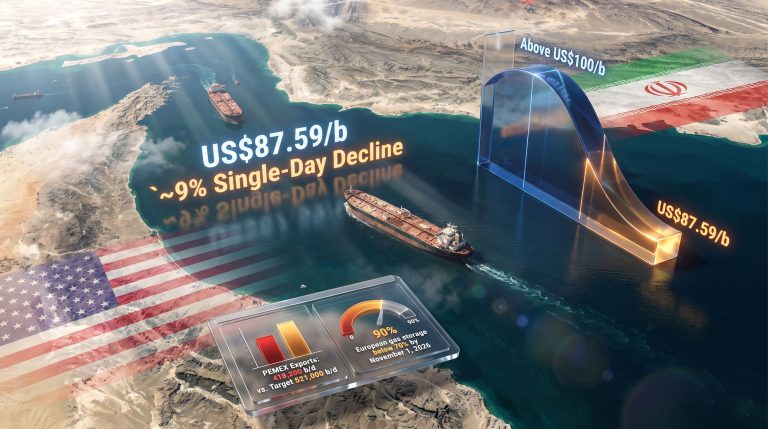
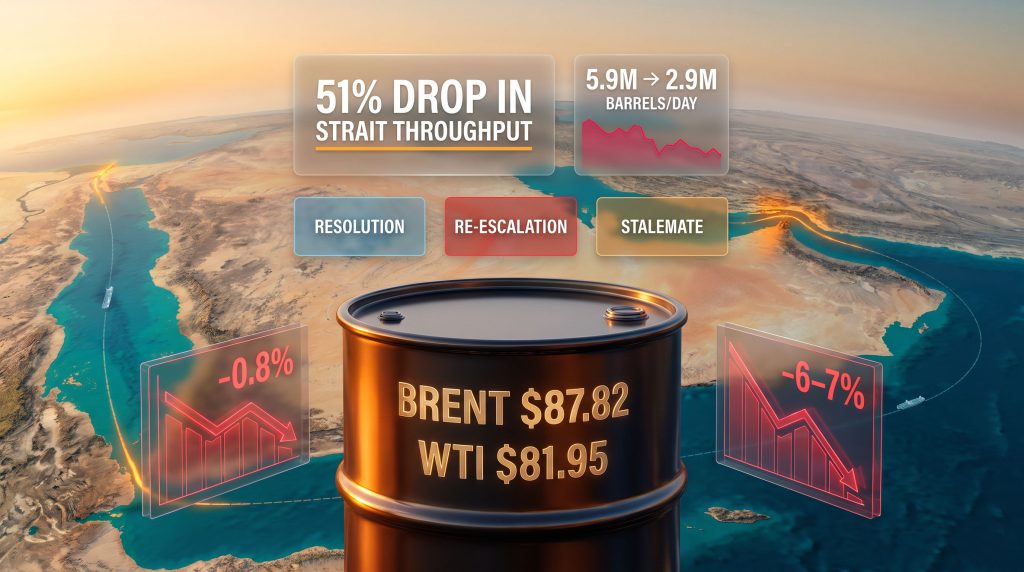
When diplomatic signals emerge, whether a pause in military operations or statements indicating that negotiations are progressing, that probability distribution shifts. The expected cost of disruption falls, the premium compresses, and prices decline. This is exactly the mechanism driving the current episode, where Brent crude futures fell to $87.82 per barrel (down 0.6%) and U.S. West Texas Intermediate dropped to $81.95 per barrel (down 0.8%) following signals that a pause in U.S. strikes on Iran had created conditions for diplomatic engagement.
Both benchmarks had earlier touched their lowest levels in more than a week during the session, with intraday declines reaching approximately 1%. At earlier points during the conflict escalation cycle, oil price volatility trends showed single-session declines of 6% to 7% as diplomatic signals first emerged, illustrating just how violently these premiums can unwind.
The Strait of Hormuz: The World's Most Consequential Energy Chokepoint
No analysis of oil price volatility in a U.S.-Iran conflict context is complete without a thorough understanding of the Strait of Hormuz. This narrow maritime passage, located between Iran and the Musandam Peninsula of Oman, is the single most critical chokepoint in the global energy system. Under normal operating conditions, crude oil and refined product net exports through the strait average approximately 5.9 million barrels per day.
During the current period of heightened military tension, that figure collapsed dramatically. According to analysis from Barclays, in the week ending July 24, 2026, crude oil and refined product net exports through the Strait of Hormuz averaged just 2.9 million barrels per day, compared with 5.9 million in the prior week. That represents a reduction of approximately 51% from baseline volumes.
| Time Period | Strait of Hormuz Throughput | Change from Baseline |
|---|---|---|
| Baseline (pre-escalation) | 5.9 million bbl/day | Reference point |
| Week ending July 24, 2026 | 2.9 million bbl/day | Down approximately 51% |
| Post-diplomatic pause (projected normalisation) | Partial recovery expected | Dependent on negotiation outcomes |
A 51% reduction in Strait of Hormuz throughput is historically extreme. Approximately 20% of all global oil trade passes through this corridor, and the available alternative routing options are severely limited. The East-West Pipeline across Saudi Arabia exists as a partial bypass but carries significantly lower capacity and imposes substantially higher logistics costs on producers and buyers alike.
When the strait is threatened, the physics of global oil supply become brutally apparent: there is no easy detour for the volume of energy that flows through this passage daily.
The Bab el-Mandeb: A Second Chokepoint Risk Enters the Equation
While the Strait of Hormuz commands the most attention, a second chokepoint has been drawn into this conflict's market implications. Yemen-based Houthi forces have explicitly stated an intention to extend maritime disruption strategy to the Bab el-Mandeb Strait, the narrow passage connecting the Red Sea to the Gulf of Aden. Afrah al-Zouba, the foreign minister-designate of Yemen's internationally recognised Saudi-backed government, publicly confirmed that Houthi fighters were aiming to replicate Iran's control of shipping through the Strait of Hormuz at this secondary corridor.
The Bab el-Mandeb carries substantial volumes of global container and energy shipping traffic moving between Asia, Europe, and the Americas via the Suez Canal route. Disruption here forces vessels onto the far longer Cape of Good Hope routing around the southern tip of Africa, adding days to transit times and meaningfully increasing shipping costs and insurance premiums.
Whether Houthi forces possess the military capability to enforce a comprehensive blockade at Bab el-Mandeb is widely regarded by analysts as doubtful, particularly given sustained Saudi Arabian counter-pressure and international naval presence in the region. However, as market commentary from Marex has noted, the military feasibility of a full blockade is somewhat beside the point: even partial disruption through missile threats, drone harassment of commercial vessels, or reputational deterrence is sufficient to reroute traffic and tighten effective global supply availability. The significant reduction in Red Sea traffic already observed confirms that commercial operators are not waiting for the threat to be proved out before adjusting their routing decisions.
Why Chokepoint Disruptions Amplify So Rapidly in Financial Markets
A less commonly understood dynamic in chokepoint economics is the asymmetry between disruption speed and recovery speed. When a major shipping corridor comes under threat, the repricing in crude futures markets occurs almost instantaneously because algorithmic trading systems and risk models immediately adjust probability weightings. Recovery, however, is far slower: shipping operators require multiple confirmed days of safe passage before they resume normal routing, insurers take time to revise Lloyd's of London war-risk premiums, and cargo owners remain cautious even after formal hostilities pause.
This asymmetry means that the actual physical flow recovery from a chokepoint disruption significantly lags the financial market recovery, creating divergences between paper prices and physical supply availability that can persist for weeks. Consequently, understanding the broader impact on oil markets from these compounding pressures is critical for accurate price forecasting.
Demand Destruction: The Force Keeping a Ceiling on Prices
A critical and somewhat counterintuitive factor shaping current crude pricing is the role of demand destruction, particularly across Asian economies. Despite the severity of the supply-side disruption signals, prices have not climbed as high as the raw supply data might suggest. Analysis from Marex identifies demand erosion in Asia as a key structural factor acting as a ceiling on how far benchmarks can rise during this conflict period.
The mechanism is straightforward: when energy prices rise sharply, industrial buyers, transport operators, and petrochemical producers in price-sensitive Asian markets reduce consumption or switch to alternative inputs where possible. This reduction in demand growth offsets some of the supply disruption premium, creating a self-limiting dynamic in oil price escalation.
This demand destruction effect is particularly pronounced in emerging Asian economies, where energy intensity remains high but price elasticity is also significant. It represents a hidden moderating force in the market that does not appear in supply-side data but shows up clearly in import volume statistics and refinery run rates.
| Price Driver | Direction | Mechanism |
|---|---|---|
| Strait of Hormuz disruption | Upward | 51% throughput reduction tightens global supply |
| Diplomatic pause in U.S. strikes | Downward | Risk premium compression |
| Asian demand destruction | Downward | Reduced consumption moderates price ceiling |
| U.S. crude inventory drawdown | Upward | Signals domestic consumption exceeding supply |
| Houthi activity at Bab el-Mandeb | Upward | Secondary chokepoint risk adds uncertainty |
| Distillate inventory build | Slightly downward | Modest bearish signal for middle distillates |
U.S. Inventory Data: The Fundamental Counterweight
Beneath the geopolitical noise, underlying fundamental data continues to exert influence on pricing direction. A preliminary Reuters market poll conducted ahead of official government data releases indicated that U.S. crude oil stockpiles likely declined over the prior week, alongside a probable drawdown in gasoline inventories. Distillate stocks were expected to show a modest build over the same period.
Crude and gasoline drawdowns carry a mildly bullish fundamental signal: they indicate that consumption is outpacing supply replenishment in the world's largest oil market. During a period when diplomatic developments are pushing prices lower through risk premium compression, this underlying inventory tightness provides a partial price floor, limiting how far benchmarks can fall in response to positive diplomatic news.
This is one reason that even with a confirmed diplomatic pause generating a 0.6% to 0.8% benchmark decline, prices have not collapsed to pre-crisis levels. The combination of still-subdued Strait of Hormuz flows, ongoing Houthi activity, and tight U.S. inventories continues to support a floor under current price levels. In addition, OPEC's market influence remains a significant variable in how these supply dynamics ultimately resolve.
The next major ASX story will hit our subscribers first
Three Scenarios for Oil Price Trajectories From Here
Given the acknowledged fluidity of the situation, market participants are currently pricing a probabilistic blend of three distinct outcome pathways. IG analyst Tony Sycamore noted in commentary that while the relief associated with an apparent off-ramp has reduced immediate price pressure and eased concerns around Houthi attacks on Saudi infrastructure, the situation retains significant uncertainty in all directions. Oil prices and trade war dynamics further complicate the outlook, adding another layer of uncertainty for traders attempting to position themselves confidently.
Scenario 1: Diplomatic Resolution
- Strikes formally suspended; a negotiated framework emerges
- Strait of Hormuz throughput recovers progressively toward the 5.9 million bbl/day baseline
- Geopolitical risk premium fully unwinds; Brent likely retreats into the low-to-mid $80s range
- Asian demand destruction partially reverses as price stability reduces consumption deterrence
Scenario 2: Talks Collapse and Strikes Resume
- Negotiations break down; U.S. military operations recommence
- Risk premium re-enters the market rapidly; Brent potentially retests or exceeds recent highs
- Houthi activity at Bab el-Mandeb intensifies, compounding Red Sea shipping disruptions
- Asian demand destruction deepens further as the energy cost burden rises
Scenario 3: Prolonged Stalemate
- Neither resolution nor full escalation materialises; partial military activity continues
- Markets oscillate between risk-on and risk-off positioning on each news cycle
- High intraday volatility persists, with 1% to 5% single-session swings becoming normalised
- Structural supply uncertainty begins feeding into longer-dated futures contracts, steepening the forward curve
The third scenario carries arguably the most complex market implications because it denies traders the clarity they need to position confidently in either direction. Prolonged uncertainty typically forces institutional investors toward aggressive hedging strategies, which can itself amplify volatility through the options market.
Structural Lessons for Energy Security Architecture
Beyond the immediate price movements, the current episode exposes a deeper structural vulnerability in the global energy system. The speed and magnitude of price responses to a single diplomatic statement underscore how heavily the world's energy architecture remains dependent on a small number of Persian Gulf supply corridors operating without disruption.
Energy importing nations, particularly in Asia and Europe, are confronting this reality in real time. The episode strengthens the economic case for several structural shifts:
- Strategic petroleum reserve expansion among major importing nations to provide buffer capacity against future chokepoint disruptions
- Accelerated investment in non-Gulf supply sources, including U.S. shale production, West African producers, and Brazilian deepwater developments
- Shipping route diversification planning at a corporate level, reducing dependence on Red Sea and Hormuz-dependent routing
- Faster energy transition timelines in economies seeking to reduce hydrocarbon import exposure over the medium to long term
None of these structural adaptations happen quickly. In the near term, the global energy system remains exposed to the same chokepoint vulnerabilities that have existed for decades, and the current conflict episode has demonstrated precisely how rapidly those vulnerabilities can translate into market disruption. For a detailed breakdown of how these events unfolded in real time, Reuters reported on the 6% price dip following the initial pause in fighting, which captured the speed of the market's reaction. Furthermore, Yahoo Finance's coverage of the price decline provides additional context on how benchmark crude responded across global trading sessions.
Frequently Asked Questions
Why do oil prices fall when the U.S. pauses strikes on Iran?
A pause in military operations reduces the market-assessed probability of a supply-disrupting escalation. The geopolitical risk premium embedded in prices compresses rapidly when diplomatic signals emerge, causing benchmarks to decline even without any physical change in production volumes. Oil prices fall on pause in US strikes on Iran precisely because markets are pricing the reduced probability of a worst-case supply scenario.
How much did Strait of Hormuz throughput fall during peak disruption?
According to Barclays analysis, crude oil and refined product net exports through the strait fell to approximately 2.9 million barrels per day in the week ending July 24, 2026, compared with 5.9 million the prior week, representing a decline of roughly 51%.
What is demand destruction and why does it matter during a geopolitical crisis?
Demand destruction occurs when elevated energy prices cause buyers to reduce consumption. During the current conflict period, softening Asian demand has acted as a structural ceiling on how high crude benchmarks can rise, partially offsetting the supply-side disruption premium.
What happens to oil prices if U.S.-Iran talks fail?
If diplomatic negotiations collapse and military strikes resume, the geopolitical risk premium would likely re-enter the market rapidly, pushing Brent and WTI benchmarks higher. A return to full escalation threatening Strait of Hormuz shipping could produce sharp upward price movements within a single trading session. However, any sustained recovery would ultimately depend on whether oil prices fall on pause in US strikes on Iran once more, or whether markets are forced to price in a prolonged conflict scenario.
Disclaimer: This article contains forward-looking analysis and scenario projections that involve significant uncertainty. Geopolitical developments are inherently unpredictable, and nothing in this article should be construed as financial or investment advice. Readers should conduct independent research and consult qualified advisors before making any investment decisions.
Want to Stay Ahead of Commodity Market Movements Driven by Geopolitical Shifts?
Discovery Alert's proprietary Discovery IQ model delivers real-time alerts on significant ASX mineral discoveries, transforming complex market signals into actionable investment insights for both short-term traders and long-term investors — explore historic discoveries and their returns to understand the opportunity, then begin your 14-day free trial to position yourself ahead of the market.