July 28, 2026
The Industrial Logic Behind Vertical Integration in Emerging Metal Economies
For decades, the global aluminium industry operated on a straightforward but deeply unequal premise: resource-rich developing nations would extract and partially process raw materials, while higher-value downstream production remained concentrated in industrialised economies. That model is facing structural pressure as countries sitting atop large mineral endowments increasingly recognise the economic gap between exporting alumina and selling finished metal. The difference is not marginal. It is the difference between capturing roughly 15-20% of final product value versus capturing the majority of it.
Vietnam's emergence as a producer of Vietnam primary aluminium ingots sits squarely within this broader industrial transformation. The country has long held one of Southeast Asia's largest bauxite reserves, yet for most of its modern industrial history it exported partially processed material for foreign refiners to convert into finished aluminium. That equation has now fundamentally changed.
When big ASX news breaks, our subscribers know first
Understanding Vietnam's Bauxite Wealth and Why It Took So Long to Monetise
Vietnam's Central Highlands region contains bauxite deposits estimated among the largest in the world. The country ranks consistently in global top-ten lists for bauxite reserve endowment, yet its contribution to finished aluminium output remained negligible until very recently. This disconnect reflects a challenge common across resource-rich developing markets: possessing the raw material is only the first step in a capital-intensive, technically demanding value chain. Global bauxite production data consistently highlights Vietnam as a nation with significant untapped conversion potential.
Completing the full production sequence from bauxite mining through alumina refining to electrolytic aluminium smelting requires:
- Substantial long-term capital commitment, often exceeding USD 1 billion for a single integrated facility
- Reliable, large-scale electricity infrastructure, given that aluminium smelting is among the most energy-intensive industrial processes in existence
- Access to specialised electrolysis technology, typically sourced from a small number of international providers
- Trained industrial workforce capable of operating continuous-process facilities safely
- Downstream market development to absorb domestic output
The Đắk Nông smelter, operated by Tran Hong Quan Metallurgy Co., Ltd., represents an eleven-year construction journey that culminated in the production of the country's first Vietnam primary aluminium ingots at its Nhan Co Industrial Park facility in Lam Dong Province. That timeline itself speaks to the complexity of what has been achieved.
What Are Primary Aluminium Ingots and Why Does the Purity Level Matter?
Primary aluminium ingots are produced through the electrolytic reduction of alumina, a white powder derived from processing bauxite ore through the Bayer process. The resulting aluminium metal is cast into standardised ingot forms for downstream industrial use. Unlike secondary or recycled aluminium, primary ingots begin from virgin ore, delivering consistent chemical composition and reliable mechanical properties.
The three-stage value chain can be summarised as:
- Bauxite mining – raw ore extraction, relatively low value per tonne
- Alumina refining – Bayer process converts bauxite to aluminium oxide, moderate value addition
- Electrolytic smelting – Hall-Héroult process reduces alumina to primary aluminium, highest value capture
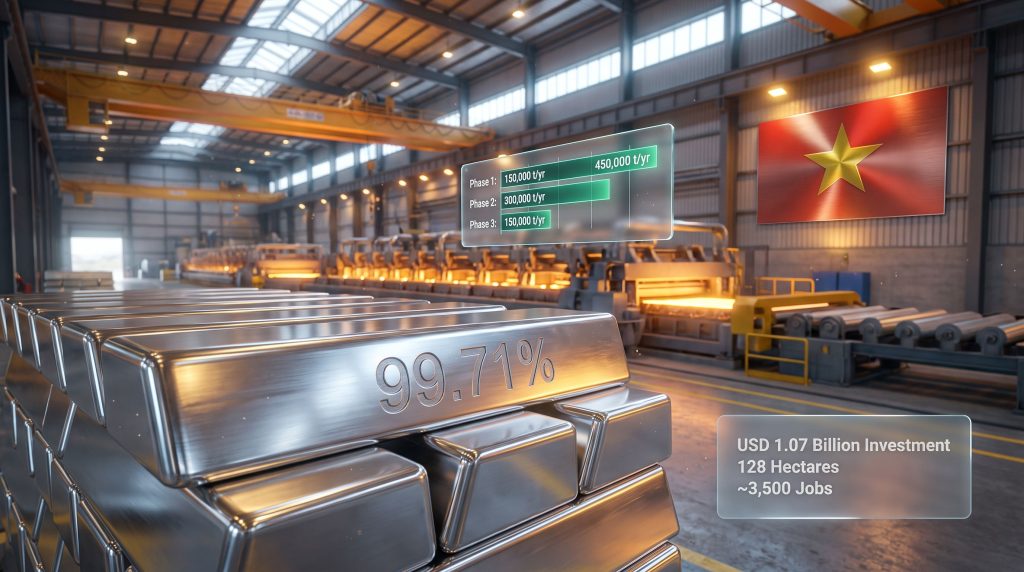
Vietnam's domestically produced ingots have been reported at a purity level of 99.71%, a specification that places them firmly within the high-purity classification used across demanding industrial applications. The table below contextualises this grade against standard industry classifications:
| Purity Grade | Classification | Typical Application |
|---|---|---|
| 99.5% – 99.7% | Standard Grade | Construction, general engineering |
| 99.7% – 99.9% | High Purity | Automotive, electronics, aerospace |
| 99.71% (Vietnam) | High Purity | Domestic manufacturing + export markets |
| 99.9%+ | Super Purity | Specialist industrial and defence |
The 99.71% purity benchmark is significant not merely as a technical specification but as a commercial positioning statement. It signals that Vietnam's domestically produced metal is not positioned as a low-grade commodity competing purely on price. High-purity aluminium commands premium applications and opens access to value-added manufacturing sectors that standard-grade material cannot serve.
Technical Note: One aspect of aluminium purity that is often underappreciated outside the industry is how even marginal differences in trace element composition can affect machinability, corrosion resistance, and surface finish quality. For downstream manufacturers in electronics and aerospace in particular, specifying a high-purity input is not optional — it directly determines product reliability.
The 500-Kiloampere Electrolysis Advantage: Scale, Efficiency, and Output
The Đắk Nông facility employs 500-kiloampere (kA) electrolysis cell technology, a configuration that represents the higher end of modern smelting cell design. Understanding why this matters requires a brief explanation of how aluminium smelting actually works at scale.
In the Hall-Héroult process, aluminium oxide dissolved in molten cryolite is subjected to electrical current, which strips oxygen from the alumina and deposits liquid aluminium at the cell's cathode. The amperage running through each cell determines how much aluminium is produced per unit of time. Higher-amperage cell designs offer several advantages:
- Greater aluminium output per cell, reducing the number of cells needed for a given production target
- Improved energy efficiency per tonne of metal produced, which is critical given electricity's dominant share of operating costs in smelting
- A smaller total physical footprint for equivalent output capacity
- Reduced capital cost per tonne of annual capacity at full scale
State-of-the-art smelters globally have progressively migrated toward higher-amperage designs over recent decades, with the 500 kA range representing current best practice for new greenfield facilities. The choice of this technology for Vietnam's inaugural smelter signals a deliberate decision to build at internationally competitive efficiency standards rather than commission older, lower-amperage technology that would face cost disadvantages over time. Indeed, aluminium power costs represent one of the most critical variables in determining long-run smelter viability.
Capacity Rollout and the USD 1.07 Billion Investment Thesis
The Đắk Nông project represents a total committed investment of approximately VND 28 trillion, equivalent to roughly USD 1.07 billion, spread across a 128-hectare industrial site. The capacity expansion follows a structured three-phase timeline:
| Production Phase | Target Capacity | Expected Timeline |
|---|---|---|
| Phase 1 (Completed) | 150,000 tonnes/year | Operational as of 2026 |
| Phase 2 | 300,000 tonnes/year | End of 2026 |
| Phase 3 | 450,000 tonnes/year | Early 2027 |
The phased approach is strategically rational for several reasons. It allows operational teams to develop process expertise progressively before scaling, enables incremental capital deployment rather than a single front-loaded commitment, and provides time to develop downstream customer relationships that can absorb increasing output volumes.
At full Phase 3 capacity, 450,000 tonnes per year of primary aluminium would make Vietnam a meaningful producer on the global stage. For context, the International Aluminium Institute reports global primary aluminium production at approximately 70 million tonnes annually, meaning Vietnam's full-capacity facility would represent roughly 0.6% of world output, a modest but strategically important share for a nation that previously produced none.
Quantifying the Import Substitution Opportunity
The headline economic case for domestic primary aluminium production is compelling: industry estimates suggest Vietnam could reduce its annual aluminium import expenditure by approximately USD 1.5 billion once the smelter operates at full capacity. This figure deserves careful interpretation.
Strategic Insight: Import substitution arithmetic in aluminium is not simply about replacing volume. It also concerns price formation. Vietnamese manufacturers that have historically purchased aluminium priced against London Metal Exchange benchmarks, plus international freight costs, insurance, and import duties, would gain access to domestically produced material with an entirely different landed cost structure. The margin improvement potential for downstream fabricators could be substantial.
The downstream sectors positioned to benefit span the full breadth of Vietnam's manufacturing economy. Furthermore, Vietnam's first primary aluminium ingot products have already begun distribution, signalling that commercial momentum is building alongside industrial capacity:
| Industry Sector | Aluminium Application | Potential Benefit from Domestic Supply |
|---|---|---|
| Construction | Profiles, cladding, windows | Lower input costs, faster procurement |
| Automotive Manufacturing | Body panels, engine components | Supply chain localisation |
| Electronics | Heat sinks, casings, connectors | Reduced import lead times |
| Renewable Energy | Solar panel frames, wind turbine parts | Supports green energy buildout |
| Aerospace | Structural components | Foundation for higher-value manufacturing |
| Engineering | Machinery, fabricated parts | Broader industrial self-sufficiency |
Vietnam's construction sector alone consumes enormous quantities of aluminium profiles and extrusions. As the country continues rapid urbanisation, demand for aluminium window systems, curtain wall cladding, and architectural components is expanding consistently. Access to domestically priced primary aluminium could meaningfully reduce construction input costs at a time when Vietnam's property and infrastructure development pipeline remains substantial.
The next major ASX story will hit our subscribers first
Vietnam's Position in the Regional Aluminium Supply Landscape
Prior to this development, Southeast Asia's primary aluminium production capacity was heavily concentrated outside Vietnam. The region has historically been a net consumer rather than a producer of primary metal, with significant import flows from China, the Middle East, and Australia. Vietnam's new smelting capacity does not immediately transform this picture, but it introduces a new competitive dynamic into the regional supply equation.
Several factors determine whether Vietnam can evolve from import substitution to partial regional export:
- Energy cost competitiveness: Aluminium smelting economics are dominated by electricity costs, which can account for 30-40% of total production costs. Vietnam's ability to access affordable power over the long term will be a primary determinant of export competitiveness.
- LME price environment: When global aluminium prices are elevated, Vietnamese producers can compete more readily against imports. Prolonged periods of depressed LME pricing create margin pressure.
- Chinese export volumes: China accounts for more than half of global primary aluminium output. Periods of Chinese export acceleration have historically suppressed regional aluminium prices, creating conditions under which new, higher-cost smelters face acute margin pressure.
- Logistics and port infrastructure: Exporting 450,000 tonnes annually requires efficient bulk logistics from the Central Highlands to deep-water port facilities.
Regional Context: The broader geopolitical diversification of industrial supply chains following pandemic-era disruptions has elevated the strategic value of regional self-sufficiency in critical materials. Southeast Asian manufacturing hubs have actively sought to reduce concentration risk in their input supply chains, which creates a receptive market environment for a new regional primary aluminium producer.
Consequently, the top aluminium producers globally will be monitoring Vietnam's ramp-up trajectory closely, given its potential to reshape regional supply dynamics over the medium term.
Employment and Regional Development: Beyond the Tonne Count
The Đắk Nông smelter is projected to generate approximately 3,500 direct and indirect jobs, a figure that encompasses both facility-level operations and the broader ecosystem of services, logistics, and supply inputs a large industrial installation requires.
The Central Highlands region, historically reliant on agricultural activity and limited industrial employment, stands to benefit meaningfully from the emergence of an aluminium industrial cluster. The multiplier effects of a 128-hectare smelting complex extend well beyond its direct workforce, including:
- Transport and logistics providers servicing inbound alumina and outbound ingot shipments
- Industrial maintenance and engineering contractors
- Local supplier development across consumables and services
- Infrastructure development in road, power, and communications networks serving the expanded industrial zone
Workforce skill development represents both a challenge and an opportunity. Electrolytic aluminium production requires a trained technical workforce capable of managing continuous, high-temperature industrial processes. Building this capability within Vietnam's Central Highlands labour market represents a long-term investment in human capital with benefits that extend beyond a single facility.
Key Risks That Investors and Industry Observers Should Monitor
While the milestone is genuinely significant, several risk factors merit careful consideration.
Energy supply and cost trajectory: Aluminium smelting's extraordinary electricity demand makes it uniquely sensitive to power grid reliability and tariff structures. Vietnam's electricity sector is undergoing transition, and any structural increase in industrial power costs would directly compress smelting margins.
Environmental management: Bauxite extraction and alumina refining generate large volumes of red mud, a caustic residue with significant environmental management requirements. As Vietnam scales its aluminium production ambitions, regulatory and community scrutiny of red mud storage and treatment will intensify. In this respect, industrial decarbonisation strategies adopted in comparable heavy industrial contexts offer instructive parallels for managing environmental transition risks.
Chinese overcapacity dynamics: China accounts for more than half of global primary aluminium production. Periods of Chinese export acceleration have historically suppressed regional aluminium prices, creating conditions under which new, higher-cost smelters in emerging markets face acute margin pressure.
Scaling execution risk: Doubling and then tripling Phase 1 output within roughly twelve months is an ambitious operational timeline. Technical commissioning challenges, workforce readiness, and alumina supply security all represent variables that could delay Phase 2 and Phase 3 milestones.
Disclaimer: The risk scenarios described above represent analytical observations and do not constitute financial advice. Investors and industry participants should conduct independent due diligence before making decisions based on information in this article.
How Domestic Aluminium Production Supports Vietnam's Broader Industrial Goals
Vietnam's industrial policy trajectory over the past two decades has emphasised value-added manufacturing and the progressive development of more sophisticated production capabilities. The country has attracted significant foreign direct investment in electronics assembly, automotive component manufacturing, and textile production. Each of these sectors consumes aluminium as a core input material.
Completing the bauxite-to-aluminium value chain domestically creates upstream linkages that strengthen the overall manufacturing ecosystem. It reduces the imported input cost embedded in Vietnamese-manufactured goods, potentially improving export competitiveness at the finished product level. Furthermore, aluminium sector investment trends globally demonstrate that capital increasingly follows jurisdictions capable of offering integrated, stable production environments rather than fragmented upstream-only assets.
Vietnam's renewable energy expansion ambitions are particularly relevant here. Solar panel mounting systems, wind turbine structural components, and transmission infrastructure all consume significant volumes of aluminium. A domestic supply source aligned with the country's green energy build-out timeline creates natural synergies between the energy transition agenda and upstream metal production capacity.
Frequently Asked Questions: Vietnam Primary Aluminium Ingots
What purity level are Vietnam's domestically produced primary aluminium ingots?
Vietnam's first domestically produced primary aluminium ingots have been reported at a purity level of 99.71%, meeting high-grade international industrial standards and qualifying for use across automotive, electronics, construction, and renewable energy manufacturing applications.
Where is Vietnam's primary aluminium smelter located?
The facility is situated within Nhan Co Industrial Park in Lam Dong Province, in Vietnam's Central Highlands, a region in close geographic proximity to the country's substantial bauxite ore deposits.
What is the total planned production capacity of Vietnam's aluminium smelter?
The facility is designed to reach a full operational capacity of 450,000 tonnes of primary aluminium per year across three phases, with Phase 1 delivering 150,000 tonnes annually, Phase 2 targeting 300,000 tonnes by end-2026, and Phase 3 targeting 450,000 tonnes by early 2027.
How much will Vietnam save on aluminium imports through domestic production?
Industry estimates indicate that domestic primary aluminium production at full scale could reduce Vietnam's annual aluminium import expenditure by approximately USD 1.5 billion, representing a meaningful improvement in the country's metals trade balance. In addition, Vietnam's aluminium import landscape prior to this development underscores just how significant the substitution potential truly is.
What electrolysis technology is used at Vietnam's aluminium smelter?
The Đắk Nông smelter employs 500-kiloampere electrolysis cell technology, a high-amperage configuration consistent with modern international smelting standards that supports efficient large-scale aluminium production.
What downstream industries will benefit from Vietnam's domestic aluminium supply?
Key beneficiary sectors include construction, automotive manufacturing, electronics, engineering, renewable energy infrastructure, and aerospace, all of which rely on aluminium as a core input material and have historically sourced it through imports.
Key Takeaways: Vietnam's Primary Aluminium Milestone in Numbers
| Metric | Detail |
|---|---|
| Ingot Purity | 99.71% |
| Electrolysis Technology | 500 kA cell configuration |
| Phase 1 Capacity | 150,000 tonnes/year |
| Full Designed Capacity | 450,000 tonnes/year |
| Total Project Investment | VND 28 trillion (~USD 1.07 billion) |
| Site Area | 128 hectares |
| Projected Import Reduction | ~USD 1.5 billion/year |
| Jobs Created | ~3,500 direct and indirect |
| Key Downstream Sectors | Construction, automotive, electronics, renewables, aerospace |
What This Milestone Signals for Emerging Market Industrialisation
Vietnam's achievement in producing its first Vietnam primary aluminium ingots at domestic scale is more than a national industrial milestone. It represents a replicable template for resource-rich developing economies seeking to capture more of the value embedded in their mineral endowments rather than exporting it to foreign refiners and smelters.
The critical variables that determined Vietnam's success — long-term capital commitment, access to current-generation smelting technology, geographic co-location with raw material supply, and phased capacity expansion — are applicable lessons for other nations evaluating similar upstream-to-downstream integration strategies.
What comes next will be watched closely by regional aluminium market participants. Phase 2 and Phase 3 execution timelines will serve as the real test of the project's operational credibility. If the capacity ramp proceeds as scheduled, Vietnam will have transformed from a bauxite exporter into a primary aluminium supplier of regional significance within the span of roughly twelve months. That is an industrial transformation of genuine strategic consequence, regardless of how global aluminium markets evolve in the interim.
Further Exploration: Readers seeking additional context on global bauxite and alumina market dynamics can explore publicly available industry reporting and trade data from organisations such as the World Bureau of Metal Statistics and the International Aluminium Institute, which publish regular updates on primary aluminium production trends across emerging and established producing nations.
Want to Know Which ASX Mineral Discoveries Could Deliver the Next Major Industrial Shift?
Just as Vietnam's vertical integration into primary aluminium production illustrates how transformative commodity developments can reshape entire supply chains, Discovery Alert's proprietary Discovery IQ model scans the ASX daily to deliver real-time alerts on significant mineral discoveries — instantly identifying actionable opportunities in aluminium, bauxite, and over 30 other commodities before the broader market reacts. Explore how historic mineral discoveries have generated substantial returns and begin your 14-day free trial at Discovery Alert to position yourself ahead of the next major market-moving find.