July 28, 2026
When Diplomacy Becomes a Bearish Catalyst: The Coming Oil Oversupply
Every experienced commodity trader understands that geopolitical risk is never permanent. It is borrowed time priced into a barrel of crude. When that time begins running out, the unwinding can be faster and more disorderly than most market participants anticipate. That is precisely the dynamic now unfolding in global oil markets, where Macquarie warns of oil glut as U.S.-Iran tensions ease, and where diplomatic momentum is increasingly being read as a sell signal rather than a stabilising force.
The counterintuitive reality is this: in a market where supply disruption has been propping up prices, peace is the threat.
When big ASX news breaks, our subscribers know first
The Geopolitical Risk Premium and Why Its Clock Is Ticking
How War Masked an Underlying Oversupply
Before hostilities between the United States and Iran escalated in late February 2026, the global crude market was already drifting toward a surplus. Demand growth had moderated, non-OPEC supply was expanding, and inventory builds were beginning to materialise. The outbreak of conflict effectively buried that imbalance beneath a layer of supply disruption, temporarily tightening balances and pushing current crude oil prices higher as traders priced in the loss of Middle Eastern barrels.
This is the mechanism behind a geopolitical risk premium: markets assign a probability-weighted value to potential supply loss and embed it in spot prices and futures curves. When that probability shrinks, the premium deflates. When it collapses entirely, prices can fall sharply and rapidly.
Macquarie's energy strategy team has framed this dynamic using an options analogy. The market currently holds what functions like a put option against supply disruption. However, that protection loses value with every week that passes without escalation, and its effective expiration date is the U.S. midterm election in November 2026. With fewer than 100 days remaining until those elections, the window for geopolitical risk to justify elevated prices is narrowing fast. Macquarie's analysts have concluded that de-escalation is now a matter of weeks, not months.
"When geopolitical risk is priced into oil as a premium, any credible move toward peace functions like an option expiring. The protective value collapses rapidly, pulling prices lower with it."
The Political Logic Driving the Timeline
The midterm election calculus is central to understanding why the diplomatic timeline is being compressed. U.S. gasoline prices have climbed back above $4 per gallon nationally, a threshold historically associated with significant voter dissatisfaction and electoral risk for the incumbent party. With inflation already a top concern heading into November, the Republican Party's ability to retain control of Congress is closely tied to whether energy costs can be brought down before polling day.
This creates a tangible incentive structure. A ceasefire or functional de-escalation arrangement with Iran does not need to be a comprehensive peace agreement. It simply needs to be sufficient to restore oil supply flows, reduce pump prices, and provide the administration with a visible economic win before voters head to the polls.
Iran's position is shaped by a mirror-image calculation. If negotiations collapse before the midterms and the U.S. political environment hardens post-election, Tehran risks confronting a more aggressive American military posture with fewer diplomatic levers available. The country also has access to billions of dollars in frozen assets that remain locked as long as the conflict persists, creating a direct financial incentive to reach at least a partial agreement. Furthermore, oil market trade risks add another layer of complexity to an already volatile pricing environment.
Quantifying the Potential Oil Glut
Surplus Projections Through Early 2027
Macquarie warns of oil glut as U.S.-Iran tensions ease, and its supply-balance modelling points to a significant and accelerating oversupply once Middle Eastern flows resume. The projections below illustrate the trajectory:
| Time Period | Projected Daily Surplus | Market Condition |
|---|---|---|
| Pre-conflict baseline (early 2026) | ~4 MMbbl/day | Oversupply forming |
| During active U.S.-Iran conflict | Disruption absorbed surplus | Tight/balanced |
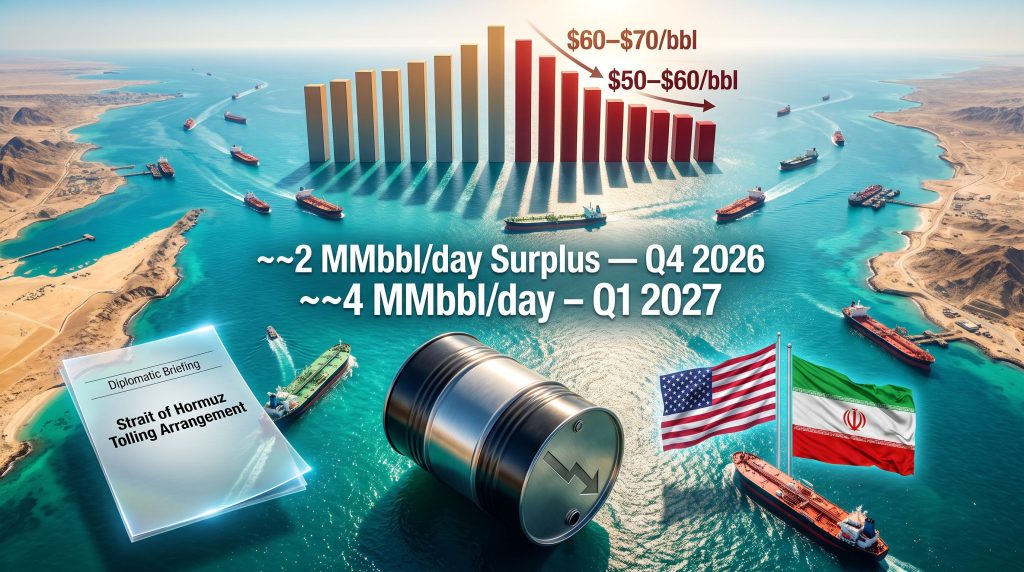
| Q4 2026 (post-de-escalation forecast) | ~2 MMbbl/day surplus | Oversupply resuming |
| Q1 2027 (extended scenario) | ~4 MMbbl/day surplus | Deep oversupply |
The critical point is that the underlying surplus never disappeared — it was masked. Once the disruption factor is removed, the structural imbalance reasserts itself with compounding force. Inventory builds, once they begin, tend to feed on themselves as producers hesitate to cut output and traders front-run storage economics. Bloomberg's analysis of the Macquarie forecast similarly highlights this risk of rapid market rebalancing under a deal scenario.
The Strait of Hormuz: The World's Most Consequential Chokepoint
Under normal operating conditions, approximately 20% of global oil supply transits the Strait of Hormuz. The effective closure of the strait following conflict escalation has been the single largest contributor to the artificial tightening of global crude balances in 2026. Its reopening would not merely add marginal supply — it would release a significant volume of constrained barrels into a market that is already structurally oversupplied beneath the surface.
Compounding this is the secondary disruption layer created by Iran-backed Houthi rebel attacks on Saudi oil tankers transiting the Red Sea. The geographic overlap between Hormuz closure impacts and Red Sea routing constraints has forced tankers onto longer, more expensive alternative routes, inflating insurance premiums and raising delivered crude costs for Asian importers. A simultaneous easing of both chokepoints would amplify the supply restoration effect considerably.
The Tolling Arrangement: A Pragmatic Middle Ground
The most likely mechanism for de-escalation, according to energy market analysts, is not a formal peace treaty but rather a functional tolling regime at the Strait of Hormuz. Under this type of arrangement, Iran would collect transit fees from vessels passing through the strait, allowing it to monetise its geographic leverage without requiring full military disengagement. The United States, for its part, would accept this structure as the price of restoring global oil flows before the midterms.
Macquarie's analysts have characterised this outcome as effectively unavoidable given the current balance of leverage. Iran retains the physical capacity to interdict strait traffic, and the U.S. has limited practical options for permanently neutralising that capability. A tolled-but-open strait, even if politically uncomfortable for both parties, resolves the immediate supply disruption while leaving broader geopolitical tensions unresolved.
"Neither side is entering this arrangement from a position of strategic preference. The tolling regime is emerging because the alternative — a prolonged impasse — carries higher costs for both parties than the compromise itself."
Brent and WTI Price Scenarios Under De-Escalation
Three Pathways and Their Price Implications
| Scenario | Probability | Brent Price Range | Key Trigger |
|---|---|---|---|
| Full de-escalation pre-midterms | Moderate-High | $50-$60/bbl | Ceasefire + Hormuz partial reopening |
| Partial ceasefire, gradual restoration | Moderate | $60-$70/bbl | Tolling agreement + phased supply return |
| Negotiations collapse post-midterms | Lower probability | $80+/bbl | Renewed military escalation |
Under the most bearish scenario, a rapid and comprehensive de-escalation that coincides with OPEC+ supply additions could push Brent crude into the low-to-mid $50s per barrel. Historical precedent from previous geopolitical risk unwinding events — including the resolution of the first Gulf War and the post-2022 recalibration following Russian supply disruptions — shows that price corrections following premium removal can be swift and deep. Reviewing broader crude oil price trends reinforces just how quickly sentiment can shift when supply assumptions are upended.
A more measured outcome, where a partial ceasefire leads to a phased and gradual return of Middle Eastern supply, points to Brent trading in the $60-$70 corridor through the first half of 2027. This scenario preserves some optionality for OPEC+ to respond with coordinated cuts, though the cartel's internal cohesion under these conditions remains uncertain.
The bull case, in which negotiations collapse entirely after the midterms and U.S. military posture hardens, would support prices above $80 per barrel as the supply disruption premium re-enters the market. This is considered the lower-probability outcome, but it cannot be dismissed given the complexity and unpredictability of U.S.-Iran diplomatic history.
OPEC+'s Shrinking Room to Manoeuvre
The Cartel's Strategic Dilemma
OPEC+ built its production strategy around an assumption of prolonged supply disruption from the Middle East conflict. A rapid return of Iranian volumes would challenge that framework in real time, potentially requiring an emergency production review before the cartel's scheduled meeting cycle allows for an orderly response. In addition, OPEC's market influence has historically been tested most severely during precisely these kinds of supply-shock reversals.
Saudi Arabia occupies a uniquely complex position in this equation. The kingdom is simultaneously one of the world's largest crude exporters, a direct target of Houthi tanker attacks in the Red Sea, and a central pillar of OPEC+ cohesion. Its incentive to see maritime security restored is genuine, but acting too quickly to cut production in response to returning Iranian supply could fracture relationships with other cartel members who prioritise market share over price support.
Saudi spare capacity decisions over the coming months will be a critical variable in determining how deep any post-de-escalation price correction ultimately runs. Consequently, OPEC demand forecasts will require significant revision should de-escalation proceed faster than the cartel currently anticipates.
Signals to Watch and Portfolio Considerations
Key Market Indicators Before Year-End
Investors and traders monitoring this evolving situation should track the following leading indicators:
- Diplomatic communication frequency between U.S. and Iranian officials as an early signal of de-escalation pace
- Tanker traffic data through the Strait of Hormuz and Red Sea as a real-time proxy for supply restoration progress
- U.S. retail gasoline prices as a barometer of political urgency driving the negotiation timeline
- OPEC+ emergency meeting announcements as a reactive indicator that the cartel is recognising supply imbalance
- Brent futures curve structure as a forward-looking signal, where a shift into contango indicates the market is beginning to price inventory accumulation
Portfolio Positioning in a Bearish Supply Environment
For energy investors, the implications of a $50-$60 Brent environment are significant and asymmetric across different asset types:
- Pure-play upstream producers with high break-even oil prices face disproportionate downside, particularly those carrying elevated debt loads relative to their cash flow generation at lower price decks
- Integrated majors with meaningful downstream refining and marketing operations are better insulated, as their earnings structure partially offsets upstream margin compression
- LNG and natural gas assets may offer relative value if oil-linked contract pricing creates a lag effect, allowing some portfolio diversification benefit
- Refining margins could face compression as crude input costs fall faster than refined product demand adjusts, though this dynamic varies significantly by geography and product slate
Furthermore, ACE Investors' commentary on volatile oil markets underscores that even a fragile ceasefire introduces meaningful repricing risk across energy portfolios.
Risk Warning: Oil market forecasts during active geopolitical conflicts carry exceptionally wide uncertainty bands. Diplomatic timelines are notoriously difficult to predict, and any single escalatory event can rapidly invalidate supply-restoration assumptions. Nothing in this article constitutes financial advice.
The next major ASX story will hit our subscribers first
Frequently Asked Questions
What is driving the oil glut warning from investment bank analysts?
The warning reflects a convergence of three forces: a pre-existing structural surplus in global crude markets that predates the U.S.-Iran conflict, the expectation of diplomatic de-escalation ahead of U.S. midterm elections, and the anticipated return of suppressed Middle Eastern oil volumes once the Strait of Hormuz reopens. Combined, these forces point to a daily surplus of approximately 2 million barrels by Q4 2026, potentially doubling in Q1 2027.
Why does the U.S. midterm election affect oil prices?
With national gasoline prices above $4 per gallon and inflation ranking among the top voter concerns, the current administration faces strong political incentives to lower energy costs before November 2026. Reaching even a partial ceasefire with Iran could facilitate supply restoration and reduce pump prices, making diplomatic progress a near-term priority rather than a long-term aspiration.
What is a Strait of Hormuz tolling regime?
A tolling arrangement would allow Iran to collect fees from vessels transiting the strait, effectively compensating Iran for allowing passage without requiring full military withdrawal or formal peace terms. Energy analysts view this as a practical mechanism for restoring oil flows while allowing both parties to claim partial concessions.
Could OPEC+ offset the price impact of returning Iranian supply?
Theoretically yes, but practically the challenge is considerable. The speed of supply restoration could outpace the cartel's formal decision-making cycle. Internal disagreements between members prioritising price versus those prioritising market share add further uncertainty to any coordinated response.
What oil price levels are being discussed under a de-escalation scenario?
Under a full de-escalation with rapid supply restoration, Macquarie warns of oil glut as U.S.-Iran tensions ease and projects Brent crude could fall to the low-to-mid $50s per barrel. A more gradual partial ceasefire scenario suggests a range closer to $60-$70 through the first half of 2027.
Want to Stay Ahead of Commodity Market Shifts That Could Impact Your Portfolio?
Discovery Alert's proprietary Discovery IQ model scans ASX announcements in real time, instantly identifying actionable mineral discovery opportunities across more than 30 commodities — explore historic discoveries and their market returns to understand the magnitude of what early positioning can achieve, then begin your 14-day free trial at Discovery Alert to secure a market-leading edge.