July 28, 2026
The Hidden Benchmark That Actually Controls Aluminium Profitability
Most investors tracking the aluminium sector fix their attention on the LME aluminium price. It is visible, liquid, and directly tied to the finished metal that downstream industries purchase. Yet this focus creates a systematic blind spot. One layer deeper in the supply chain, a separate pricing mechanism has been generating some of the most extreme margin shifts in the industry's recent history, largely without attracting equivalent scrutiny.
The LME alumina price trend has, over the past three years, moved independently of aluminium, surged to record highs, collapsed with unusual speed, and resettled into a range that is simultaneously comfortable for smelters and uncomfortable for refiners. Understanding why it behaves this way, and what drives it, is increasingly essential for anyone seeking a complete picture of aluminium market economics.
When big ASX news breaks, our subscribers know first
How Alumina Pricing Works and Why It Diverges From Aluminium
Alumina sits at the midpoint of the aluminium value chain. Bauxite ore is mined, refined into alumina through the Bayer process, and then smelted into primary aluminium using the Hall-Heroult electrolytic process. Each tonne of primary aluminium requires approximately 1.93 tonnes of alumina as feedstock, making it the single largest raw material cost for any smelter. Furthermore, understanding bauxite's role in production helps contextualise why disruptions at the mining stage cascade so rapidly through the entire value chain.
The primary international pricing reference for alumina is the Platts alumina assessment, which reflects spot transaction data for smelter-grade alumina (SGA) on a cost-and-freight basis into major import regions. The LME also lists an alumina futures contract tied to this Platts benchmark, allowing hedging and price discovery outside Chinese domestic markets.
The Shanghai Futures Exchange (SHFE) lists a separate yuan-denominated alumina contract that tracks Chinese domestic supply-demand conditions. Because China accounts for more than 50% of global alumina production and consumption, divergences between SHFE domestic pricing and international Platts-linked assessments have become increasingly important indicators of arbitrage opportunity and regional market stress. The two benchmarks can diverge for weeks before eventually converging, and traders who monitor only one face significant information gaps.
The Alumina-to-Aluminium Ratio: The Margin Indicator Most Investors Overlook
The ratio expressing alumina's price as a percentage of the LME aluminium price is one of the most informative metrics in upstream aluminium analysis, yet it remains largely absent from mainstream investment commentary.
Its long-run average sits around 14-17%. When the ratio climbs materially above that range, refiners benefit from expanded revenue while smelters face feedstock cost inflation that compresses or eliminates operating margins. When it falls well below that range, as it has through much of 2025-2026, the economics invert: smelters enjoy unusually wide margins while refiners face revenue pressure.
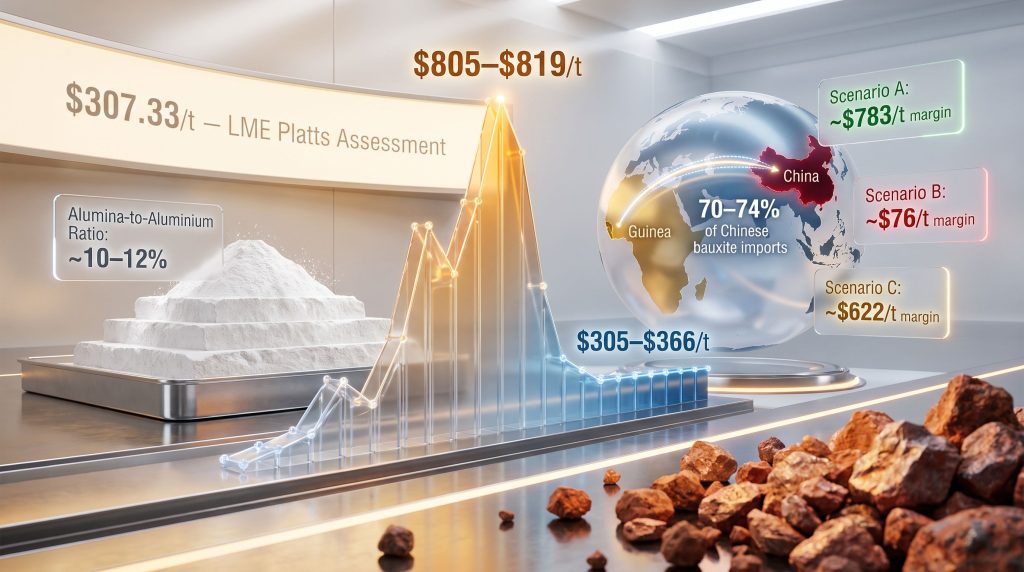
The alumina-to-aluminium ratio at mid-2026 levels of approximately 10-12% represents a strongly smelter-favourable environment, one of the most favourable in the recent cycle. This is not simply a function of low alumina prices; it reflects an active divergence between the two markets that integrated producers can exploit while single-segment operators cannot.
The 2025-2026 LME Alumina Price Trend in Numbers
The current LME alumina price trend is best characterised as soft-to-stable. After one of the most dramatic price cycles in modern alumina market history, the market has settled into a comparatively narrow trading range.
| Timeframe | Alumina Price (USD/t) | Daily Movement | Market Context |
|---|---|---|---|
| February 6, 2026 | $308.73 | +0.26% | Early 2026 baseline |
| June 25, 2026 | $307.33 | Unchanged | LME Platts assessment |
| Late June 2026 | $305.40 | -0.2% | Near-term spot |
| July 15, 2026 | $365.09 | -0.31% | Mid-2026 firmer patch |
| October 2025 avg. | ~$320.00 | -5.6% MoM | Second consecutive monthly decline |
The mid-2026 pricing environment reflects a market that is structurally oversupplied rather than fundamentally balanced. Alumina has oscillated between approximately $305-$366/t through the first half of 2026, with brief periods of firmness unable to generate sustained momentum given the weight of new refining capacity coming online across China and Indonesia.
Nalco's publicly stated guidance points to alumina prices remaining within the $320-$330/t range for much of 2026, consistent with the observed trading pattern and with analyst expectations for continued supply-side pressure.
From Record Lows to Record Highs: Anatomy of the 2024 Superspike
Understanding where the LME alumina price trend stands today requires revisiting how it arrived at its current level. The 2024 price spike was not a single-cause event. It was the product of multiple simultaneous supply-side shocks compressing available alumina volumes across different geographies at the same moment.
Phase One: The Setup
The tightening cycle began taking shape in late 2023. Bauxite mine suspensions across China's Shanxi and Henan provinces, combined with Indonesia's national bauxite export ban, began squeezing ore availability for Chinese refiners. Alumina entered 2024 at roughly $350/t, representing around 15% of the aluminium price, a ratio consistent with the long-run average and offering no obvious warning signal of what was to follow.
Phase Two: Compounding Disruptions
Supply disruptions then arrived in sequence, each individually significant but collectively extraordinary:
- Alcoa permanently closed its loss-making Kwinana refinery in Western Australia, removing approximately 2.2 million tonnes of annual capacity from global supply
- A gas pipeline fire at Rio Tinto's Gladstone operations removed around 1.2 million tonnes of output
- Bauxite mine suspensions in China's Shanxi and Henan provinces restricted domestic ore supply for Chinese refiners already under pressure from Indonesia's export ban
- In October 2024, Guinean customs suspended bauxite exports from an Emirates Global Aluminium subsidiary. This single event drove alumina prices to $633.35/t within days, pushing the alumina-to-aluminium ratio toward 25%
- Speculative trading on the SHFE amplified the move, with single-session volumes reportedly approaching one-fifth of annual global alumina production
By early December 2024, Australian alumina assessments had reached approximately $805-$819/t, surpassing the previous record established during the 2018 Rusal sanctions crisis and marking a genuine all-time high for the commodity.
Phase Three: The Collapse
The correction that followed was faster and sharper than almost any comparable commodity price reversal in the alumina market's history. The causes were structural rather than speculative.
Over 13 million tonnes of new Chinese refining capacity was commissioned across 2024-2025. Indonesian and Indian refining output expanded concurrently. Bauxite availability concerns eased. Quarterly benchmark prices fell by 20-29% in successive periods before stabilising near $310-$320/t by end-2025.
Comparing the Two Major Alumina Shocks
| Event | Peak Price | Ratio to Aluminium | Duration of Spike |
|---|---|---|---|
| 2018 Rusal/Alunorte disruption | ~$700/t | ~30% | Several months |
| 2024 multi-source supply shock | ~$805-$819/t | ~25% at Guinea event | Approximately 6-8 weeks |
| Mid-2026 current level | ~$305-$366/t | ~10-12% | Ongoing range-bound |
The 2024 spike was larger in absolute terms but shorter in duration, a pattern consistent with a market in which new capacity can be commissioned quickly but cannot be deployed instantaneously to prevent short-term dislocations.
The Margin Arithmetic Every Aluminium Investor Should Model
The practical implications of alumina price movements for smelter profitability are best understood through direct numerical comparison. The following scenarios use a constant aluminium price to isolate the effect of alumina cost alone.
Scenario A: Low Alumina Environment (Mid-2026 Conditions)
- Aluminium price: USD 2,600/t
- Alumina consumption: 1.93t per tonne of aluminium
- Alumina at $330/t: feedstock cost of approximately USD 637/t
- Conversion and energy costs: approximately USD 1,180/t
- Estimated operating margin: approximately USD 783/t, or roughly 30%
Scenario B: Peak Alumina Environment (Late 2024 Conditions)
- Same aluminium price: USD 2,600/t
- Alumina at $800/t: feedstock cost of approximately USD 1,544/t
- Estimated operating margin: approximately USD 76/t, effectively breakeven
Scenario C: Weak Aluminium With Low Alumina
- Aluminium price: USD 2,400/t
- Alumina at $310/t: feedstock cost of approximately USD 598/t
- Estimated operating margin: approximately USD 622/t, materially healthier than Scenario B despite lower metal prices
The counterintuitive takeaway from these scenarios is significant: a smelter operating in a weak aluminium price environment with low alumina costs can outperform a smelter in a strong aluminium price environment burdened by peak alumina costs. The feedstock ratio, not the metal price alone, determines operational viability.
Real-World Validation: Alcoa's Q2 2026 Results
Alcoa's second-quarter 2026 results provide a live example of this dynamic in action. The company's aluminium segment delivered a record 32.3% operating margin, supported by stronger LME aluminium prices and the comparatively low alumina cost environment. Meanwhile, its alumina business was forced to lower guidance after gas supply disruptions at the Pinjarra refinery in Western Australia tightened output and increased costs at the refinery level.
The contrast between the two segments within a single reporting period illustrates precisely why the alumina-to-aluminium ratio matters. Furthermore, the Alcoa IGNIS EQT joint venture reflects the broader industry response: vertical integration across the value chain reduces exposure to ratio volatility by capturing margin at multiple stages simultaneously.
China's Structural Role in Shaping the Global Alumina Market
No analysis of the LME alumina price trend is complete without accounting for China's dominant position across the value chain. In addition, China's steel and iron ore challenges provide useful context for understanding how Chinese industrial policy shapes commodity markets more broadly.
| Metric | Figure |
|---|---|
| Annual alumina production/consumption | ~80 million tonnes |
| Share of global output | Over 50% |
| Total metallurgical refining capacity | ~110 million tonnes |
| Current capacity utilisation | ~80% |
| Primary aluminium smelting cap | ~45.5 million tonnes |
| Guinean bauxite as share of Chinese imports | ~70-74% |
China's government-imposed ceiling on primary aluminium smelting capacity at approximately 45.5 million tonnes creates a structural imbalance. With refining capacity of around 110 million tonnes operating at 80% utilisation, the country produces significantly more alumina than its smelters can absorb. China became a net alumina exporter in 2024 and has continued shipping surplus volumes into Asian and Middle Eastern markets.
This dynamic means that Chinese refinery expansion decisions now effectively set the marginal global alumina price. The irony is that China's refining sector is itself highly exposed: approximately 70-74% of its bauxite imports originate from Guinea, creating a concentrated supply dependency that represents the single most consequential near-term risk to global alumina market stability.
Why the SHFE-to-Platts Spread Matters
Domestically priced yuan-denominated alumina on the SHFE does not always track international Platts assessments. Divergences between the two markets create arbitrage windows that can influence trade flows, shipping patterns, and inventory accumulation strategies. Monitoring the spread between Chinese domestic pricing and international benchmarks has become an increasingly reliable leading indicator of emerging supply-demand imbalances before they appear in headline price data.
The next major ASX story will hit our subscribers first
Supply-Side Risk Across the Global Alumina Value Chain
Guinea: The Pivotal Supplier That Could Reshape Everything
Guinea exported a record 183 million tonnes of bauxite in 2025, with volumes continuing to grow through the first half of 2026. The scale of this output has had a deflationary effect on bauxite prices, which have fallen approximately 50% from their early-2025 peak as supply has overwhelmed demand.
The Guinean government's response to this price pressure has created a new risk dimension. Authorities have raised export tariffs, revoked mining permits deemed inactive, and are actively considering an export quota system linked to domestic downstream investment. This quota has not yet been formalised, but the policy direction is clear.
Should Guinea implement a formalised bauxite export quota, Chinese refiners sourcing 70-74% of their imported ore from that single country could face supply shortfalls within weeks. Given the scale of China's refining operation and the limited short-term substitutability of Guinean bauxite grades, even a modest restriction could generate price responses disproportionate to the volume affected.
Australia: Energy Vulnerability in a Mature Sector
Australia's refining sector is characterised by mature, relatively high-cost assets with significant energy infrastructure exposure, as demonstrated by Rio Tinto's Gladstone gas pipeline incident. At least one major Australian producer is reportedly evaluating a strategic shift toward higher-value alumina products rather than conventional smelter-grade material, a development that could alter the country's contribution to global SGA supply over the medium term.
Indonesia and India: The Emerging Counterweights
Indonesia has undergone a remarkable transformation. Having previously been a source of market disruption through its bauxite export ban, the country is now a primary contributor to global alumina oversupply. Refining capacity is expanding from approximately 10 million tonnes at end-2025 toward an estimated 25 million tonnes over the medium term.
India is following a parallel trajectory. Abundant domestic bauxite reserves and capacity expansions at Nalco, Vedanta, and Hindalco position India as a growing swing supplier whose incremental output will increasingly influence the global supply balance over the next five to ten years.
The Middle East: Logistics Risk Through the Strait of Hormuz
Most Gulf aluminium smelters rely on imported alumina delivered through the Strait of Hormuz. The conflict that began in late February 2026 has generated war-risk shipping surcharges and prompted vessel rerouting across the region. While physical alumina refining infrastructure has remained unaffected, the logistics cost increases flowing through supply chains represent a real, if currently modest, margin headwind for smelters dependent on seaborne alumina imports.
The 6 to 12-Month Alumina Price Outlook
Base Case: Range-Bound Stability
The most probable scenario for the LME alumina price trend over the next six to twelve months is continued range-bound trading, supported by approximately 17 million tonnes of new global refining capacity expected online during 2026 across China's Guangxi region and Indonesia. With Nalco's guidance anchoring consensus expectations near $320-$330/t and the alumina-to-aluminium ratio well below historical stress thresholds, smelter margins should remain healthy while refinery economics face ongoing pressure.
Upside Risk Scenarios
| Risk Factor | Trigger | Likely Price Impact |
|---|---|---|
| Guinea export quota formalisation | Government policy announcement | Rapid tightening; potential spike toward $450-$500/t |
| Prolonged Middle East shipping disruption | Escalation of Hormuz conflict | Freight and energy cost increases across supply chain |
| Major Australian refinery outage | Energy infrastructure failure | Removal of 1-2 million tonnes of supply |
| Chinese bauxite inventory drawdown | Ore import disruption | Spot price acceleration on thin liquidity |
Downside Risk Scenarios
A move below $300/t would require either a significant acceleration in new capacity commissioning beyond current schedules, a notable weakening in Chinese aluminium smelting output (which would reduce domestic alumina demand), or a broad-based economic slowdown suppressing industrial demand across major consuming regions. None of these scenarios is the base case, but all are plausible under sufficiently adverse macroeconomic conditions.
Frequently Asked Questions: LME Alumina Price Trend
What is the current LME alumina price?
As of mid-July 2026, the Platts alumina assessment was approximately $365/t, having traded within a broader range of $305-$366/t through the first half of 2026. Earlier in the year, prices were anchored closer to $307-$309/t before a brief firming episode in July.
Why did alumina prices spike so dramatically in late 2024?
A rare convergence of independent supply disruptions struck simultaneously. Refinery closures in Australia, a gas outage at Gladstone, bauxite mine suspensions in China, Indonesia's export ban, and Guinea's customs suspension of an EGA subsidiary's shipments all removed supply at the same moment. Speculative trading on the SHFE amplified the market response, pushing prices to an all-time high of approximately $805-$819/t.
How does the alumina price affect smelter profitability?
Alumina represents the single largest raw material cost for primary aluminium smelters. At 1.93 tonnes of alumina consumed per tonne of aluminium produced, a move from $330/t to $800/t in the alumina price reduces the operating margin by approximately $707/t without any change in the LME aluminium price. This is why the alumina-to-aluminium ratio is a more complete measure of smelter health than the aluminium price alone.
What is the alumina-to-aluminium ratio, and what does it indicate?
The ratio expresses the alumina price as a percentage of the LME aluminium price. Its long-run average is approximately 14-17%. A ratio above 20% historically signals refinery margin outperformance and smelter stress. The mid-2026 ratio of approximately 10-12% is well below the long-run average, indicating an unusually favourable smelting environment.
How does Guinea's bauxite policy affect the global alumina market?
Guinea supplies approximately 70-74% of China's bauxite imports and exported a record 183 million tonnes globally in 2025. Any formalised export quota or significant tariff increase carries the potential to tighten Chinese refinery feedstock availability within weeks, given the near-absence of short-term substitution options at that scale.
Key Structural Takeaways for Investors and Industry Participants
- The LME alumina price trend operates on independent supply-demand dynamics that frequently diverge from aluminium price movements, sometimes dramatically
- The 2024 superspike to approximately $805-$819/t and subsequent collapse to $305-$320/t represents one of the most extreme commodity price cycles in the alumina market's history
- At mid-2026 levels, the alumina-to-aluminium ratio of approximately 10-12% creates unusually wide smelter margins and equally unusual pressure on refinery economics
- Guinea's bauxite export policy trajectory remains the most consequential near-term supply risk to the global alumina market, given China's near-total import dependency on Guinean ore
- Integrated producers operating across bauxite mining, alumina refining, and primary smelting are structurally better positioned to manage ratio volatility than single-segment operators. The top aluminium mining companies demonstrate this advantage clearly through their diversified asset structures
- The approximately 17 million tonnes of new refining capacity expected online in 2026 makes a near-term return to 2024-style tightness unlikely in the absence of a major, unexpected supply shock
This article is intended for informational purposes only and does not constitute financial or investment advice. Forecasts, price projections, and scenario analyses involve inherent uncertainty and should not be relied upon as predictive of actual market outcomes. Readers should conduct their own due diligence before making any investment decisions.
Want to Identify the Next Major ASX Mineral Discovery Before the Market Moves?
Discovery Alert's proprietary Discovery IQ model delivers real-time alerts on significant ASX mineral discoveries — instantly transforming complex mineral data into actionable investment insights for traders and long-term investors alike. Explore historic discoveries and the returns they generated, then start your 14-day free trial at Discovery Alert to position yourself ahead of the broader market.