July 28, 2026
The Processing Gap: Why West Africa's Mineral Wealth Is Worth More Than the Ore in the Ground
Every major clean energy transition ultimately runs through a refinery before it reaches a battery. This is the fundamental reality that shapes the U.S. China competition for West Africa critical minerals, and it explains why the contest unfolding across Guinea, Ghana, Mali, and Côte d'Ivoire is far more consequential than a straightforward race to acquire mining licences. The deeper prize is not the ore itself but the ability to define where it goes, how it is transformed, and whose supply chains it ultimately serves.
West Africa sits at a structural inflection point. Its Atlantic-facing coastline, combined with an extraordinary concentration of battery-critical materials, positions the region as a potential pivot in global clean energy supply chains. Yet the mineral endowment alone does not determine outcomes. Processing capacity, infrastructure connectivity, and financing architecture collectively determine whether West African resources flow into Chinese, American, or genuinely diversified supply chains.
When big ASX news breaks, our subscribers know first
West Africa's Mineral Endowment and Why It Matters Now
The breadth of West Africa's critical mineral base is rarely appreciated in its full strategic context. Furthermore, understanding critical minerals demand helps clarify why both powers are investing so heavily in the region. The region holds:
- Guinea: The world's largest known bauxite reserves, alongside graphite, iron ore, and gold
- Ghana: Commercially significant lithium deposits, particularly at Ewoyaa, plus graphite resources
- Mali: Lithium resources currently under Chinese operational control, alongside substantial gold production
- Côte d'Ivoire: Active nickel and manganese production, with advancing exploration in copper, lithium, and coltan
- Sierra Leone and Liberia: Earlier-stage critical mineral corridors with iron ore and emerging battery-material potential
What makes this geography strategically urgent is the convergence of Atlantic export logistics with minerals that are central to electric vehicle batteries, energy storage systems, and advanced electronics. Both Washington and Beijing understand that securing Atlantic-facing mineral corridors reduces dependence on Central African routes and creates redundancy in supply chain architecture.
"The competition over West Africa's critical minerals is not primarily a contest over mine ownership. It is a structural battle over who controls processing, refining, and the downstream value chain that converts raw ore into battery-grade materials."
How China Built Its West African Mineral Position
Decades of Integrated Investment
China's advantage in West Africa was not assembled quickly. Over roughly two decades, Chinese state-backed financing institutions enabled Chinese mining and infrastructure companies to move faster and accept more risk than Western counterparts constrained by commercial return requirements and governance conditionality.
The model is distinctive in its integration. Chinese firms typically combine mine financing with the construction of processing infrastructure and logistics connectivity, creating a vertically linked position that Western investors, who tend to compartmentalise these functions, have struggled to replicate. Consequently, even where Western companies hold exploration licences or development-stage assets, Chinese firms may control the downstream pathway through which ore is eventually processed into battery-grade material.
The Processing Advantage: Refining as the Real Choke Point
China controls an estimated 60 to 80 percent of global battery-grade mineral refining capacity across key materials including lithium, cobalt, and graphite, according to widely cited industry analyses. This dominance means that a Western mining company can win access to a West African lithium deposit while remaining structurally dependent on Chinese processing networks to convert spodumene concentrate into the lithium hydroxide or lithium carbonate that battery manufacturers actually require.
This is a critical and often underappreciated dynamic. Mine ownership and supply chain control are not the same thing. Battery-grade lithium hydroxide, for example, requires multi-stage chemical processing that demands significant capital, technical expertise, and energy input. Owning the mine without controlling or having assured access to the refinery leaves Western supply chain architects in a subordinate position. Indeed, lithium supply chains remain one of the most contested elements of the broader competition.
Key Chinese Asset Positions Across West Africa
| Country | Mineral | Chinese Involvement | Strategic Significance |
|---|---|---|---|
| Mali | Lithium | Operational mine control | Diverts output from Western supply chains |
| Ghana | Lithium (Ewoyaa) | Pending acquisition ($281M combined offer) | Redirects away from North American market targeting |
| Côte d'Ivoire | Coltan | SODEMI joint venture with Chinese partner | State-level processing partnership established |
| Guinea | Bauxite | Dominant investor across multiple projects | Controls access to world's largest bauxite reserves |
At Issia in Côte d'Ivoire, the state-owned mining company SODEMI has entered a partnership with a Chinese company to develop a coltan deposit, demonstrating that Chinese processing involvement is increasingly structured through African state entities rather than purely foreign investment vehicles. This model provides political legitimacy while embedding Chinese technical and commercial influence at the processing layer.
The U.S. Response: Capital, Kilowatts, and Customers
The DFC's West African Mandate
The U.S. International Development Finance Corporation established its regional office in Abidjan approximately 18 months before the Mining on Top Africa conference held in Paris in July 2026, at which DFC officials participated alongside representatives from multiple West African governments. Since opening that office, the agency has been evaluating mining, mineral processing, and infrastructure projects across the sub-region, with Guinea identified as a particularly high-priority jurisdiction given the number of projects combining mining with local processing ambitions.
The DFC's financing toolkit includes:
- Debt facilities for commercially viable mining and processing projects
- Equity participation in strategic mineral ventures
- Political risk insurance to reduce investor exposure in higher-risk jurisdictions
- Project preparation grants to advance early-stage projects toward commercial viability
One structural limitation is significant. The DFC does not finance mineral exploration. It engages only after mineral resources have been formally defined and projects have advanced toward commercial development. This creates a competitive gap at the earliest stages of the mining investment cycle, where Chinese financing has historically been most influential in establishing relationships and securing asset positions. As Reuters reports, this gap in early-stage financing remains one of Washington's most pressing strategic vulnerabilities.
Washington's Three-Pillar Strategic Framework
At the African Development Bank's Ministerial Forum on Critical Minerals held in Abidjan on July 10, 2026, U.S. Treasury officials articulated a strategic framework for African critical mineral value chains organised around three interdependent pillars. A U.S. Treasury representative summarised the approach as capital, kilowatts, and customers, capturing the integrated logic of the American position.
- Capital: Development finance as a structured alternative to Chinese state-backed resource lending, linked to governance standards and community benefit obligations
- Kilowatts: Direct investment in energy infrastructure as the foundational enabler of mineral processing, addressing the chronic power shortages that constrain processing plant viability across West Africa
- Customers: Securing offtake agreements that route West African mineral production into U.S.-aligned battery and manufacturing supply chains, rather than into Chinese processing networks
Comparing U.S. and Chinese Engagement Models
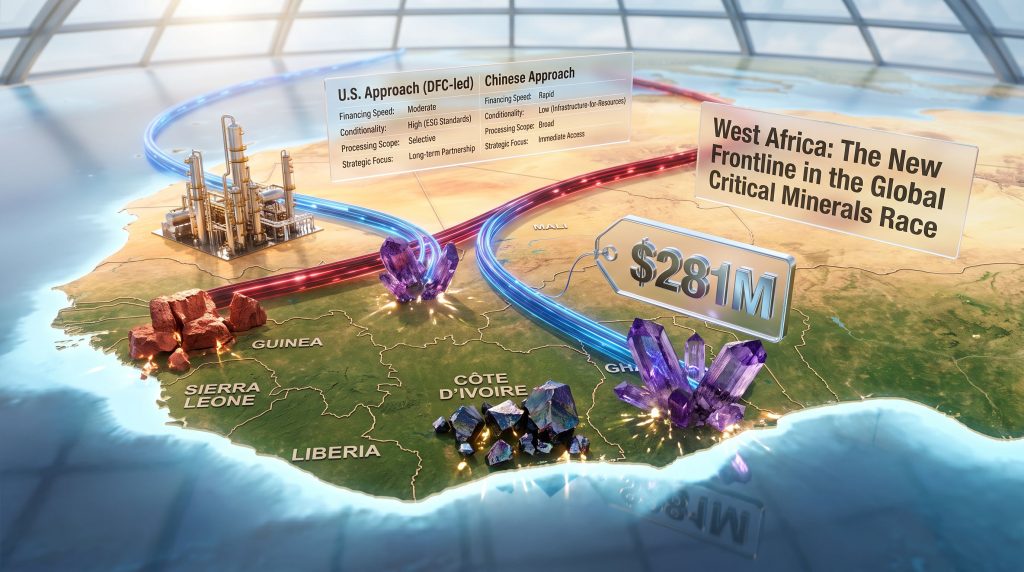
| Dimension | U.S. Approach (DFC-led) | Chinese Approach |
|---|---|---|
| Financing Speed | Slower; requires viability assessments | Faster; state-directed capital deployment |
| Scope | Mining, processing, infrastructure | Fully integrated from mine to refinery |
| Conditionality | Community benefit, governance standards | Fewer conditions; resource-backed lending |
| Processing Investment | Emerging focus | Deeply established |
| Exploration Financing | Not offered | Often included |
| Diplomatic Leverage | Multilateral forums, AfDB partnerships | Bilateral deals, infrastructure diplomacy |
Guinea: The Most Contested Territory in the Region
Guinea's strategic importance extends well beyond its bauxite reserves, which are the largest in the world. The country's broader mineral portfolio and the growing number of projects combining extraction with local processing have drawn intensive attention from both Washington and Beijing.
DFC officials have identified Guinea as a jurisdiction with a significant number of projects under review, reflecting the agency's recognition that Guinea represents both the highest mineral stakes and the most complex competitive environment in West Africa. Critically, Guinea's government has demonstrated sophisticated awareness of its leverage position, using competing great-power interest to push harder for infrastructure commitments and local value-addition requirements from both sides.
The Lobito Corridor, Washington's flagship African minerals infrastructure initiative spanning Angola, the Democratic Republic of Congo, and Zambia, provides a reference point for what U.S. engagement in West Africa could eventually resemble. However, that Central African corridor project reflects years of accumulated diplomatic and financial commitment that West Africa has not yet attracted at the same scale.
The Ghana Ewoyaa Lithium Acquisition: A Supply Chain Turning Point
The $281 Million Strategic Pivot
In May 2026, Zhejiang Huayou Cobalt signed two separate agreements that together represent a $281 million combined bid for control of Ghana's Ewoyaa lithium project. The structure involves a $210 million offer to acquire Atlantic Lithium, the project's majority owner, alongside a separate $71 million offer to purchase the stake held by Australia's Elevra Lithium.
Both transactions remain subject to regulatory approval. However, the strategic implications are already reshaping how analysts and policymakers assess West African lithium's trajectory. Atlantic Lithium and Elevra Lithium had originally targeted North American battery supply chains as the primary market for Ewoyaa's future production. A completed Chinese acquisition would fundamentally redirect that output, illustrating why a coherent lithium resource strategy matters so greatly for Western planners.
Scenario Analysis: Three Outcomes for Ewoyaa
Scenario 1 – Chinese Acquisition Approved: Ewoyaa's lithium output integrates into Chinese battery supply chains. U.S. access to West African lithium narrows further, and the precedent accelerates Chinese interest in other regional lithium assets.
Scenario 2 – Regulatory Block or Renegotiation: West African regulatory review or international diplomatic pressure delays or restructures the deal. Alternative Western offtake arrangements become viable, potentially with DFC financing support for processing infrastructure.
Scenario 3 – Hybrid Outcome: A partial Chinese stake is approved alongside mandatory local processing requirements and diversified offtake commitments. Ghana extracts maximum value from competing bidder interest while maintaining some supply chain diversification.
The next major ASX story will hit our subscribers first
Infrastructure: The Structural Constraint Beneath the Competition
Energy, Ports, and Rail as the Real Bottlenecks
No mineral processing strategy succeeds without reliable energy. West Africa's chronic power deficits remain the single most significant constraint on the viability of in-country processing investment. Industrial-scale lithium processing, for example, is an energy-intensive operation requiring consistent high-voltage power supply that most West African grid systems cannot currently guarantee.
Beyond energy, two additional infrastructure gaps compound the challenge:
- Port capacity limitations reduce export competitiveness for bulk mineral shipments and increase logistics costs for processing inputs
- Underdeveloped railway corridors disconnect inland mineral deposits from coastal processing and export infrastructure, raising unit costs and deterring investment
Whichever external power more effectively addresses these three bottlenecks will secure the strongest long-term positioning in West African mineral value chains. This is precisely why the U.S. Treasury's emphasis on kilowatts at the Abidjan forum was strategically significant. It signals recognition that financing a mine without resolving the energy constraint leaves the processing advantage with whoever has already built refining capacity elsewhere, which currently means China.
West African Governments' Non-Negotiable Demand
Across the region, a growing policy consensus is consolidating around a single non-negotiable principle: raw mineral exports must give way to in-country processing. This political priority fundamentally changes the negotiating dynamic.
Governments that once competed to attract any form of mining investment are increasingly prepared to withhold or condition approvals on processing commitments. This shift creates a potential competitive differentiator for the DFC, whose mandate explicitly includes financing mineral processing infrastructure aligned with local value-addition objectives. As noted by the Atlantic Council, the governance-linked financing model may resonate with governments concerned about resource-backed debt dependency. Furthermore, the broader energy security implications of these decisions extend well beyond the African continent.
Country-by-Country Strategic Mineral Profiles
| Country | Key Critical Minerals | U.S. Engagement Level | Chinese Engagement Level |
|---|---|---|---|
| Guinea | Bauxite, graphite | High (DFC priority) | Very High (dominant investor) |
| Ghana | Lithium, graphite | Moderate | High (Ewoyaa acquisition pending) |
| Mali | Lithium, gold | Low | Very High (operational control) |
| Côte d'Ivoire | Nickel, manganese, coltan, copper | Emerging | High (state JV at Issia) |
| Sierra Leone | Iron ore, critical minerals | Low | Moderate |
| Liberia | Iron ore, critical minerals | Low | Moderate |
Can Washington Close the Gap Before 2030?
Where the U.S. Leads and Where It Lags
An honest assessment of the competitive position reveals a mixed picture for Washington:
U.S. competitive advantages:
- Governance-linked financing that aligns with African governments' institutional development priorities
- Offtake-backed deal structures that provide market certainty for processing investment
- Multilateral institutional partnerships through the African Development Bank and similar bodies
- Political alignment with value-addition agendas that resource-backed Chinese lending cannot easily match
U.S. competitive disadvantages:
- Slower capital deployment constrained by viability assessment requirements
- Absence of exploration financing, limiting early-stage relationship building
- Less developed domestic downstream processing capacity to offer as a partnership anchor
- Later market entry in most West African jurisdictions relative to Chinese counterparts
Three Strategic Trajectories Through 2030
Trajectory 1 – Chinese Consolidation: China secures additional processing partnerships and mineral asset positions while U.S. engagement remains primarily diplomatic without matching capital commitments on the ground.
Trajectory 2 – Competitive Equilibrium: The DFC scales its commitments from project assessment to large-scale infrastructure financing, and processing-linked partnerships create a genuine dual-power competition with African governments as primary beneficiaries. A well-resourced critical raw materials facility model, adapted for the West African context, could help close this gap considerably.
Trajectory 3 – Multilateral Realignment: A coordinated Western coalition spanning the U.S., European Union, Australia, and Japan develops a credible collective alternative to China's integrated supply chain model, pooling capital and processing capacity across a diversified financing architecture.
The credibility gap between Washington's diplomatic messaging and concrete capital deployment will be the decisive variable in determining which trajectory materialises. West African governments are sophisticated observers of great-power behaviour, and they will calibrate their negotiating positions accordingly.
FAQ: U.S.-China Competition for West Africa's Critical Minerals
What minerals are most contested between the U.S. and China in West Africa?
Lithium, bauxite, graphite, nickel, manganese, and coltan are the primary materials driving the U.S. China competition for West Africa critical minerals. Lithium in Ghana and Mali and bauxite in Guinea represent the highest-priority battlegrounds for both powers.
Why does China currently hold the stronger position in West Africa's critical minerals sector?
China's advantage derives from decades of integrated investment spanning mining, processing, and infrastructure, combined with faster and less conditional capital deployment through state-backed financing institutions that accepted risk profiles Western commercial lenders would not.
What financing tools does the DFC use to compete in West African mining?
The DFC deploys debt financing, equity investment, political risk insurance, and project preparation funding. It does not finance mineral exploration, which limits its competitiveness at the earliest stages of the mining investment cycle.
How does the Ewoyaa acquisition affect U.S. supply chain strategy?
If Zhejiang Huayou Cobalt's combined $281 million acquisition of Atlantic Lithium and Elevra Lithium's stake is approved, Ewoyaa's production would likely be redirected toward Chinese supply chains, narrowing U.S. access to West African lithium and setting a precedent for further Chinese consolidation.
Can West African governments use the U.S.-China rivalry to their advantage?
Yes. Competing great-power interest gives West African governments meaningful leverage to negotiate stronger infrastructure commitments, mandatory local processing requirements, and more favourable fiscal terms. Guinea is already demonstrating this approach effectively.
This article involves forward-looking analysis and scenario projections. These represent analytical frameworks rather than confirmed outcomes. Readers should conduct independent research before drawing investment conclusions based on geopolitical trend analysis.
Want to Track the Next Major Mineral Discovery Before the Market Does?
Discovery Alert's proprietary Discovery IQ model delivers real-time alerts on significant ASX mineral discoveries — instantly converting complex mineral data into actionable opportunities for both short-term traders and long-term investors. Explore Discovery Alert's discoveries page to see how historic finds have generated extraordinary returns, and begin your 14-day free trial today to position yourself ahead of the market.