July 28, 2026
The Hidden Fragility Inside One of North America's Largest Agricultural Economies
When a single geopolitical flashpoint can push the price of a crop input up by 40% within weeks, the structural design of a country's agricultural supply chain becomes a matter of national consequence. For decades, the conventional logic underpinning fertilizer procurement across emerging agricultural economies has been straightforward: buy from wherever the price is lowest. That logic has now collided with a more uncomfortable reality.
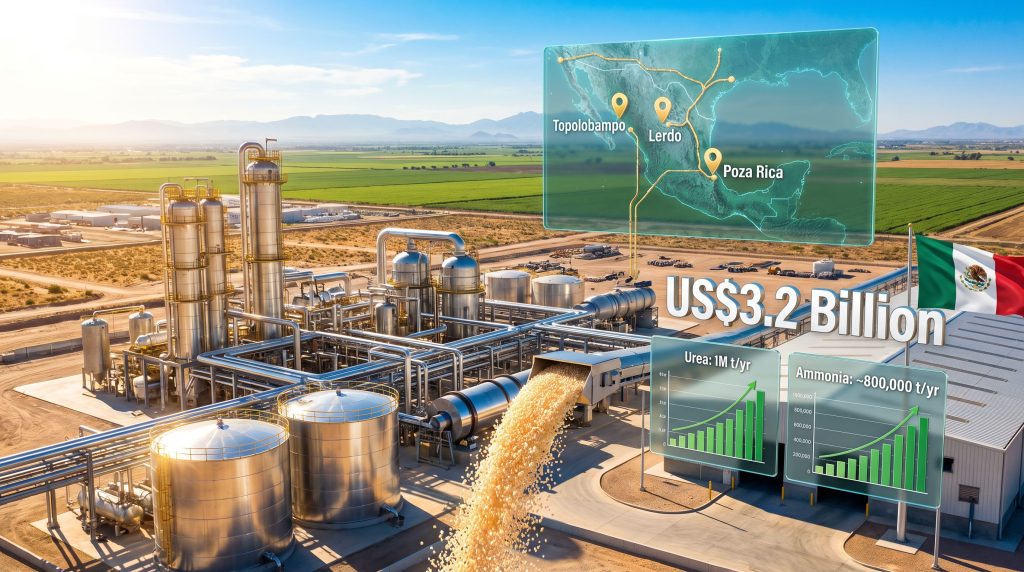
Fertilizer is not just a commodity. It is the upstream determinant of food output, farm profitability, and ultimately, the price of food on supermarket shelves. When the majority of a country's fertilizer supply is sourced from a geographically concentrated cluster of exporting nations, any disruption to that cluster ripples immediately into domestic food systems. Mexico is now confronting precisely this vulnerability, and its response, totalling more than US$3.2 billion in committed Mexico fertilizer production investment, is one of the most structurally significant shifts in Latin American agri-industrial policy in a generation.
When big ASX news breaks, our subscribers know first
How Deep Does Mexico's Import Dependency Actually Run?
Understanding the scale of Mexico's exposure requires looking beyond headline import figures. Mexico currently sources approximately 75% of its total fertilizer supply from the Persian Gulf region and Russia. The Gulf suppliers include Saudi Arabia, Kuwait, Bahrain, Qatar, the UAE, and Oman, collectively representing a production corridor that is simultaneously essential to global nitrogen supply and deeply sensitive to geopolitical disruption.
The urea picture is even more concentrated. According to the National Association of the Chemical Industry, Mexico imported 1.7 million metric tonnes of urea in 2024, with domestic production covering less than 20% of total national consumption. This is not a marginal dependency — it is a structural condition in which the viability of Mexico's grain sector is directly tied to pricing dynamics in facilities thousands of kilometres away. This pattern of fertilizer import reliance is not unique to Mexico, however the country's scale of exposure makes it particularly vulnerable.
The following data captures the full scope of Mexico's current fertilizer vulnerability:
| Metric | Current Position |
|---|---|
| Total fertilizer import dependency | ~75% of national consumption |
| Urea imports (2024) | 1.7 million metric tonnes |
| Domestic share of urea consumption | Less than 20% |
| Urea price increase during recent geopolitical period | ~40% |
| Urea spot price (recent peak) | ~US$800/t |
| Pre-disruption urea benchmark (World Bank, Feb) | ~US$472/t |
| Compensatory duty on Chinese ammonium sulfate | ~US$180/t |
| Domestic price with tariff vs. without | US$530/t vs. ~US$330/t |
Agricultural associations operating across Sinaloa, Jalisco, Michoacán, Sonora, and El Bajío — regions that together account for the majority of Mexico's commercial grain output — have formally petitioned the federal government to suspend compensatory duties on Chinese ammonium sulfate. The tariff, currently running at roughly US$180 per tonne, pushes domestic acquisition costs to US$530/t compared to an estimated US$330/t in its absence. These are not abstract figures; they translate directly into narrower farm margins and, in drought or poor yield years, into unviable production economics.
The federal Fertilizers for Well-Being program, which distributes roughly 50 kg packages to smallholder producers, operates at a scale that cannot meaningfully address the input cost pressures faced by Mexico's commercial agricultural sector. Analysts widely characterise it as a social welfare instrument rather than an agricultural productivity intervention.
The Three Projects Reshaping Mexico's Fertilizer Landscape
Fermachem's Agro-Nitrogen Industrial Complex, Lerdo, Durango
The most symbolically significant of the three major investments broke ground in June 2026. Fermachem's US$1.6 billion Agro-Nitrogen Industrial Complex in Lerdo, Durango, is designed to produce 1 million metric tonnes of granulated urea annually, with a target commencement of commercial operations in 2029.
Fermachem operates as a subsidiary of Fermaca Dreams, a private holding group with existing infrastructure assets in the Mexican energy sector. The project's cost structure hinges on one critical input advantage: access to competitively priced natural gas from Texas via pipeline infrastructure operated by affiliated company Esentia Energy Systems. This cross-border energy corridor is what makes the economics viable and gives the facility a structural cost edge over urea suppliers dependent on higher-priced feedstocks.
Furthermore, the complex incorporates self-generated electricity and carbon capture technologies, a design feature that positions the facility for compatibility with tightening environmental standards and potentially provides access to emerging carbon credit markets.
Key operational parameters at a glance:
- Annual granulated urea output: 1 million metric tonnes
- Import substitution potential: Estimated 58% reduction in Mexico's urea imports
- Construction-phase employment: 3,000 direct and indirect jobs
- Permanent operational positions: 450
- Community investment: More than MX$200 million committed
Site selection for Lerdo was driven by three converging factors: geographic positioning within northern Mexico's industrial corridor, proximity to the Esentia pipeline network, and the region's established conditions for large-scale industrial development. The facility's leadership has framed the project's foundational objective as food sovereignty rather than simply production capacity, a distinction that signals ambitions beyond commercial fertilizer supply into systemic agricultural resilience.
GPO's Anhydrous Ammonia Plant, Topolobampo, Sinaloa
While Fermachem is still in its construction initiation phase, Gas y Petroquímica de Occidente (GPO), the Mexican subsidiary of Swiss energy group Proman, is already approximately 80% complete on its own landmark facility. The US$1.63 billion anhydrous ammonia plant in Topolobampo, Sinaloa is targeting commercial operations in 2027, making it the nearer-term catalyst for import substitution.
The plant is designed to produce 2,220 metric tonnes per day, translating to roughly 800,000 metric tonnes of anhydrous ammonia annually. Upon completion, it will carry the distinction of being Latin America's largest merchant ammonia plant, a title that underscores the project's regional significance beyond Mexico's borders.
GPO has secured long-term natural gas supply agreements with CFEenergía, the commercial arm of Mexico's state electricity utility, providing feedstock cost certainty over the facility's operational horizon. The economic footprint of the project extends well beyond the plant gate:
- Up to 10,000 direct and indirect jobs are projected upon full operation
- More than 7,000 local suppliers, transport companies, and small businesses are being integrated into the regional supply chain
- The facility targets a 70% reduction in Mexico's national ammonia import dependency
The Topolobampo location is strategically deliberate. Sinaloa is already Mexico's most productive agricultural state by volume, and the region's demand for ammonia-based fertilizers is structurally embedded in its farming calendar. Locating the plant at a coastal industrial port also enables future export optionality, meaning the facility could eventually serve regional ammonia markets beyond Mexico's borders if domestic demand is saturated.
PEMEX and SENER's Petrochemical Reactivation Program
The state-led dimension of Mexico's fertilizer strategy operates through a different architecture. In June 2026, PEMEX and the Ministry of Energy (SENER) jointly announced a MX$93 billion (~US$5.3 billion equivalent) petrochemical reactivation program running through 2030. The flagship component is a MX$25 billion ammonia and urea plant in Poza Rica, Veracruz, which broke ground in 2025 and is designed to produce 708,000 metric tonnes of granulated urea annually.
The broader PEMEX program targets a combined output exceeding 4 million metric tonnes per year across rehabilitated and new facilities. Rather than committing entirely to greenfield construction, the state program prioritises leveraging existing petrochemical infrastructure. This includes rehabilitation of Fertinal-ProAgro assets and upgrades within the Cangrejera industrial complex, an approach that can compress development timelines and reduce capital intensity compared to full greenfield builds.
Comparing All Three Major Investment Vehicles
| Project | Developer | Location | Investment | Key Output | Target Year |
|---|---|---|---|---|---|
| Agro-Nitrogen Industrial Complex | Fermachem (Fermaca Dreams) | Lerdo, Durango | US$1.6B | 1M t/yr granulated urea | 2029 |
| Anhydrous Ammonia Plant | GPO (Proman subsidiary) | Topolobampo, Sinaloa | US$1.63B | ~800,000 t/yr ammonia | 2027 |
| Poza Rica Urea and Ammonia Plant | PEMEX / SENER | Poza Rica, Veracruz | MX$25B (~US$1.4B) | 708,000 t/yr granulated urea | TBC (2030 program) |
| Full PEMEX Reactivation Program | PEMEX / SENER | Multiple sites | MX$93B (~US$5.3B) | 4M+ t/yr total (target) | Through 2030 |
Why Natural Gas Is the Critical Enabler, Not Just a Cost Factor
One of the less commonly understood dynamics in fertilizer production economics is how completely the sector's viability is governed by natural gas costs. Ammonia synthesis, the foundational step in producing virtually all nitrogen-based fertilizers, proceeds via the Haber-Bosch process: nitrogen from the atmosphere is reacted with hydrogen derived from natural gas at high temperature and pressure. Natural gas typically accounts for 70 to 90% of the variable operating cost of an ammonia plant, which means feedstock price is the single largest lever on production economics.
This explains why both major private-sector projects in Mexico have been structured around pipeline access to Texas natural gas. Monitoring natural gas price trends is therefore essential context for understanding the long-term viability of these facilities. North American gas prices, anchored to Henry Hub benchmarks, have historically traded at a significant discount to European and Asian equivalents. For a Mexican fertilizer producer sourcing Texas gas through cross-border infrastructure, this creates a durable structural cost advantage against competitors sourcing more expensive feedstock.
The GPO facility's long-term supply agreements with CFEenergía embed this cost advantage contractually, reducing price exposure over the asset's operating life. For Fermachem, the Esentia Energy Systems pipeline relationship functions similarly, converting spot market volatility into a more predictable cost structure. Consequently, this feedstock architecture is arguably as important to the investment thesis as the production facilities themselves.
How Do US Gas Prices Influence Mexican Production Costs?
Given the pipeline linkage between Texas gas supply and Mexican facility feedstocks, shifts in US natural gas prices have a direct bearing on the operating economics of both the Fermachem and GPO plants. A sustained period of lower Henry Hub pricing would further compress production costs, strengthening the competitiveness of domestically produced urea and ammonia relative to imports. In addition, this dynamic reinforces the strategic logic of locking in long-term supply agreements before market conditions shift.
USMCA Dynamics, Food Sovereignty, and the Geopolitical Catalyst
The timing of Mexico's fertilizer production investment push is not coincidental. Geopolitical disruptions drove urea spot prices from approximately US$472 per tonne to nearly US$800 per tonne, a ~70% price spike that exposed in stark terms how deeply Mexico's food production cost base is hostage to international events.
Beyond immediate price effects, the USMCA trade framework creates a longer-term strategic incentive. Mexican agricultural exporters competing in North American markets need input cost stability to remain price-competitive. Domestically produced urea and ammonia at competitive prices would directly strengthen the cost structure of Mexico's grain, oilseed, and horticultural export sectors, improving their position in a trade environment where cost efficiency increasingly determines market share.
The import tax structure debate playing out in comparable energy-dependent economies offers instructive parallels. Countries that have opted to reduce import duties on critical inputs during periods of market volatility have generally achieved more stable downstream food price outcomes than those relying solely on domestic production programs.
According to Juan Carlos Anaya, Director of Grupo Consultor de Mercados Agrícolas (GCMA), fertilizer availability in periods of elevated market volatility functions as a direct determinant of food security outcomes and agri-food inflation trajectories. His assessment frames expanding domestic supply alternatives as a strategic imperative for reducing systemic exposure to external crises.
The economic logic converges from multiple directions simultaneously. Geopolitical supply risk, USMCA competitiveness pressures, food price inflation concerns, and the structural inadequacy of subsidy-based short-term responses are all pointing toward the same conclusion: durable agricultural resilience requires owned production capacity, not import management. Furthermore, the energy security risks that accompany over-reliance on imported inputs extend well beyond fertilizers into the broader strategic calculus of food sovereignty.
The next major ASX story will hit our subscribers first
What This Transformation Means for Mexico's Agricultural Future
If the three major projects proceed to full operation on their stated timelines, the combined effect on Mexico's fertilizer import dependency would be substantial. Fermachem alone targets a 58% reduction in urea imports; GPO targets a 70% reduction in ammonia imports. Together with the PEMEX program's multi-site output ambitions, Mexico could feasibly transition from a position of deep import reliance to meaningful domestic self-sufficiency in nitrogen fertilizers within a decade.
The downstream benefits for Mexico's food system are material. Stabilised input costs reduce the transmission of international commodity price shocks into domestic food prices. More predictable farm economics support investment in yield-enhancing technology and infrastructure. Reduced dependence on supply chains running through geopolitically sensitive regions, moreover, insulates Mexican agriculture from a category of risk that has proven increasingly difficult to manage through policy alone.
Disclaimer: This article contains forward-looking statements, projections, and timeline estimates drawn from publicly announced investment plans. Project completion dates, output targets, and economic impact figures are subject to change based on construction progress, regulatory developments, market conditions, and other factors. This content is intended for informational purposes only and does not constitute financial or investment advice.
Frequently Asked Questions: Mexico's Fertilizer Production Investment
How Much Is Mexico Investing in Domestic Fertilizer Production?
Combined private and state-directed investment exceeds US$3.2 billion across the Fermachem and GPO private projects, with the broader PEMEX petrochemical reactivation program valued at MX$93 billion (~US$5.3 billion) through 2030.
What Percentage of Mexico's Fertilizers Are Currently Imported?
Approximately 75% of total fertilizer consumption is imported, primarily from the Persian Gulf region and Russia. For urea specifically, imports account for more than 80% of domestic consumption based on 2024 trade data.
When Will Mexico's New Fertilizer Plants Start Producing?
The GPO ammonia plant in Topolobampo is targeted for 2027. Fermachem's urea complex in Durango is scheduled for 2029. The PEMEX Poza Rica facility falls within the broader 2030 program horizon.
Why Is Natural Gas Critical to Mexico's Fertilizer Strategy?
Natural gas is the primary hydrogen feedstock for ammonia synthesis via the Haber-Bosch process. Both major private projects leverage cross-border pipeline access to competitively priced Texas gas, which provides a structural cost advantage over producers reliant on more expensive feedstock sources.
What Impact Will This Investment Have on Mexican Food Prices?
By reducing exposure to international fertilizer price volatility, expanded domestic capacity is expected to provide more stable agricultural input costs over the medium term. Analysts broadly link fertilizer price stability to downstream improvements in food price inflation outcomes, a connection that makes the Mexico fertilizer production investment case compelling well beyond the agri-industrial sector alone.
Want to Track the Next Major Resource Discovery Before the Market Reacts?
The structural shifts reshaping agricultural supply chains — from fertiliser sovereignty to natural gas feedstock dynamics — are a reminder that commodity-driven investment opportunities can emerge rapidly and without warning. Discovery Alert's proprietary Discovery IQ model scans ASX announcements in real time, instantly alerting subscribers to significant mineral discoveries across more than 30 commodities, turning complex data into actionable investment insights. Explore how historic discoveries have generated substantial returns and begin your 14-day free trial today to position yourself ahead of the market.