July 28, 2026
How Crude Oil Markets Price Geopolitical Risk Before the Fighting Stops
Energy traders operate in a world where perception precedes reality. Long before a single barrel is disrupted, futures markets begin repricing the probability of supply shortfalls. This mechanism, deeply embedded in how crude oil benchmarks function, means that diplomatic pauses can trigger price declines just as dramatic as the spikes that preceded them. Understanding why oil falls below $90 as US-Iran pause calms energy markets requires looking not at supply fundamentals alone, but at how fear itself gets embedded into price.
The war-risk premium is not a theoretical abstraction. When conflict escalates near a critical maritime chokepoint, professional traders embed a forward-looking risk adjustment into benchmark prices that can add anywhere from $10 to $30 per barrel above what supply-demand fundamentals alone would justify. The reverse is equally powerful: when de-escalation signals emerge, that embedded premium unwinds rapidly, compressing prices within a single trading session in ways that can appear disproportionate to the underlying news. The geopolitical oil price drivers at play here are well-documented and follow recognisable historical patterns.
When big ASX news breaks, our subscribers know first
The Mechanics Behind a 9% Single-Day Oil Price Drop
What Moved Markets on June 27, 2026
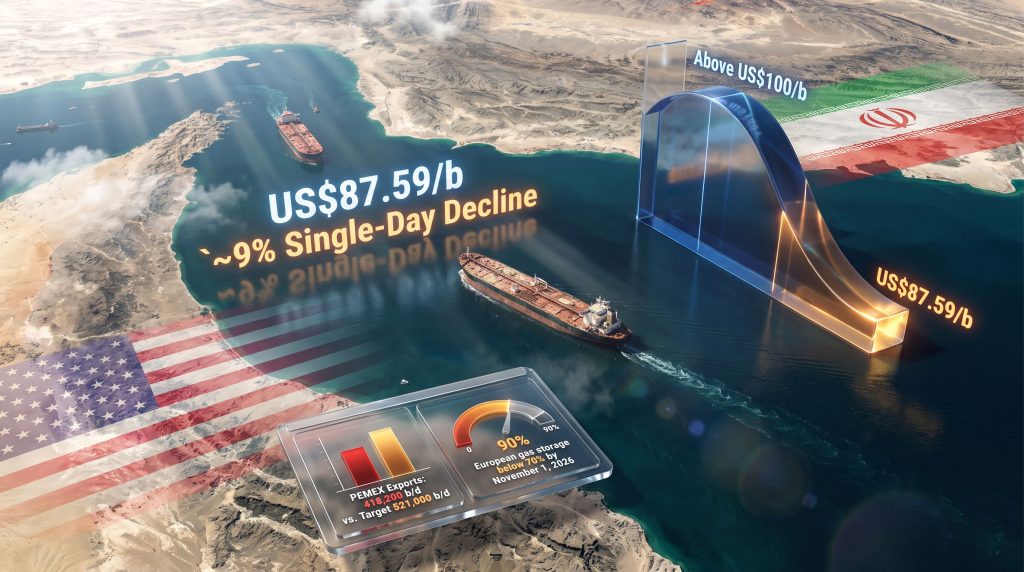
The sequence of events that drove Brent crude from above US$100 per barrel to a session low of US$87.59/b on June 27, 2026, followed a recognisable pattern. The US ambassador to the United Nations confirmed that military operations against Iran had paused for a second consecutive night to allow diplomatic discussions to proceed. Separately, an Iranian military spokesperson confirmed that retaliatory strikes in the region had also been suspended.
Taken together, these statements shifted trader expectations around one critical variable: the near-term probability of a sustained Strait of Hormuz blockade. By afternoon trading, Brent had partially recovered but still represented a single-day decline of over 6%, settling at US$90.60/b. WTI crude followed a parallel trajectory, moving sharply toward the US$83/b range.
This price correction was not the first of its kind during this conflict cycle. An earlier diplomatic pause between the US and Iran had previously produced a comparable pullback of approximately 10%, normalising prices near US$70/b after both nations signed a memorandum of understanding to suspend military actions and reopen the strait. The subsequent breakdown of that agreement, and the fresh surge back above US$100/b, illustrated a defining feature of geopolitically-driven commodity markets: price spikes occur faster than they retreat, and recoveries are fragile.
Brent vs. WTI: Benchmark Comparison During the Pause
| Benchmark | Pre-Pause Level | Post-Pause Session Low | Settled Price | Approximate Decline |
|---|---|---|---|---|
| Brent Crude | Above US$100/b | US$87.59/b (intraday) | US$90.60/b | ~6-9% |
| WTI Crude | Elevated above US$90/b | ~US$83/b | Sharp decline | Significant |
The brief breach of the US$90/b psychological threshold by Brent during intraday trading carried symbolic weight beyond the numbers themselves. In commodity markets, round-number levels attract concentrated options positioning, stop-loss triggers, and algorithmic responses. Breaching US$90/b accelerated the downward momentum before a partial recovery established a more sustainable settling price.
The Strait of Hormuz: The World's Most Consequential Waterway
Why 20% of Global Energy Flows Through a Single Narrow Passage
The Strait of Hormuz is a maritime chokepoint approximately 33 kilometres wide at its narrowest navigable point, situated between Iran and Oman at the entrance to the Persian Gulf. Through this passage flows roughly 20% of global oil and liquefied natural gas shipments daily, including the export volumes of Saudi Arabia, Iraq, Kuwait, the UAE, and a significant portion of Qatar's LNG production.
When the initial outbreak of US-Iran hostilities led to closure of this strait, the market reaction was immediate and severe. No alternative routing can fully substitute for Hormuz at scale. Pipelines that bypass the Gulf, such as the East-West Pipeline through Saudi Arabia, carry far less volume than the combined seaborne traffic and cannot be expanded overnight.
The significance of simultaneous pressure on two chokepoints during this conflict cycle deserves particular attention. Houthi forces in Yemen launched strikes against tankers operating in the Red Sea, which Saudi Arabia had been using as an alternative export corridor. With both the Strait of Hormuz and the Red Sea under simultaneous threat, the market confronted an unprecedented dual-chokepoint scenario. This dynamic partially explains why Brent surged above US$100/b before the diplomatic pause — a level not seen since the earlier period of elevated energy prices. Furthermore, the trade war impact on oil added an additional layer of complexity to an already strained supply environment.
Is the Price Decline Sustainable? Analyst Perspectives
Why the Risk Premium Has Not Fully Unwound
Market analysts have emphasised that the diplomatic pause represents a temporary interruption in hostilities rather than a resolution of the underlying conflict. Susannah Streeter, Chief Investment Strategist at Wealth Club, communicated to the BBC that financial markets remain in a state of caution given the fluid nature of the conflict, noting that current price levels continue to reflect meaningful uncertainty about whether a durable long-term settlement can be reached.
This caution is rational. The structural scenarios that could rapidly rebuild the war premium include:
- A breakdown in diplomatic talks leading to the resumption of military operations
- Re-closure of the Strait of Hormuz following renewed strikes
- Escalation of Houthi activity targeting additional Red Sea shipping lanes
- A failure to formalise the informal pause into a binding framework
Conversely, the scenarios that could support further price softening include:
- A formal ceasefire agreement with internationally verified monitoring
- Full reopening of the Strait of Hormuz to commercial shipping
- OPEC+ supply adjustments designed to offset prior market tightness, consistent with OPEC's market influence on price stabilisation
- A reduction in Houthi operational capacity affecting Red Sea targeting
"Markets have not priced out the risk premium entirely. They have repriced it downward based on a change in probability, not a change in underlying reality. Until the conflict reaches a verifiable resolution, crude prices will remain tethered to geopolitical news flow."
European Natural Gas: A Winter Crisis in Formation
While crude oil market movements dominate headlines, a parallel and potentially more structurally damaging dynamic is developing in European natural gas markets. Research from Wood Mackenzie highlights that European gas storage has reached historically low levels heading into the injection season. The firm's modelling indicates that if the Strait of Hormuz remains impassable for an additional two months beyond late June 2026, European storage could fall below 70% capacity by November 1, 2026.
This figure carries serious implications when measured against context. The five-year historical average for European gas storage at that date stands at approximately 90%. A 20-percentage-point deficit entering winter would represent an extreme tightness scenario with limited margin for cold weather variance or demand spikes. The natural gas price outlook for Europe remains deeply uncertain against this backdrop.
Massimo Di Odoardo, Vice President of Gas and LNG Research at Wood Mackenzie, has stated that the convergence of low European inventories, sustained Asian LNG demand, and constrained growth in new LNG supply capacity will likely sustain elevated LNG price pressure well into 2027. This assessment has significant implications for global spot LNG pricing and the economics of long-term contract renegotiations currently underway between European utilities and producing nations.
Mexico's Asymmetric Exposure to the Global Price Shock
A Fiscal Architecture Built on Different Assumptions
Mexico's position within this global energy disruption is structurally complex. The country does not import crude oil or natural gas directly from Middle Eastern producers, yet its exposure to global price volatility is substantial through three indirect channels: benchmark price transmission affecting PEMEX revenues, IEPS subsidy cost escalation, and shifts in international capital allocation affecting clean energy investment flows.
The 2026 federal budget was constructed on a reference price of US$54.9/b for the Mexican Mix crude. By April 2026, the SHCP's Pre-Criterios 2027 had revised that assumption upward by 40.8% to US$77.3/b, reflecting the persistent impact of the Iran conflict on global benchmarks. Through most of the second quarter of 2026, actual Mexican Mix export prices traded above even this revised estimate.
PEMEX Export Volume: The Structural Bottleneck Limiting Revenue Capture
| Metric | Target | Actual (April 2026) | Variance |
|---|---|---|---|
| PEMEX Export Volume | 521,000 b/d (SHCP target) | 418,200 b/d | ~20% below target |
| Revenue Capture vs. Potential | Full windfall at target volume | Structurally limited | Significant shortfall |
The administration's refinery-first policy, which redirects crude toward domestic processing facilities rather than international export markets, means that elevated global prices only partially translate into fiscal revenues. Fewer barrels at higher prices capture some but not all of the potential windfall that would otherwise flow from a price surge of this magnitude.
The IEPS Mechanism: Mexico's Automatic Subsidy Amplifier
Running in the opposite direction to the partial revenue benefit is Mexico's IEPS fuel subsidy framework. This mechanism functions as an automatic price stabiliser at the domestic pump: when international refined product prices rise, the government absorbs the differential between global benchmark prices and domestic retail pump prices.
"The IEPS framework means that every dollar gain in international oil benchmarks translates directly into an expanded fiscal liability for the Mexican government, regardless of what is happening to PEMEX revenue on the export side."
Under current elevated price conditions, this mechanism costs approximately MX$2.5 billion per week. Goldman Sachs has warned that easily accessible buffers of refined products, including petrochemical feedstocks such as naphtha and LPG as well as jet fuel, are being depleted at an accelerating rate. The risk of localised shortages in these product categories grows proportionally with the duration of the supply disruption.
The resulting fiscal paradox is notable: higher crude prices simultaneously increase PEMEX's per-barrel revenue potential while expanding the government's subsidy obligations on the import side. The net fiscal position depends heavily on export volume, refinery utilisation rates, and the duration of elevated international prices.
Long-Term Energy Strategy: What Geopolitical Instability Is Forcing Mexico to Confront
Renewable Energy as a Structural Hedge Against External Shocks
Mexico's solar and wind resource endowment is substantial, with northern regions such as Sonora and Chihuahua and southeastern zones offering high-capacity-factor generation potential. Energy expert Ana Laura Ludlow has noted that while Mexico does not face direct import exposure to Middle Eastern energy, the indirect transmission of global price shocks creates both risk and strategic opportunity. The renewable energy transition currently underway in the country's industrial and commercial sectors represents a meaningful structural hedge against precisely this kind of external volatility.
However, two conditions are identified as essential prerequisites:
- Grid infrastructure expansion to accommodate higher renewable penetration and reduce curtailment risk
- Regulatory clarity to provide the investment certainty that long-duration clean energy projects require
Nearshoring and the Industrial Demand Catalyst
The North American nearshoring wave — encompassing manufacturing, automotive assembly, electronics production, and data centre operations relocating to Mexico — is generating a new class of electricity demand with specific characteristics. These industrial and commercial facilities operate under corporate sustainability commitments that require access to verified low-carbon power. This drives direct demand for:
- Long-term corporate power purchase agreements (PPAs) structured around renewable generation
- On-site and grid-scale battery storage to manage supply intermittency
- Transparent carbon accounting frameworks that allow corporate buyers to verify emissions performance
Natural Gas as the Bridge Fuel and the Green Hydrogen Horizon
Mexico's access to North American natural gas supply through existing pipeline infrastructure provides a meaningful competitive advantage during the energy transition period. Domestic gas infrastructure supports grid stability and manages the intermittency inherent in variable renewable generation, reducing the cost of transition by avoiding stranded asset risk in the near term.
Looking further ahead, the structural groundwork being laid through gas infrastructure development creates a viable pathway toward low-carbon fuel alternatives. Early-stage green hydrogen project development, supported by consistent regulatory frameworks, could capture a share of the international demand that is beginning to materialise as industrial decarbonisation accelerates globally.
The next major ASX story will hit our subscribers first
Frequently Asked Questions
Why did oil fall below $90 when the US and Iran announced a pause?
When military operations pause and diplomatic channels open, traders reduce their probability estimate for a sustained Strait of Hormuz disruption. Because approximately 20% of global oil and LNG shipments transit this single chokepoint, even a partial reduction in closure risk causes markets to rapidly unwind the war-risk premium embedded in crude prices. This produced the sharp single-session decline observed on June 27, 2026, when oil falls below $90 as US-Iran pause calms energy markets became the defining headline of the trading day.
What makes the Strait of Hormuz so critical to global energy prices?
The strait is a narrow maritime passage serving as the primary export corridor for Persian Gulf oil producers. Its strategic importance means any credible threat of closure immediately elevates global crude benchmarks by pricing in potential supply shortfalls across approximately one-fifth of global daily oil and LNG volume. No alternative routing exists at comparable scale.
How does the US-Iran conflict affect Mexico despite no direct imports?
Mexico's exposure operates through three indirect channels. First, global benchmark price transmission affects both PEMEX export revenues and IEPS subsidy costs simultaneously. Second, international capital allocation shifts affect the flow of clean energy investment into Mexico. Third, supply chain disruptions in refined products and petrochemical feedstocks create potential localised shortages regardless of crude import origin.
Could Brent crude return above $100 per barrel?
This scenario remains plausible. The current decline reflects a diplomatic pause rather than a resolved conflict. If negotiations collapse, military operations resume, or the Strait of Hormuz is re-closed, the war-risk premium would rapidly rebuild. The historical precedent from earlier in this conflict cycle — where a prior pause was followed by an agreement breakdown and a fresh price surge above US$100/b — demonstrates this risk is active rather than theoretical. In this environment, oil falls below $90 as US-Iran pause calms energy markets may prove to be only a temporary reprieve.
Disclaimer: This article contains forward-looking analysis and scenario projections related to geopolitical events and energy market pricing. Such projections involve significant uncertainty and should not be interpreted as investment advice. Market conditions, diplomatic developments, and supply dynamics may change materially from those described. Readers should conduct independent due diligence before making any investment or business decisions based on information contained herein.
Want To Stay Ahead of Market-Moving Resource Discoveries Before the Crowd Catches On?
While geopolitical risk premiums dominate energy markets, significant mineral discoveries on the ASX can deliver equally transformative returns — and timing is everything. Discovery Alert's proprietary Discovery IQ model delivers real-time alerts the moment significant ASX mineral discoveries are announced, turning complex data across more than 30 commodities into clear, actionable opportunities; explore historic discovery returns on Discovery Alert's dedicated discoveries page and begin your 14-day free trial to position yourself ahead of the broader market.