July 28, 2026
The Geography of Fear: How Conflict Risk Gets Built Into Crude Oil Prices
Energy markets do not wait for wars to end before they reprice. They reprice the moment expectations shift, even fractionally, even without confirmation. This is the fundamental mechanism at work when crude benchmarks fall sharply on a single piece of geopolitical news: the market is not reacting to what has happened, it is reacting to what it now believes is less likely to happen. Understanding this distinction is essential to interpreting what the current oil prices drop on pause in U.S.-Iran hostilities actually tells us about the structure of global energy markets.
The late July 2026 decline in crude prices, which saw both major benchmarks shed more than 2% in a single session, was not a signal that the conflict had resolved. It was a signal that the worst-case probability had declined, at least temporarily. That nuance carries significant implications for investors, energy consumers, and anyone tracking Middle East geopolitical risk.
When big ASX news breaks, our subscribers know first
How the Geopolitical Risk Premium Works in Commodity Markets
Every time a credible military threat emerges near a major energy supply corridor, traders embed a risk premium into futures prices. This premium reflects the probability-weighted cost of a supply disruption scenario. The more acute the threat, the larger the embedded premium. When that threat diminishes, even partially, the premium deflates with it.
This mechanism is well-documented across decades of Middle East conflict cycles, from the Gulf War through to the Iran-Iraq tanker war of the 1980s. Furthermore, it explains why crude prices can move 2% or more in a single session without any actual change in physical supply. The market is continuously revising its expected future supply rather than reacting to current supply conditions.
Understanding geopolitical oil price drivers helps contextualise why, during the most acute phase of the U.S.-Iran standoff in mid-2026, the risk premium was estimated to have added somewhere in the range of $3 to $6 per barrel to both Brent and WTI valuations. The two-session decline following the hostilities pause effectively unwound a meaningful portion of that embedded pricing.
Brent and WTI: Where Prices Landed
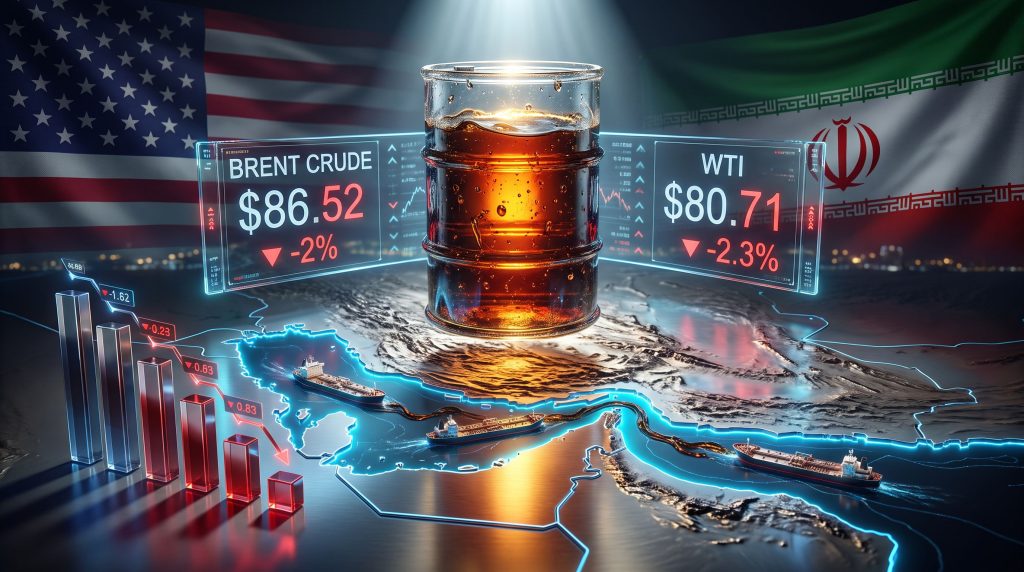
| Benchmark | Contract Month | Price Per Barrel | Session Change |
|---|---|---|---|
| Brent Crude | September 2026 | $86.52 | -2.0%+ |
| WTI Crude | September 2026 | $80.71 | -2.3% |
The spread between Brent and WTI widened slightly during the escalation phase, consistent with historical patterns where internationally-traded Brent carries greater sensitivity to Middle East supply risk than the U.S. domestic benchmark.
The Strait of Hormuz: A Chokepoint That Prices an Entire Market
To understand why U.S.-Iran tensions carry such outsized influence over global energy pricing, geography is the starting point. The Strait of Hormuz is a narrow maritime passage connecting the Persian Gulf to the broader Arabian Sea, flanked by Iran on its northern shore. At its narrowest point, the navigable channel is only a few kilometres wide, yet it serves as the primary export artery for crude oil produced in Saudi Arabia, Iraq, Kuwait, the UAE, and Iran itself.
The volume of oil transiting this passage daily is extraordinary. Estimates consistently place the figure at approximately 20 to 21 million barrels per day, representing roughly one-fifth of all petroleum consumed globally. No other single geographic point concentrates this much energy trade in such a confined space.
This structural reality creates a permanent asymmetry in how markets respond to Persian Gulf tensions. As reported by The Guardian, the scale of this asymmetry became strikingly apparent during the mid-2026 standoff:
- A partial disruption to Hormuz transit, even for a matter of days, would remove supply volumes that no other production region could replace on short notice.
- A full blockade scenario, whilst unlikely, would represent a supply shock with no modern precedent in scale.
- Even the credible threat of disruption, without any actual interference, is sufficient to move crude prices materially.
Commonwealth Bank of Australia flagged this dynamic explicitly in a research note published on the same day prices declined. The note observed that whilst the pause in direct military exchanges had reduced fears of imminent attacks on civilian and energy infrastructure, unresolved disagreements over Hormuz access represented a credible pathway through which hostilities could reignite. This assessment captures the core tension: de-escalation in rhetoric does not eliminate de-escalation in risk.
The Munitions Variable: A New Analytical Layer for Energy Markets
One of the more unusual dimensions of the mid-2026 conflict cycle has been the emergence of U.S. military capacity constraints as a market pricing input. Reports citing concerns about depleted U.S. munitions stockpiles circulated widely, suggesting that weapons availability was becoming a factor in military planning timelines.
President Donald Trump, who had publicly indicated he was weighing a large-scale strike on Iran as recently as the Friday before the pause, subsequently stepped back from those plans. The New York Times reported that arms stockpile considerations played a role in that recalibration. Publicly, the U.S. administration pushed back against this narrative. Trump told reporters aboard Air Force One that the military maintained sufficient ordnance and that concerns about supply constraints were overstated.
For energy markets, however, this conflicting information created an unusual pricing dynamic:
- If U.S. strike capability was genuinely constrained in the short term, the probability of a large-scale attack on Iranian energy or military infrastructure declined.
- Lower strike probability reduced the probability of Iranian retaliation targeting Gulf energy infrastructure.
- This chain of inference supported the broader de-escalation trade, contributing to the oil prices drop on pause in U.S.-Iran hostilities.
- However, the credibility gap between official denials and independent reporting left the market with residual uncertainty that prevented a full premium washout.
Markets have historically treated official denials with a degree of scepticism when independent reporting points in a different direction. In this instance, the ambiguity itself became a pricing input, moderating both the escalation premium and its subsequent deflation.
Iran's Position and Why the Ceasefire Remains Unconfirmed
Tehran's public stance added another layer of complexity to the de-escalation narrative. Iranian authorities rejected reports that a formal 10-day ceasefire had been agreed, meaning the reduction in hostilities reflected an operational pause rather than a negotiated settlement. This distinction matters considerably from a risk management perspective.
An operational pause can end at any moment without formal notice. A negotiated ceasefire, by contrast, creates institutional accountability and typically involves third-party monitoring. Consequently, the absence of any confirmed diplomatic framework means that the current calm rests on informal mutual restraint — a far more fragile foundation than markets sometimes price.
Risk Framework: Current Conflict Variables and Their Market Implications
| Variable | Current Status | Market Sensitivity |
|---|---|---|
| Direct military exchanges | Temporarily paused | High, immediate price impact on resumption |
| Formal ceasefire agreement | Not confirmed | Fragile baseline, reversal risk elevated |
| Hormuz shipping disruption | Currently stable | Extreme, any interference triggers sharp repricing |
| Iranian energy infrastructure | Intact | No supply shock embedded yet |
| U.S. munitions constraints | Reported, officially denied | Ambiguous, introduces strategic uncertainty |
| OPEC+ spare capacity | Available but limited | Partial buffer only, insufficient for Hormuz closure |
What a Price Reversal Would Look Like
The current pricing environment reflects a de-escalation scenario that neither party has formally endorsed. This creates asymmetric risk to the upside for crude prices. Several specific triggers could rapidly reinstate and potentially amplify the conflict premium:
- Any confirmed naval confrontation in the Strait of Hormuz, including vessel seizures or mining incidents.
- A missile or drone strike on export terminals in Saudi Arabia, the UAE, or Iraq.
- A resumption of direct U.S.-Iran strikes involving energy or civilian infrastructure.
- Formal Iranian closure of Hormuz shipping lanes, even temporarily.
OPEC's market influence provides some context here, as member nations hold meaningful spare production capacity. However, this buffer carries a critical limitation: most of that spare capacity is located within the Persian Gulf region, meaning its export route also runs through Hormuz. A closure scenario would simultaneously remove Iranian supply and constrain the ability of other Gulf producers to compensate.
The next major ASX story will hit our subscribers first
Energy Supply Security in a Concentrated World
The broader strategic lesson from the 2026 U.S.-Iran conflict cycle extends well beyond any single price move. The episode has reinforced how concentrated global energy supply infrastructure remains around a small number of geographic points. Decades of investment in Gulf production capacity have created an efficient system under normal conditions, but an extraordinarily fragile one under stress.
Major energy-importing nations have responded in predictable ways. As CNBC reported, the scale of the price movement prompted a renewed wave of strategic policy responses across importing economies:
- Strategic petroleum reserve discussions have intensified across Europe and Asia as short-term buffer mechanisms.
- Non-Middle Eastern supply diversification has gained renewed policy attention, accelerating conversations about North American, West African, and South American production investment.
- Alternative fuel investment has been indirectly supported by the conflict, as the vulnerability of fossil fuel supply chains provides additional justification for energy transition spending.
In addition, the broader trade war impact on oil has compounded these pressures, whilst oil trade and geopolitics continue to intersect in ways that complicate any straightforward price forecast. Furthermore, energy transition pressures are gaining renewed attention as the vulnerabilities of fossil fuel supply chains become increasingly apparent. None of these responses address the immediate risk — they represent longer-cycle adjustments that take years to materially reduce the world's dependence on Hormuz transit.
FAQ: Understanding Oil Prices and the U.S.-Iran Standoff
Why do oil prices fall during a pause rather than waiting for a full resolution?
Commodity markets price probabilities continuously. A pause reduces the estimated likelihood of imminent supply disruption, which is sufficient to deflate the embedded risk premium, even without a final settlement. Traders do not wait for certainty because certainty arrives too late to act on profitably.
How significant is the $3 to $6 per barrel conflict premium estimate?
At peak escalation, this range represents a material uplift on an $80 to $90 base price. A 5% conflict premium embedded in global crude pricing has downstream effects on transportation fuel costs, manufacturing input costs, and inflation measures across importing economies.
Could OPEC+ offset a Hormuz closure?
Not in any meaningful timeframe. The majority of OPEC+ spare capacity is held by Gulf producers whose export routes also depend on Hormuz transit. A closure would simultaneously reduce Iranian supply and constrain the ability of Saudi Arabia, the UAE, Kuwait, and Iraq to compensate.
What is the difference between Brent and WTI, and why does it matter here?
WTI reflects U.S. domestic supply and demand dynamics, priced at Cushing, Oklahoma. Brent reflects internationally traded crude and serves as the global reference price. Brent typically carries higher sensitivity to Middle East geopolitical events, which is why the oil prices drop on pause in U.S.-Iran hostilities has influenced both benchmarks but with slightly different magnitudes.
What would a formal ceasefire change in market terms?
A confirmed, monitored ceasefire would provide a more durable basis for premium deflation. Without it, the current price decline rests on informal restraint, meaning the conflict risk has been repriced lower rather than eliminated. Investors should, however, treat these as fundamentally different scenarios.
Disclaimer: This article contains forward-looking assessments and references to geopolitical scenarios that involve significant uncertainty. Crude oil price projections and conflict risk assessments are inherently speculative. Nothing in this article constitutes financial or investment advice. Readers should conduct their own research and consult qualified professionals before making investment decisions.
Want to Stay Ahead of the Market Opportunities Emerging From Global Commodity Disruptions?
Discovery Alert's proprietary Discovery IQ model delivers real-time alerts on significant ASX mineral discoveries, instantly transforming complex commodity data into actionable insights for both short-term traders and long-term investors — explore historic discovery returns to understand the scale of opportunity these market shifts can create, and begin your 14-day free trial at Discovery Alert to position yourself ahead of the broader market.