May 20, 2026
What Makes Aluminum Uniquely Vulnerable to Energy Market Shocks?
Global energy markets operate through interconnected networks where disruptions in one region cascade across continents, but few industrial commodities demonstrate this vulnerability as starkly as aluminum. The relationship between energy costs and aluminum production creates a direct transmission mechanism that transforms geopolitical tensions into immediate price volatility, with aluminum prices and gulf conflict dynamics highlighting this unique exposure more clearly than other base metals that rely more heavily on raw material availability than energy inputs.
The Energy-Intensive Nature of Primary Aluminum Production
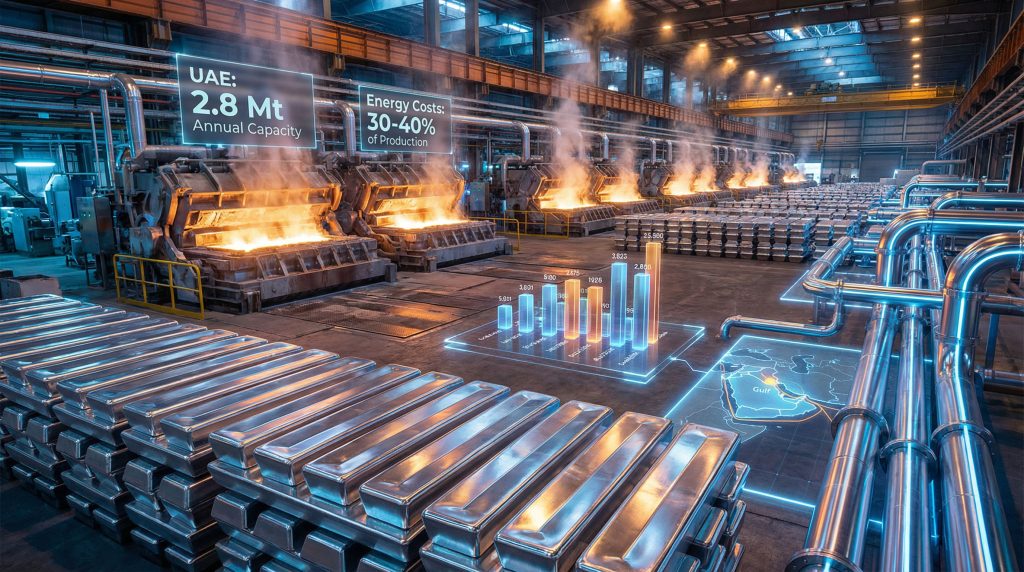
Aluminum smelting represents one of the most electricity-intensive industrial processes in the modern economy. The electrolytic reduction process that converts alumina into metallic aluminum requires approximately 13-15 megawatt-hours per tonne of finished metal, making energy costs account for 30-40% of total operational expenses at most facilities.
This energy dependency creates immediate cost transmission when power prices fluctuate. Unlike steel production, which relies primarily on coal and iron ore inputs, or copper extraction, which depends more heavily on ore grades and processing techniques, aluminum's production economics shift almost instantaneously with electricity price movements.
Key Energy Requirements by Metal:
- Aluminum: 13-15 MWh per tonne (primarily electricity)
- Steel: 20-25 GJ per tonne (primarily coal/natural gas)
- Copper: 15-20 MWh per tonne (mixed energy sources)
- Zinc: 10-12 MWh per tonne (mixed energy sources)
Why Traditional Hedging Strategies Fall Short During Energy Crises
Financial markets provide sophisticated hedging instruments for most commodity inputs, but electricity markets remain fragmented and regionally constrained. Aluminum producers can hedge metal prices through London Metal Exchange contracts and secure alumina supply agreements, but electricity price hedging remains limited to short-term regional contracts that often exclude force majeure scenarios.
The time lag between energy price spikes and production adjustments compounds this vulnerability. While other metals can adjust output relatively quickly by scaling mining industry innovation operations or processing throughput, aluminum smelters require continuous power supply to maintain their electrolytic cells.
Interrupting this process damages equipment and requires months of careful restart procedures. Furthermore, the US natural gas forecast indicates continued volatility that could further impact aluminum production costs globally.
When big ASX news breaks, our subscribers know first
How Regional Energy Dependencies Create Systemic Market Risks
Gulf States' Strategic Position in Global Aluminum Supply
The Persian Gulf region has emerged as a critical hub for global aluminum production, leveraging abundant natural gas reserves to build world-class smelting capacity. This concentration creates systemic risk when regional tensions threaten energy infrastructure or transportation routes.
Middle East Aluminum Production Capacity Analysis
| Country | Annual Capacity (Mt) | % of Global Non-China Supply | Primary Export Routes |
|---|---|---|---|
| UAE | 2.8 | 12.1% | Strait of Hormuz |
| Bahrain | 1.5 | 6.5% | Strait of Hormuz |
| Qatar | 0.7 | 3.0% | Strait of Hormuz |
| Saudi Arabia | 1.8 | 7.8% | Red Sea/Hormuz |
The Gulf region's 6.8 million tonnes of annual primary aluminum production represents approximately 9% of global output and more than 21% of non-Chinese supply. This concentration means that regional disruptions have disproportionate global impact, particularly since roughly three-quarters of Gulf aluminum production targets export markets.
Energy Infrastructure Vulnerabilities Beyond Direct Warfare
Modern aluminum production depends on integrated energy systems that extend far beyond individual smelter facilities. Natural gas pipeline networks, liquefied natural gas terminals, and interconnected electricity grids create multiple points of potential disruption that don't require direct military action to impact production.
Regional power grid interdependencies mean that energy supply disruptions in one country can affect neighbouring aluminum producers. In addition, strategic petroleum reserve drawdowns during crisis periods redirect energy supplies away from industrial users toward strategic stockpiling, creating secondary effects on aluminum production costs even in facilities not directly threatened by conflict.
Why Current Price Movements Signal Structural Market Changes
Analyzing the $3,400+ Price Surge Through Supply-Demand Fundamentals
Recent market movements reflect more than temporary geopolitical premium pricing. LME spot prices reaching $3,384.50 per tonne with three-month contracts at $3,446 per tonne indicate fundamental supply-demand imbalances driven by energy cost recalibration across global production networks.
According to S&P Global, aluminum prices and gulf conflict dynamics have created unprecedented supply chain disruptions that extend beyond traditional shipping constraints.
London Metal Exchange inventory data reveals the speed and magnitude of supply tightening. Active LME stocks declined from 420,850 tonnes on February 27 to 273,775 tonnes by March 9, representing a 147,000-tonne reduction in less than two weeks. This inventory depletion rate suggests market participants anticipate sustained supply constraints rather than temporary logistical delays.
Energy Premium vs. Traditional Geopolitical Risk Premium
Current aluminum price movements represent a fundamental energy cost recalibration across global production networks rather than conventional transportation risk premiums typically associated with geopolitical tensions.
Traditional war premiums in commodity markets typically reflect increased transportation costs, insurance surcharges, and temporary supply route disruptions. Energy-driven premiums operate differently, directly impacting the marginal cost of production and creating sustained price floor adjustments that persist beyond immediate conflict resolution.
However, the current oil price rally adds another layer of complexity to production costs, as refineries and power generation facilities face increased fuel expenses that ultimately impact aluminum smelting operations.
Regional Price Divergence Patterns
Regional premium structures demonstrate how energy market integration amplifies aluminum price volatility beyond base LME pricing. European duty-paid premiums have increased to $410-440 per tonne, representing a 20% increase from pre-crisis levels, while U.S. Midwest premiums reached $1.06-1.08 per pound.
Asian spot premiums show strong correlation with regional natural gas prices, as electricity generation in major consuming markets relies heavily on gas-fired power plants. This correlation creates feedback loops where energy market volatility multiplies aluminum price instability across multiple geographic markets simultaneously.
What Happens When China's Buffer Capacity Reaches Its Limits?
The End of China's Role as Global Swing Producer
China's aluminum industry has historically provided global market stability through flexible production capacity that could respond to international price signals. Government policy now caps domestic aluminum production at approximately 45 million tonnes annually, with current utilisation rates approaching these maximum sustainable levels.
This constraint removes the world's largest producer from its traditional role as swing supplier. Previous price spikes could trigger increased Chinese exports of semi-finished aluminum products, providing global supply relief. Current capacity restrictions mean China increasingly absorbs more metal domestically while reducing export availability for international markets.
Implications for Global Price Discovery Mechanisms
Reduced elasticity in global supply response fundamentally alters how aluminum markets discover prices during supply disruptions. Without Chinese capacity expansion capability, regional supply shocks translate more directly into global price increases, creating higher baseline volatility for aluminum compared to other industrial metals.
New price formation dynamics emerge when the world's largest producer shifts from net exporter to net importer status. Chinese aluminum import increases create additional demand pressure on international markets already constrained by Gulf region supply uncertainties.
How Energy Market Integration Amplifies Aluminum Price Volatility
Natural Gas Price Transmission Mechanisms
Natural gas serves as the primary fuel for electricity generation in many aluminum-producing regions, creating direct cost transmission from gas markets to metal prices. European aluminum producers face particularly acute exposure as regional electricity markets incorporate natural gas price volatility directly into industrial power tariffs.
Cross-commodity correlation analysis reveals strengthening relationships between natural gas futures, electricity forward curves, and aluminum pricing. Statistical correlation coefficients between Henry Hub natural gas prices and LME aluminum have increased from approximately 0.3 during stable periods to over 0.7 during energy market stress periods.
Transportation Cost Multiplier Effects
Energy market disruptions create cascading cost increases beyond direct smelting expenses. Higher fuel prices increase shipping costs for both alumina inputs and finished aluminum products, while insurance premium surges add additional cost layers during crisis periods.
Crisis Period Cost Component Analysis
| Cost Element | Normal Conditions | Crisis Premium | Impact on Final Price |
|---|---|---|---|
| Base Energy | 35% | +40-60% | $400-600/tonne |
| Transportation | 8% | +25-40% | $80-120/tonne |
| Insurance | 2% | +200-300% | $60-90/tonne |
| Working Capital | 5% | +15-25% | $50-80/tonne |
Which Production Regions Face the Greatest Restructuring Pressure?
Comparative Energy Security Analysis by Region
North American aluminum producers benefit from shale gas abundance and relatively stable electrical grid infrastructure, providing competitive advantages during global energy market volatility. Canadian facilities with access to hydroelectric power demonstrate particular resilience to fossil fuel price fluctuations.
European aluminum production faces significant challenges from renewable energy transition complexities combined with reduced Russian gas availability. Consequently, grid stability concerns during high renewable penetration periods create additional operational risks for continuous-process smelting operations.
Australian aluminum smelters rely heavily on coal-based electricity generation, providing some insulation from natural gas price volatility but creating exposure to carbon pricing policies and environmental regulations. For instance, this creates potential constraints on long-term competitiveness as renewable energy solutions become more prevalent.
Long-term Competitiveness Shifts in Global Aluminum Industry
Capital allocation patterns indicate strategic repositioning toward energy-secure jurisdictions. New smelting capacity investments increasingly prioritise regions with diversified energy portfolios, stable regulatory frameworks, and long-term power purchase agreement availability.
Technology adoption rates for energy-efficient production methods accelerate as energy cost volatility increases return on investment calculations for advanced smelting technologies. Furthermore, renewable energy integration timelines become critical competitive factors for long-term facility planning.
The next major ASX story will hit our subscribers first
What Do Forward Markets Signal About Long-term Supply Security?
Futures Curve Analysis and Market Expectations
Aluminum futures curves demonstrate persistent backwardation during energy market stress periods, indicating markets expect current supply constraints to persist beyond immediate crisis resolution. Three-month versus 15-month contract spreads provide insight into expected duration of energy-related supply limitations.
Reuters analysis suggests that aluminum prices and gulf conflict interactions may continue influencing market dynamics well into 2026, with shipping disruptions creating sustained supply chain pressures.
Options volatility surfaces reveal tail risk pricing that extends well beyond historical norms for aluminum markets. Implied volatility levels suggest market participants anticipate continued energy-driven price instability rather than return to previous trading ranges.
Investment Flow Implications for Aluminum Sector Development
Capital expenditure deferrals in high-energy-cost regions accelerate as investors reassess long-term production economics under volatile energy pricing scenarios. New project development timelines extend to incorporate additional energy security due diligence and risk mitigation planning.
Strategic stockpiling decisions by major consuming nations reflect concerns about supply chain resilience during energy market disruptions. Government policies increasingly treat aluminum as strategically important material requiring domestic reserve management.
How Should Industrial Users Adapt to New Supply Chain Realities?
Risk Management Evolution Beyond Traditional Hedging
Industrial aluminum consumers must develop sophisticated energy-linked pricing mechanisms that account for production cost volatility beyond simple metal price hedging. Regional supply diversification strategies become essential for maintaining operational continuity during energy market disruptions.
Vertical integration considerations gain importance as energy cost volatility increases the value of controlling multiple supply chain stages. Large automotive and aerospace manufacturers evaluate backward integration into aluminum production to secure energy-stable metal supplies.
Moreover, US tariff impacts on global trade patterns may further complicate supply chain strategies, requiring additional flexibility in sourcing arrangements.
Strategic Inventory Management in Volatile Energy Environments
Optimal inventory levels during energy price uncertainty require balancing carrying costs against supply security premiums. Just-in-time delivery systems face challenges when energy market volatility creates unpredictable production schedules at supplier facilities.
Regional stockpiling versus centralised inventory management decisions increasingly factor in energy market stability across different geographic locations. Financial cost of carry calculations must incorporate supply security value during extended energy market stress periods.
FAQ: Understanding Aluminum's Energy-Price Relationship
Why doesn't aluminum production simply shift to lower-cost regions immediately?
Aluminum smelter operations require significant capital investment and specialised infrastructure that cannot be quickly relocated. Facility restart complexities mean that once a smelter is shut down, complete recovery requires careful multi-month procedures to restore electrolytic cell operations without equipment damage.
Skilled workforce requirements and supporting infrastructure create additional barriers to rapid capacity reallocation. Modern aluminum smelting requires highly trained technicians familiar with electrolytic process control, electrical systems management, and specialised maintenance procedures that take years to develop.
How long do energy-driven price premiums typically persist?
Historical analysis suggests energy-driven aluminum price premiums persist longer than transportation-based disruption premiums. While shipping delays may resolve within weeks or months, energy cost structure changes often require years for full market adjustment through demand elasticity responses and supply chain adaptation.
Supply chain adaptation timelines depend on new capacity development, which requires 3-5 years for greenfield aluminum smelting projects. Brownfield capacity expansions or restarts typically require 12-18 months, meaning energy-driven supply constraints cannot be quickly resolved through increased production.
What role do strategic reserves play in price stabilisation?
Government stockpile release mechanisms provide limited aluminum market stabilisation due to relatively small reserve quantities compared to annual consumption. Strategic reserves typically focus on national security applications rather than broad industrial supply stabilisation.
Private sector inventory strategies during supply disruptions create more significant market impact than government reserves. Industrial consumers' destocking during high prices and restocking during corrections often amplifies price volatility rather than stabilising markets.
International coordination frameworks for critical materials remain underdeveloped for aluminum compared to energy commodities, limiting coordinated response capability during supply crises. Regional trade agreements and bilateral supply arrangements provide more practical supply security than multilateral reserve coordination.
This analysis is provided for informational purposes and does not constitute investment advice. Commodity markets involve significant risk, and past performance does not guarantee future results. Readers should consult qualified professionals before making investment decisions.
Ready to Capitalise on Energy-Driven Commodity Volatility?
Discovery Alert's proprietary Discovery IQ model provides instant notifications on significant ASX mineral discoveries, helping investors navigate volatile commodity markets with real-time insights that turn complex market dynamics into actionable opportunities. Begin your 14-day free trial today at Discovery Alert to position yourself ahead of energy-driven market shifts affecting aluminum and other critical commodities.