July 30, 2026
The Dual-Commodity Thesis Reshaping Junior Mining Capital in 2026
Across global commodity markets, a structural shift is underway. Investors who once evaluated mining projects through a single-resource lens are increasingly drawn to assets capable of generating revenue from two distinct market segments simultaneously. The convergence of traditional industrial metals with technology-critical minerals has created a new archetype of junior explorer, one that speaks fluently to both aluminium supply chain buyers and semiconductor-focused technology investors in the same breath.
This is precisely the investment logic underpinning the Alurion IPO for Amargosa Bauxite-Gallium Project, a landmark transaction that brought a purpose-built, single-asset explorer to the ASX in mid-2026 with AUD 50 million in fresh capital and a project footprint in one of Brazil's most mineral-endowed states.
When big ASX news breaks, our subscribers know first
What Makes the Amargosa Project a Dual-Commodity Opportunity?
Bauxite, Gallium, and the Convergence of Two Megatrends
The Amargosa Bauxite-Gallium Project in Bahia, Brazil sits at the intersection of two powerful and largely independent demand cycles. On one side, bauxite remains the foundational raw material for aluminium production, and global bauxite supply continues its structural upward trajectory driven by electric vehicles, lightweight construction, and grid infrastructure. On the other side, gallium has undergone a fundamental reassessment in strategic importance over the past three years.
Gallium is not a standalone mined commodity in the conventional sense. It occurs at trace concentrations within bauxite ore and is recovered as a byproduct during the Bayer process, the industrial method used to refine bauxite into aluminium oxide (alumina). This co-production model is critical to understanding Amargosa's economics: gallium extraction does not require a separate mine, separate infrastructure, or a dramatically different processing circuit. It leverages existing refining infrastructure, meaning the incremental capital cost of adding gallium recovery to an alumina operation is substantially lower than developing a primary gallium mine from scratch.
The Bayer process, developed in 1888 and still the dominant global method for alumina production, involves dissolving bauxite in hot caustic soda to separate aluminium hydroxide from impurities. Gallium, present in bauxite at concentrations typically between 40 and 80 parts per million, accumulates in the caustic liquor during this process and can be recovered through ion exchange or solvent extraction techniques.
Furthermore, the critical minerals demand surge has amplified the strategic relevance of projects capable of producing gallium as a co-product. The primary applications driving gallium demand include:
- Gallium arsenide (GaAs) semiconductors used in smartphones, satellite communications, and radar systems
- Gallium nitride (GaN) transistors powering 5G base stations and high-efficiency power electronics
- Photovoltaic solar cells using copper indium gallium selenide (CIGS) thin-film technology
- Military and defence radar systems operating at high frequencies
- Substrates for artificial intelligence chip architectures requiring high-frequency, high-power performance
China currently controls an estimated 80% or more of global gallium production, a concentration that prompted the Chinese government to impose export restrictions on gallium and germanium in August 2023, triggering immediate supply chain anxiety across Western technology sectors. Those restrictions have since been tightened further, accelerating the urgency among US, European, and Australian policymakers to develop non-Chinese gallium supply. Gallium critical mineral deposits have been formally designated as a priority by the United States Geological Survey, the European Commission, and the Australian Government's Critical Minerals List, reflecting gallium's irreplaceable role in defence and technology supply chains.
Alurion's ASX Listing: Capital Structure and Market Mechanics
IPO Metrics and Share Register Architecture
The Alurion IPO for Amargosa Bauxite-Gallium Project was structured around a clean, straightforward capital raise. According to reporting from Mining Reporters, the key metrics are summarised below:
| Metric | Detail |
|---|---|
| Total Capital Raised | AUD 50,000,040 (~USD 35 million) |
| Shares Issued at IPO | 47,619,048 fully paid ordinary shares |
| Issue Price Per Share | AUD 1.05 (~USD 0.74) |
| Total Shares on Issue Post-Listing | 204,701,236 fully paid ordinary shares |
| ASX Ticker | ALU |
| Official List Admission | 29 July 2026 |
| Trading Commencement | 31 July 2026 |
Escrow Design and Its Implications for Retail Investors
A total of 39,025,413 restricted ordinary shares and 6,010,000 options are held in 24-month escrow until 31 July 2028. An additional 4,190,000 unquoted options fall outside escrow restrictions.
For retail investors assessing near-term liquidity dynamics, the escrow structure is meaningful. When a significant portion of a junior explorer's share register is locked up during its formative listed phase, the supply of shares available for secondary market trading is constrained. This can dampen near-term selling pressure from founders and pre-IPO participants who may otherwise seek early exits. The practical effect is that Alurion's freely tradable float in its first two years of listing is proportionally smaller than its total issued share count suggests.
Investor consideration: Escrow arrangements benefit long-term holders by reducing near-term dilution risk, but investors should note that once escrow periods expire, the release of a significant tranche of shares can create temporary selling pressure if holders choose to exit.
The Amargosa Project: Geological Scale and Resource Definition
JORC Resource, Direct-Ship Bauxite, and What the Numbers Mean
The Amargosa project hosts a JORC-classified resource of approximately 568 million tonnes, making it one of the larger bauxite resource inventories held by an ASX-listed junior explorer. Within this total, approximately 98 million tonnes is classified as direct-ship bauxite (DSB), a particularly commercially significant distinction.
Direct-ship bauxite refers to ore that meets the minimum quality specifications for export and direct use in alumina refineries without requiring beneficiation or upgrading. For mining operations, DSB dramatically simplifies the early development pathway: ore can be mined, crushed, and shipped without the capital expenditure of a processing plant. This lowers the funding threshold for initial production, reduces the technical complexity of early-stage operations, and shortens the timeline to first revenue.
The project's total development scale has been assessed at USD 119 million, reflecting the capital requirements to bring a project of this size to production-ready status. That figure provides a reference point against the AUD 50 million IPO raise, making clear that the current capital is intended to fund exploration and early-stage development activities rather than construction.
Bahia's Geology and Export Infrastructure Advantage
Bahia is located within Brazil's broader mineral endowment corridor, a region that has attracted significant investment from global mining majors across iron ore, manganese, chromite, and bauxite. The state's regulatory frameworks and infrastructure investment history provide a more developed operating environment than many frontier mineral jurisdictions.
The project's 160-kilometre road distance to Porto de Enseada is a meaningful logistical advantage. Port proximity directly determines freight economics for a bulk commodity like bauxite, where transport costs can represent a substantial share of total delivered cost to refineries in Asia or Europe. Brazil is already among the world's top bauxite exporters, competing alongside Guinea, Australia, and Indonesia in global supply chains, and this existing trade infrastructure benefits emerging projects like Amargosa.
How IPO Proceeds Will Be Deployed
The AUD 50 million raised will be allocated across the following priority areas:
- Land acquisition to secure tenure over prospective ground adjacent to the existing JORC resource footprint
- Technical studies encompassing metallurgical testing, resource modelling, and feasibility-level engineering assessments
- Environmental licensing under Brazil's National Mining Agency (ANM) regulatory framework
- Exploration programmes including systematic drilling campaigns and geological mapping to target resource expansion
- Community and social licence development through engagement with Bahia's local communities
- Equipment procurement for field and laboratory operations supporting ongoing programmes
How the Brazilian Rare Earths Demerger Created Alurion
Corporate Separation Logic and Shareholder Endorsement
Alurion did not emerge from a greenfield incorporation. The company was carved out of Brazilian Rare Earths (BRE), an ASX-listed explorer focused on rare earth development in Brazil. BRE had held the Amargosa bauxite-gallium asset alongside its rare earth portfolio, but the strategic logic of managing two fundamentally different commodity themes within a single vehicle was increasingly questioned by the market.
The demerger thesis rested on a well-established principle in resource equity markets: focused, single-commodity vehicles tend to attract more targeted capital than diversified junior explorers, because specialist fund managers and commodity-specific investors can build precise exposure without taking on unwanted commodity risk. A rare earth investor does not necessarily want bauxite exposure, and a bauxite investor may not want rare earth exploration risk.
The shareholder vote held on 10 July 2026 delivered a result that left little room for interpretation: 99.94% of votes cast were in favour of the restructuring. This near-unanimous outcome is exceptionally rare for a corporate restructuring vote at the junior mining level, where contested transactions, proxy battles, and divided shareholder bases are common.
Under the transaction mechanics, BRE shareholders received Alurion shares on a pro-rata basis, and BRE retained approximately 16% to 18% equity in the newly listed entity, preserving some ongoing exposure to Amargosa's development potential. For further context on the demerger announcement, the original ASX release outlines the full terms of the corporate separation.
The market's reaction to the announcement was immediate and positive: BRE's share price rose 8.7% following the demerger announcement, a signal that investors interpreted the separation as value-creative rather than administratively complex.
Why Gallium's Geopolitical Dimension Elevates This Project
China's Export Restrictions and the Western Supply Chain Response
The geopolitical context surrounding gallium cannot be overstated when evaluating a project like Amargosa. In August 2023, China formally required export licences for gallium and germanium, effectively weaponising its near-monopoly in global gallium production as a countermeasure in the broader technology trade dispute with Western nations. China's export controls were subsequently tightened in late 2024, further constraining the flow of gallium to non-Chinese buyers.
The consequence has been a scramble among Western governments and technology companies to identify, fund, and develop alternative gallium supply sources. This strategic context has elevated bauxite-gallium projects from niche geological curiosities to assets of genuine geopolitical interest.
It is worth noting that gallium's trace concentration in bauxite means that very large bauxite resource bases are required to support meaningful gallium co-production volumes. A deposit of 568 million tonnes, even at average gallium concentrations of 50 to 60 parts per million, contains several thousand tonnes of contained gallium metal equivalent, a potentially significant figure in a global market where annual primary gallium production has historically ranged between 300 and 500 tonnes per year according to USGS estimates.
Speculative perspective: Some analysts within the critical minerals sector have proposed that the next phase of gallium market development may involve alumina refineries in non-Chinese jurisdictions adding dedicated gallium recovery circuits to existing operations, effectively transforming large-scale bauxite projects into dual-revenue assets without requiring primary gallium mining. Amargosa's scale and co-location of both commodities positions it as a candidate for precisely this development pathway, though this remains speculative and is not reflected in current project economics.
The next major ASX story will hit our subscribers first
Valuation Uncertainty and Financial Context
A Wide Range Reflecting Genuine Uncertainty
The gap between the bear and bull case valuations for Alurion is not a sign of analytical failure. It is a mathematically appropriate reflection of the binary-style risk profile inherent to pre-feasibility junior explorers. A definitive feasibility study will ultimately be required to resolve many of these uncertainties, but that milestone remains some years away.
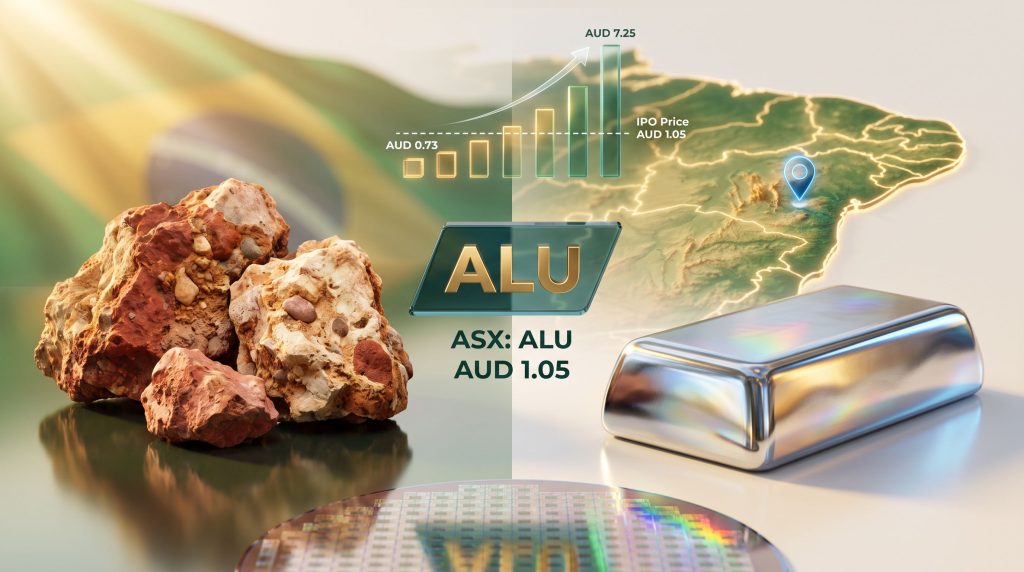
| Valuation Scenario | Per Share (AUD) | Per Share (USD) |
|---|---|---|
| Bear Case | AUD 0.73 | ~USD 0.51 |
| IPO Issue Price | AUD 1.05 | ~USD 0.74 |
| Bull Case | AUD 7.25 | ~USD 5.08 |
The bear case reflects a scenario in which drilling results fail to materially expand the JORC resource, Brazilian regulatory timelines extend, commodity prices soften, and subsequent capital raises occur at dilutive pricing. The bull case incorporates a resource upgrade from exploration success, gallium price appreciation driven by continued geopolitical supply disruption, and potential strategic acquisition interest from aluminium majors or technology companies seeking gallium supply security.
A 10x spread between bear and bull case valuations is not unusual for single-asset explorers at this stage. What matters for investors is understanding which variables have the most leverage over the outcome.
The Parent Company's Financial Profile as a Precedent
Brazilian Rare Earths provides a useful reference point for understanding the capital intensity of advancing large-scale mineral projects in Brazil. BRE recently reported AUD 4.24 million in revenue against a net loss of AUD 42.06 million, despite having raised AUD 120 million in the prior year. This financial profile underscores a fundamental reality of the junior mining sector: significant cash generation from operations remains years away for projects at this stage, and ongoing capital requirements will almost certainly exceed the current IPO proceeds as Alurion advances toward feasibility.
This article is for informational purposes only and does not constitute financial advice. Investing in junior mining and exploration companies involves significant risk, including the potential loss of capital. Past performance of comparable companies is not indicative of future results. Readers should seek independent financial advice before making investment decisions.
Key Milestones to Monitor Following the ASX Listing
Near-Term Catalysts That Will Define Early Sentiment
Investors tracking the Alurion IPO for Amargosa Bauxite-Gallium Project should monitor the following development triggers in the months following listing:
- Initial drilling assay results and their implications for resource expansion potential
- Environmental licensing progress through Brazil's ANM and any timeline signals from regulators
- Land acquisition completions that expand the project's tenure boundary
- Preliminary technical study outputs, including scoping-level economic assessments
- Any announcements regarding strategic partnerships with aluminium producers or technology supply chain participants
Medium-Term Considerations for a Multi-Year Investment Thesis
Beyond the initial post-listing period, the strategic trajectory of Alurion will be shaped by:
- The scope and outcomes of a formal pre-feasibility or feasibility study, which will reveal the true capital requirement to bring Amargosa to production
- Gallium and bauxite price trajectories as geopolitical dynamics in the critical minerals sector continue to evolve
- BRE's management of its retained 16% to 18% equity stake and whether it participates in or dilutes through future capital raises
- The broader ASX junior mining capital environment and its receptiveness to follow-on fundraising for Brazil-based projects
How Alurion Fits Within the Evolving ASX Critical Minerals Landscape
The ASX as a Global Venue for Dual-Commodity Junior Miners
The ASX has developed a well-earned reputation as the world's leading exchange for junior resource listings, with a deep retail and institutional investor base familiar with the risk profile of early-stage explorers. The exchange has hosted a growing number of internationally focused critical mineral projects over the past decade, with Brazilian assets in particular finding favour given the country's geological endowment and established mining sector.
An emerging structural trend on the ASX involves companies deliberately pairing traditional bulk commodity assets with co-located critical mineral potential. Scandium within laterite nickel deposits, vanadium within iron ore formations, and now gallium within bauxite sequences represent this co-production investment thesis in practice. The dual-commodity framing is not simply a marketing strategy: it genuinely expands the investor audience, bringing technology sector and critical minerals-focused capital into contact with projects that would otherwise attract only traditional base metals funds.
The Alurion IPO for Amargosa Bauxite-Gallium Project, combined with the operational clarity delivered by the demerger structure, places it at the forefront of this evolving market dynamic as it embarks on its first full year as an independently listed explorer on the ASX.
Want to Stay Ahead of the Next Major ASX Mineral Discovery?
Discovery Alert's proprietary Discovery IQ model scans ASX announcements in real time, delivering instant alerts on significant mineral discoveries across more than 30 commodities — including the kind of dual-commodity, critical minerals projects reshaping junior mining capital in 2026. Explore historic discoveries and their market returns, then begin your 14-day free trial to position yourself ahead of the broader market.