July 30, 2026
The Geology That Cannot Be Legislated Away
Most critical mineral supply risks have a policy remedy. Build more processing capacity, diversify trade relationships, renegotiate supply agreements. Platinum group metals are different. South African PGM supply risk is not an artefact of trade policy or corporate consolidation. It is a geological reality, and geological realities do not respond to executive orders or five-year plans.
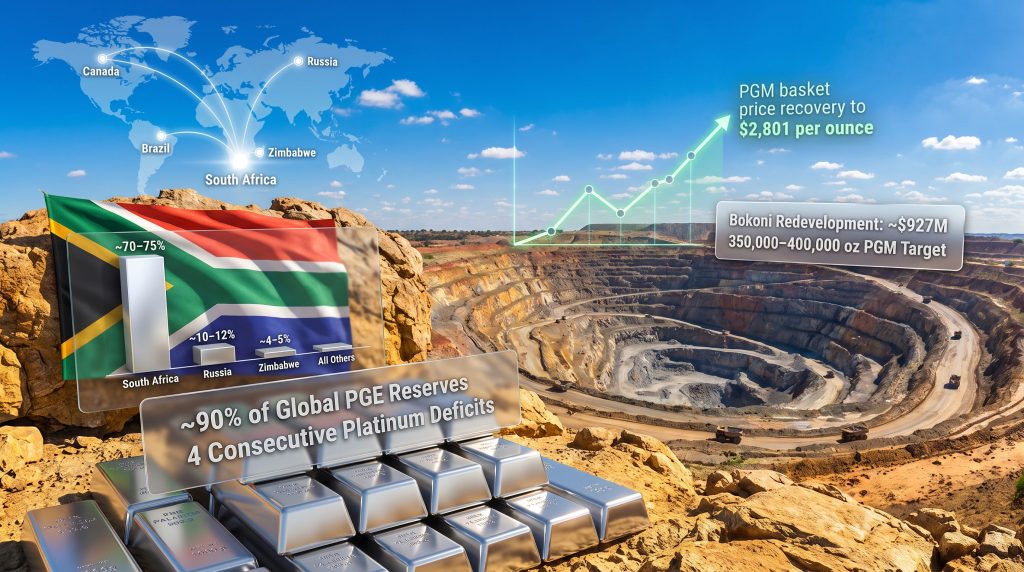
South Africa holds approximately 90% of global platinum group element (PGE) reserves, a concentration that exists because the Bushveld Igneous Complex, one of the largest layered intrusions on Earth, formed roughly 2 billion years ago in what is now the northern part of the country. No comparable geological structure of equivalent scale and grade exists anywhere else. The Bushveld hosts the Merensky Reef and UG2 Chromitite Layer, the two principal ore horizons from which the vast majority of the world's platinum, palladium, rhodium, ruthenium, and iridium are extracted. These ore bodies are not replicable through capital deployment or policy intent.
This geological monopoly is what makes South African PGM supply risk categorically different from other commodity concentration concerns. Understanding why capital continues to flow into this same concentrated geography, even as both Washington and Beijing formally identify it as a vulnerability, requires examining the structural forces that simultaneously create the risk and make it almost impossible to resolve quickly.
When big ASX news breaks, our subscribers know first
Why Two Superpowers Reached the Same Conclusion Independently
In January 2026, the US Department of Commerce concluded that imports of processed critical minerals, including platinum, palladium, rhodium, ruthenium, and iridium, constitute a threat to national security. Proclamation 11001, signed on January 14, 2026, directed the Department of Commerce and the US Trade Representative to negotiate critical minerals trade agreements with partner nations and report within 180 days. Rather than imposing immediate tariffs, the proclamation preserved future optionality for measures including import quotas or minimum import prices, contingent on the outcome of those negotiations.
The 180-day deadline passed on July 13, 2026 without any public announcement of a tariff, import quota, or finalised trade agreement. This leaves the national security finding technically unresolved, meaning the policy risk premium attached to PGM equities and physical metal remains active rather than settled. Investors and industrial consumers of platinum and palladium are exposed to a potential policy outcome that has not yet been formally defined.
Working from an entirely separate policy framework, China's 15th Five-Year Plan arrived at an identical assessment. The plan designates PGMs as priority critical materials, citing the country's dependence on imports from South Africa and Russia across applications including hydrogen fuel cell systems, advanced electronics, AI infrastructure components, and emissions-control catalysts. Furthermore, critical minerals demand growth across these sectors shows no sign of abating, and China holds minimal domestic PGE reserves, meaning it cannot materially change its import dependence in the near term regardless of how aggressively it pursues strategic stockpiling.
The convergence of the world's two largest economies on the same supply vulnerability, through entirely separate policy processes, is arguably the most significant structural signal in the PGM market right now. It is not a bilateral trade dispute. It is a shared geological reality being recognised simultaneously from opposite sides of the Pacific.
| Policy Framework | Country | Designation | Key Applications Cited | Current Status |
|---|---|---|---|---|
| Proclamation 11001 | United States | National Security Threat | Defence, clean energy, electronics | Unresolved post-July 13, 2026 |
| 15th Five-Year Plan | China | Priority Critical Material | Hydrogen, AI, emissions control | Strategic import security focus |
The Production Concentration That Makes Disruption Systemic
South African PGM supply risk flows directly from the country's production dominance. With approximately 70 to 75% of global PGM mine supply originating in South Africa, and a further 10 to 12% from Russia, the two jurisdictions collectively account for more than 80% of primary production. Every other country combined contributes the remaining fraction. The metals and mining geopolitics surrounding this concentration have become increasingly difficult for governments and investors to ignore.
| Country | Share of Global PGM Mine Supply | Primary Metals Produced |
|---|---|---|
| South Africa | ~70–75% | Platinum, Palladium, Rhodium, Ruthenium, Iridium |
| Russia | ~10–12% | Palladium, Platinum |
| Zimbabwe | ~4–5% | Platinum, Palladium |
| All Others | ~8–16% | Mixed |
Source: USGS
This structure means a labour dispute, infrastructure failure, or regulatory change in South Africa is not a localised event. It is a global supply shock. There is no geographic redundancy to absorb the disruption, and secondary supply from recycling, while growing, cannot substitute for primary mine production at the volumes required. The supply constraints in the PGM market are, consequently, among the most structurally embedded of any commodity sector.
Eskom's Load-Shedding: An Unresolved Operational Variable
One of the most underappreciated dimensions of South African PGM supply risk is power infrastructure. Eskom's chronic load-shedding programme has repeatedly disrupted mining and smelting operations across the Bushveld Complex, with consequences that compound over time rather than resolving after each episode.
What makes this particularly damaging for PGM producers is the nature of their processing infrastructure. PGM smelting and refining require continuous high-temperature operations. When power is interrupted, furnaces cannot simply be paused and restarted without significant thermal shock risk to the refractory lining. Shutdowns impose restart costs, production losses, and in some cases accelerate the degradation of capital equipment that is already ageing.
Underground mining operations face a parallel set of risks. Electricity is required for:
- Hoisting systems that bring ore and personnel to surface
- Ventilation networks that maintain safe working conditions at depth
- Water management pumps that prevent flooding in deep-level workings
- Refrigeration systems required to maintain safe temperatures in ultra-deep shafts
A power interruption that lasts hours can generate production losses that take days to recover, if they are recovered at all. When load-shedding events occur frequently across a season, the cumulative output loss becomes material at a portfolio level.
Aging Infrastructure and the Replacement Capital Problem
South Africa's PGM sector is largely built on mining operations that have been producing for decades. Shaft infrastructure, processing plants, and underground development across the Bushveld Complex reflect capital investment decisions made in earlier price cycles. A prolonged period of weak PGM basket prices during the early 2020s led many producers to defer maintenance and reduce replacement capital expenditure to preserve cash flow.
When capital investment falls below the threshold needed to replace depleted reserves and maintain ageing infrastructure, production decline is not a risk scenario. It is a scheduled outcome. Ore grades typically decline with depth, hoisting distances increase, and unit costs rise as mines mature, creating a structural headwind that only sustained reinvestment can offset.
Labor Volatility as a Supply Shock Mechanism
South Africa's deep-level PGM mining sector is labour-intensive by global standards, employing tens of thousands of workers across multiple operating companies. The sector has a documented history of industrial action, including strikes of varying duration that have generated production losses of hundreds of thousands of ounces across cycles.
Shaft closures driven by restructuring programmes add a more permanent dimension to this risk. When marginal shafts are closed to reduce costs, the production capacity they represent is rarely recovered. Infrastructure deteriorates, workforces disperse, and the capital required to recommission closed operations typically exceeds the original closure savings. This makes workforce restructuring events asymmetrically damaging to long-run supply potential, even when they improve short-term producer economics.
Producer Earnings Recovery and the Bokoni Commitment
Against this backdrop of structural risk, current PGM price levels are generating the cash flow needed to fund new mine investment. Valterra Platinum, the world's largest integrated PGM producer, reported first-half 2026 headline earnings up more than 1,388% year over year, driven by an 18% increase in PGM sales volumes and an 85% rise in the US dollar PGM basket price to $2,801 per ounce. Own-mined production increased 13% in the second quarter of 2026, with full-year 2026 group PGM production guidance set at 3.0 million to 3.4 million ounces.
These figures reflect a commodity cycle recovery, but also something more durable: the market signalling that South African PGM supply deserves capital at current prices. African Rainbow Minerals responded to that signal by approving approximately $927 million to redevelop the Bokoni platinum mine, targeting annual production of 350,000 to 400,000 ounces of PGMs once fully operational. The scale of this commitment, made following a period of widespread mine closures and production cuts, reflects confidence that current price levels justify multi-decade capital deployment in South African supply.
A near-$1 billion capital commitment in South Africa is not just a project decision. It is a market statement that producers believe the PGM deficit cycle is durable enough to underwrite long-duration investment in the same geography that both Washington and Beijing have identified as a concentration risk.
Valterra also announced a multi-year platinum electroplating partnership with Umicore's Metal Deposition Solutions unit, targeting the electronics connector market and positioning platinum as a durable, lower-cost alternative to gold. Industrial gold demand exceeds 9.5 million ounces annually, representing a substantial addressable market if platinum captures even a modest share of substitution volume. This demand expansion increases rather than reduces concentration risk, by adding another major industry to the list of sectors dependent on Bushveld Complex production.
Four Consecutive Deficits and Shrinking Buffer Stock
The World Platinum Investment Council forecasts a fourth consecutive annual platinum deficit in 2026, with above-ground stock cover projected to fall to approximately three months of demand by year-end. This is not a temporary inventory drawdown. Four years of consecutive deficits reflects a structural imbalance between demand growth and constrained supply expansion. For further context on platinum's tightening supply and rising geopolitical risks, the implications for investment strategy are becoming increasingly pronounced.
| Year | Market Balance | Above-Ground Stock Trend |
|---|---|---|
| 2022 | Deficit | Declining |
| 2023 | Deficit | Declining |
| 2024 | Deficit | Declining |
| 2025 | Deficit | Declining |
| 2026 (Forecast) | Deficit | ~3 months demand cover |
Source: World Platinum Investment Council (WPIC)
The most counterintuitive consequence of persistent deficits is that they actively reinforce geographic concentration. Deficit-driven capital flows toward the jurisdictions capable of adding supply fastest. South Africa is currently the only geography that meets that criterion at meaningful scale. This means that the same market mechanism intended to correct undersupply is simultaneously deepening the concentration vulnerability that policymakers are trying to address.
The Alternative Supply Pipeline: Remarkably Thin
The credible development-stage PGM asset base outside South Africa and Russia can be listed on a single page. Companies including Stillwater Critical Minerals, Bravo Mining, Platinum Group Metals, and Generation Mining collectively represent much of the alternative supply candidate pool, yet even the most advanced among them remain at the Inferred Resource, PEA, definitive feasibility study, or Feasibility Study stage. The gap between a feasibility study and commercial production in deep-level PGM mining typically spans a decade or more.
| Country | Share of Global PGE Reserves | Development Status |
|---|---|---|
| South Africa | ~90% | Active production and new investment |
| Russia | ~5–7% | Active production |
| Zimbabwe | ~2–3% | Limited development |
| Canada | Less than 1% | Early-stage projects |
| United States | Less than 1% | Early-stage projects |
| Brazil | Less than 1% | Early exploration |
Source: USGS
Brazil as a Frontier Jurisdiction
Brazil represents one of the more geologically prospective frontiers for PGM exploration outside the dominant producing regions, but the operative word is frontier. Exploration professionals in the country estimate that only approximately 30% of Brazil's landmass has been mapped to a high-resolution geological standard, leaving the majority of a continental-scale land package effectively unexplored using modern methods. This represents both significant upside potential and a reminder of how early the alternative supply story remains.
ValOre Metals' Pedra Branca project in Ceará State, Brazil, hosts an Inferred Resource of 2.2 million ounces of combined platinum, palladium, and gold equivalent (2PGE+Au) at an average grade of 1.08 g/t across 63.3 million tonnes, based on an Independent Technical Report effective March 8, 2022. A Preliminary Economic Assessment is targeted for Q4 2026, and no capital cost estimate or production schedule has yet been published. With a market capitalisation of approximately CAD$26 million as of July 1, 2026, the project provides early-stage exposure to a strategically located PGM resource outside the dominant producing regions rather than near-term production optionality.
Thiago Diniz, Vice President of Exploration at ValOre Metals, has noted that the geographic rarity of PGM production makes advancement of projects outside the traditional producing regions an opportunity specifically for investors seeking geopolitical diversification, given how few jurisdictions possess comparable geological potential. (Source: Crux Investor, July 2026)
It is worth noting the difference between an Inferred Resource and a commercially viable deposit. Inferred classifications carry higher geological uncertainty than Indicated or Measured resources, and the completion of a PEA will be the first test of whether the project's economics support further investment. Investors should treat early-stage developers as exposure to diversification potential rather than near-term supply alternatives. Understanding the distinction between mineral deposit tiers is, however, essential before drawing any investment conclusions from resource announcements.
The next major ASX story will hit our subscribers first
Demand Diversification Without Supply Diversification
Platinum demand is expanding into hydrogen fuel cell systems, advanced electronics, AI infrastructure components, and industrial gold substitution, precisely the applications cited in China's 15th Five-Year Plan. This demand diversification is structurally bullish for platinum prices in the long run, but it does not change the supply geography. Indeed, South African mine supply is in decline even as these new demand vectors emerge, compounding the structural imbalance.
Each new end market added to the platinum demand base increases the systemic consequences of a South African production disruption. Automotive catalysts, hydrogen electrolysers, AI server components, and electronics connectors all drawing from the same concentrated supply base means that a Bushveld production shortfall now carries consequences across a wider range of critical industries than it did a decade ago.
Scenario Framework for Investors
Bull Case: South African producers sustain current output levels, Bokoni comes online on schedule, platinum deficits persist or widen, and US trade policy concludes without disruptive tariffs. China's Five-Year Plan drives incremental strategic procurement, and PGM basket prices sustain above $2,500 per ounce.
Base Case: South African production remains broadly stable against ongoing headwinds from power constraints and ageing infrastructure. Platinum deficits continue at a moderate pace, and US–South Africa negotiations produce a framework that avoids immediate tariffs while preserving future policy optionality.
Bear Case: A convergence of power failures, labour disruptions, and deferred capital expenditure triggers a meaningful South African production shortfall. US trade measures impose import quotas, creating market dislocation. Platinum deficits widen sharply, but alternative supply development remains too early-stage to provide meaningful relief.
Key Market Signals to Monitor
- WPIC Platinum Quarterly scheduled for September 9, 2026: will indicate whether the deficit supporting South African capital investment is widening, narrowing, or stabilising
- US Section 232 policy outcome: any tariff, import quota, or trade measure following the July 13, 2026 deadline converts an unresolved national security finding into a defined market variable
- South African producer capital allocation: new mine investments, expansions, or asset sales will signal whether current PGM prices continue to justify long-duration deployment
- Alternative project milestones: PEA completions, feasibility study releases, or investment events involving non-South African PGM projects would represent the first meaningful evidence that capital is beginning to flow toward geographic diversification
Disclaimer: This article is for informational purposes only and does not constitute financial advice. Forecasts, scenarios, and projections discussed herein involve assumptions and uncertainties. Investors should conduct their own due diligence before making investment decisions. Past performance and current market conditions are not reliable indicators of future outcomes.
Want to Stay Ahead of the Next Major Mineral Discovery?
Discovery Alert's proprietary Discovery IQ model scans ASX announcements in real time, instantly identifying high-potential opportunities across platinum group metals and more than 30 other commodities — turning complex geological data into clear, actionable insights. Explore how historic mineral discoveries have delivered extraordinary returns on Discovery Alert's dedicated discoveries page, and begin your 14-day free trial today to position yourself ahead of the broader market.