
July 30, 2026
The Infrastructure Nobody Built: Inside Latin America's US$210 Billion Cleantech Recycling Opportunity
Every major energy transition eventually produces two things: a new generation of operational infrastructure, and a future generation of end-of-life assets. Europe learned this lesson with its early-generation wind farms. China is confronting it now with first-cohort solar installations. Latin America's cleantech recycling boom is building momentum as the region, having spent two decades constructing one of the world's most ambitious renewable energy footprints, approaches the same inflection point — but with one critical difference: the region still has time to build the recovery infrastructure before the wave arrives.
That window is narrowing. And the financial stakes are becoming impossible to ignore.
When big ASX news breaks, our subscribers know first
The Numbers Behind Latin America's Cleantech Recycling Boom
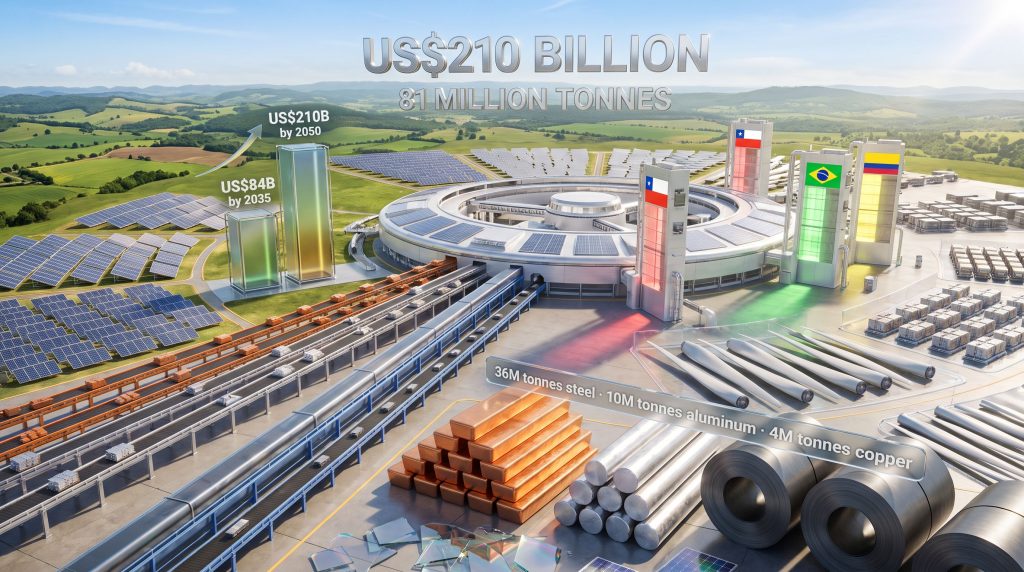
Regional assessments linked to the Latin American Energy Organization (OLADE) place the total recoverable value of end-of-life clean energy infrastructure across the region at approximately US$209 to US$210 billion by 2050, with an intermediate milestone of US$84 billion recoverable by 2035. These are not speculative projections built on optimistic demand forecasts. They are materials-accounting calculations anchored to assets that are already deployed, already generating power, and already ageing through their operational lifecycles.
The physical scale of what has been built is striking:
| Metric | Estimated Figure |
|---|---|
| Total recoverable value by 2050 | US$209–210 billion |
| Recoverable value by 2035 | US$84 billion |
| Solar panels currently operating in the region | ~150 million units |
| Wind turbines currently operating | ~16,000 units |
| Total embedded materials by 2050 | ~81 million tonnes |
| Steel embedded in transition technologies | ~36 million tonnes |
| Aluminium embedded in transition technologies | ~10 million tonnes |
| Copper embedded in transition technologies | ~4 million tonnes |
Critical framing: The distinction between waste disposal economics and circular economy value creation is not semantic. It determines whether end-of-life clean energy hardware is treated as a liability requiring costly management or as a recoverable asset class generating measurable returns. Capital allocators who adopt the second framing are entering a fundamentally different market.
When Does the End-of-Life Wave Actually Arrive?
Understanding the timing dynamics of Latin America's cleantech recycling boom requires separating three distinct material streams, each with its own retirement cycle and recovery economics.
Solar photovoltaic panels represent the largest volume opportunity but operate on the longest decommissioning timeline. First-generation utility-scale solar installations, many of which came online between 2010 and 2015, carry design lifespans of 25 to 30 years. This places the primary end-of-life inflection point around 2040 to 2045. However, repowering activity — where operators replace underperforming panels with higher-efficiency models before technical end-of-life — is already generating decommissioning volumes ahead of schedule.
Wind turbine components follow a different pattern. Steel-heavy nacelles, towers, and cabling have strong near-term recovery economics given established scrap metal processing infrastructure. The harder problem is composite wind turbine blades, which are manufactured from glass fibre and carbon fibre reinforced resins that resist conventional recycling methods. This remains an unsolved problem globally, not just in Latin America, and represents one of the sector's most significant technical and commercial challenges.
Lithium-ion battery storage systems operate on the most compressed timeline of the three. Battery energy storage systems (BESS) deployed in grid applications typically cycle through their useful life in 10 to 15 years, significantly faster than solar or wind assets. This creates an earlier and more urgent recycling demand curve, which partly explains why battery recycling is attracting the most immediate commercial attention across the region. For further context, recent research on battery recycling innovation highlights how technical advances are reshaping recovery economics globally.
Three Structural Forces Creating Market Conditions
Latin America's cleantech recycling boom is not being driven by a single regulatory event or commodity price spike. It reflects three forces converging simultaneously:
-
Asset maturity accumulation: The installed base of renewable energy infrastructure is large enough, and old enough, that end-of-life volumes are transitioning from theoretical to operational reality in some markets.
-
Policy architecture expansion: Extended producer responsibility (EPR) frameworks, which assign financial and operational accountability for end-of-life product management to manufacturers and importers, are spreading across the region to cover batteries, e-waste, and increasingly, cleantech hardware.
-
Market formalisation pressure: Informal waste collection networks, which handle a significant proportion of recoverable materials across Latin American markets today, are coming under increasing regulatory and commercial pressure to integrate into traceable, institutionalised supply chains.
The intersection of these three forces is what creates the early mover window. Regulatory mandates are not yet fully hardened. Processing capacity is not yet contested. Collection networks are not yet consolidated. The infrastructure decisions made over the next three to five years will likely determine the competitive structure of the market for decades.
Regulatory Readiness Varies Dramatically Across the Region
One of the most important and underappreciated dynamics in Latin America's cleantech recycling landscape is the degree of regulatory fragmentation across its major markets. A company building a regional strategy cannot apply a single regulatory playbook to every jurisdiction.
| Country | Regulatory Maturity | Key Focus Areas | Frontrunner Status |
|---|---|---|---|
| Chile | Advanced | Batteries, e-waste, EPR law | Yes |
| Brazil | Developing | Battery recycling, reverse logistics | Yes |
| Colombia | Developing | Lithium battery infrastructure | Yes |
| Mexico | Early-stage | E-waste frameworks | Emerging |
| Argentina | Early-stage | Policy drafting phase | Emerging |
| Peru | Early-stage | Mining-linked recycling | Nascent |
| Ecuador | Nascent | Limited formal frameworks | Nascent |
Chile stands out as the regional regulatory leader, having enacted comprehensive EPR legislation that covers multiple product categories including batteries and e-waste. Brazil and Colombia are advancing battery-specific recycling frameworks. Mexico, Argentina, Peru, and Ecuador remain in earlier stages, though activity is accelerating in each. For instance, Latin America's multi-billion recycling industry is already drawing significant commercial attention as regulatory conditions mature.
Policy Watch: OLADE-linked assessments identify four critical enablers needed to unlock the circular economy at scale across the region: stronger regulatory frameworks, mandatory product take-back systems, traceability mechanisms for battery and panel material flows, and formalised reverse logistics networks. None of these is optional. All four must develop together for the market to reach its potential.
A particularly underappreciated barrier is the absence of mandatory traceability systems across most markets. Without the ability to track materials from decommissioning through processing to secondary market sale, both regulatory compliance and commercial value capture become structurally difficult. Companies that build proprietary traceability infrastructure now are creating a competitive moat that becomes increasingly valuable as regulatory standards tighten.
Where the Value Chain Opportunities Actually Sit
The US$210 billion figure describes the aggregate recoverable value, but capital deployment decisions require understanding where within the value chain that value is most accessible and most defensible. Furthermore, the critical minerals demand arising from the energy transition adds urgency to developing robust recovery infrastructure. Four distinct positions exist:
-
Collection and reverse logistics: The physical infrastructure to aggregate end-of-life assets from distributed locations across large geographies. This is capital-intensive, operationally complex, and currently underdeveloped relative to the incoming material volumes.
-
Processing and materials recovery: Industrial-scale facilities capable of separating recovered copper, aluminium, steel, silicon, silver, and battery-grade critical minerals including lithium, cobalt, nickel, and manganese. Hydrometallurgical processing routes generally achieve higher material purity than pyrometallurgical alternatives but carry higher capital costs and require more sophisticated operational expertise.
-
Reuse and remanufacturing: Secondary markets for components with remaining useful life, particularly solar inverters and battery modules that retain partial capacity. This segment requires less capital but demands strong quality assessment capabilities and secondary market relationships.
-
Digital infrastructure: Traceability platforms, asset tracking systems, and marketplace solutions connecting asset owners with collectors and processors. This is the highest-margin, lowest-capital-intensity position in the value chain, and the one most likely to be captured by technology-native entrants rather than incumbent industrial operators.
The next major ASX story will hit our subscribers first
Latin America's Structural Advantages and the Gaps That Must Close
Compared against the European Union and China, which both have mature solar recycling regulation and comprehensive battery EPR frameworks already in operation, Latin America sits at an earlier stage of formal recycling infrastructure development. However, characterising this purely as a disadvantage misreads the competitive dynamics.
| Dimension | Latin America | European Union | China |
|---|---|---|---|
| Solar recycling regulation | Emerging | Mandatory (WEEE Directive) | Mandatory |
| Battery EPR frameworks | Partial/developing | Comprehensive | Comprehensive |
| Formal recycling infrastructure | Limited | Mature | Mature |
| End-of-life volume (near-term) | Growing rapidly | Peaking | Peaking |
| Cost competitiveness | High potential | Moderate | High |
The region's proximity to the world's largest lithium, copper, and nickel primary mining operations creates a natural integration logic between primary extraction and secondary recovery that no other region can replicate. Chile's position as both the world's leading copper producer and an emerging battery recycling hub is not coincidental. Consequently, the copper market trends shaping global supply chains in 2025 reinforce why secondary recovery of this metal is becoming commercially critical.
Lower labour costs relative to developed markets support the collection and manual disassembly economics that make certain recycling business models viable in Latin America at scale thresholds that would be uneconomic in Europe or North America.
The gaps are real, however. Reverse logistics infrastructure is underdeveloped across most markets. Regulatory frameworks remain fragmented and inconsistently enforced. Cross-border material flows face customs and trade barriers that complicate regional supply chain integration. In several material categories, domestic demand for recycled materials is insufficient to support processing economics without export market access.
The Cross-Border Hub Model and Why It Matters
A widely underappreciated structural reality of Latin America's cleantech recycling market is that no single country generates sufficient end-of-life volume in the near term to justify world-class industrial recycling infrastructure on a standalone basis. The economics of advanced processing facilities, particularly for lithium battery hydrometallurgical operations, require volume aggregation across multiple national markets.
This creates a natural architecture around regional processing hubs, most likely located in Chile, Brazil, or Mexico, serviced by cross-border collection networks operating across smaller markets. Companies that begin building multi-country collection relationships now, before processing capacity comes online, are securing the feedstock position that will determine who controls the value chain when volumes escalate after 2035.
The social dimension of this model also carries strategic weight. Informal waste collectors, known across the region as catadores in Brazil or recicladores de base in Spanish-speaking markets, handle a substantial share of current recoverable material flows. Business models that integrate rather than displace these networks gain both operational reach and social licence in markets where informal sector relationships are deeply embedded in community structures. In addition, the urban mining opportunity presented by anthropogenic material stocks underscores the long-term strategic logic of formalising these collection networks.
Frequently Asked Questions: Latin America's Cleantech Recycling Boom
What is the total value of Latin America's cleantech recycling opportunity?
Regional assessments place the total recoverable value of end-of-life clean energy infrastructure at approximately US$209 to US$210 billion by 2050, with US$84 billion recoverable by 2035.
Which countries are leading cleantech recycling in Latin America?
Chile, Brazil, and Colombia are the current frontrunners, particularly in lithium battery recycling infrastructure and EPR regulatory framework development.
What materials can be recovered from end-of-life clean energy assets?
By 2050, the region's transition technology assets are projected to contain approximately 81 million tonnes of recoverable materials, including 36 million tonnes of steel, 10 million tonnes of aluminium, 4 million tonnes of copper, and significant quantities of battery-grade critical minerals.
When will solar panel recycling volumes peak in Latin America?
The primary inflection point is projected around 2040 to 2045, when first-generation utility-scale solar installations reach technical end-of-life. Near-term volumes from repowering projects are expected to drive earlier activity before that date.
What are the biggest barriers to scaling cleantech recycling across the region?
Underdeveloped reverse logistics infrastructure, fragmented regulatory frameworks across major markets, absence of mandatory traceability systems, and insufficient formal processing capacity relative to projected end-of-life material volumes. Furthermore, understanding the battery recycling process as developed in more mature markets provides a valuable benchmark for what Latin America must build.
Key Takeaways for Investors and Operators
-
The value embedded in Latin America's deployed clean energy infrastructure is a materials-accounting certainty tied to known asset lifecycles, not a speculative demand forecast.
-
The early mover window is open now, before regulatory mandates harden and processing capacity becomes contested across the region's key markets.
-
Battery recycling represents the most urgent near-term opportunity given compressed lithium-ion lifecycle dynamics. Solar panel recycling represents the largest long-term volume opportunity. The battery recycling breakthrough emerging from China offers instructive lessons for what commercial-scale recovery can look like.
-
Market entry strategies must account for significant country-level variation in regulatory readiness, particularly the gap between Chile's advanced EPR framework and the nascent policy environments in Ecuador, Argentina, and Peru.
-
The regional hub model, aggregating cross-border collection volumes into centralised processing infrastructure, is the most economically viable path to world-class recovery operations.
-
Digital traceability infrastructure is the highest-margin position in the value chain and the most likely to attract technology-sector capital alongside traditional industrial investment.
Strategic Imperative: Companies building collection networks, regulatory relationships, and processing partnerships today will hold structural advantages when end-of-life volumes escalate sharply after 2035. The infrastructure decisions made in the next five years will determine who captures the value embedded in Latin America's cleantech recycling boom and who arrives too late to compete for it.
This article is intended for informational purposes only and does not constitute financial, investment, or legal advice. Forecasts and projections referenced are based on third-party assessments and involve inherent uncertainty. Readers should conduct independent due diligence before making capital allocation decisions. Readers seeking additional regional market intelligence on Latin America's energy transition and infrastructure investment landscape can explore related industry reporting available through BNamericas.
Want to Spot the Next Major Mineral Discovery Before the Broader Market Does?
Latin America's cleantech recycling boom signals the growing demand for critical minerals like copper, lithium, and aluminium — and the companies exploring for these materials on the ASX could represent compelling opportunities. Discovery Alert's proprietary Discovery IQ model delivers real-time alerts on significant ASX mineral discoveries, turning complex data across 30+ commodities into actionable insights the moment announcements hit the exchange. Explore historic discoveries and their returns to understand what's at stake, then begin your 14-day free trial at Discovery Alert to position yourself ahead of the market.