July 30, 2026
The Slow Unravelling of a Diamond Empire: What the De Beers Sale Reveals About the Future of Natural Diamonds
Commodity cycles have a way of exposing corporate strategies that flourished in one era but become liabilities in another. For more than a century, diamonds occupied a unique position in the global luxury hierarchy, underpinned by carefully managed supply, aspirational marketing, and a near-monopolistic grip on rough stone distribution. That architecture, largely constructed by De Beers, is now fracturing under simultaneous pressure from synthetic competition, shifting consumer values, and the strategic recalculations of the world's most powerful diversified miners. The Anglo American De Beers sale is not simply a transaction. It is a signal that the structural foundations of the natural diamond market have shifted in ways that even the most optimistic industry insiders can no longer dismiss.
When big ASX news breaks, our subscribers know first
Why Anglo American Is Exiting the Diamond Business Now
A Portfolio Under Pressure Long Before the Sale Was Announced
Anglo American's decision to divest De Beers did not emerge in isolation. It is the product of years of sustained pressure across multiple fronts, including declining rough diamond prices, repeated asset write-downs across De Beers' balance sheet, and the relentless growth of laboratory-grown diamonds eating into the natural stone market. These forces combined to make De Beers an increasingly poor fit for a mining group trying to concentrate capital in higher-return commodities.
The broader corporate context matters here. Anglo American faced a hostile takeover approach from BHP in 2024, and its rejection of that bid accelerated the need to demonstrate a credible self-restructuring plan to shareholders. Divesting De Beers became a central plank of that strategy, alongside the planned exits from its platinum and coal businesses. The BHP strategic pivot toward core commodities created ripple effects across the sector, ultimately influencing Anglo's own portfolio rethink. The goal is a leaner Anglo American, focused on copper, iron ore, and crop nutrients as its core earning drivers going forward.
How Years of Diamond Market Weakness Forced a Strategic Reckoning
The natural diamond market entered a prolonged downturn shaped by at least three converging forces:
-
Laboratory-grown diamond penetration, which accelerated sharply after 2020, compressing prices for smaller and lower-quality natural stones and eroding the perceived uniqueness of natural diamonds in key consumer segments.
-
Chinese luxury demand weakness, where post-pandemic consumption patterns diverged sharply from pre-2020 expectations, leaving global diamond traders with inventory that proved far harder to clear than projected.
-
Indian cutting sector margin compression, where the world's dominant diamond processing industry faced acute pressure as rough prices remained elevated relative to polished prices, squeezing midstream players and reducing demand pull for rough stones.
Together, these dynamics created a supply glut that hammered De Beers' revenues and forced repeated production curtailments, the most recent and significant being the two-year halt at the Venetia mine in South Africa, announced in July 2026.
How Much Is De Beers Actually Worth? The $1 Billion Valuation Explained
A Steep Compression From Peak Valuations
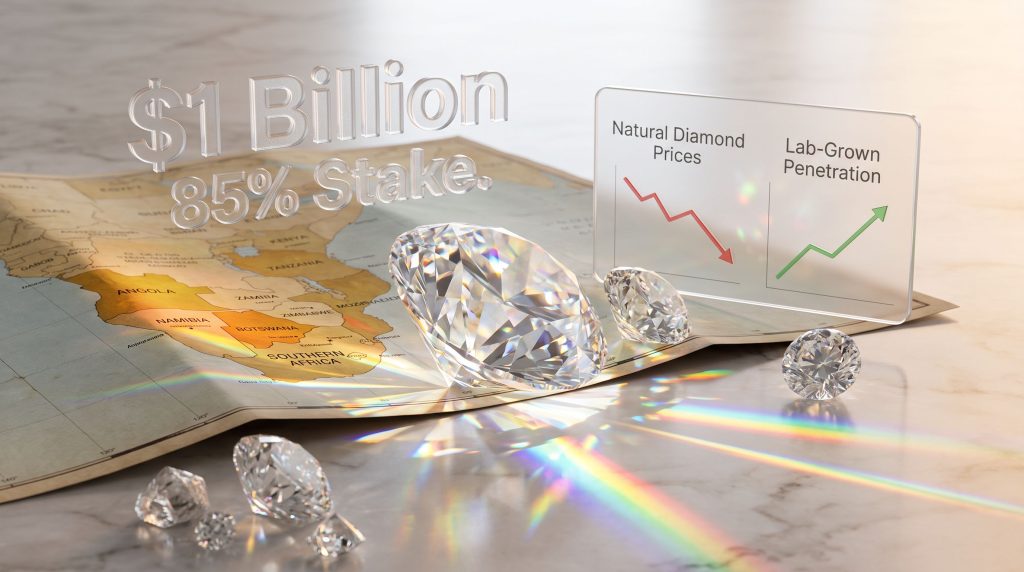
The reported deal structure is striking in its implied value destruction. At approximately $1 billion in total transaction value, the Anglo American De Beers sale represents a dramatic discount compared to prior valuations. According to reporting on the De Beers valuation, what was once an $18 billion diamond empire may sell for just a fraction of that figure. In 2011, Anglo American paid approximately $5.1 billion to increase its stake in De Beers to 85%, implying a total enterprise value well in excess of $6 billion at the time.
| Metric | Estimated Figure |
|---|---|
| Reported total deal value | ~$1 billion |
| Estimated upfront payment | ~$750 million |
| Deferred/performance-linked payment | ~$250 million |
| Anglo American's stake in De Beers | 85% |
| Botswana Government's stake | 15% |
The structure itself is informative. A deferred or performance-linked component of roughly $250 million signals that the buyer consortium is cautious about near-term recovery prospects and unwilling to commit full capital upfront. This kind of earnout mechanism is typically employed when there is material uncertainty around asset value, and its inclusion here speaks volumes about the prevailing sentiment toward the diamond market's recovery trajectory.
Understanding the Write-Down Cycle and Lab-Grown Disruption
De Beers has recorded substantial impairments in recent years as rough diamond prices declined across all size and quality categories. This impairment cycle is not purely cyclical in nature. A meaningful portion reflects structural demand destruction driven by laboratory-grown diamonds.
Lab-grown stones now capture a significant and growing share of the bridal and fashion jewellery segments in the United States, the world's largest diamond consuming market by value. Critically, lab-grown diamond prices have collapsed by an estimated 80 to 90 percent over the past five years as production technology improved and manufacturing scaled. This created an impossible competitive dynamic for natural diamonds in lower and mid-tier price points, forcing natural stone positioning increasingly toward the ultra-premium end of the market, a segment that is both smaller and more volatile.
The repricing of natural diamonds relative to lab-grown alternatives is one of the most significant structural shifts in luxury goods markets in decades, and its full effect on long-term demand remains genuinely uncertain.
Who Is Buying De Beers? Inside the Global Diamond Consortium
The Consortium Structure and Its Strategic Dimensions
Media reports emerging in July 2026 identified a consortium led by Gareth Penny, a former De Beers CEO with deep institutional knowledge of the company's operations, marketing philosophy, and producer relationships, as the preferred bidder for Anglo's 85% stake. The consortium reportedly includes interests from Namibia and Angola, two of southern Africa's most significant diamond-producing nations.
The involvement of sovereign and regional interests from diamond-producing African nations is not merely symbolic. It reflects a deliberate effort to align the ownership structure of De Beers with the geopolitical realities of modern resource governance on the continent. This mirrors broader shifts in the mining geopolitical landscape, where host nations are increasingly asserting control over strategic resource assets. Both Namibia and Angola have significant stakes in the broader diamond pipeline.
Namibia's Namdeb Holdings, a joint venture between the Namibian government and De Beers, produces some of the world's highest-value rough diamonds from marine and alluvial deposits. Angola's Endiama controls that country's diamond sector and has been a growing force in African diamond geopolitics.
Why Leadership Continuity in the Bid Matters
Gareth Penny's involvement carries strategic weight beyond name recognition. De Beers operates an unusual commercial model centred on its sightholder system, a curated network of approved rough diamond buyers who purchase stones at periodic sales events called sights. This system requires deep relationships, institutional trust, and an understanding of how to balance supply allocation with price stability. A former CEO leading the acquisition bid signals an intention to preserve operational continuity rather than pursue aggressive post-acquisition restructuring.
Anglo's Stated Position: No Exclusivity, No Certainty
Anglo American CEO Duncan Wanblad confirmed publicly in late July 2026 that the company is not in an exclusive arrangement with any consortium regarding the De Beers sale. This statement is significant for investors and observers trying to read the transaction's trajectory. Furthermore, Forbes reporting on the sale process highlights how Botswana's position continues to complicate the timeline.
Non-exclusivity in a complex mining divestiture of this scale means several scenarios remain live simultaneously.
Scenario 1: Consortium Deal Closes as Reported
- The Global Diamond Consortium acquires Anglo's 85% stake at approximately $1 billion.
- Botswana retains its 15% position, potentially negotiating enhanced royalty or governance terms as a condition of approval.
- De Beers operates under new leadership with meaningful African sovereign influence in its ownership structure.
Scenario 2: Renegotiation or Competing Bid Emerges
- Anglo's non-exclusivity keeps the process open to alternative offers.
- A competing bid from a sovereign wealth fund, major trading house, or strategic investor could extend the timeline and potentially lift the valuation.
- Extended timelines create operational uncertainty for De Beers and its sightholder network.
Scenario 3: Deal Collapses, Anglo Retains De Beers Temporarily
- Structural disagreements, Botswana's approval requirements, or financing constraints stall the transaction.
- Anglo manages De Beers through a further operational rationalisation period, deepening production cuts as a cost-management strategy.
- The Venetia halt and other curtailments become a longer-term holding posture rather than a pre-sale clean-up exercise.
The Venetia Mine Halt: What It Signals About De Beers' Operational State
A Two-Year Production Suspension at South Africa's Most Significant Diamond Mine
Venetia is South Africa's largest diamond mine by production volume and one of De Beers' core operational assets. Announcing a two-year production halt at Venetia in the context of an active sale process is a strategically complex decision that warrants careful interpretation.
On one level, the halt reduces cash burn at an operation that is producing at a time when rough diamond prices cannot justify the marginal cost of extraction. On another level, it sends a message to prospective buyers that operational rationalisation is already underway, potentially simplifying post-acquisition integration planning.
Suspending production at a flagship asset during a live divestiture process is an unusual move. It can be read as operational discipline, but it also concentrates attention on whether the broader asset base can generate sufficient cash flow to sustain the business through the transaction period.
Venetia's Geological Significance
Venetia's deposits are kimberlite-hosted, the same geological formation responsible for the world's most significant primary diamond deposits. Kimberlite pipes are ancient volcanic conduits through which carbon-rich material was transported from deep mantle depths to the surface. The grade and quality of diamonds extracted from kimberlite varies significantly between pipes and even within individual pipes at different depth horizons.
Venetia has historically delivered stones across a broad quality spectrum, contributing meaningfully to De Beers' rough revenue. A two-year halt effectively removes this production from the global rough supply picture, which in theory should provide some marginal price support for natural diamonds during the suspension period.
Diamond Market Dynamics: Where Are Prices Headed?
| Market Factor | Current Trend | Outlook |
|---|---|---|
| Natural diamond prices | Declining multi-year trend | Cautiously stabilising |
| Lab-grown diamond penetration | Rapidly expanding | Continued growth expected |
| Chinese luxury demand | Subdued post-pandemic | Uncertain recovery timeline |
| Indian diamond cutting sector | Under margin pressure | Structural adjustment ongoing |
| US bridal diamond demand | Bifurcating toward lab-grown | Structural shift accelerating |
The geographic demand picture is uneven. The United States remains the world's single largest market for diamond jewellery by value, but the bifurcation between natural and lab-grown preferences is intensifying. The China iron ore market slowdown has also contributed to broader luxury goods weakness, with Chinese consumers proving far more selective than anticipated across multiple premium categories, including diamonds.
India's role in the diamond pipeline is worth understanding in detail. Approximately 90 percent of the world's rough diamonds by volume are cut and polished in India, primarily in Surat. When the midstream cutting sector is under margin pressure, demand for rough stones weakens even if end consumer demand is holding steady, creating a structural lag in price signals that can mislead observers about underlying market health.
The next major ASX story will hit our subscribers first
Botswana's Role: Minority Stake, Major Leverage
Why 15% Ownership Carries Outsized Influence
The Government of Botswana holds a 15% stake in De Beers, but its actual leverage in the sale process is considerably greater than that minority position implies. Botswana is the world's largest producer of rough diamonds by value, and its relationship with De Beers through the Debswana joint venture underpins a significant portion of De Beers' total production. Any change of control at De Beers requires careful navigation of Botswana's national interests, approval processes, and expectations regarding continued investment and royalty arrangements.
Botswana's negotiating posture in deals of this nature reflects a broader trend across sub-Saharan Africa, where resource-dependent host nations are increasingly asserting stronger governance roles in the disposition of major natural resource assets, even from minority equity positions. This is not unique to diamonds. Consequently, similar dynamics have played out in copper, platinum, and gold across the region.
Anglo American's Post-De Beers Strategy
Copper and Iron Ore as the New Core
The strategic logic of the Anglo American De Beers sale becomes clearest when viewed against Anglo's broader portfolio ambitions. The company is repositioning around copper, where demand growth is underpinned by electrification and energy transition infrastructure. In addition, the copper market trends emerging from supply constraints make this a particularly compelling strategic bet for Anglo going forward.
Anglo is also focusing on iron ore through its Kumba Iron Ore subsidiary, which produces high-grade lump products increasingly valued in lower-emission steelmaking processes. These are commodities where Anglo believes it can generate structurally higher returns on capital than in diamonds. The divestiture also serves a defensive purpose, demonstrating a credible, self-directed restructuring plan that reduces the risk of renewed M&A approaches.
Frequently Asked Questions: Anglo American De Beers Sale
How much is Anglo American selling De Beers for?
Reports indicate the transaction is being discussed at approximately $1 billion in total, structured as roughly $750 million payable upfront with a further $250 million deferred or tied to performance-linked conditions.
Who owns De Beers currently?
Anglo American holds an 85% controlling stake in De Beers, with the remaining 15% owned by the Government of Botswana.
Who is buying De Beers from Anglo American?
A Global Diamond Consortium reportedly led by former De Beers CEO Gareth Penny, and including interests from Namibia and Angola, has been identified as the preferred bidder as of late July 2026. For further background on corporate deal structures in this sector, the Peabody-Anglo deal insights provide useful comparative context on how major mining divestiture processes unfold.
Is the De Beers sale confirmed?
No. Anglo American CEO Duncan Wanblad confirmed in late July 2026 that the company is not in an exclusive arrangement with any consortium, meaning the process remains open and terms are not yet finalised.
What happened to the Venetia mine?
De Beers announced a two-year production halt at its Venetia diamond mine in South Africa as part of operational streamlining efforts during the sale process.
Why did Anglo American decide to sell De Beers?
Anglo American is executing a broader corporate restructuring designed to concentrate its portfolio around higher-returning commodities, particularly copper and iron ore, while exiting assets that have experienced sustained valuation and demand pressure.
Key Takeaways for Investors and Industry Observers
The Anglo American De Beers sale is one of the most consequential events in the global diamond industry in a generation. It raises fundamental questions that extend well beyond the specifics of one corporate transaction:
-
Can natural diamonds maintain pricing power against an accelerating lab-grown alternative that is chemically and visually identical?
-
Will African sovereign interests, now increasingly embedded in diamond asset ownership, manage supply with the same discipline that characterised the De Beers-led system of the 20th century?
-
Does the $1 billion implied valuation represent a distressed-cycle entry point for opportunistic investors, or does it reflect a genuine structural derating of natural diamond assets?
-
What does Anglo's pivot toward copper and iron ore signal about where institutional capital sees the best risk-adjusted returns in mining over the next decade?
This article contains analysis of corporate transactions, commodity market dynamics, and forward-looking scenarios. It is intended for informational purposes only and does not constitute financial advice. Readers should conduct their own due diligence before making investment decisions. Transaction details and valuations are based on media reports current as of late July 2026 and are subject to change. Readers seeking ongoing coverage of the Anglo American De Beers sale and related mining industry developments can follow reporting through Mining Weekly at miningweekly.com.
Want to Stay Ahead of the Next Major Mining Shake-Up?
While the De Beers sale reshapes the diamond industry, significant mineral discoveries on the ASX continue to create compelling opportunities for informed investors — and Discovery Alert's proprietary Discovery IQ model delivers real-time alerts the moment these discoveries are announced, turning complex geological data into actionable insights. Explore how major mineral discoveries have historically generated exceptional returns on Discovery Alert's dedicated discoveries page, and begin your 14-day free trial today to position yourself ahead of the broader market.