July 30, 2026
The Structural Economics Behind the Section 338 Salt Tariff on Canadian Deicing Salt
Long before trade policy enters a headline, commodity markets quietly absorb decades of underinvestment, regulatory inertia, and geographic concentration into their pricing structures. The deicing salt market across North America is a textbook example. For roughly thirty years, no major new rock salt mine has reached commercial production on the continent, while one underground facility in Ontario has supplied a disproportionate share of US highway deicing needs. When the Section 338 salt tariff on Canadian deicing salt lands on that fragile supply architecture, the consequences extend well beyond a single tariff line. They reprice an entire regional market simultaneously.
When big ASX news breaks, our subscribers know first
What Section 338 Actually Is, and Why Its Activation Is Historically Significant
Section 338 of the Tariff Act of 1930 is not a trade defence mechanism created for routine commercial disputes. It is a broad executive authority granting the US President the power to impose discriminatory duties on goods from countries determined to be engaging in unfair or inequitable trade practices against American commerce. The statute has existed for nearly a century but sat dormant in modern trade practice, making its invocation through three presidential proclamations dated July 20, 2026, one of the most consequential unilateral tariff actions in the post-WWII era of US trade policy. Understanding how tariffs work at a structural level is essential context for appreciating just how significant this activation is.
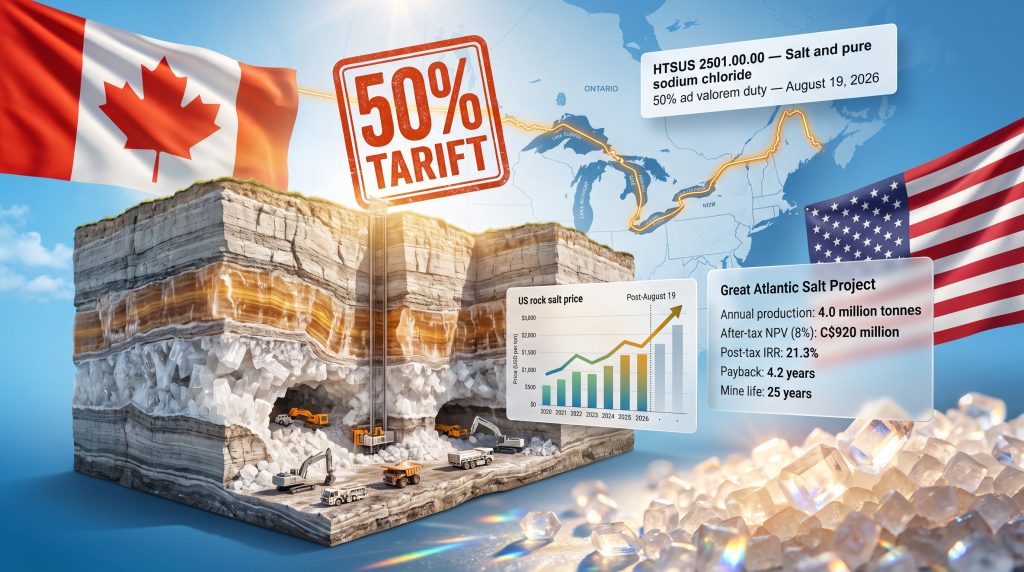
The duty takes effect at 12:01 a.m. Eastern time on August 19, 2026, and is set at 50% ad valorem on a defined list of Canadian goods. What distinguishes this action from prior tariff rounds is its explicit treatment of USMCA-qualifying goods. Earlier tariff measures generally excluded products that met USMCA origin requirements, providing Canadian exporters with meaningful cost insulation. The White House fact sheet confirms that Section 338 removes that insulation entirely.
The proclamations explicitly confirm that the 50% duty applies regardless of whether the goods in question qualify under the United States-Mexico-Canada Agreement, fundamentally altering the cost basis for Canadian exporters who had relied on USMCA treatment as a financial planning assumption.
For producers like Compass Minerals International, whose fiscal 2025 disclosures confirmed that Canadian-sourced salt exports were remaining tariff-free on the basis of USMCA qualification, this is not a marginal adjustment. It is a structural reset.
How Section 338 Differs From Prior Trade Measures
Furthermore, the broader tariff impacts on supply chains across North America have been well documented in recent years, however Section 338's unique dormancy and sudden activation make it categorically different from standard trade defence tools. Its reach is broader, its legal basis more archaic, and its implications for long-term supply agreements more disruptive than routine anti-dumping or countervailing duty proceedings.
The HTS Classification Gap: Why Tariff Scope Remains Legally Unconfirmed
The White House annex accompanying the Section 338 proclamations identifies HTSUS 2501.00.00, Salt and pure sodium chloride, as a covered product category. This is the classification under which standard deicing rock salt is typically entered. However, a critical regulatory detail deserves attention from procurement officers and legal teams: as of the proclamation date, the Harmonized Tariff Schedule Chapter 99 codes implementing Section 338 had not yet been published.
This publication gap creates genuine legal uncertainty about the tariff's final scope. Three scenarios remain technically possible before August 19:
- The HTS codes are published confirming the full 50% rate on HTSUS 2501.00.00, locking in maximum cost increases for Canadian-origin deicing salt
- The codes narrow the product scope, potentially excluding specific salt compositions or processing classifications, producing a partial duty reduction
- Bilateral negotiations produce an exemption or suspension before the effective date, reverting pricing conditions toward pre-announcement baselines
Until the Chapter 99 codes are formally published, final contract pricing assumptions for the 2026-27 winter season carry material regulatory uncertainty. This is not a theoretical risk. It has direct implications for bid season negotiations already underway or approaching closure.
Why Canadian Salt Became an Irreplaceable US Supply Source
Understanding why the Section 338 salt tariff on Canadian deicing salt carries such outsized market weight requires a working knowledge of North American salt geology and mine development timelines.
The Goderich, Ontario facility, the world's largest underground rock salt mine, sits beneath Lake Huron and has operated as a cornerstone supplier to the US market for decades. Its geographic position within the US salt belt — the corridor spanning the Great Lakes through the northeastern states — makes it logistically optimal for reaching the highest-demand consumption zones. Critically, the mine has historically been treated not as supplemental import volume but as a structural component of regional supply.
The barriers preventing rapid substitution are worth enumerating precisely, because the market narrative often underestimates them:
- Geology: Viable large-scale rock salt deposits of sufficient grade and thickness are geographically rare. The evaporite sequences that host high-purity halite formations suitable for mining at scale are not distributed evenly across North America.
- Permitting: Mining permitting challenges for a new greenfield operation involve environmental impact assessments, provincial or state regulatory approvals, Indigenous consultation processes, and federal review layers that routinely span multiple years before a construction permit is issued.
- Construction: Even after permits are granted, shaft sinking, underground development, surface infrastructure construction, and equipment commissioning for a major rock salt mine require years of sustained capital expenditure before any saleable product is produced.
- Capital intensity: New mine development demands significant upfront capital, often in the range of hundreds of millions of dollars, committed before revenue generation begins, making lender confidence in long-term cash flow projections a prerequisite for project advancement.
The cumulative effect of these constraints is that the deicing salt market cannot self-correct through new supply in the timeframe that matters for 2026-27 winter contracts. Price adjustment and margin compression are the primary near-term equilibrating mechanisms.
How Municipal Procurement Mechanics Determine Who Absorbs the Cost
A feature of the deicing salt market that distinguishes it from most bulk commodity markets is its procurement structure. US highway deicing salt is not traded on liquid spot markets with continuous price discovery. It is sold primarily through multi-year contracts negotiated during the summer bid season, when state transportation departments and municipal public works agencies lock in volumes and minimum prices months before the first winter demand event.
The August 19, 2026 effective date for the Section 338 duty falls during or immediately after the pricing window for many 2026-27 contracts. That timing creates a compressed decision environment for all parties.
| Outcome Scenario | Who Bears the Cost | First Observable Signal |
|---|---|---|
| Full pass-through to municipalities | Public buyers via higher contract prices | Summer 2026 bid season contract awards |
| Partial pass-through | Shared between producers and buyers | Bid season pricing vs. prior year benchmarks |
| Full producer absorption | Canadian-origin suppliers via margin compression | Producer financial results (Q3-Q4 2026) |
| Contract renegotiation | Case-by-case; depends on force majeure clauses | Supplier notifications to municipal buyers |
The bid season outcome will constitute the earliest publicly observable data point on tariff pass-through, arriving before any producer financial statements can reflect the change. Municipal procurement records are typically public documents, making them a useful leading indicator for market participants trying to quantify the financial impact before it appears in earnings disclosures.
The Geopolitical Dimension: Ontario's Retaliatory Position
The Section 338 salt tariff on Canadian deicing salt does not exist in a purely economic vacuum. Ontario Premier Doug Ford's public statement on July 20, 2026, calling for Canada to respond on an equivalent basis to each US tariff, carries direct market relevance precisely because Ontario is the provincial jurisdiction home to the Goderich mine. Any retaliatory measures implemented by the Canadian federal government in coordination with provincial positions could affect US goods crossing into Canada, potentially escalating bilateral trade costs in both directions.
Conversely, retaliatory pressure from a major trading partner creates incentive for a negotiated resolution. Legal analysis from Thompson Hine suggests a bilateral agreement that suspends or exempts the salt duty before August 19 remains a live scenario, though one that procurement and financing teams cannot rely upon for contract planning purposes until it is formally confirmed.
The next major ASX story will hit our subscribers first
New Supply Economics: Why Long-Life Projects Withstand Short-Term Policy Cycles
The structural supply deficit in North American deicing salt has created conditions in which new project development carries strategic market value that extends well beyond the tariff environment at any single point in time. Atlas Salt's Great Atlantic Salt Project in Newfoundland illustrates how a long-life asset with sound feasibility economics is evaluated differently from a spot-market commodity trade.
A thorough definitive feasibility study is critical to establishing this kind of lender confidence, and the 2025 Updated Feasibility Study for the project models the following:
| Metric | Value |
|---|---|
| Annual production target | 4.0 million tonnes |
| Mine life | 25 years |
| After-tax NPV (8% discount rate) | C$920 million |
| Post-tax IRR | 21.3% |
| Payback period | 4.2 years |
| After-tax free cash flow (life of mine) | ~C$188 million |
A 4.2-year payback period against a 25-year mine life means the project recovers its capital investment early in its operating life, leaving more than two decades of cash flow generation evaluated across multiple trade policy cycles, currency regimes, and market conditions. This structural characteristic is precisely what institutional lenders assess when deciding whether to advance a project through formal credit processes.
Export Development Canada has issued a non-binding Letter of Interest to act as Mandated Lead Arranger for up to C$150 million of approximately C$350 to C$400 million in senior secured debt being arranged for the project. It is important to note the precise nature of this signal: the Letter of Interest is subject to due diligence, credit approval, and definitive documentation, and does not constitute a committed financing facility.
What the EDC's involvement does signal, however, is that the project's economics have cleared a preliminary institutional threshold sufficient to advance formal financing discussions. Export credit agency engagement at this stage reduces perceived execution risk for co-investors, offtake counterparties, and lenders reviewing the project's capital structure — not because it guarantees funding, but because it indicates the project has been subject to a level of institutional scrutiny that early-stage projects have not.
In capital-intensive mining development, disciplined project scheduling is not merely an operational preference. It is a financing requirement. Lenders providing hundreds of millions of dollars in senior secured debt assess whether a project can advance from construction start to steady-state production on the schedule required to begin generating debt service cash flow. Idle committed capital represents a direct cost to a project's economics.
What Investors and Procurement Teams Should Monitor
The Section 338 salt tariff on Canadian deicing salt is not a single event but a sequence of decision points, each of which will produce measurable market data. The following represent the most consequential variables for both market participants and investors tracking North American salt supply economics.
For procurement officers and municipal buyers:
- Assess current contract expiry dates against the August 19, 2026 effective date and identify which agreements will face repriced renewals
- Review force majeure and price adjustment provisions in existing multi-year contracts to understand legal exposure
- Model budget scenarios under full pass-through, partial absorption, and duty rollback conditions before finalising winter season allocations
- Recognise that US-domestic substitution capacity is structurally limited in the near term; supplier diversification strategies require multi-year planning horizons
For investors tracking the deicing salt market:
- HTS Chapter 99 code publication before August 19 will confirm or narrow the tariff's final scope, resolving the regulatory uncertainty currently embedded in producer cost models
- 2026-27 municipal bid season contract pricing will show the first measurable evidence of pass-through versus absorption, arriving before quarterly earnings disclosures
- Canadian retaliatory measures or bilateral negotiations could alter the tariff's duration and scope on a timeline shorter than mine development cycles
- New project financing milestones, particularly definitive debt facility agreements for projects like the Great Atlantic Salt Project, will indicate whether institutional capital is committing to new North American supply
- Winter weather patterns remain the dominant demand variable; a severe 2026-27 winter would amplify tariff cost impacts, while a mild season would dampen them regardless of the duty level
The Financing Advantage as the New Competitive Moat
Perhaps the least discussed but most consequential structural shift emerging from this tariff environment is the growing primacy of financing access over resource size as the decisive competitive differentiator among deicing salt developers. In a market where no major new mine has entered production in approximately thirty years, the ability to demonstrate institutional lender confidence has become central to mining project economics for new entrants.
Furthermore, maintaining a permitting and construction schedule that minimises idle committed capital, and presenting long-term cash flow characteristics that survive multi-scenario stress testing, has become more valuable than having a large resource at a geologically favourable location.
Projects that can demonstrate predictable regulatory timelines, efficient capital deployment schedules, and feasibility economics meeting export credit agency thresholds are structurally better positioned to reach construction than those competing primarily on resource metrics. This dynamic is likely to persist regardless of how the Section 338 salt tariff ultimately resolves, because the supply deficit it is amplifying predates the current trade environment by decades.
Disclaimer: This article is intended for informational and educational purposes only and does not constitute financial or investment advice. All financial metrics, project timelines, and regulatory details are sourced from publicly available filings and announcements. Tariff outcomes, financing decisions, and market conditions are subject to change. Readers should conduct independent due diligence and consult qualified advisors before making investment or procurement decisions.
Want to Capitalise on the Resource Opportunities Emerging From Major Market Disruptions Like This?
Discovery Alert's proprietary Discovery IQ model delivers real-time alerts on significant ASX mineral discoveries, instantly translating complex mineral data into actionable investment insights — explore historic examples of major discovery returns to understand the magnitude of opportunity these market shifts can unlock, and begin your 14-day free trial at Discovery Alert to position yourself ahead of the broader market.