July 30, 2026
When Operating Leverage Meets Structural Reform: Inside India's Aluminium Earnings Cycle
There are moments in industrial markets when cyclical tailwinds and structural transformation converge simultaneously. These convergences are rare, and when they do occur, they produce earnings outcomes that appear almost implausible against historical baselines. The aluminium sector in India is currently moving through precisely such a period, and Vedanta Aluminium's Q1 FY27 results serve as the clearest financial evidence of this shift.
Understanding what is actually driving Vedanta Aluminium Q1 profit growth requires separating three distinct forces: global commodity price movements, internally generated volume expansion, and the structural cost architecture built through years of backward integration investment. Each of these elements is contributing meaningfully, but their interaction is what produces results of this magnitude.
When big ASX news breaks, our subscribers know first
The Numbers That Define the Quarter
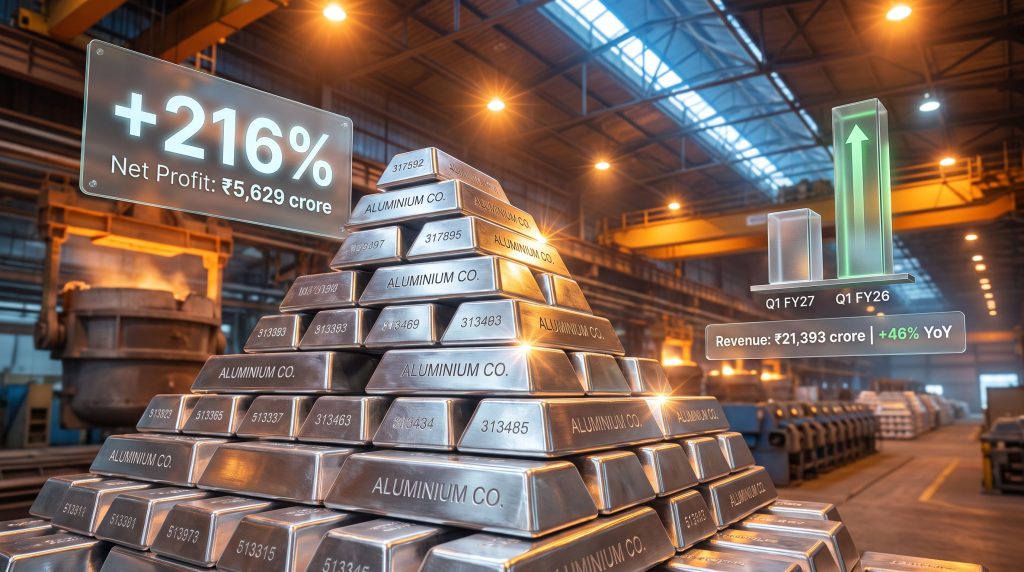
The headline figures from Q1 FY27 are difficult to contextualise without the right analytical framework. A 216% year-on-year rise in net profit to ₹5,629 crore is the kind of number that invites scepticism, yet the underlying data supports it. Furthermore, for a deeper look at how these results compare to prior periods, Vedanta's investor results portal offers comprehensive historical reporting.
| Financial Metric | Q1 FY27 | Q1 FY26 | YoY Change |
|---|---|---|---|
| Net Profit | ₹5,629 crore | ₹1,781 crore | +216% |
| Revenue from Operations | ₹21,393 crore | ~₹14,556 crore | +46% |
| Total Income | ₹21,702 crore | — | +46%+ |
| Total Expenses | ₹12,870 crore | — | +7.5% |
| QoQ Net Profit Growth | ₹5,629 crore vs prior quarter | — | +33.8% |
The single most telling figure in this table is not the profit number itself. It is the divergence between revenue growth and expense growth. Revenue expanded by 46% while total expenses rose by only 7.5%. This asymmetry is the fingerprint of operating leverage, a condition where incremental revenue flows disproportionately to the bottom line because the cost base has been structurally anchored.
Operating leverage at this scale does not occur by accident. It reflects years of deliberate cost engineering, captive resource development, and production ramp-up that collectively lower the marginal cost of each additional tonne produced.
Prior to the demerger from the broader Vedanta conglomerate, the aluminium business was effectively priced inside a diversified holding company discount. The separation creates a standalone entity that capital markets can now value on its own earnings trajectory, without the noise of unrelated commodity exposures distorting the picture. This broader pattern of aluminium sector restructuring is visible across global markets, not just in India.
Three Structural Drivers Behind the Earnings Surge
Global Aluminium Prices: The Catalyst, Not the Whole Story
Aluminium prices on the London Metal Exchange strengthened materially through the April to June 2025 period, and Indian smelters with significant production scale were direct beneficiaries. Estimated EBITDA growth of approximately 123% year-on-year and 17.5% sequentially reflects how quickly higher spot prices translate into margin expansion for low-cost producers.
However, attributing the entire earnings surge to price is analytically incomplete. Kotak Institutional Equities projected net profit of approximately INR 5,693.5 crore (USD 595 million) for the quarter, while noting that the company's hedging positions would partially moderate the full uplift from spot price gains. Hedging is a standard risk management tool, but in strongly rising price environments it creates a temporary drag between reported earnings and the theoretical maximum that pure spot exposure would generate.
This is a nuance that investors and analysts modelling forward earnings need to incorporate carefully. The company's realised price per tonne will consistently differ from spot during periods of sustained price movement, in either direction. In addition, the aluminium tariff impacts playing out globally have added further complexity to how smelters price and hedge their output.
Production Volume Expansion: The BALCO Engine
Aluminium output for Q1 FY27 is estimated at approximately 0.63 million tonnes, representing:
- A 6.8% increase year-on-year
- A 1.9% sequential rise from the prior quarter
- Growth anchored to new smelting capacity coming online at Bharat Aluminium Company (BALCO)
BALCO is a critical operational asset within the Vedanta Aluminium structure. Its smelting ramp-up is not a speculative future event but an active ongoing process, with incremental tonnes feeding directly into quarterly production figures. What makes this volume story compelling over a multi-year horizon is the compounding effect: sustained 6–7% annual production growth, when layered across an already significant production base, produces meaningful absolute volume gains that amplify the earnings impact of any given price environment.
Backward Integration: The Cost Architecture Competitors Cannot Easily Replicate
The most structurally significant aspect of Vedanta Aluminium's competitive position is its vertically integrated raw material supply chain. The company has guided for a cost of production below USD 1,500 per tonne, underpinned by:
- 100% captive coal integration covering energy requirements for smelting operations
- 90% captive alumina supply reducing exposure to third-party refinery pricing
- 60% captive bauxite coverage providing upstream ore security
To appreciate why this matters, consider that aluminium smelting is one of the most energy-intensive industrial processes on Earth. Approximately 14 to 16 megawatt-hours of electricity are required to produce a single tonne of primary aluminium, and energy costs typically represent 30 to 40% of total production costs for smelters relying on grid or merchant power. Captive coal access fundamentally changes this cost equation.
Similarly, alumina, which is refined from bauxite and then reduced electrochemically into aluminium metal, is a significant input cost component. Global alumina markets have experienced episodic tightening, including disruptions linked to Australian refinery curtailments and Guinea export constraints. Producers with 90% captive alumina supply are effectively insulated from these market events.
Most global aluminium producers remain exposed to third-party alumina and energy markets. Vedanta Aluminium's integrated model creates a structurally lower cost floor, which protects EBITDA margins precisely when spot prices weaken, offering a form of natural earnings resilience that purely merchant-supply producers cannot replicate.
The Medium-Term Earnings Architecture: FY26 to FY28
Volume Growth Roadmap
ICICI Securities projects aluminium volumes reaching 2.9 million tonnes in FY28, implying a CAGR of approximately 9% over the FY26 to FY28 period. This is not a speculative forecast constructed from aspirational guidance. It is anchored to already-commissioned infrastructure and documented ramp-up timelines at existing smelting facilities.
The distinction matters for investors. Volume growth forecasts backed by physical infrastructure are fundamentally different in risk character from forecasts dependent on greenfield project approvals or capital expenditure commitments that have not yet been made. Consequently, this positions Vedanta favourably relative to top aluminium companies that still rely heavily on unbuilt capacity.
EBITDA Scaling Projections
| Metric | FY28 Target | Implied CAGR (FY26–FY28) |
|---|---|---|
| Total EBITDA | ₹38,900 crore (~USD 4.1 billion) | ~24% |
| EBITDA per Tonne | USD 1,429/tonne | — |
| Cost Reduction Target | ~USD 70/tonne below FY26 levels | — |
The USD 70 per tonne cost reduction target is expected to be achieved primarily through greater utilisation of captive alumina refineries, bauxite mines, and coal assets. As captive coverage deepens across the supply chain, the reliance on third-party procurement at market prices diminishes, and the cost base becomes progressively more predictable and lower.
Value-Added Products: The Margin Upgrade That Changes the Revenue Mix
Perhaps the least discussed but most strategically significant element of the Vedanta Aluminium Q1 profit growth story is the planned shift in product mix toward value-added aluminium products (VAP). The share of VAP revenue is projected to increase from approximately 60% currently to 75% by FY28.
VAP encompasses downstream processed forms of aluminium, including alloys, flat-rolled products, extrusions, wire rods, and specialty billets. These products command materially higher selling prices than commodity-grade primary aluminium because they incorporate additional processing, specification compliance, and often customer-specific formulation.
The strategic logic here mirrors approaches taken by global aluminium majors over the past two decades, and it aligns closely with the broader value-added metals strategy being pursued across the industry. By shifting volume toward downstream value-added forms:
- Average realised selling prices improve without requiring any change in spot commodity prices
- Customer relationships deepen through specification lock-in and technical service requirements
- Revenue volatility decreases because VAP contracts often include cost pass-through or tolling arrangements
- Operating margins structurally expand as processing value is captured internally rather than by downstream converters
This de-commoditisation strategy is particularly relevant given that global aluminium markets may face supply surplus conditions by FY29, which would place downward pressure on commodity-grade primary aluminium prices.
Market Valuation and Capital Allocation Signals
Analyst Price Targets and Consensus Positioning
As of July 2025, institutional brokerage price targets for Vedanta Aluminium ranged from INR 520 (USD 5.43) to INR 630 (USD 6.58) per share, with a consensus target of approximately INR 564 (USD 5.89), implying roughly 28% potential upside from prevailing market prices.
The breadth of the target range itself is informative. The spread between the low and high targets reflects genuine analytical disagreement about the pace of backward integration deepening, the sustainability of aluminium price levels, and the speed of VAP mix improvement, rather than uncertainty about the directional earnings story. For a detailed breakdown of how analysts are framing the upcoming period, Q1 FY27 earnings preview analysis offers useful additional context.
The First Interim Dividend: Reading the Capital Allocation Signal
Vedanta Aluminium declared its first interim dividend of INR 8 per equity share for FY27, totalling approximately INR 3,128.55 crore (USD 327 million). The timing of this declaration, in the very first quarter of the company's post-demerger existence as a standalone listed entity, carries interpretive weight beyond the cash amount itself.
Early dividend declarations from newly demerged industrial companies are often interpreted by market participants as a credibility signal. Management is committing to a capital return framework before the full-year earnings picture has crystallised, which communicates a level of cash generation confidence that forward guidance statements alone cannot convey.
For income-oriented investors evaluating the stock, the dividend declaration also establishes a baseline expectation for capital allocation discipline going forward.
Risk Factors That Could Moderate the Growth Thesis
Global Supply Dynamics: The West Asia and Indonesia Variables
Aluminium price strength through Q1 FY27 was partly supported by supply disruptions in West Asia related to shipping constraints affecting the Strait of Hormuz corridor. Market analysts have noted that expectations around the normalisation of West Asian aluminium supply caused some moderation in price momentum toward the end of the quarter.
The risk scenario for medium-term pricing is more complex than a simple supply restoration story. Analysts project that full restoration of West Asian aluminium supply could occur around Q2 FY28, and when combined with incremental capacity additions from Indonesia, the global aluminium market could shift into surplus conditions by FY29. A supply surplus environment would place meaningful downward pressure on LME prices and, consequently, on per-tonne realisations for all producers, including vertically integrated ones.
Hedging Positions as an Earnings Drag in Rising Markets
As noted earlier, Vedanta Aluminium's hedging book partially offset the Q1 FY27 benefit from higher spot prices. While hedging protects against downside in falling price environments, it creates a systematic underperformance against spot in rising markets. Investors should be aware that:
- Reported EBITDA per tonne will diverge from theoretical spot-price EBITDA during periods of sustained price movement
- The magnitude of this divergence depends on the size, tenor, and strike levels of active hedge positions
- As hedges roll off and are reset, the relationship between spot prices and reported earnings will shift accordingly
Residual Raw Material Exposure
Despite strong backward integration progress, the company retains some exposure to third-party markets: approximately 10% of alumina requirements and 40% of bauxite requirements are sourced externally. Any sustained tightening in global alumina supply chains, whether from Australian refinery disruptions, West African export restrictions, or Indian domestic mining constraints, could partially erode the cost advantage that the captive integration model is designed to deliver.
The next major ASX story will hit our subscribers first
Three Metrics Investors Should Track in Coming Quarters
For investors monitoring the structural earnings thesis, three forward-looking indicators will reveal whether the growth narrative is tracking as projected. Understanding commodity price leverage and how it interacts with operational metrics is essential for interpreting these signals accurately.
- EBITDA per tonne progression toward the USD 1,429/tonne FY28 target, which validates both cost reduction execution and pricing realisation quality
- VAP share expansion from the current ~60% toward 75%, signalling whether the product mix upgrade strategy is operationally on track
- Global aluminium price trends, particularly early signals around West Asian supply restoration timelines and Indonesian capacity commissioning schedules, both of which affect the FY29 surplus scenario probability
The convergence of volume growth, cost reduction, and product mix improvement creates a multi-layered Vedanta Aluminium Q1 profit growth thesis that is meaningfully different from a simple commodity price leverage story. Whether the FY28 targets are met will depend on execution across all three dimensions simultaneously, which introduces complexity but also resilience. If commodity prices soften, cost reduction and VAP mix improvement provide partial offsets that a purely price-dependent earnings model would not capture. For broader context on how this quarter fits into the company's longer-term trajectory, earlier performance analysis provides useful comparison points.
Disclaimer: This article is intended for informational purposes only and does not constitute financial advice. All forecasts, analyst projections, and price targets referenced are sourced from institutional research as cited and represent opinions at the time of publication. Past financial performance is not a reliable indicator of future results. Readers should conduct independent due diligence before making any investment decisions.
Want to Catch the Next Major Mineral Discovery Before the Market Does?
Discovery Alert's proprietary Discovery IQ model scans ASX announcements in real time, instantly identifying significant mineral discoveries and turning complex data into actionable investment insights — ideal for both short-term traders and long-term investors. Explore historic discoveries and the returns they generated, then start your 14-day free trial at Discovery Alert to position yourself ahead of the broader market.