July 30, 2026
When Iron Ore Quality Becomes the Strategy: Understanding Champion Iron's Pivotal Quarter
The global steel industry is undergoing a structural rearrangement that happens perhaps once every few decades. As electric arc furnace technology scales and direct reduced iron production expands, the specification requirements for iron ore feedstocks are tightening dramatically. Producers supplying standard-grade concentrates face an increasingly bifurcated market, where the premium commanded by high-purity material grows wider with each passing year. It is within this evolving backdrop that the Champion Iron Ore first quarter results for FY2027 must be understood, not as a simple financial miss, but as a snapshot of a company mid-transformation.
When big ASX news breaks, our subscribers know first
What the Headline Numbers Actually Tell Us
The quarter ended June 30, 2026 produced results that, on the surface, read as a sharp deterioration. A closer inspection, however, reveals a more nuanced picture where timing, accounting conventions, and one-time commissioning costs account for the vast majority of the headline damage.
| Metric | Q1 FY2027 | Q4 FY2026 (Mar 2026) | Q1 FY2026 (Jun 2025) | YoY Change |
|---|---|---|---|---|
| Production (wmt) | 3.9 million | — | ~3.5 million | +12% |
| Sales (dmt) | 3.3 million | — | ~3.8 million | -13% |
| Revenue | $356.9M | $390.0M | $390.0M | -8.5% |
| EBITDA | $32.8M | $114.3M | $57.8M | -43% YoY |
| EBITDA Margin | ~9% | ~29% | ~15% | -6 ppts YoY |
| Net Income / (Loss) | -$41.5M | $23.2M | $23.8M | Swing to loss |
| EPS / (LPS) | -$0.07 | $0.04 | $0.05 | Swing to loss |
| Available Liquidity | $653.1M | $812.4M | — | -$159.3M QoQ |
Production rose 12% year-over-year to 3.9 million wet metric tonnes, yet sales volumes fell 13% to 3.3 million dry metric tonnes. This inverse relationship between production growth and sales decline is the single most important dynamic of the quarter. It traces directly back to vessel scheduling disruptions during the Direct Reduction Pellet Feed commissioning ramp-up at Bloom Lake.
Dissecting the $41.5 Million Net Loss: How Much Was Real?
One of the most important analytical skills in resource sector investing is distinguishing between cash losses and accounting-driven losses. In Q1 FY2027, this distinction carries significant weight.
The Non-Cash Components
Of the $41.5 million net loss recorded for the quarter, approximately $34.8 million can be attributed to non-cash items:
- Unrealised foreign exchange loss: $17.2 million arising from net monetary liabilities denominated in foreign currencies, a figure entirely driven by currency movements rather than operational performance
- Derivative instrument fair value adjustments: $17.6 million in unfavourable mark-to-market movements on commodity and financial derivatives, which are subject to reversal in subsequent periods as positions unwind or markets move
The Cash-Related Costs
The remaining cash-affecting charges included:
- DRPF commissioning startup costs: $6.6 million, representing one-off expenditures associated with bringing the Direct Reduction Pellet Feed facility online
- Rana Gruber inventory valuation adjustment: $2.9 million, a non-cash purchase price accounting charge applied to acquired inventory under standard acquisition accounting rules
What matters to investors assessing operational health is that the core Bloom Lake operation continued to deliver 3.5 million wet metric tonnes in line with expectations. The loss is an accounting event layered over a functioning, producing asset base.
The DRPF Project: What It Is and Why It Changes Everything
Understanding Direct Reduction-Grade Iron Ore
Most investors and observers are familiar with the basic iron ore benchmark, the 62% Fe fines price quoted daily from Platts or Fastmarkets. What is less widely understood is that direct reduction-grade iron ore is an entirely different product category requiring iron content typically above 67% Fe, with strict limits on impurities including silica, alumina, phosphorus, and sulphur.
This is not simply a higher-grade version of standard concentrate. The DRI steelmaking process, which reduces iron ore using natural gas or hydrogen rather than coking coal, demands feedstocks of exceptional chemical consistency. Gangue minerals and impurities that are manageable in a blast furnace become significant efficiency and quality problems in a shaft furnace or fluidised bed reactor. The tolerance thresholds are fundamentally different.
Furthermore, this explains why DR-grade material commands a meaningful price premium over standard iron ore concentrates. The iron ore demand outlook suggests this premium has widened as DRI capacity expansion accelerates globally, particularly in the Middle East, Europe, and increasingly in North America.
Bloom Lake's DRPF Achievement
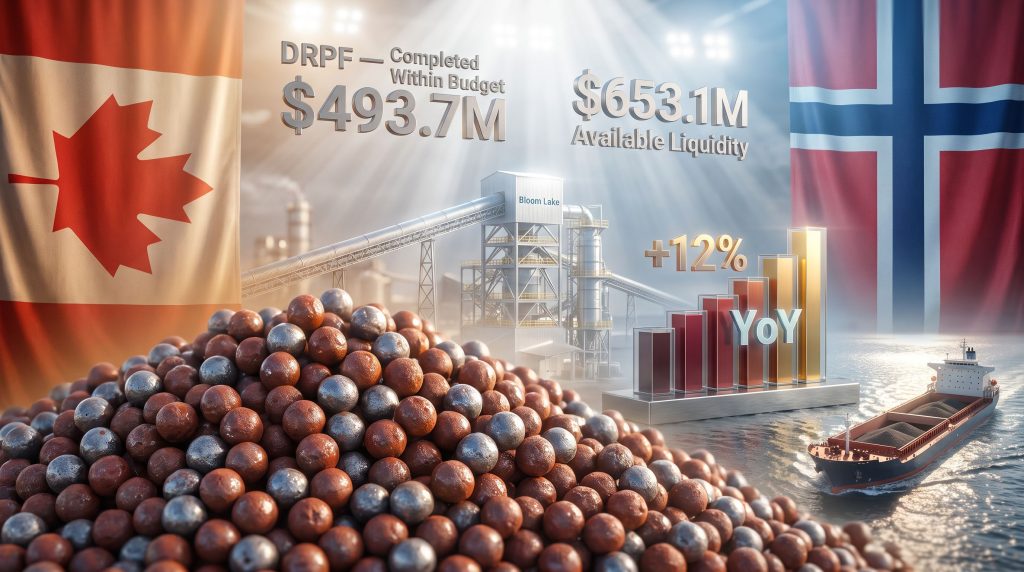
- The DRPF project was completed within its revised $500 million budget, with cumulative capital expenditure reaching $493.7 million at June 30, 2026, representing a $6.3 million underspend against the approved ceiling
- DR-quality iron ore was produced from Bloom Lake for the first time during Q1 FY2027, confirming the technical success of the beneficiation upgrade
- The first commercial shipment of DR-grade material is targeted for the September 2026 quarter
- A commercial offtake agreement for a portion of near-term DRPF production capacity was secured during the quarter, with customer discussions continuing
How the Commissioning Disrupted Near-Term Sales
The transition from standard concentrate production to DR-grade output at Bloom Lake required a sequencing adjustment at the Port of Sept-Îles, the primary export terminal for Bloom Lake's production. Vessel bookings were reduced during the ramp-up period to accommodate the operational transition, which directly constrained the volume of iron ore shipped and recognised as revenue during Q1 FY2027.
This is a well-understood dynamic in mining project commissioning: new processing configurations require product qualification, vessel scheduling adjustments, and inventory management changes before a steady-state commercial rhythm is established. The revenue, EBITDA, and cash flow impact is real but temporary. Consequently, the full financial benefit of the DRPF upgrade is expected to materialise from the September 2026 quarter onward.
Rana Gruber: The Norway Acquisition in Context
Acquisition Parameters
| Parameter | Detail |
|---|---|
| Target | Rana Gruber, Norway-based high-purity iron ore producer |
| Completion Date | April 10, 2026 |
| Financing | New term loan under syndicated senior credit facilities |
| Revolving Credit Facility | $400 million, maturity extended to April 2030 |
What Rana Gruber Is and Why It Matters
Rana Gruber is a Norwegian iron ore mining and processing company with a long operating history in the Mo i Rana region of northern Norway. It produces high-purity magnetite concentrates, a product profile closely aligned with Champion's Bloom Lake output. Furthermore, it aligns with the high-grade feedstock requirements of European steelmakers facing some of the world's most stringent carbon reduction regulations.
Norway's geographic position, established port infrastructure, and proximity to European steel markets make Rana Gruber a strategically complementary asset. European steel producers are accelerating transitions toward EAF and DRI-based production in response to the EU's Carbon Border Adjustment Mechanism, creating growing local demand for exactly the type of high-purity iron ore feedstocks that both Bloom Lake and Rana Gruber produce. The broader China steel market trends also reinforce why diversifying into European supply chains offers meaningful strategic value.
Rana Gruber's Q1 FY2027 Contribution
- Production: approximately 400,000 wmt, accounting for the bulk of Champion's 12% year-over-year production increase
- Sales: 200,000 dmt of the 3.3 million dmt quarterly total
- Revenue: $23.9 million included in the $356.9 million consolidated figure
- EBITDA headwind: $2.9 million non-cash inventory valuation charge from acquisition accounting, which will not recur once the acquired inventory is fully sold through
The integration of Rana Gruber transforms Champion from a single-jurisdiction Canadian producer into a dual-jurisdiction Canada-Norway operator with exposure to two distinct iron ore markets, customer bases, and decarbonisation-driven demand pools.
Revenue Performance: A Volume Story, Not a Price Story
A critical analytical point that risks being obscured by the headline revenue decline is that realised selling prices actually improved during Q1 FY2027 relative to the prior comparable period. The gross average realised selling price increased year-over-year, partially offsetting higher freight and fuel costs.
The $33.1 million revenue shortfall versus Q1 FY2026 is therefore entirely attributable to lower shipment volumes, not pricing weakness. Bloom Lake's underlying pricing power remains intact. The constraint was operational sequencing during DRPF commissioning, a known and bounded factor. When DR-grade shipments begin in Q2 FY2027, the blended realised price per tonne is expected to improve further, as DR-quality material commands premiums above standard high-grade concentrate pricing.
The revenue gap is a volume story, not a price story. Bloom Lake's pricing power appears intact; the constraint was shipment sequencing during DRPF commissioning, a temporary, operationally-driven dynamic expected to normalise from the September 2026 quarter onward.
The next major ASX story will hit our subscribers first
Liquidity and Balance Sheet: Reading the $159 Million Reduction Correctly
Available liquidity declined from $812.4 million at March 31, 2026 to $653.1 million at June 30, 2026, a reduction of $159.3 million over a single quarter. Context is essential here.
This drawdown primarily reflects:
- Capital deployed for the Rana Gruber acquisition, funded through a new term loan under Champion's syndicated senior credit facility
- Final DRPF project expenditure as the project reached completion at $493.7 million cumulative spend
- Operational cash flows deferred by the volume shortfall during DRPF commissioning
The extension of the revolving credit facility maturity to April 2030 is a meaningful balance sheet management action, removing near-term refinancing pressure and providing flexibility as the company transitions into its post-construction, DR-grade commercial phase. With $653.1 million in available liquidity, the company retains a substantial operational buffer. Investors can review Champion's financial regulatory reports for a more detailed breakdown of the company's balance sheet position.
The Decarbonisation Macro: Why Champion's Product Positioning Is Timely
Understanding the DRI Value Chain
Direct reduced iron is produced by reacting iron ore with a reducing gas, traditionally natural gas-derived hydrogen and carbon monoxide, at temperatures below iron's melting point. The resulting sponge iron is a high-metallic-content feedstock used in electric arc furnaces to produce steel with substantially lower CO2 emissions than the traditional blast furnace-basic oxygen furnace route.
The carbon intensity of DRI-EAF steelmaking is roughly 40-60% lower than blast furnace steelmaking on a per-tonne-of-steel basis. Furthermore, when green hydrogen is used as the reductant, near-zero-emissions steel production becomes technically achievable. Understanding green iron production in this context helps illustrate why global DRI capacity has grown steadily, with major expansions underway in the Middle East, Europe, and North America.
Why Purity Is the Critical Variable
A factor not widely appreciated outside the steelmaking industry is that gangue content in DRI feedstocks accumulates in the EAF slag, increasing energy consumption, electrode wear, and refractories costs per heat. Every percentage point of silica or alumina in the iron ore feedstock has a measurable cost impact at the steelmill level.
In addition, the role of hydrogen-based iron reduction is accelerating the demand for ultra-pure feedstocks, as hydrogen shaft furnaces are even less tolerant of impurities than gas-based DRI plants. This economic mechanism underpins the sustainable price premium for DR-grade ore and explains why Champion's DRPF investment is strategically timed to coincide with accelerating DRI capacity additions globally.
Key Risks and Forward Indicators for Q2 FY2027
Risk Factors to Monitor
- DRPF commercial ramp-up pace: The speed at which Champion can achieve steady-state DR-grade shipment volumes will determine how quickly the deferred Q1 revenue is recovered
- Derivative and FX exposure: The $34.8 million combined non-cash loss in Q1 FY2027 highlights ongoing sensitivity to currency movements and commodity derivative positions; these can reverse but also compound
- Rana Gruber integration complexity: Combining Norwegian and Canadian operations across different regulatory regimes, labour frameworks, and logistics networks introduces execution risk in the near term
- Iron ore price trajectory: Macro uncertainty, particularly around Chinese steel demand and property sector activity, continues to influence benchmark iron ore pricing and investor sentiment toward the sector. Understanding the various iron ore market types is helpful context for assessing how different product grades respond to these macro pressures
Positive Signals Heading Into Q2 FY2027
- Zero serious workplace injuries and no major environmental incidents during the quarter, maintaining Champion's ESG performance credentials
- Bloom Lake continued delivering 3.5 million wmt in line with plan, confirming operational stability at the core asset
- DR-grade production achieved during Q1 FY2027, with the first commercial shipment targeted for the September 2026 quarter
- A cost management and operational optimisation program underway across both Bloom Lake and Rana Gruber
- Secured offtake agreement for a portion of near-term DRPF production capacity, with additional customer discussions ongoing
FAQ: Champion Iron Ore Q1 FY2027 Results
What period do the Champion Iron Ore first quarter results cover?
The results cover the three months ended June 30, 2026, representing Q1 of Champion Iron's financial year 2027.
Why did Champion Iron record a net loss despite production growth?
The $41.5 million net loss was dominated by $17.2 million in unrealised foreign exchange losses and $17.6 million in unfavourable derivative fair value adjustments, both non-cash items, alongside $6.6 million in DRPF commissioning costs and a $2.9 million acquisition accounting charge from Rana Gruber.
What is DR-grade iron ore and why does it command a premium?
Direct reduction-grade iron ore contains iron content typically above 67% Fe with tightly controlled impurity levels. It is required for DRI-based steelmaking, which produces steel with substantially lower carbon emissions than traditional blast furnace routes. The purity requirement and growing DRI capacity globally underpin a structural price premium over standard concentrates.
When does Champion expect to ship its first DR-grade cargo?
The inaugural commercial shipment of direct reduction-quality iron ore from Bloom Lake is targeted for completion during the September 2026 quarter. Investors seeking further detail can access the full quarterly activities report for additional operational context.
What did Rana Gruber contribute in the quarter?
Acquired on April 10, 2026, Rana Gruber contributed approximately 400,000 wmt of production, 200,000 dmt of sales, and $23.9 million in revenue during Q1 FY2027.
Is Champion Iron's liquidity position adequate?
Available liquidity of $653.1 million at June 30, 2026, combined with the revolving credit facility extended to April 2030, provides a substantial buffer for operational continuity and strategic flexibility.
What Q1 FY2027 Signals About the Medium-Term Trajectory
The Champion Iron Ore first quarter results for FY2027 represent one of the more analytically complex quarterly reports the company has produced. The headline figures, a net loss of $41.5 million and EBITDA compression to $32.8 million, sit in sharp contrast to the strategic progress made during the same period: DRPF completion within budget, first DR-grade production, Rana Gruber integration commenced, and an offtake agreement secured.
The two dominant loss drivers, non-cash FX movements and derivative fair value adjustments totalling $34.8 million combined, are inherently variable and subject to reversal. The commissioning-related volume shortfall is bounded in time. The inventory valuation charge on Rana Gruber will not recur once acquired stock is sold through.
What persists beyond this transitional quarter is a fundamentally upgraded asset base: a Bloom Lake mine now capable of producing premium DR-grade iron ore, a Norwegian operation providing European market exposure, and a combined production platform positioned to supply the high-purity feedstocks that a decarbonising steel industry increasingly demands.
Champion Iron enters the remainder of FY2027 having absorbed the peak financial disruption of its transformation cycle. The investments are largely complete. The commercial proof points, first DR-grade shipment and expanded offtake agreements, are the near-term catalysts that will determine how quickly the market recalibrates its assessment of the company's margin trajectory.
This article contains forward-looking statements and financial analysis intended for informational purposes only. It does not constitute financial advice. Readers should conduct their own due diligence and consult a licensed financial adviser before making any investment decisions. Past performance is not indicative of future results.
Want to Identify the Next Major Mineral Discovery Before the Broader Market Does?
Discovery Alert's proprietary Discovery IQ model delivers real-time alerts on significant ASX mineral discoveries — instantly translating complex geological and commodity data into actionable investment insights, much like the structural shifts reshaping iron ore demand explored in this article. Explore how historic discoveries have generated extraordinary returns on Discovery Alert's dedicated discoveries page, and begin your 14-day free trial today to position yourself ahead of the market.