June 29, 2026
The Race to Rewire the Rare Earth Supply Chain Starts Underground
The modern clean energy economy runs on a handful of elements most people have never heard of. Dysprosium powers the magnets inside electric vehicle motors. Terbium enables the efficiency gains that make wind turbines commercially viable. Yttrium underpins phosphors used across display technologies and lighting systems. These heavy rare earth elements (HREEs) are not interchangeable, not easily substituted, and not evenly distributed across the Earth's crust. More critically, the infrastructure to mine, process, and refine them sits overwhelmingly within a single country's borders. Amaroq rare earth drilling in Greenland is emerging as one of the most watched responses to this structural vulnerability.
China currently controls roughly 60% of global rare earth mining output and an estimated 85 to 90% of global rare earth processing capacity, according to data from the U.S. Geological Survey. That concentration has become a fault line in Western industrial policy, accelerating exploration mandates across jurisdictions that were, until recently, considered too remote or too complex to be commercially viable. The rare earth supply chain is consequently being redrawn, and Greenland critical minerals are at the centre of that effort. Within the island's borders, the Gardar Alkaline Province of South Greenland has emerged as a geological corridor of genuine global significance.
When big ASX news breaks, our subscribers know first
Why the Gardar Alkaline Province Stands Apart Geologically
Understanding why the Gardar Province attracts such sustained exploration interest requires stepping back from geopolitics and examining the geology directly. Most of the world's economically significant rare earth deposits fall into three broad categories: carbonatite-hosted systems (like Mountain Pass in the U.S. and Lynas's Mount Weld in Australia), laterite-hosted systems common across Southeast Asia and parts of Africa, and alkaline-to-pegmatite systems, which are rarer but can carry exceptional grades and favourable mineral chemistry.
The Gardar Province belongs firmly to that third category. Formed through a series of alkaline igneous intrusions during the Proterozoic era, the province generated a suite of rare-earth-enriched pegmatite bodies distributed across South Greenland. These are not diffuse, low-grade disseminated deposits. They are structurally distinct, often steeply dipping bodies with high degrees of mineralogical differentiation, meaning that economically valuable elements can concentrate into discrete zones rather than being spread uniformly through the host rock.
Collectively, the Gardar Province hosts more than 1.5% of all identified global rare earth mineral resources, a remarkable figure for a single geological corridor. Globally recognised projects including Kvanefjeld and the Tanbreez REE deposit sit within or adjacent to this same geological framework, lending strong geological credibility to newer exploration targets in the region.
Pegmatite Systems Versus Other REE Host Rocks: A Critical Distinction
One aspect that rarely receives enough attention in mainstream coverage is the processing dimension of different REE host rock types. Carbonatite systems often carry elevated levels of radioactive thorium and uranium as co-mingled minerals, creating regulatory and processing complexity that has derailed multiple projects globally. Laterite systems tend to be lower grade and require high volumes of acid for leaching, generating significant environmental footprints.
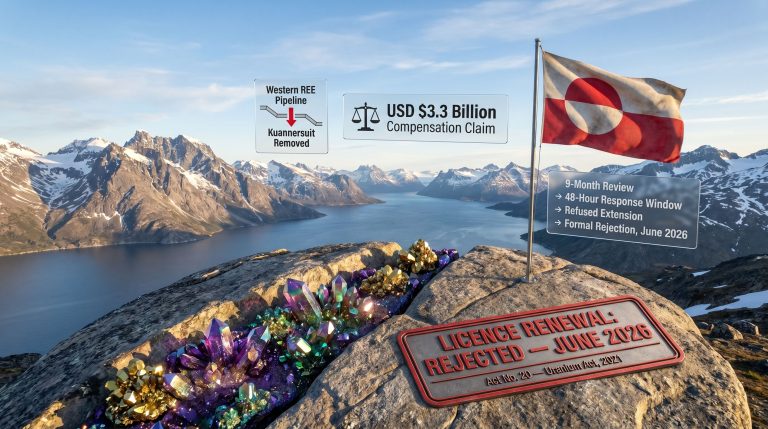
Pegmatite-hosted REE systems, by contrast, can exhibit more conventional mineralogy, meaning standard concentration and separation techniques may apply without the radioactive by-product burden that has historically plagued Greenland-specific projects. Furthermore, the rare earth processing challenges associated with uranium co-extraction have become a defining filter for viable REE development in this jurisdiction. This distinction is not academic. Greenland's government denied a licence renewal to an Australian miner in June 2026 specifically because its project involved uranium co-extraction.
Projects that can demonstrate low uranium and thorium content from early-stage sampling are, in regulatory terms, operating in an entirely different risk category from those that cannot. In Greenland's current regulatory environment, this distinction may determine which projects advance and which do not.
Amaroq Rare Earth Drilling in Greenland: The Ilua Pegmatite in Detail
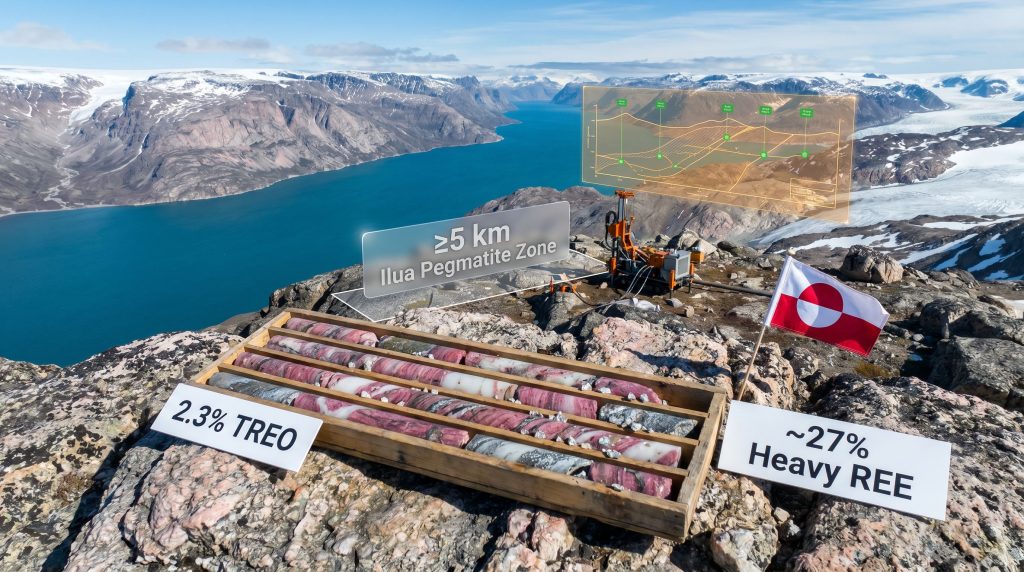
Amaroq Minerals began Amaroq rare earth drilling in Greenland at the Ilua site as the first of its 2026 exploration programmes, targeting a zone with at least 5 kilometres of confirmed surface strike length. The company's 2026 drilling campaign on the Ilua pegmatite represents the first downhole assessment of what surface evidence suggests is a substantial rare earth system.
That figure carries significant implications for resource scale potential. In pegmatite geology, strike length alone does not determine resource size, but it establishes the spatial envelope within which mineralisation could be continuous. A 5 km strike, if supported by consistent grade and adequate width at depth, would place Ilua among the more dimensionally significant early-stage pegmatite REE targets globally.
Surface Sampling Results: What the 2025 Data Revealed
Surface sampling conducted across the Ilua Pegmatite Zone in 2025 returned grades of up to 2.3% total rare earth oxides (TREO). That headline figure is encouraging, but the more strategically significant data point is the heavy rare earth proportion. Approximately 27% of the total rare earth content at Ilua comprises heavy rare earths, a ratio that distinguishes this system from most early-stage REE targets.
To contextualise that figure: most carbonatite-hosted REE deposits are dominated by light rare earths (LREEs), particularly cerium, lanthanum, and neodymium. While these are commercially valuable, they are also far more abundant and face steeper price competition. Heavy rare earths including dysprosium, terbium, holmium, and yttrium are significantly scarcer, command higher per-kilogram pricing, and are disproportionately critical to permanent magnet manufacturing used in EV drivetrains and direct-drive wind turbines.
The 2026 Scout Drilling Programme: Structure and Scientific Intent
The 2026 programme has been structured around three initial scout drill targets distributed along the Ilua Pegmatite Zone. This phased approach reflects best practice for early-stage pegmatite evaluation, where the primary objective is not yet resource definition but geometry and continuity assessment. Specifically, the programme seeks to determine:
- Whether the grade signature observed at surface persists at depth with meaningful continuity
- The three-dimensional orientation, dip, and width of mineralised zones
- The mineralogical composition of REE-bearing phases and their amenability to processing
- Whether the system displays internal zonation that could concentrate HREEs into discrete higher-value intervals
Supporting this drilling effort are parallel workstreams including detailed geological mapping, channel sampling (to establish representative bulk grades along exposed outcrop), and mineralogical studies aimed at identifying which specific REE-bearing minerals are present and how they respond to physical and chemical processing.
How Ilua Compares to Other Greenland REE Projects
| Feature | Ilua Pegmatite | Typical Greenland REE Systems |
|---|---|---|
| Host Rock Type | Conventional pegmatite | Alkaline intrusive / carbonatite |
| Surface TREO Grade | Up to 2.3% | Often 0.5 to 1.5% |
| Heavy REE Proportion | ~27% of total REE | Generally lower HREE ratios |
| Uranium/Thorium Content | Relatively low | Frequently elevated |
| Processing Complexity | More conventional | Often complex with radioactive by-products |
| Strike Length Confirmed | 5 km minimum | Highly variable by project |
| Regulatory Risk Profile | Lower | Higher in uranium-associated systems |
The Processability Advantage: Why Low Radioactive Content Is a Commercial Differentiator
The regulatory burden associated with uranium and thorium in REE processing is frequently underestimated by generalist investors. When these radioactive elements occur as by-products of rare earth extraction, the processing facility is legally classified as handling radioactive material, triggering an entirely different set of environmental, health, safety, and waste disposal requirements. In practical terms, this can add years to permitting timelines and substantially increase capital expenditure for waste management infrastructure.
Several globally significant REE projects, including some in the Gardar Province itself, have faced prolonged permitting delays or outright rejection because of this issue. The Ilua pegmatite's relatively low uranium and thorium concentrations, as identified through 2025 surface sampling, represent a genuine commercial advantage that extends well beyond geology into the economics of project development, offtake negotiations, and financing structures.
Amaroq's Broader Critical Minerals Strategy in Greenland
Greenland's rare earth opportunity sits within a larger operational framework for Amaroq that spans two distinct hubs. In South Greenland, the Nalunaq gold mine provides an operating revenue base that funds ongoing exploration without full dependence on external capital markets. This is a structurally significant feature: early-stage critical mineral exploration is notoriously capital-intensive with no near-term revenue offset, and having an operating mine in the same jurisdiction reduces both the funding risk and the logistical complexity of exploration campaigns.
In West Greenland, the Black Angel site, historically known as a zinc and lead mine, is being reassessed for its potential germanium and gallium content. Both minerals have become acutely strategically important following China's rare earth restrictions and export controls on gallium in 2023 and germanium in the same year — measures that sent industrial buyers across the United States, Japan, and Europe scrambling for alternative sources. Identifying these critical minerals at an existing mine site, with established infrastructure and permitting history, represents a lower-risk pathway to supply chain diversification than greenfield development.
The Paatusoq REE Project: Contextualising Ilua Within a Larger Portfolio
The Ilua campaign sits alongside Amaroq's primary rare earth resource definition project, Paatusoq, which is progressing through a more advanced phase of evaluation. According to Global Mining Review's coverage of Amaroq's 2025 exploration campaign, the 2025 Paatusoq programme included up to 3,500 metres of surface drilling across multiple rigs, specifically designed to generate data sufficient for a maiden mineral resource estimate. Paatusoq's proximity to globally recognised Gardar Province deposits reinforces the geological plausibility of the broader portfolio.
New exploration licences have been added to expand Amaroq's regional footprint, covering both confirmed REE targets and newly identified prospects within the Gardar Province corridor.
Ownership Structure: The Gardaq Joint Venture
Amaroq holds 51% ownership of its strategic metals licences, with the remaining 49% held through the Gardaq Joint Venture, which includes institutional and high-net-worth investor participation. This joint venture model serves a dual function: it distributes the financial risk of early-stage exploration across multiple parties while preserving Amaroq's operational control over programme design and execution. For investors evaluating the company, this structure signals that independently capitalised parties have validated the geological thesis sufficiently to commit capital alongside Amaroq.
From Scout Drilling to Potential Supply Chain Asset: The Development Pathway
Understanding where the Ilua programme fits within the broader development lifecycle is essential context for evaluating its significance. The pathway from current exploration to potential production involves several distinct stages:
- Scout drilling (current phase): Testing three initial targets to assess geometry, continuity, and grade at depth
- Resource definition drilling: Systematic infill drilling to support a maiden inferred mineral resource estimate
- Metallurgical test work: Confirming which processing routes achieve acceptable rare earth recovery rates
- Scoping and prefeasibility studies: Constructing economic models and identifying commercialisation pathways
- Permitting and project financing: Regulatory approvals, environmental assessments, and capital structure development
The transition between stages one and two — specifically the move from scout drilling to resource definition — is the most consequential early milestone. Positive scout drill results demonstrating that surface grades persist at depth with adequate continuity would elevate Ilua's status materially within the global REE development pipeline and likely trigger a more intensive follow-up programme.
Key Metrics to Watch When Drill Results Are Released
For investors and industry analysts tracking Amaroq rare earth drilling in Greenland, the following data points will carry the most interpretive weight when results are published:
- Drill intercept grades: Do downhole TREO values approach the 2.3% surface peak, or are they materially lower?
- Intercept widths: Wider mineralised zones at consistent grades translate more directly to resource tonnage
- HREE-to-LREE ratios at depth: Does the 27% HREE proportion observed at surface hold through the drilled profile?
- Mineralogical consistency: Are the same REE-bearing mineral phases present at depth as at surface, supporting processing assumptions?
- Structural continuity: Do multiple drill holes intersect mineralisation at predictable orientations, confirming the zone's geometry?
In pegmatite-hosted REE systems, the transition from surface sampling to drill-confirmed subsurface continuity is the single most critical de-risking milestone. Consistent grade profiles at depth would substantially elevate Ilua's standing within the global REE development pipeline.
Greenland's Regulatory Landscape: What Explorers Must Navigate
Greenland operates its own mining regulatory framework through the Bureau of Minerals and Petroleum (BMP), having assumed resource governance authority from Denmark as part of its expanded autonomy arrangements. The licensing framework is structured but carries specific risks that explorers must anticipate.
The most consequential regulatory constraint for REE developers is Greenland's uranium mining ban, which prohibits the extraction of uranium as a primary product and creates significant complications for projects where uranium occurs as an unavoidable by-product of REE processing. This policy was reinforced in June 2026 when Greenland's government declined to renew an exploration licence for an Australian mining company on precisely these grounds, establishing a clear and recent precedent.
For Ilua, the lower uranium and thorium content observed in surface sampling provides a meaningful regulatory buffer that other Gardar Province projects, burdened by radioactive mineral associations, cannot claim. This distinction is likely to become an increasingly important differentiator as the BMP applies its licensing criteria with greater stringency.
The next major ASX story will hit our subscribers first
Frequently Asked Questions: Amaroq Rare Earth Drilling in Greenland
What is the Ilua pegmatite project and where is it located?
The Ilua pegmatite is an early-stage rare earth exploration target within the Gardar Alkaline Province of South Greenland. It is part of Amaroq's growing critical minerals portfolio in the region and represents the first drill-stage evaluation of a surface-confirmed mineralised system extending at least 5 km along strike.
What surface grades have been recorded at Ilua?
Surface sampling in 2025 returned grades of up to 2.3% total rare earth oxides, with approximately 27% of that total comprising heavy rare earth elements, a notably elevated HREE proportion for an early-stage target in any jurisdiction.
Why does low uranium and thorium content matter so much at Ilua?
Greenland's regulatory framework places strict limitations on uranium co-extraction. Projects that carry elevated radioactive mineral content face prolonged permitting timelines and, in recent cases, outright licence denial. Ilua's relatively low levels of these elements reduce that regulatory risk considerably.
How many drill targets are being tested in 2026?
Three initial scout drill targets are being tested, distributed across the Ilua Pegmatite Zone's confirmed strike length of at least 5 kilometres.
Is Amaroq currently producing rare earths?
No. As of mid-2026, Amaroq remains in the exploration and resource definition phase for all its rare earth projects. Gold production at Nalunaq provides operational revenue, however no rare earth production is active or imminent.
What other critical minerals is Amaroq pursuing in Greenland?
Beyond rare earths, Amaroq is evaluating germanium and gallium potential at its Black Angel site in West Greenland, two elements now subject to Chinese export restrictions and of growing strategic importance to Western semiconductor and defence supply chains.
Key Data Summary: Ilua and the Broader Greenland REE Opportunity
| Metric | Data Point |
|---|---|
| Ilua Pegmatite Strike Length | At least 5 km confirmed surface expression |
| Peak Surface Grade (2025) | 2.3% total rare earth oxides |
| Heavy REE Proportion | ~27% of total REE content |
| 2026 Scout Drill Targets | 3 initial targets along Ilua Pegmatite Zone |
| Paatusoq Drilling Scope (2025) | Up to 3,500 m of surface drilling |
| Gardar Province REE Share | More than 1.5% of global rare earth mineral resources |
| Amaroq Licence Ownership | 51% (49% via Gardaq Joint Venture) |
| China's Share of REE Processing | Estimated 85 to 90% of global capacity |
This article contains forward-looking statements and speculative projections based on early-stage exploration data. Surface sampling results are not necessarily indicative of subsurface grade, resource continuity, or eventual economic viability. Investors should conduct independent due diligence before making any investment decisions related to companies or projects referenced in this article.
Ready to Invest in the Next Major Rare Earth Discovery?
Discovery Alert's proprietary Discovery IQ model delivers real-time alerts the moment significant mineral discoveries are announced on the ASX, instantly cutting through complex geological data to surface actionable opportunities in critical minerals like rare earths — explore historic discoveries and their returns, then begin your 14-day free trial at Discovery Alert to position yourself ahead of the broader market.