June 29, 2026
The Arctic Rare Earth Gamble: When Resource Nationalism Meets Critical Mineral Urgency
Few tensions in modern resource geopolitics are as unresolved as the one playing out across the Arctic. Western governments are racing to secure supply chains for rare earth elements (REEs), yet the jurisdictions that hold some of the world's most significant deposits are simultaneously tightening legislative and community-based controls over extraction. Greenland blocks Kuannersuit licence renewal in a decision that crystallises this contradiction in striking fashion, offering a case study that goes far beyond one company's exploration setback.
When big ASX news breaks, our subscribers know first
What the Kuannersuit Deposit Actually Represents
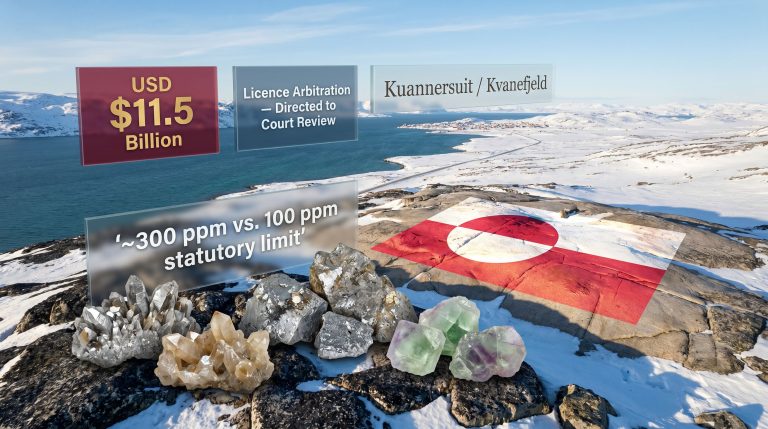
The Kuannersuit deposit, situated near the town of Narsaq in South Greenland and internationally referenced by its Danish name Kvanefjeld, is not simply a large rare earth project. It is one of the most mineralogically complex and geopolitically significant undeveloped REE accumulations in the entire Arctic region.
What makes Kuannersuit unusual is the co-occurrence of rare earth minerals with uranium. This geological characteristic, known as a polymetallic or multi-commodity deposit structure, simultaneously amplifies the project's commercial potential and its regulatory exposure. In most jurisdictions, uranium as a byproduct mineral adds processing complexity and waste classification obligations. In Greenland, since 2021, it triggers an outright legislative prohibition.
Key Deposit Facts at a Glance
| Feature | Detail |
|---|---|
| Location | Near Narsaq, South Greenland |
| Primary Commodity | Rare Earth Elements (REEs) |
| Complicating Byproduct | Uranium |
| Alternative Name | Kvanefjeld |
| Licence Holder | Greenland Minerals (ETM subsidiary) |
| Parent Company | Energy Transition Minerals (ETM), Australia |
| Compensation Claim Filed | ~USD $3.3 billion |
The deposit's scale has drawn sustained attention from analysts tracking the global REE supply pipeline, particularly given the broader Greenland minerals race now intensifying across the Arctic. Rare earth elements are foundational inputs for the permanent magnets used in electric vehicle motors, offshore wind turbines, and precision defence electronics. China currently controls an estimated 60% of global REE mining output and a significantly higher share of processing capacity, making non-Chinese advanced-stage projects strategically important to Western supply chain planners.
Greenland's Uranium Act: The Legislative Mechanism Behind the Rejection
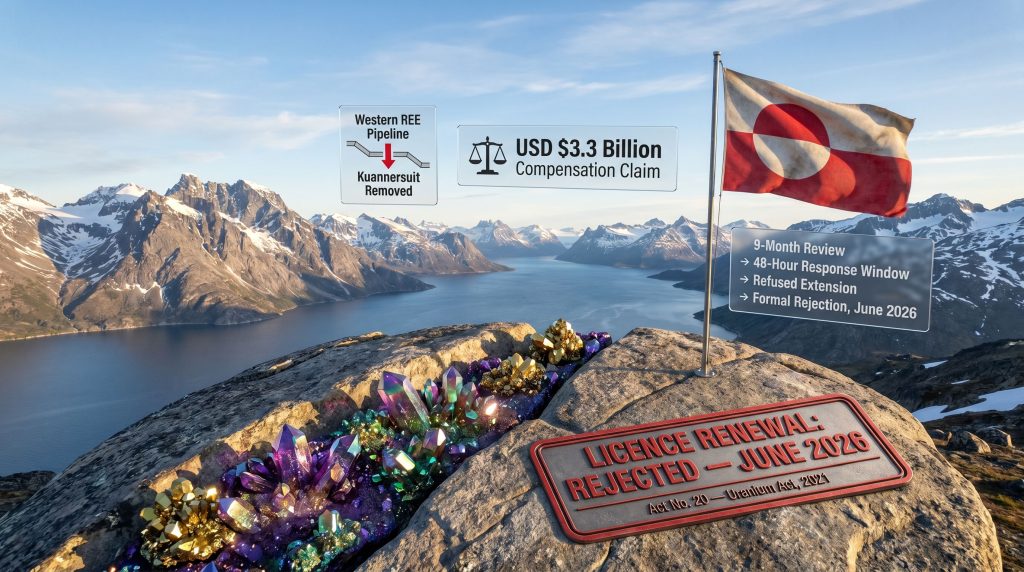
The story of how Greenland blocks Kuannersuit licence renewal cannot be fully understood without examining the legal architecture that produced it. Following the 2021 general election, in which the Inuit Ataqatigiit party secured a parliamentary majority partly on a platform of halting uranium-linked mining activity, Greenland passed Act No. 20. This legislation established a blanket prohibition on any mining where uranium is present as either a primary or byproduct mineral.
The Act's reach is deliberately broad. It does not distinguish between projects where uranium is the primary economic driver and those where it appears only as a trace or secondary mineral alongside commercially valuable rare earths. For Kuannersuit, this creates an insurmountable regulatory barrier: no matter how robust the REE resource economics, the uranium co-occurrence disqualifies the project from receiving an exploitation licence under current law.
"Under Act No. 20, the governing test for licence renewal is not whether a project is commercially viable for its primary commodity, but whether the deposit can be legally exploited at all. Where uranium's presence makes lawful development impossible, renewal is structurally unavailable."
The 2021 Political Shift That Rewrote Greenland's Mining Future
The Inuit Ataqatigiit party's 2021 electoral victory represented a significant reorientation of Greenland's resource governance philosophy. Prior administrations had pursued a more commercially permissive approach to mining, viewing large-scale foreign investment in mineral extraction as a pathway to economic diversification and eventual fiscal independence from Denmark.
The 2021 result reversed that trajectory. Community opposition in South Greenland, particularly among residents of Narsaq whose livelihoods depend on fishing and agriculture, had been vocal and consistent for years. Concerns centred on potential contamination of water sources, disruption to traditional land use, and the long-term environmental liability of managing uranium-bearing mine waste in an Arctic environment where remediation options are limited and costly.
Greenland's Minister of Foreign Affairs and Mineral Resources, Mute Egede, confirmed that the rejection reflected both legislative compliance and a commitment to honouring the clearly expressed preferences of affected communities in South Greenland. Notably, Egede had served as Prime Minister when the original uranium ban was enacted in 2021. Furthermore, as Greenland critical minerals policy continues to evolve, such decisions carry significant weight for the island's long-term development trajectory.
How the Procedural Breakdown Unfolded
Energy Transition Minerals has publicly characterised the renewal process as procedurally deficient, and the timeline of events offers context for understanding why that argument may carry legal weight.
The Disputed Procedural Timeline
-
ETM submits exploration licence renewal application to the Ministry of Mineral Resources.
-
The Ministry retains the application under review for approximately nine months.
-
In April 2026, a draft decision is issued to ETM signalling the Ministry's intent to recommend declining the application.
-
ETM is provided with a 48-hour window to respond to the Ministry's technical geological assessments.
-
ETM requests a one-week extension to prepare a substantive response incorporating recent exploration data.
-
The extension request is refused by the Ministry.
-
The formal rejection is issued in June 2026.
The asymmetry embedded in this timeline is notable. A nine-month administrative review followed by a 48-hour response window creates a structural imbalance that ETM argues prevented its most recent geological fieldwork from being formally considered. The company contends that new mineralised zones identified across the broader licence area were material to the renewal assessment and should have been factored into the decision.
"Whether the compressed response timeframe constitutes a procedural deficiency under Greenlandic administrative law, or under applicable investment treaty standards, is likely to become a central argument in any forthcoming legal challenge. Procedural fairness obligations in investment treaty arbitration typically require that investors be afforded a meaningful opportunity to respond to adverse decisions."
The $3.3 Billion Legal Exposure and Arbitration Trajectory
The June 2026 licence rejection is not the opening move in a new dispute. It is an escalation of a legal conflict that has been building since 2021. ETM, formerly listed as Greenland Minerals Ltd., has already lodged a compensation claim of approximately USD $3.3 billion against the Greenlandic government. The claim rests on the argument that the company had secured an unconditional legal right to an exploitation licence prior to the enactment of the uranium ban, and that the 2021 legislation therefore constituted a retroactive impairment of vested commercial rights.
Arbitration proceedings were initiated in 2022 under this framework. The June 2026 rejection adds a new layer to the dispute, providing additional grounds for challenging both the substantive and procedural conduct of the licence assessment. For further background on how the licence rejection unfolded, the detailed timeline is instructive.
Legal Avenues Remaining Open to ETM
-
Domestic administrative review of the Ministry's procedural conduct during the renewal assessment, particularly regarding the 48-hour response window.
-
Continuation or expansion of existing international arbitration proceedings on substantive investment protection grounds.
-
Bilateral investment treaty claims if applicable protections exist under Australia-Denmark or Australia-Greenland investment frameworks.
-
Arguments based on legitimate expectations, a recognised principle in investor-state dispute settlement (ISDS) mechanisms, where investors demonstrate that prior regulatory conduct created reasonable expectations of project advancement.
Jurisdictions that impose sweeping legislative prohibitions affecting established mineral rights face elevated exposure under ISDS frameworks, particularly where foreign investors can demonstrate that project development had advanced materially before the legislative change occurred.
Greenland's Investment Positioning Problem
The Kuannersuit rejection places Greenland in an uncomfortable position relative to its stated ambitions as a critical minerals destination. The island has actively promoted itself as a frontier opportunity for foreign mining capital, particularly as the United States and European Union invest in diversifying REE supply away from Chinese dominance. However, understanding the full mining geopolitics landscape helps contextualise why such tensions are increasingly common across Arctic jurisdictions.
ETM's public response captured this tension precisely: Greenland has positioned itself as commercially open for business, yet the handling of the Kuannersuit renewal creates a materially different impression for prospective investors.
The Dual-Signal Problem for Investor Confidence
| Signal to Market | Practical Implication |
|---|---|
| Active promotion of critical mineral investment | Attracts exploration capital and foreign interest |
| Uranium Act blocking REE projects with byproduct uranium | Structurally eliminates a category of viable deposits |
| Compressed procedural timelines in licence decisions | Raises due process concerns for project developers |
| Strong community opposition in affected regions | Demonstrates social licence constraints on development |
| Ongoing arbitration exposure | Increases sovereign risk premium for Greenland projects |
For investors evaluating Greenlandic exploration assets, the Kuannersuit case introduces a new analytical lens: the presence of uranium, even as a trace or secondary mineral, now functions as a potential veto trigger under current law. This has implications for how the market prices exploration upside across Greenland's broader mineral portfolio.
The next major ASX story will hit our subscribers first
The Social Licence Dimension: Why Narsaq's Opposition Matters
The communities of South Greenland, and Narsaq in particular, have maintained sustained opposition to the Kuannersuit project across more than a decade of development attempts. Their objections are rooted in a specific set of concerns that reflect the particular vulnerabilities of Arctic communities dependent on natural resource-based economies.
Key community concerns have consistently included:
-
Potential contamination of freshwater sources critical to both human consumption and traditional agricultural practices.
-
Disruption to fishing activities that form a core component of South Greenland's economic and cultural identity.
-
Long-term environmental liability from uranium-bearing tailings in an Arctic environment with limited remediation infrastructure.
-
The irreversibility of certain environmental impacts in high-latitude ecosystems where ecological recovery timelines are extended.
The Kuannersuit case is increasingly cited as a landmark example of indigenous governance frameworks shaping the trajectory of large-scale mineral development in Arctic jurisdictions. The Inuit Ataqatigiit party's 2021 electoral mandate demonstrated that community consent, when institutionalised through democratic processes, can function as a decisive mechanism overriding commercial mining rights regardless of a project's strategic or economic scale. The CSIS analysis on Greenland rare earths and Arctic security provides valuable additional context on how these community-driven decisions intersect with broader strategic interests.
Implications for the Western REE Supply Chain
The continued blockage of Kuannersuit removes one of the most advanced non-Chinese REE projects from the near-to-medium term supply pipeline at a moment of acute strategic concern. Western policymakers have identified REE supply chain diversification as a national security priority, yet the advanced-stage project pipeline outside China remains thin. Consequently, the challenges posed by rare earth supply chains are becoming more acute as viable projects are removed from consideration.
"The Kuannersuit situation illustrates a structural paradox in Western critical mineral strategy: the jurisdictions most enthusiastically targeted for REE supply diversification are often subject to the most stringent community consent, environmental, and indigenous governance frameworks. Resolving this paradox requires engagement with the political economy of host communities, not merely the geology of the deposits."
The loss of Kuannersuit as a viable development pathway narrows an already constrained pipeline and may contribute to sustained pricing pressure in REE markets as demand from electric vehicle manufacturing and defence electronics continues to grow. In addition, the broader implications for rare earth geopolitics suggest that such blockages will increasingly shape how Western governments approach mineral diplomacy. Furthermore, ongoing tensions surrounding critical mineral governance in uranium-bearing deposits add another layer of complexity for any future Greenlandic projects.
FAQ: Greenland Blocks Kuannersuit Licence Renewal
Why did Greenland block the Kuannersuit licence renewal?
The Greenlandic government concluded that further exploration was unlikely to yield deposits that could be lawfully exploited under Act No. 20, which prohibits mining activity where uranium is present as a primary or byproduct mineral.
What is the Kuannersuit deposit?
Kuannersuit, also known as Kvanefjeld, is a large rare earth element deposit near Narsaq in South Greenland. It is notable for its uranium co-occurrence, which simultaneously elevates its commercial potential and its regulatory complexity under current Greenlandic law.
When was uranium mining banned in Greenland?
Act No. 20 prohibiting uranium mining was passed in 2021 following the election of the Inuit Ataqatigiit party, which campaigned explicitly on halting uranium-linked mining activity.
How much compensation is ETM seeking?
ETM has lodged a compensation claim of approximately USD $3.3 billion, asserting that it held vested rights to an exploitation licence prior to the enactment of the 2021 uranium ban.
What are the broader supply chain implications?
The blockage removes a significant potential non-Chinese REE source from the global supply pipeline at a time when Western governments are actively investing in REE supply chain diversification for energy transition and defence applications.
Was ETM given a fair procedural opportunity to respond?
ETM argues it was not, citing a nine-month review period followed by a 48-hour response window. A request for a one-week extension was refused, preventing the company from formally submitting recent exploration results identifying new mineralised zones.
Want to Track the Next Major Mineral Discovery Before the Market Does?
Discovery Alert's proprietary Discovery IQ model delivers real-time alerts on significant ASX mineral discoveries — including critical commodities like rare earths — instantly translating complex geological data into actionable investment insights, as demonstrated by historic discoveries such as those made by De Grey Mining and WA1 Resources. Explore Discovery Alert's dedicated discoveries page to understand the returns major mineral discoveries can generate, and begin your 14-day free trial to position yourself ahead of the market.