June 27, 2026
The Uranium Threshold That Stopped a World-Class Deposit in Its Tracks
Rare earth supply chain strategy is rarely determined in boardrooms or commodity exchanges. More often, it is shaped by the collision of geology, legislation, and community sentiment in remote jurisdictions that most investors never visit. Few cases illustrate this dynamic more starkly than the fate of the Kvanefjeld deposit in southern Greenland, where one of the planet's largest undeveloped concentrations of rare earth elements sits legally inaccessible beneath Arctic terrain.
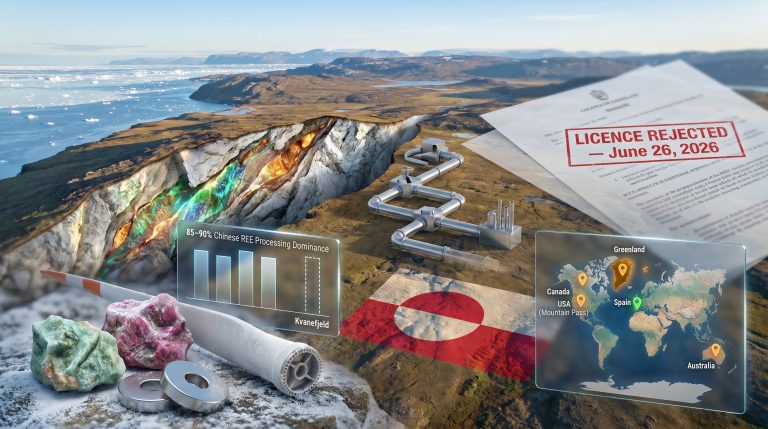
Greenland rejects Energy Transition Minerals licence renewal for Kuannersuit rare earths project — a decision that removes a significant non-Chinese rare earth resource from near-term global supply consideration at a time when Western economies are urgently seeking alternatives to Chinese dominance of the critical minerals market.
When big ASX news breaks, our subscribers know first
Understanding What the Kuannersuit Deposit Actually Represents
The Kvanefjeld deposit, known commercially as the Kuannersuit project, is not a marginal exploration target. It sits among the largest undeveloped rare earth concentrations identified anywhere in the world, hosting a mineral profile that includes rare earth elements, zinc, and fluorspar alongside uranium as a naturally co-occurring byproduct. That last characteristic is the source of every legal and political complication that has followed.
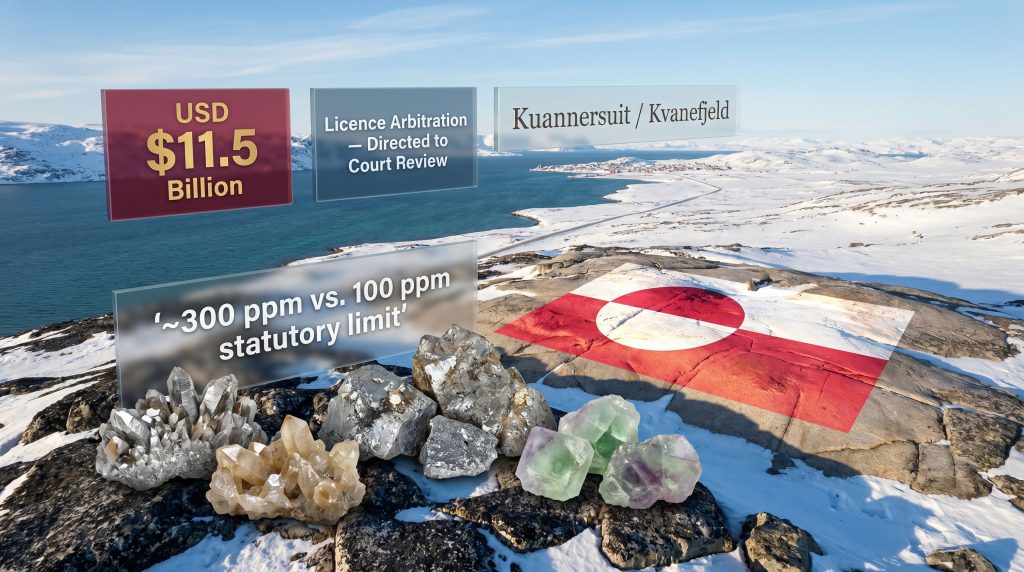
The deposit's uranium concentration registers at approximately 300 parts per million (ppm) at Kvanefjeld. Greenland's Uranium Act, passed following the 2021 election of the Inuit Ataqatigiit party, prohibits prospecting, exploration, and commercial exploitation of uranium-bearing deposits above a statutory ceiling of 100 ppm. The arithmetic is unambiguous: the deposit exceeds the permissible threshold by a factor of three, and no operational model proposed to date has resolved that gap within the current legislative framework.
What makes this particularly significant from a supply chain perspective is the composition of the rare earth content itself. Kvanefjeld is notably enriched in the heavy rare earth elements (HREEs), a subset of the rare earth group that includes dysprosium, terbium, and yttrium. These elements are disproportionately critical to permanent magnet manufacturing, which underpins electric vehicle motors and wind turbine generators. Global HREE supply is overwhelmingly concentrated in China's ionic clay deposits, making every non-Chinese HREE source strategically consequential. The loss of Kvanefjeld from development consideration therefore carries a qualitative weight that deposit tonnage figures alone do not fully capture.
| Metric | Detail |
|---|---|
| Uranium concentration at Kvanefjeld | ~300 ppm |
| Greenland's statutory uranium limit | 100 ppm |
| ETM's arbitration compensation claim | USD $11.5 billion |
| ETM's response window (draft decision) | 48 hours (extension refused) |
| Minerals in alternative exploitation proposal | Rare earths, zinc, fluorspar |
How Greenland's 2021 Uranium Act Created an Insurmountable Regulatory Ceiling
The legislative architecture that made this rejection possible was constructed quickly and with a clear political mandate. The Inuit Ataqatigiit party won Greenland's 2021 election on a platform that prominently included opposition to uranium mining, driven in part by sustained community resistance centred on the town of Narsaq, which sits in close proximity to the Kvanefjeld deposit.
The resulting Uranium Act did not create a licensing process with elevated scrutiny for uranium-adjacent projects. It created a hard prohibition. The law bars any resource activity involving uranium-bearing material above the 100 ppm threshold, effectively classifying the Kvanefjeld deposit as outside the scope of permissible development under any exploitation model that disturbs the orebody.
Energy Transition Minerals had attempted to navigate this constraint through a December 2022 alternative exploitation licence application proposing extraction of rare earths, zinc, and fluorspar while storing uranium-bearing material in tailings facilities rather than processing it commercially. The Greenland government rejected that application, establishing that the statutory prohibition applied to the act of mining uranium-bearing material regardless of whether the uranium itself was the target commodity.
Furthermore, Greenland's Ministry of Mineral Resources has stated that the rejection reflects legislative compliance, not administrative discretion. This framing matters because it signals that no ministerial pathway exists to approve the project without parliamentary amendment of the Uranium Act itself.
Minister Mute Egede, who also held the position of prime minister when the uranium ban was enacted, reinforced this position publicly, affirming that the government's course reflects both the legislation passed by parliament and the clear, long-standing position of communities in southern Greenland.
What Does the Greenland Election Mean for Critical Minerals Policy?
The 2025 Greenland election introduced fresh political dynamics around resource development. However, the depth of community opposition in southern Greenland and the legislative entrenchment of the uranium ban suggest that near-term policy reversal remains unlikely, regardless of shifts in electoral sentiment.
A Nine-Month Review Compressed Into 48 Hours: The Procedural Breakdown
The sequence of events leading to the final rejection raises substantive procedural concerns that extend beyond the licence decision itself and into the arbitration record.
ETM's renewal application sat with the Ministry of Mineral Resources for nine months without a determination being issued. When the ministry issued a draft decision in April indicating its intent to recommend rejection, ETM was given 48 hours to respond to the technical geological assessments underpinning that recommendation. The company requested a one-week extension to allow adequate review. That request was refused.
The consequences of that compressed timeline were material. ETM has stated that recent exploration work had identified new mineralised zones across the wider licence area, information that could not be adequately incorporated into its response within the 48-hour window. The company characterised the draft decision as a reproduction of prior refusals rather than an independent assessment of either its legal rights or the technical merits of its alternative extraction proposal.
This procedural sequence is likely to feature prominently in legal proceedings. In international arbitration and administrative law contexts, the combination of a prolonged review period followed by an unusually compressed response window creates grounds for challenging the procedural integrity of the decision, independent of its substantive merits. Reuters reported on this rejection and its implications for ETM's position.
Procedural timeline at a glance:
- ETM submits licence renewal application
- Nine months pass with no ministerial determination
- Draft rejection decision issued in April
- ETM given 48 hours to respond to technical assessments
- ETM requests one-week extension, refused
- Final rejection issued by Greenland government
The $11.5 Billion Arbitration: What ETM Is Actually Claiming and Where the Law Stands
ETM has pursued parallel legal tracks alongside the licence renewal process. The company is engaged in Copenhagen arbitration proceedings seeking either formal confirmation of its right to an exploitation licence or compensation of USD $11.5 billion on the basis that Greenland's legislative and regulatory actions constitute expropriation of a previously licenced investment.
The legal theory is grounded in the sequence of events post-2021. ETM's position is that Greenland renewed licences after the introduction of the Uranium Act, creating a reasonable expectation that regulatory engagement would continue, and that the subsequent policy of effective prohibition constitutes a compensable taking of the commercial value of the investment.
The arbitration tribunal has, however, issued a significant jurisdictional ruling: the question of granting a licence is not arbitrable, and the Danish State cannot be named as a party to the proceedings. This ruling redirects the dispute toward court review as the primary resolution mechanism, extending the timeline and altering the strategic calculus for both parties.
| Legal Track | Current Status | Key Outcome |
|---|---|---|
| Licence arbitration (Copenhagen) | Ruled non-arbitrable | Directed to court review |
| Danish State as party | Ruled inadmissible | Danish State excluded |
| Expropriation compensation claim | USD $11.5 billion sought | Proceedings ongoing |
| Alternative exploitation licence (Dec 2022) | Rejected | No active alternative pathway |
It is worth noting a nuance that receives insufficient attention in most coverage of this case: the expropriation claim is not simply about the value of minerals in the ground. It encompasses the value of the investment made in reliance on the licences granted, including exploration expenditure, feasibility work, permitting costs, and the forward-looking commercial value destroyed by the legislative change. Quantifying that figure at $11.5 billion reflects the scale of the deposit's projected economic value, but courts adjudicating expropriation claims apply specific legal tests that do not automatically equate deposit value with compensable loss.
Sovereign Risk, Arctic Investment, and the Signal Being Sent to Capital Markets
The Kuannersuit rejection does not exist in isolation. It arrives at a moment when Arctic and sub-Arctic jurisdictions are actively competing for critical minerals investment, and when the legal frameworks governing that investment are in rapid flux.
ETM's public statement that Greenland has positioned itself as open for business while this decision creates a different impression is a carefully calibrated message aimed at institutional investors evaluating Arctic exposure. The sentiment reflects a genuine tension: Greenland has legitimate ambitions to develop its resource base as a pathway to economic self-sufficiency, yet the procedural treatment of one of its highest-profile investment applications sends a signal that legislative stability and process integrity cannot be taken for granted.
Comparable dynamics have emerged in other Arctic-adjacent jurisdictions. Norway's Svalbard framework navigates environmental sensitivity and treaty obligations that constrain resource development. Canada's Northwest Territories has seen uranium and rare earth projects stall at the intersection of federal environmental review processes and Indigenous land rights frameworks. The common thread is not that these jurisdictions are hostile to investment, but that they contain non-negotiable variables — community consent, Indigenous governance, and environmental legislation — that must be treated as primary rather than secondary risk considerations.
For investors and capital allocators, the Kuannersuit case reinforces several principles of Arctic critical minerals due diligence:
- Legislative stability risk is a first-order variable in jurisdictions where resource policy intersects with Indigenous governance and environmental sensitivity
- Deposit geology cannot be separated from regulatory geology: a world-class ore body is commercially inaccessible if a single trace element exceeds a statutory threshold
- Community opposition, when formalised into legislation, creates a category of risk that technical mitigation measures cannot resolve
- Procedural fairness violations may become actionable in ways that outlast the underlying licence dispute
The next major ASX story will hit our subscribers first
What the Rejection Means for Global Rare Earth Supply Chains
The effective removal of Kvanefjeld from near-term development consideration has quantifiable supply chain consequences. Western rare earth supply diversification strategies, including the EU Critical Raw Materials Act targets and US Department of Energy rare earth sourcing objectives, are premised on the assumption that a pipeline of non-Chinese projects will advance toward production over the coming decade.
Kvanefjeld's continued unavailability concentrates pressure on a smaller set of alternative projects. Australia's Mount Weld deposit (Lynas Rare Earths), Canada's Nechalacho project, and a handful of US-based initiatives represent the most advanced non-Chinese HREE development candidates. None individually replicates the scale or heavy rare earth enrichment profile of Kvanefjeld.
The strategic gap is most acute in dysprosium and terbium, the two elements most critical to high-performance permanent magnets used in EV traction motors. China currently controls an estimated 85–90% of global dysprosium and terbium refining capacity, and Kvanefjeld represented one of the few non-Chinese resources with the deposit size and mineralogy to meaningfully challenge that concentration. The geopolitical impact of rare earths in this context cannot be overstated, as Western supply chains remain acutely exposed.
Scenarios for the Project's Future
Three plausible pathways exist for the Kuannersuit project, each carrying materially different implications for ETM's balance sheet and for global rare earth supply.
Scenario 1: Legislative Reform
A future Greenlandic government could revisit the Uranium Act, either raising the statutory threshold or creating an exemption mechanism for deposits where uranium is incidental rather than target material. This scenario is considered low probability in the near term given the current administration's stated commitment to its legislative course and the depth of community opposition in southern Greenland.
Scenario 2: Successful Expropriation Claim
Court proceedings establishing compensable expropriation could generate financial liability significant enough to create political pressure for a negotiated resolution, potentially including some form of conditional development pathway. This scenario hinges on legal determinations that remain genuinely uncertain. Mining.com has also reported on the broader implications of this rejection for Arctic resource investment.
Scenario 3: Project Abandonment and Write-Down
If legal avenues are exhausted without resolution, ETM faces the prospect of writing down the carrying value of the Kuannersuit asset, with consequent impacts on the company's balance sheet and investor confidence. This outcome would also formally retire one of the most significant non-Chinese rare earth development candidates from the global supply pipeline.
Key Takeaways for Investors and Industry Observers
- A 100 ppm uranium statutory ceiling versus a 300 ppm deposit reality illustrates how a single regulatory parameter can render a world-class resource commercially inaccessible regardless of its strategic importance
- The 48-hour response window following a nine-month review period creates substantive procedural grounds for legal challenge independent of the licence decision's merits
- Heavy rare earth enrichment at Kvanefjeld, particularly dysprosium and terbium content, gives this deposit strategic significance beyond its tonnage, making its continued unavailability a material constraint on Western supply chain diversification
- Expropriation law does not automatically equate deposit value with compensable loss: the $11.5 billion claim will be tested against specific legal standards in court proceedings that are now the primary dispute resolution pathway
- Sovereign risk assessment in Arctic jurisdictions must incorporate legislative stability, Indigenous governance frameworks, and community consent as primary variables, not afterthoughts in project financing models
This article is for informational purposes only and does not constitute financial or investment advice. Forward-looking statements, scenario projections, and legal outcome assessments involve significant uncertainty and should not be relied upon as the basis for investment decisions.
Want to Track the Next Major Mineral Discovery Before the Market Does?
Discovery Alert's proprietary Discovery IQ model delivers real-time alerts on significant ASX mineral discoveries across more than 30 commodities, turning complex geological data into actionable investment insights — explore historic discoveries and their returns to understand the opportunity, then begin your 14-day free trial to position yourself ahead of the broader market.