
June 26, 2026
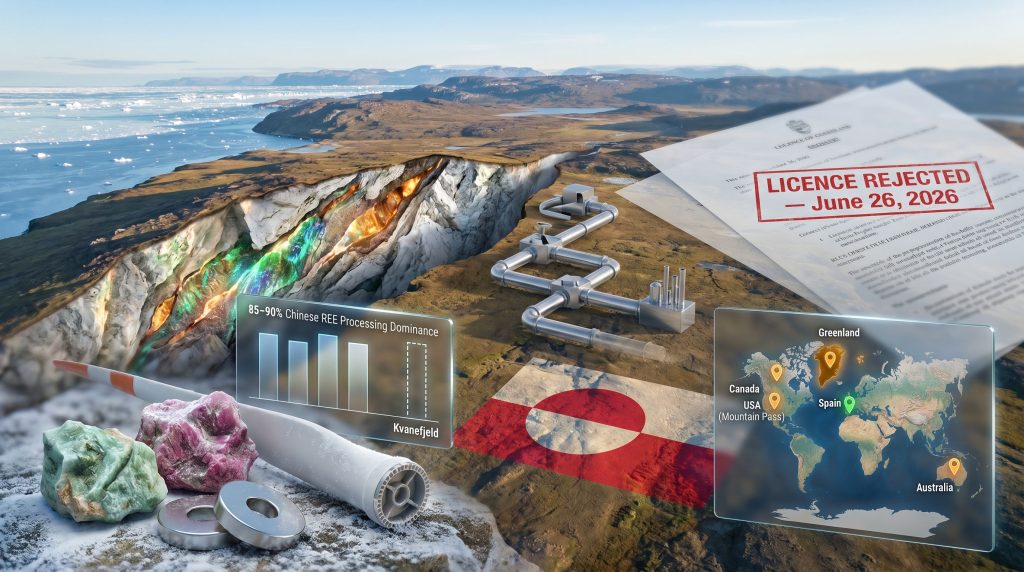
The Geological Trap at the Heart of the Energy Transition
There is a recurring irony embedded in the geology of the Arctic that policymakers are only beginning to reckon with: some of the world's most strategically valuable rare earth deposits are chemically inseparable from one of the minerals most politically toxic to extract. This is not a regulatory loophole or a corporate oversight. It is a geological fact, and the Kvanefjeld deposit in southern Greenland has become the most prominent case study in what happens when that geological reality collides with democratic environmental governance.
Understanding why Greenland rejects Energy Transition Minerals licence renewal requires more than reading the decision letter. It demands a deeper look at deposit mineralogy, indigenous rights frameworks, the architecture of international investment law, and the accelerating geopolitical contest over rare earth supply chains.
When big ASX news breaks, our subscribers know first
What Makes Kvanefjeld Geologically Unique
The Rare Earth-Uranium Co-occurrence Problem
Kvanefjeld is not simply large. It is compositionally unusual in ways that make it both extraordinarily valuable and extraordinarily difficult to develop under modern environmental governance frameworks.
The deposit is hosted within a peralkaline igneous complex called the Ilimaussaq intrusion, a rare geological formation that concentrates a suite of economically significant elements simultaneously. The primary rare earth minerals at Kvanefjeld are dominated by steenstrupine, a complex phosphate mineral that carries both light rare earth elements and uranium within the same crystallographic structure. This is not uranium sitting alongside rare earths in adjacent ore zones. The elements are chemically bound at the mineral grain level.
This distinction matters enormously for processing. Unlike some mixed deposits where physical separation of ore types is feasible, the Kvanefjeld resource requires hydrometallurgical processing that inherently liberates uranium alongside rare earth elements. Furthermore, there is no currently commercialised extraction method that recovers the rare earths while leaving the uranium locked in the waste stream in a form acceptable to regulators.
The deposit contains significant concentrations of neodymium and praseodymium, the rare earth elements most critical to permanent magnets used in electric vehicle motors and wind turbine generators. It also hosts dysprosium and terbium, the heavy rare earths that improve magnet performance at elevated temperatures. These are among the most geopolitically sensitive materials in the global supply chain, with demand forecasts suggesting structural deficits developing through the late 2020s and into the 2030s as EV adoption accelerates.
The Regulatory Architecture That Blocked Development
Greenland's Uranium Act and Its Cascading Consequences
When the Inuit Ataqatigiit party won the April 2021 Greenlandic general election, it did so on a platform that explicitly included ending uranium mining. The resulting legislation, commonly referred to as the Uranium Act, established a zero-tolerance threshold for uranium extraction across the entire territory. Critically, the law does not distinguish between uranium as a primary extraction target and uranium as an unavoidable processing byproduct.
This legislative design choice, whether intentional or consequential, effectively functions as a blanket prohibition on developing any deposit where uranium cannot be entirely excluded from the processing stream. For Kvanefjeld, that means the entire resource is functionally off-limits regardless of how small the uranium volumes are relative to the rare earth output.
The formal rejection — where Greenland rejects Energy Transition Minerals licence renewal on June 26, 2026 — was the legal endpoint of a process that had been building for five years. The government's stated rationale was direct: further exploration was not considered likely to produce a deposit that could be exploited in compliance with the Uranium Act. Industry analysts had flagged the risk of precisely this outcome well before the formal decision was issued.
| Event | Date |
|---|---|
| Inuit Ataqatigiit election victory | April 2021 |
| Uranium Act enacted | 2021 |
| ETM initiates Copenhagen arbitration | 2023 |
| ETM exploration licence lapses | December 2025 |
| Draft decision issued by Greenland government | April 2026 |
| Formal licence renewal rejection | June 26, 2026 |
The Democratic Legitimacy Dimension
Greenland's Minister of Foreign Affairs and Mineral Resources, Mute Egede, who also served as Prime Minister when the uranium ban was originally enacted, confirmed that the government's decision was grounded in parliamentary legislation rather than bureaucratic discretion. Egede emphasised that the position of communities in southern Greenland, where the project is physically located, had been consistently and clearly articulated over many years.
This is an important political framing. The decision is not presented as a regulatory technicality. It is presented as the execution of a democratic mandate expressed through elections, legislation, and sustained community opposition. That framing has significant implications for ETM's legal strategy, because it reduces the space available for arguments based on legitimate expectation or inconsistent government conduct.
The principle of Free, Prior and Informed Consent, enshrined in the United Nations Declaration on the Rights of Indigenous Peoples, has been a consistent reference point for community opposition to uranium-adjacent mining in southern Greenland. Indigenous land rights concerns are not peripheral to this dispute. They are, however, structurally embedded in the political coalition that produced and maintains the uranium ban.
ETM's Legal Position: Strengths, Weaknesses, and Timelines
The Expropriation Argument in International Investment Law
ETM's most significant legal avenue is its expropriation claim in Copenhagen arbitration proceedings initiated in 2023. In international investment law, regulatory expropriation occurs when a host government's legislative or administrative actions destroy the commercial value of a foreign investment without providing compensation, even if the government does not take physical possession of the asset.
ETM's argument rests on a sequence that is legally interesting if not necessarily determinative:
- ETM held a valid exploration licence and had made substantial investments in the Kvanefjeld project.
- Greenland enacted the Uranium Act in 2021, which functionally destroyed the commercial viability of that licence.
- Critically, the exploration licence was renewed by Greenland's government after the Uranium Act was enacted and during active legal proceedings challenging the ban's application to the project.
- ETM contends that this post-Act renewal created a legitimate expectation under international investment law that the government would not subsequently refuse further licence continuity.
The legitimate expectation doctrine in investment arbitration holds that a state cannot induce a foreign investor to continue investing by taking actions that imply continued rights, and then withdraw those rights without compensation. Whether a routine administrative renewal of an exploration licence constitutes such an inducement is precisely the kind of question that arbitral tribunals wrestle with over multi-year proceedings.
The weakness in ETM's position is that the lapse of the exploration licence in December 2025 complicates its standing. A company arguing for the right to transition to an exploitation licence while its exploration licence has already lapsed is in a legally ambiguous position that Greenland's government will almost certainly exploit in proceedings. The broader context of strategic minerals geopolitics adds further complexity to how such disputes are ultimately resolved.
Three Realistic Scenarios for ETM
Scenario A: Legal victory through arbitration or court challenge
ETM succeeds in demonstrating expropriation or procedural invalidity in the Greenland High Court. Greenland is ordered to reinstate licence rights or pay compensation. Timeline: realistically four to seven years, with significant outcome uncertainty.
Scenario B: Negotiated financial settlement
Greenland and ETM reach a structured commercial resolution. The project remains blocked, but ETM receives compensation for stranded capital. This outcome would be consistent with precedents in other Arctic jurisdictions where environmental legislation has rendered mining assets commercially worthless.
Scenario C: Full abandonment and strategic pivot
ETM writes down Greenland-related assets and accelerates its Spanish mineral exploration programme. Kvanefjeld remains undeveloped indefinitely. This is the outcome most harmful to global rare earth supply chain diversification.
The Global Supply Chain Consequences
Western Rare Earth Dependence: A Structural Problem
The strategic significance of Kvanefjeld's suspension cannot be understood without context. China currently controls approximately 85 to 90 percent of global rare earth refining capacity. That concentration is not primarily a mining problem. It is a processing and chemical separation problem, built over three decades of deliberate industrial policy investment.
Kvanefjeld was significant not merely because of its size, but because it was designed as an integrated operation: mine, concentrator, and refinery in a single value chain. This vertical integration would have produced separated rare earth oxides ready for magnet manufacturing, bypassing the Chinese separation infrastructure that Western supply chain strategists are most concerned about. Indeed, the broader Greenland critical minerals race has intensified precisely because of these strategic stakes.
The indefinite suspension of that project means the global rare earth supply diversification effort loses one of its largest potential non-Chinese contributions at precisely the moment when critical minerals demand is forecast to accelerate most sharply.
Is the Uranium Byproduct Problem Unique to Greenland?
A less commonly understood dimension of this story is that the Kvanefjeld situation is not an isolated geological anomaly. Several significant rare earth deposits globally contain uranium as a co-occurring element, including deposits in Australia, Canada, and Africa. The regulatory precedent established by Greenland's Uranium Act, and the legal dispute now unfolding around it, will be watched closely by mining jurisdictions grappling with how to draw the line between uranium-primary extraction and uranium-incidental processing.
Blanket mineral bans that fail to distinguish between these categories carry hidden economic and legal costs that may not be apparent at the time of enactment. The Greenland case is the most advanced example of those costs becoming concrete. Legal scholars have already begun characterising this situation as a cautionary tale for jurisdictions considering similar prohibitions.
| Region | REE Development Status | Uranium Complication |
|---|---|---|
| Greenland (Kvanefjeld) | Licence rejected; legal dispute active | Central to rejection |
| Australia | Active development pipeline | Managed case by case |
| Canada | Early to mid-stage exploration | Deposit dependent |
| USA (Mountain Pass) | Operational | Absent |
| Africa (various) | Mixed regulatory and ESG risk | Varies significantly |
ETM's Strategic Hedge: The Spanish Pivot
Why European Assets Now Carry Greater Strategic Weight
Prior to the formal rejection, ETM had been actively investigating mineral assets in Spain, a move that reads as a deliberate hedge against the Greenland outcome. Spain's regulatory framework presents no equivalent uranium byproduct prohibition for rare earth deposits. Moreover, the European policy environment has become materially more hospitable to critical minerals development following the introduction of the EU Critical Raw Materials Act.
The EU legislation establishes domestic and allied-nation sourcing benchmarks for strategic raw materials, creating a structured incentive framework for projects capable of supplying European industry. In this context, European strategic metals projects are attracting significant investor and policy attention. Spanish-based REE projects would qualify under that framework in ways that a Greenland-based project complicated by Arctic governance tensions and unresolved legal disputes cannot.
Whether ETM's Spanish assets carry anything approaching the scale or grade characteristics of Kvanefjeld remains to be established through exploration. The geological endowment of the Ilimaussaq intrusion is genuinely exceptional, and replicating it elsewhere is unlikely in the near term.
The next major ASX story will hit our subscribers first
The Energy Transition Paradox: A Policy Design Failure
The Kvanefjeld case is now a reference point for a deeper structural tension in critical minerals policy. Decarbonisation requires rare earth permanent magnets at scale. Those magnets require neodymium, praseodymium, dysprosium, and terbium. Those elements are geologically concentrated in deposits that frequently co-occur with uranium, thorium, and other radioactive materials.
A regulatory framework that applies zero-tolerance uranium policies without distinguishing between deposit types will, in a meaningful number of cases, prevent the extraction of the very minerals needed to power the energy transition. This is not a hypothetical tension. The fact that Greenland rejects Energy Transition Minerals licence renewal has made it empirically concrete.
More calibrated regulatory design — one capable of assessing uranium risk at the deposit and process level rather than applying blanket prohibitions — would allow jurisdictions to capture the economic and strategic value of REE-dominant deposits while maintaining credible environmental safeguards. The absence of that nuance in Greenland's legislative framework is the precise mechanism that produced the current legal and commercial impasse.
The outcome of ETM's legal proceedings will have implications extending well beyond a single Arctic deposit. It will help define the boundaries of host government regulatory authority over foreign mining investments, the legal status of uranium byproduct prohibitions under international investment treaties, and the practical limits of blanket mineral bans in geologically complex terrains. Those questions will not be resolved quickly. However, they are now formally before the courts.
Want to Track the Next Major Critical Minerals Discovery Before the Market Does?
Discovery Alert's proprietary Discovery IQ model delivers real-time alerts on significant ASX mineral discoveries — including critical minerals and rare earths — transforming complex geological data into actionable investment insights the moment they hit the exchange; explore historic discoveries and their returns to understand the scale of opportunity, then begin your 14-day free trial at Discovery Alert to position yourself ahead of the broader market.