June 27, 2026
The Hidden Mineral Wealth Sitting in Plain Sight Across Australia's Mine Sites
Across Australia, thousands of hectares of mining land are covered by tailings storage facilities, vast impoundments of finely ground rock left over after ore has been processed. Conventionally, these sites represent a cost centre: an environmental liability requiring monitoring, capping, and eventual rehabilitation. But a fundamental rethink is underway, one driven not by geology or commodity prices alone, but by biology.
The prospect of using living organisms to achieve super fungi critical minerals recovery from waste streams is no longer confined to speculative research papers. Environmental engineers at the University of Queensland are cultivating specially developed fungal strains capable of dissolving and recovering valuable metals from mining tailings, all without the corrosive acid chemistry that has defined mineral processing for more than a century. Understanding why this matters requires stepping back to examine the structural problems facing conventional extraction methods and why the global mining industry is searching urgently for alternatives.
When big ASX news breaks, our subscribers know first
Why Conventional Leaching Is Losing Ground
The dominant approach to recovering metals from ore and mineral waste involves hydrometallurgical leaching, typically using sulphuric acid, hydrochloric acid, or other aggressive reagents. These chemicals dissolve target metals effectively but generate substantial environmental risks. Acid mine drainage, in which acidic, metal-laden water migrates into surrounding soil and waterways, is one of the mining industry's most persistent and costly environmental problems globally.
Regulatory frameworks governing acid-intensive processing are tightening progressively across Australia and internationally. The operational cost structure of conventional leaching is also under pressure, with reagent costs, waste disposal, and regulatory compliance adding meaningful expense to already marginal processing operations.
At the same time, the volume of untapped mineral value sitting in legacy tailings is enormous. Australia's mining history spans more than 150 years, leaving behind an extensive inventory of waste stockpiles that contain recoverable concentrations of vanadium, scandium, rare earth elements, and other critical minerals. These resources were either undetected using older analytical technologies or were uneconomic to recover under the processing methods available at the time.
As commodity prices for critical minerals have risen and processing technology has evolved, these waste streams are increasingly being reconsidered as prospective mineral inventories. The environmental benefits of leaching through biological methods, furthermore, offer a compelling alternative to chemical-intensive approaches that have long dominated the sector.
"The economic reframing of tailings from environmental liability to recoverable asset is one of the most consequential shifts in mining industry thinking over the past decade, with implications for asset valuation, closure planning, and capital allocation."
What Bioleaching Actually Involves and How It Differs from Bacterial Methods
Bioleaching refers to the use of biological organisms to extract metals from solid mineral matrices by converting insoluble metal compounds into soluble forms that can be captured through downstream processing. The concept is not new. Microbial mineral processing has been understood, at least in observational form, since the 1950s, when researchers noted that certain bacteria appeared to accelerate the natural weathering of sulphide minerals.
Commercial bacterial bioleaching, primarily using iron- and sulphur-oxidising species such as Acidithiobacillus ferrooxidans, has been deployed in copper heap leach operations and gold pre-treatment circuits for decades. These bacterial systems work through an oxidative mechanism, essentially accelerating the chemical weathering of sulphide-bound metals by producing ferric iron and sulphuric acid in situ.
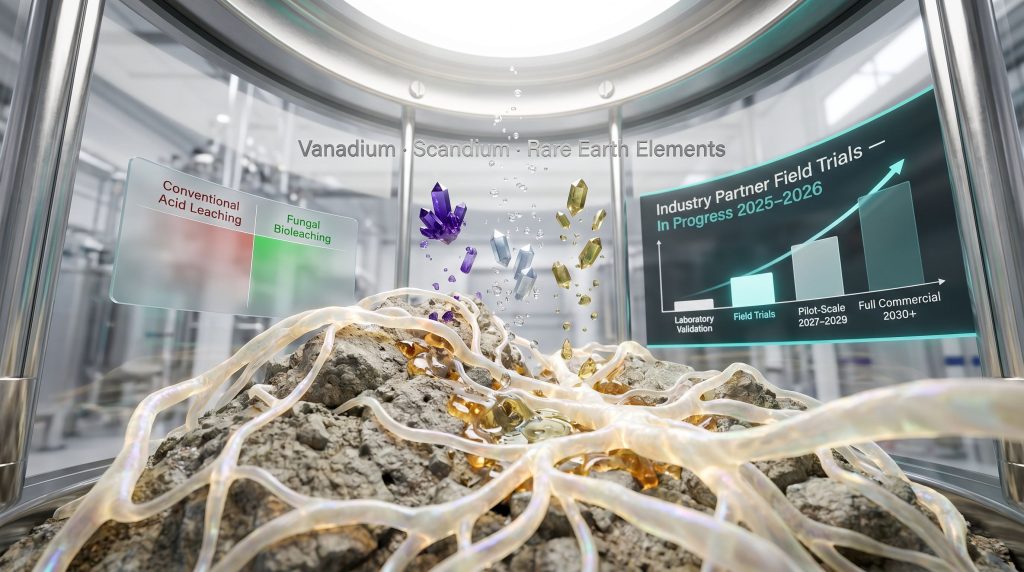
Fungal bioleaching, however, operates through an entirely different biochemical pathway. Rather than oxidative dissolution, fungi produce organic acids — including citric acid, oxalic acid, and gluconic acid — as metabolic by-products when consuming organic feedstocks in bioreactor environments. These organic acids interact with the crystalline lattice structures of mineral-bearing tailings in ways that conventional acid chemistry cannot replicate with the same selectivity.
For rare earth elements, scandium, and vanadium in particular, organic acid dissolution can achieve meaningful recovery rates from matrices that are poorly amenable to bacterial or conventional acid processing. The distinction matters because the global supply challenge for critical minerals is not uniformly distributed across mineral classes. Rare earths, scandium, and vanadium sit at the more technically challenging end of the processing spectrum, and it is precisely in these categories that fungal bioleaching offers the most differentiated potential.
Engineering Super Fungi Through Adaptive Laboratory Evolution
The fungal strains being developed at the University of Queensland are not genetically modified organisms in the conventional sense. They are produced through a process called adaptive laboratory evolution, in which naturally occurring fungi found in mining-affected environments are cultivated under progressively harsher chemical and thermal conditions across successive generations.
This methodology mimics the mechanism of natural selection but compresses the timescale dramatically. Strains that survive and remain metabolically productive under increasing concentrations of heavy metals, acidic pH conditions, and elevated temperatures are selectively propagated. Over many generations, the surviving fungal population develops a high tolerance for the toxic conditions characteristic of mine tailings, combined with the metabolic efficiency required to produce organic acids at commercially relevant yields.
Key distinction: Because adaptive laboratory evolution does not involve direct manipulation of the organism's genetic code, the resulting strains may face a more straightforward regulatory pathway than genetically modified organisms, particularly for contained bioreactor applications. This is a meaningful practical advantage when considering deployment timelines.
The resulting organisms, described by University of Queensland researchers as super fungi given their enhanced tolerance profile compared to wild-type strains, represent a genuinely novel class of bioprocessing agent. Their development reflects the convergence of environmental microbiology, evolutionary biology, and metallurgical engineering in ways that were not practically achievable even fifteen years ago.
How Super Fungi Dissolve and Release Critical Minerals
Within a bioreactor system, the engineered fungal strains are provided with an organic feedstock, such as a carbon source like glucose or agricultural waste streams. As the fungi metabolise this material, they excrete organic acids into the surrounding solution. When tailings material is introduced into the bioreactor, these acids interact chemically with the mineral matrix.
The organic acids work by attacking the metal-oxide and metal-carbonate bonds that lock target elements within the crystalline structure of tailings particles. As these bonds are disrupted, metals including vanadium, scandium, and rare earth elements are released into solution. The metal-bearing leachate can then be processed through conventional solvent extraction or ion exchange circuits to produce a purified product stream.
A particularly valuable secondary function of this process is its contribution to site remediation. Unlike sulphuric acid, which persists in the environment and can generate ongoing contamination problems, organic acids biodegrade naturally. The fungal biomass remaining after the leaching process can be composted or applied as a soil amendment, leaving treated areas in a biologically active state conducive to revegetation.
Performance Comparison: Fungal Bioleaching vs Conventional Acid Leaching
| Performance Dimension | Conventional Acid Leaching | Fungal Bioleaching |
|---|---|---|
| Primary chemical inputs | Sulphuric acid, hydrochloric acid | Naturally produced organic acids |
| Environmental risk profile | High: acid drainage, soil contamination | Low: organic acids biodegrade naturally |
| Operational cost structure | High reagent and disposal costs | Lower input costs, reduced waste handling |
| Site remediation capability | None, often worsens contamination | Active: biological neutralisation assists rehabilitation |
| Target mineral classes | Broad but non-selective | Vanadium, scandium, rare earth elements |
| Regulatory complexity | Increasing globally | Potentially streamlined under green chemistry frameworks |
The Three Critical Minerals That Make This Technology Strategically Significant
Vanadium and Grid-Scale Energy Storage
Vanadium is emerging as a strategically important mineral for grid-scale energy storage infrastructure, primarily through its role in vanadium redox flow batteries. Unlike lithium-ion systems, vanadium redox flow batteries offer multi-hour discharge durations and indefinite cycle life, characteristics that make them particularly attractive for firming large-scale renewable energy generation.
Global vanadium supply is concentrated in a small number of producing nations, with China, Russia, and South Africa accounting for the overwhelming majority of output. Australia holds significant vanadium endowment, and the ability to recover vanadium from existing tailings rather than primary ore represents a lower-cost, lower-impact pathway to expanding domestic supply. Processing waste rather than developing new greenfield mines, furthermore, avoids many of the permitting, infrastructure, and community engagement challenges associated with new projects.
Scandium: High-Value Metal Hidden in Waste Streams
Scandium is one of the more obscure but commercially significant rare metals relevant to super fungi critical minerals recovery. Its primary applications include strengthening aluminium alloys for aerospace and defence applications, where even trace additions of scandium dramatically improve strength-to-weight ratios, and as a component of solid oxide fuel cells. Global scandium supply is exceptionally constrained, with no large-scale primary scandium mining operations in existence.
Most commercial scandium is recovered as a by-product from nickel laterite and bauxite processing operations. Fungal bioleaching has demonstrated particular promise for laterite and bauxite residue matrices, suggesting that legacy tailings from nickel and aluminium operations could represent a meaningful untapped scandium resource. Given scandium's price point, which has historically ranged between $3,000 and $15,000 per kilogram depending on purity and market conditions, even relatively modest recovery rates from tailings can generate significant value.
Rare Earth Elements and the Geopolitical Dimension
Rare earth elements sit at the centre of one of the most consequential supply chain vulnerabilities facing advanced manufacturing globally. China controls an estimated 85 to 90 percent of global rare earth processing capacity, a concentration that has driven concerted efforts by Australia, the United States, Canada, and the European Union to develop alternative supply chains. Consequently, the pressure to diversify rare earth supply chains has never been more acute.
Australia holds world-class rare earth resources, but processing has historically been a bottleneck. Many rare earth deposits, particularly those hosted in weathered clay profiles similar to ionic adsorption clay deposits in southern China, contain mineralisation at grades that are uneconomic under conventional processing methods. Organic acid dissolution pathways, of the type produced by engineered fungi, are chemically well-suited to releasing rare earth ions from clay-hosted and oxide-hosted matrices.
The next major ASX story will hit our subscribers first
Where the Technology Stands: Research Progression and Commercialisation Pathway
Laboratory-scale bioreactor validation by the University of Queensland's environmental engineering research group has demonstrated proof-of-concept mineral release from tailings matrices. The program is now transitioning toward field trials conducted in partnership with industry collaborators, a critical step in demonstrating that fungal strain performance observed in controlled laboratory conditions can be replicated under the variable temperature, pH, and feedstock conditions present at real mine sites.
Projected Development Timeline
| Development Stage | Status | Estimated Timeline |
|---|---|---|
| Laboratory bioreactor validation | Completed | Achieved prior to 2025 |
| Industry partner field trials | In progress | 2025 to 2026 |
| Pilot-scale site deployment | Pre-commercial | 2027 to 2029 (estimated) |
| Full commercial operations | Development-dependent | 2030 and beyond |
"Timelines for novel biotechnologies in mining applications are inherently uncertain. Commercialisation in the resources sector for emerging biological processing methods typically spans seven to twelve years from laboratory proof-of-concept. The above timeline is indicative only and subject to regulatory approvals, field trial outcomes, and funding availability."
Several scale-up challenges must be addressed before industrial deployment becomes viable:
- Maintaining consistent fungal strain performance at volumes orders of magnitude larger than laboratory bioreactor conditions
- Managing the variability of real mine site tailings chemistry, including fluctuating metal concentrations, pH, and temperature
- Securing regulatory approval for biological agents used in open-environment or semi-contained mining applications under Australian frameworks, including oversight from the Office of the Gene Technology Regulator for any applications outside fully contained systems
- Demonstrating recovery economics that satisfy industry partner investment thresholds across a range of commodity price scenarios
Australia's Unique Competitive Position in Fungal Bioleaching Research
Australia's competitive advantage in this field extends beyond the quality of its university research infrastructure. The country's extensive mining history has created a diverse array of mining-affected environments, each with its own unique microbial ecology shaped by decades of exposure to heavy metals, acid conditions, and processing chemicals. This represents an extraordinary natural library of pre-adapted fungal candidates for adaptive evolution programs.
Research programs pursuing similar approaches are underway in Canada, Chile, and South Africa, primarily focused on bacterial systems for copper and gold applications. Australia's focus on fungal systems targeting rare earths, scandium, and vanadium represents a differentiated scientific position with potentially strong intellectual property implications. University-developed biotechnologies entering commercial licensing agreements will, however, require robust patent strategies covering both the strain development methodology and the specific application protocols for different tailings chemistries.
ESG Alignment and the Investor Case for Biological Processing
The ESG dimension of fungal bioleaching is genuinely multi-layered in ways that straightforward low-emission mining narratives often are not. The technology addresses three distinct ESG considerations simultaneously, and the growing critical minerals demand from clean energy industries makes this alignment increasingly compelling for investors:
- Environmental: Organic acid processing eliminates the most environmentally hazardous reagents from the processing circuit, while the biodegradation of leaching acids and the soil-improving properties of fungal biomass actively contribute to site rehabilitation
- Social: The ability to process existing waste stockpiles without new greenfield disturbance reduces community impact and addresses the social licence challenges that increasingly constrain new mine development
- Governance: Fungal bioleaching can assist mining companies in meeting rehabilitation bond obligations at legacy sites, reducing long-term financial liabilities and improving the credibility of closure plans presented to regulators and investors
Institutional investors and international offtake partners have progressively tightened their ESG criteria for mining counterparties. Technologies that simultaneously reduce chemical inputs, support site rehabilitation, and enable secondary recovery from waste rather than primary extraction are increasingly aligned with the procurement and investment criteria being applied by major industrial consumers in Europe, Japan, and North America.
Key Risks That Could Constrain Adoption
A balanced assessment of super fungi critical minerals recovery technology requires clear-eyed acknowledgement of the risks involved. In addition to the scientific uncertainties, commercial and regulatory barriers remain significant.
Technical risks:
- Fungal strain stability over extended operational periods remains to be demonstrated at scale; performance degradation under sustained industrial conditions is a realistic concern
- Not all tailings chemistries will be compatible with organic acid dissolution pathways; site-specific characterisation will be essential before any deployment decision
- Competition from other emerging low-impact processing technologies, including ionic liquid extraction and electrochemical recovery methods, which are also progressing through development pipelines
Economic risks:
- Bioleaching economics are most favourable when target mineral prices are high and tailings volumes are large; price volatility in vanadium and rare earth markets creates investment case uncertainty
- Capital expenditure for bioreactor infrastructure may be significant relative to the value of mineral inventories in smaller or lower-grade tailings deposits
Regulatory risks:
- Australian frameworks distinguish between contained bioreactor use and open-environment biological agent deployment, with the latter attracting greater scrutiny under OGTR and relevant state-level approval processes
- International precedents for microbial mining approvals vary considerably across jurisdictions, creating uncertainty for projects with potential cross-border commercial applications
Redefining Mine Waste as a Mineral Inventory
The broader conceptual shift that super fungi critical minerals recovery technology represents is perhaps as significant as the technology itself. Treating tailings storage facilities as mineral inventories rather than environmental liabilities requires changes in how mine assets are valued, how closure liabilities are calculated, and how capital is allocated across the mining project lifecycle. Integrating natural capital in mining frameworks into this calculus is becoming increasingly important for long-term asset stewardship.
A new category of secondary mining operation, focused exclusively on reprocessing historical waste rather than developing new ore resources, becomes economically viable if biological processing costs are sufficiently low relative to recoverable metal values. This model could be particularly powerful in jurisdictions like Australia where legacy tailings are extensive, regulatory pressure for rehabilitation is increasing, and critical mineral supply chains are a stated national priority.
The convergence of synthetic biology, environmental engineering, and metallurgy is not a distant prospect. It is an active research frontier, and the University of Queensland's fungal bioleaching program represents one of its more advanced applied manifestations. Robust mine reclamation strategies will increasingly need to incorporate biological processing as a core tool, not simply an experimental alternative. Whether the technology translates into commercial-scale operations within this decade will depend on field trial outcomes, regulatory navigation, and the sustained commitment of industry partners willing to co-invest in a genuinely transformative but still-emerging processing paradigm.
Want to Stay Ahead of the Next Major Critical Minerals Discovery?
Discovery Alert's proprietary Discovery IQ model scans ASX announcements in real time, instantly identifying significant mineral discoveries — including those tied to critical minerals driving the energy transition — and translating complex data into actionable investment insights. Explore historic discoveries and their returns to understand the opportunity, then begin your 14-day free trial at Discovery Alert to position yourself ahead of the broader market.