June 9, 2026
The Critical Economic Vulnerabilities Exposed by America's Energy Infrastructure
America's energy security framework faces mounting pressure from increasingly volatile weather patterns that reveal fundamental weaknesses in critical infrastructure systems. These disruptions create cascading economic effects extending far beyond immediate production losses, fundamentally altering market dynamics and exposing systemic vulnerabilities in the nation's energy supply chain. Severe winter storm impacts US gas production particularly demonstrate how weather events can trigger widespread economic disruptions that cascade through multiple sectors simultaneously.
Modern energy infrastructure operates within narrow operational parameters that become critically stressed during severe weather conditions. When these systems encounter conditions beyond their design specifications, the resulting economic impacts ripple through multiple sectors simultaneously, creating compounding effects that challenge traditional risk management approaches.
When big ASX news breaks, our subscribers know first
Infrastructure Design Limitations During Extreme Weather Events
Natural gas production systems demonstrate particular vulnerability to temperature extremes, with severe winter storm impacts US gas production creating immediate operational challenges across multiple facility types. Production facilities encounter cascading failure modes when temperatures drop below critical operational thresholds, triggering automatic safety shutdowns designed to protect equipment but simultaneously eliminating output capacity.
Wellhead freeze-off mechanisms represent the most immediate vulnerability point in the production chain. Moisture in natural gas condenses and freezes at extremely low temperatures, blocking flow passages and activating protective shutdowns. Processing plants face similar constraints, with separation and processing equipment operating within discrete temperature ranges beyond which efficiency declines precipitously.
Pipeline infrastructure limitations become particularly evident during extreme cold events. Gas density and pressure relationships change significantly with temperature variations, affecting maximum sustainable flow rates through fixed-diameter transportation systems. Cold weather increases gas viscosity and density, fundamentally reducing throughput capacity even when production facilities remain operational.
Storage facility withdrawal constraints create additional bottlenecks during peak demand periods. Delivery infrastructure possesses discrete maximum withdrawal rates that cannot be exceeded regardless of total storage volumes. When simultaneous production losses occur during peak heating demand, storage systems cannot physically deliver replacement volumes quickly enough to compensate for supply shortfalls.
Regional Infrastructure Resilience Variations
Different geological formations and production regions demonstrate dramatically varying degrees of weather resistance, creating uneven economic impact distributions across the continental United States. Northern production areas typically incorporate comprehensive winterisation protocols developed through decades of cold-weather operational experience.
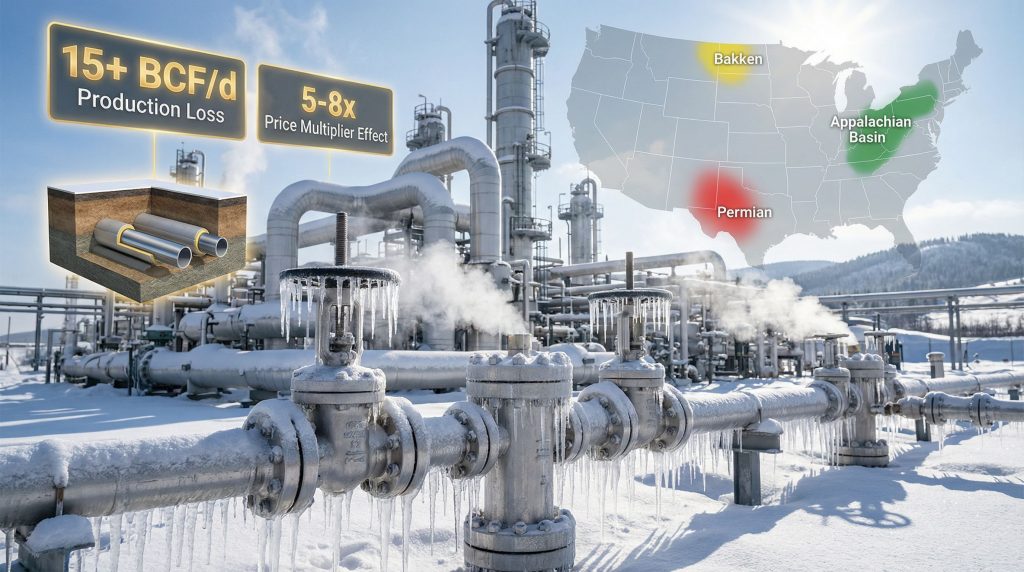
Appalachian Basin facilities demonstrate high cold tolerance due to established engineering practices designed for harsh winter conditions. Bakken Formation operations maintain moderate resilience through proven cold-climate operational protocols and equipment specifications.
Conversely, Permian Basin infrastructure shows limited winterisation capacity because regional climate patterns historically required minimal cold-weather protection investments. Gulf Coast operations possess minimal cold protection systems, having been designed for temperate operational environments that rarely encounter freezing conditions.
Recent severe weather events exposed these regional disparities dramatically. Winter Storm Fern in January 2026 demonstrated these vulnerabilities starkly, with initial production losses reaching 2 billion cubic feet per day (Bcfd) escalating rapidly to 12 Bcfd as conditions intensified. Total peak losses approached 20 Bcfd when accounting for intrastate pipeline production not captured in federal flow monitoring systems.
Market Dynamics During Supply Disruption Events
Energy markets exhibit predictable but extreme volatility patterns during weather-related supply disruptions, with price movements reflecting both immediate physical constraints and forward-looking risk assessments. The Henry Hub contract for February through December 2026 increased from $3.22 per million British thermal units (MMBtu) to $4.31 during a single week of storm intensification, representing a 33.5% price surge driven by supply constraint expectations.
Furthermore, these market reactions become amplified when considering broader commodity markets and their interconnections. Comprehensive oil price rally analysis reveals how weather-related disruptions create cascading effects across multiple energy sectors, influencing everything from crude oil pricing to refined product markets.
Supply-Demand Imbalance Amplification Effects
Winter storms create perfect conditions for extreme price volatility through simultaneous supply contractions and demand surges that overwhelm normal market equilibration mechanisms. Production facility shutdowns coincide with peak seasonal heating demand, creating unprecedented supply-demand imbalances that drive exponential price increases beyond normal market correction patterns.
Production Loss Impact Framework:
- 5-10 BCF/d losses with 10-15 BCF/d demand surge: 2-3x baseline pricing
- 10-15 BCF/d losses with 15-25 BCF/d demand surge: 3-5x baseline pricing
- 15+ BCF/d losses with 25+ BCF/d demand surge: 5-8x baseline pricing
These multiplier effects reflect non-linear demand response patterns, storage withdrawal constraints, and financial market leverage effects that amplify physical supply disruptions into dramatic price spikes. Wood Mackenzie documented peak single-day freeze-offs of 17 billion cubic feet on January 25, 2026, approaching record levels established during Winter Storm Uri in 2021.
Forward Market Adjustments and Investment Signals
Energy futures markets incorporate complex risk assessments that extend beyond immediate supply constraints to include recovery timeline estimates, seasonal demand projections, and probability assessments for additional weather disruptions. These forward-looking adjustments create investment signals that influence capital allocation decisions across the energy sector.
Cumulative winter season freeze-offs exceeded 58 billion cubic feet by late January 2026, demonstrating the compounding effect of multiple weather disruptions across a single winter season rather than isolated event impacts. This cumulative disruption pattern influences forward pricing curves and investment planning beyond immediate recovery timelines.
Moreover, traders implementing market volatility hedging strategies must account for these weather-related disruption patterns when designing risk management frameworks. Market participants demonstrated cautious responses to price signals, with many producers maintaining conservative positions despite elevated pricing.
Industrial and Regional Economic Consequences
Weather-related energy disruptions create cascading economic impacts extending far beyond energy sector boundaries into industrial production, regional economic activity, and consumer cost structures. Energy-intensive industries face immediate operational challenges requiring either production reductions or significant cost absorption during supply constraint periods.
Manufacturing Sector Vulnerability Analysis
Different industrial processes exhibit varying sensitivity to energy price volatility based on energy intensity and operational flexibility characteristics. Chemical manufacturing typically experiences 15-25% production reductions during peak energy disruption periods due to high gas consumption requirements and limited fuel substitution options.
Steel production faces 10-20% capacity utilisation declines as energy costs constitute substantial portions of total production expenses. These industries cannot easily adjust production schedules or substitute alternative energy sources during short-term supply disruptions without significant operational complications.
Power generation facilities implement emergency fuel switching to higher-cost alternatives when natural gas supplies become constrained or prohibitively expensive. This fuel switching creates secondary cost pressures throughout the electricity distribution system, affecting all electricity consumers regardless of their direct natural gas exposure.
Geographic Economic Impact Distribution
Regional economic vulnerability depends heavily on energy supply infrastructure, heating fuel composition, and industrial energy intensity. States relying predominantly on natural gas for residential heating experience 300-500% cost increases during severe supply disruptions, creating immediate household budget pressures and broader consumer spending impacts.
Midwest and Northeast regions face disproportionate impacts due to heavy natural gas dependence for residential heating and electricity generation. Regions with more diversified energy portfolios, including hydroelectric, nuclear, or coal generation capacity, experience more limited disruptions during natural gas supply constraints.
According to data from Reuters, severe winter storm impacts US gas production extend beyond natural gas to affect crude oil operations. Oil production secondary effects compound regional impacts, with Rystad Energy estimating crude oil output declines of approximately 390,000 barrels per day from pre-freeze baseline levels of 11.4 million barrels per day for Lower 48 onshore production.
Infrastructure Investment Strategy Evolution
Recurring weather-related disruptions drive systematic reassessment of infrastructure investment priorities, balancing immediate production capacity expansion against long-term resilience improvements. These investment decisions fundamentally shape regional economic development patterns and energy security outcomes over multi-decade timeframes.
In addition, broader economic considerations influence these infrastructure investment decisions. Analysis of US economic vulnerabilities reveals how energy infrastructure resilience connects to national economic stability, particularly during periods of fiscal stress and inflation pressure.
Capital Allocation Framework Development
Energy companies must navigate complex trade-offs between different investment categories that compete for limited capital resources. Immediate ROI projects focused on production capacity expansion typically receive priority consideration due to direct revenue generation capabilities and shorter payback periods.
Medium-term resilience investments in winterisation upgrades require longer-term value justification despite obvious protective benefits during extreme weather events. These investments create value through avoided production losses and reduced operational risk exposure rather than direct revenue generation.
Long-term security investments in diversified supply networks represent strategic positioning for enhanced operational stability but require significant capital commitments with uncertain return timelines. Emergency response capabilities for rapid recovery constitute specialised investments that create value primarily during disruption events.
Investment Priority Ranking:
- Immediate ROI Projects: Production capacity expansion with direct revenue generation
- Medium-term Resilience: Winterisation upgrades and equipment protection systems
- Long-term Security: Diversified supply infrastructure and redundant systems
- Emergency Response: Rapid recovery capabilities and specialised equipment
Risk Management Innovation in Energy Finance
Financial markets develop increasingly sophisticated risk management instruments to address weather-related energy volatility, creating new investment products and hedging strategies that influence capital flows across the energy sector. These financial innovations enable better risk distribution while creating new market mechanisms for pricing weather-related disruption risks.
Advanced derivative products allow energy market participants to hedge specific weather scenarios, seasonal demand variations, and production disruption risks. Weather derivatives and temperature-linked financial instruments provide mechanisms for transferring weather-related financial risks to specialised market participants willing to assume these exposures.
Recovery Timeline Patterns and Market Normalisation
Historical weather disruption events reveal predictable recovery patterns that enable improved economic forecasting and risk assessment capabilities. Different production regions demonstrate varying restoration speeds based on infrastructure design specifications, operational protocols, and equipment protection systems.
Production Restoration Phase Analysis
Recovery from severe weather events follows identifiable phases with characteristic timelines that vary based on storm intensity, geographic scope, and infrastructure preparedness levels. Peak impacts typically occur within 24-48 hours of maximum weather intensity, followed by gradual restoration as conditions moderate.
Typical Recovery Timeline:
- Days 1-3: Emergency assessment and initial restart procedures for protected facilities
- Days 4-7: Gradual production restoration in winterised operations and less-affected regions
- Days 8-14: Full capacity restoration and system normalisation for standard operations
- Weeks 3-4: Infrastructure damage assessment and repair completion for severely affected facilities
According to CNBC analysis, the recovery process often faces additional complications as supply concerns persist even after initial weather events subside. Appalachian and Bakken production regions experienced only minor slowdowns during Winter Storm Fern due to established winterisation protocols and cold-weather operational experience.
Permian Basin and Gulf Coast facilities required extended recovery periods following equipment protection system activation and facility restart procedures. However, severe winter storm impacts US gas production patterns vary significantly across different geological formations and operational environments.
Price Normalisation Dynamics
Energy prices follow predictable normalisation patterns as production recovers and emergency demand subsides, though correction speed depends on storage levels, alternative supply availability, and weather forecast reliability. Markets typically anticipate recovery trajectories, with forward prices adjusting based on expected restoration timelines rather than current production levels alone.
January 2026 Lower 48 gas production originally forecast at 104 Bcfd faced base-case downside projections of 3.3 Bcfd reduction. Severe scenarios resembling 2021 Winter Storm Uri suggested additional losses reaching 2.3 Bcfd, primarily concentrated in Permian, Haynesville, and Eagle Ford production regions.
Contemporary US natural gas forecasts incorporate these weather-related disruption patterns into longer-term price projections, recognising that recurring severe weather events fundamentally alter supply reliability assumptions.
The next major ASX story will hit our subscribers first
Building Systemic Weather Resilience
Developing weather-resilient energy systems requires coordinated approaches combining infrastructure hardening, geographic diversification, and improved emergency response capabilities. Strategic infrastructure investments create long-term economic value while reducing systemic vulnerability to weather-related disruptions across multiple production regions simultaneously.
Infrastructure Diversification Strategies
Geographic production diversification reduces concentrated weather exposure by spreading operational assets across regions with different climate patterns and seasonal risk profiles. Companies operating solely in southern production regions face higher weather-related disruption risks compared to operators with geographically diversified asset portfolios.
Enhanced winterisation protocols require substantial upfront capital investments but provide measurable protection against production losses during severe weather events. Cost-benefit analysis must weigh winterisation expenses against potential production loss values and price volatility exposure during disruption periods.
Improved emergency response capabilities enable faster recovery following weather-related shutdowns, reducing total production loss volumes and market disruption duration. These capabilities include specialised equipment, trained personnel, and established operational protocols for rapid facility restart procedures.
Regulatory Framework Development
Policy frameworks must balance competitive market efficiency with energy security objectives, creating appropriate incentives for weather resilience investments without distorting normal market operations. Effective regulations encourage protective infrastructure investments while maintaining competitive dynamics that drive operational efficiency and cost management.
Regulatory considerations include mandatory winterisation standards, emergency response requirements, and infrastructure reliability specifications that establish minimum operational resilience levels across different production regions and facility types. Furthermore, these regulatory frameworks must consider broader energy transition challenges that affect long-term infrastructure planning and investment decisions.
Technology Innovation and Future Preparedness
Advanced forecasting capabilities, automated production systems, and improved materials science offer pathways to reduce weather-related energy disruptions while creating economic opportunities in technology development and infrastructure modernisation. These technological innovations represent significant economic opportunities while enhancing overall energy system reliability and resilience.
Predictive Technology Integration
Enhanced weather forecasting systems enable proactive operational adjustments that minimise production disruptions through advance preparation and protective system activation. Machine learning algorithms can optimise shutdown and restart procedures based on predicted weather patterns and facility-specific vulnerability characteristics.
Automated production control systems reduce response times during rapidly changing weather conditions, enabling faster protective actions and more precise operational adjustments. These systems can implement graduated shutdown procedures that maintain partial production longer while protecting critical equipment from damage.
Material Science Advances
Improved materials and equipment designs increase operational temperature ranges for production facilities, reducing the frequency and severity of weather-related shutdowns. Advanced insulation systems, freeze-resistant components, and enhanced equipment protection enable operations in more extreme conditions.
Investment in research and development creates competitive advantages for companies that successfully develop and deploy weather-resistant technologies across their operational portfolios. These technological improvements provide both defensive benefits during weather events and offensive competitive positioning in challenging operational environments.
Strategic Market Positioning for Weather Volatility
Energy market participants must develop comprehensive strategies for managing weather-related volatility that combine operational resilience, financial risk management, and strategic positioning for different weather scenarios. Understanding weather impact patterns enables better investment decisions and more effective risk management across diverse operational portfolios.
Growing weather volatility necessitates substantial infrastructure adaptation investments, creating both economic challenges and investment opportunities for companies positioned to capitalise on resilience technology development and deployment. Proactive weather resilience investments create competitive advantages while contributing to overall energy security enhancement.
Climate adaptation requirements represent fundamental shifts in energy sector capital allocation priorities, requiring long-term strategic planning that incorporates increasing weather volatility into operational and financial planning processes. Companies that successfully navigate this transition gain sustainable competitive advantages in increasingly challenging operational environments.
Investment decisions involving energy sector assets should consider weather-related risks and infrastructure resilience capabilities as fundamental factors in long-term value creation and risk management strategies.
Ready to Capitalise on Energy Market Volatility?
Discovery Alert's proprietary Discovery IQ model delivers real-time notifications on significant ASX mineral discoveries, empowering investors to identify actionable opportunities in commodity markets before broader market recognition occurs. Begin your 30-day free trial today to secure your market-leading advantage during periods of heightened energy and commodity volatility.