June 9, 2026
The Structural Collapse of U.S. Aluminium Production and Why Inola Matters
For decades, the United States has been quietly hollowing out one of its most strategically important industrial sectors. Primary aluminium smelting has almost entirely disappeared from American soil. In the 1980s, the U.S. operated dozens of active smelters. Today, only a handful remain, and their combined output meets a fraction of national demand. This structural dependency on imported aluminium now sits at the centre of a heated political and community battle unfolding in rural Oklahoma, where Inola aluminium plant opposition has ignited resistance from residents, ranchers, and even the state's own attorney general.
The Inola aluminium plant opposition is not simply a local land-use dispute. It is a microcosm of a national tension that will define how the United States attempts to rebuild heavy industrial capacity in the years ahead. Furthermore, the controversy connects directly to wider debates around US aluminium tariffs and the reshaping of domestic supply networks.
When big ASX news breaks, our subscribers know first
What Is Being Proposed in Inola, Oklahoma?
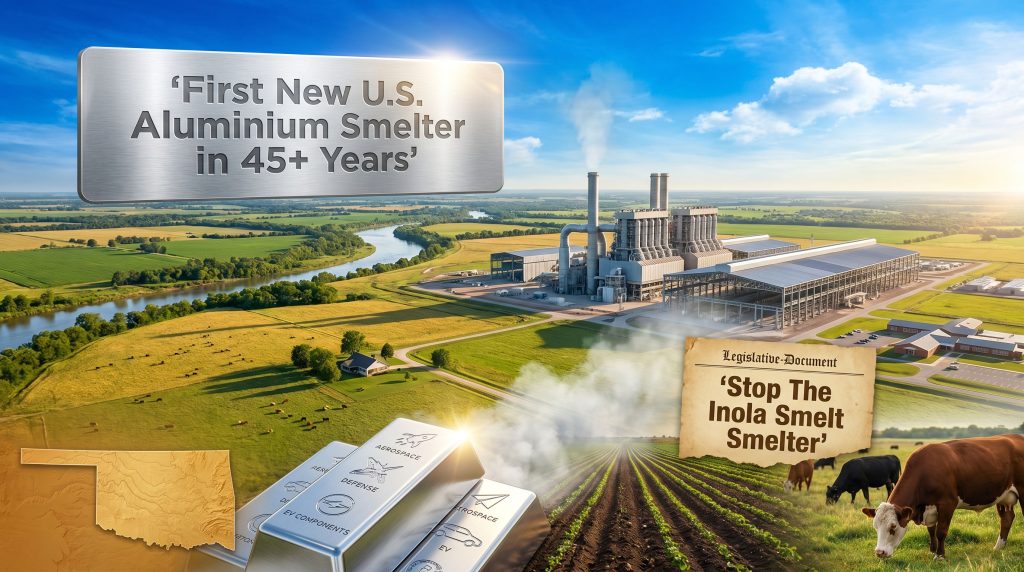
The proposed facility would be located in Inola, a small rural community in Rogers County, Oklahoma, characterised by agricultural land, cattle ranching operations, and low-density residential settlement. What makes this proposal extraordinary from an industrial history standpoint is its claimed significance: if constructed as planned, it would be the first new primary aluminium smelter built in the United States in more than 45 years, and the largest aluminium production facility ever constructed on American soil.
For context, primary aluminium smelting is a fundamentally different process from secondary or recycled aluminium production. Primary smelting uses the Hall-Heroult process, which passes electrical current through molten aluminium oxide dissolved in a cryolite bath, separating pure aluminium metal. This process is extraordinarily energy-intensive and produces several industrial byproducts, including gaseous fluoride compounds, which have become central to the community opposition surrounding Inola.
Key Project Metrics at a Glance
| Feature | Detail |
|---|---|
| Location | Inola, Rogers County, Oklahoma |
| Project Type | Primary aluminium smelter (Hall-Heroult process) |
| Historical Significance | First new U.S. primary smelter in 45+ years |
| Scale | Largest aluminium plant ever proposed in the U.S. |
| Proximity Concerns | Adjacent to farmland, residential properties, schools, and the Verdigris River |
The Strategic Case for Domestic Aluminium Production
Understanding why this project has attracted high-level political support requires examining just how dependent the U.S. has become on overseas aluminium supply. Aluminium is not a niche industrial commodity. It is foundational to aerospace fuselages, military vehicles, naval vessels, electric vehicle frames, and renewable energy infrastructure including solar panel mounting systems and wind turbine components.
Over the past five decades, the economics of global aluminium production shifted dramatically. Lower energy costs in the Middle East, Iceland, and parts of Asia made offshore smelting far cheaper than operating plants in the United States, where electricity prices are comparatively high. One of the key cost drivers in aluminium smelting is electricity, which typically accounts for 30 to 40 percent of total production costs. As U.S. smelters became uneconomical, they closed, and imports filled the gap.
Today, the U.S. imports a substantial proportion of its primary aluminium needs. This dependency carries real strategic risk, particularly as domestic metal supply chains are increasingly prioritised for defence procurement and traceability purposes.
Oklahoma Governor Kevin Stitt has publicly endorsed the Inola facility, positioning it as a critical step in restoring domestic manufacturing capacity. State leadership has framed aluminium's role across defence, aerospace, and transportation as justification for prioritising domestic production infrastructure, describing the project as part of broader industrial revival efforts.
The Opposition: A Rare Political and Legal Confrontation
Oklahoma's Attorney General Files to Stop the Project
The Inola aluminium plant opposition gained significant institutional weight when Oklahoma Attorney General Gentner Drummond filed a formal legal petition seeking to halt the project. This is a politically unusual situation: the state's chief legal officer actively working to block a project that the state's governor has publicly championed. The AG's concerns centre on several interconnected issues:
- The environmental impact of the proposed facility on surrounding land, water, and communities
- Questions about the integrity and adequacy of the permitting process
- Concerns about the foreign ownership structure of the project and what that means for national security considerations
The juxtaposition of gubernatorial support and attorney general opposition creates a fractured state position that will likely complicate any straightforward regulatory path forward.
Community Mobilisation: Stop the Inola Smelter
At the grassroots level, residents have organised into a sustained opposition movement. Public meetings have been dominated by community members raising environmental, agricultural, and quality-of-life objections. The Stop the Inola Smelter campaign has become a focal point for locals seeking to formalise their resistance through coordinated action.
Among those who have spoken publicly is Christine Roam, a local resident whose property sits adjacent to the proposed development site. Her concerns reflect a broader community sentiment: that the introduction of large-scale primary aluminium smelting would permanently and irreversibly alter the agricultural and ranching character of the Inola region.
The fear is not abstract. Residents are acutely aware that primary smelting operations bring with them decades-long industrial footprints, significant infrastructure requirements, and persistent emission profiles that cannot simply be switched off if problems emerge.
Environmental and Health Concerns at the Heart of the Inola Aluminium Plant Opposition
Hydrogen Fluoride Emissions and Air Quality
The emission concern that has generated the most anxiety among Inola residents is hydrogen fluoride, a gaseous compound produced as a byproduct of the Hall-Heroult aluminium smelting process. During electrolysis, fluoride-containing compounds including the cryolite bath material can volatilise, releasing hydrogen fluoride and other fluoride gases into the surrounding atmosphere.
At elevated concentrations, hydrogen fluoride is acutely toxic to human respiratory systems. Even at lower chronic exposure levels, it can cause progressive damage to lung tissue, bones, and teeth. For communities living in close proximity to smelting operations, the relevant concern is not a single catastrophic release but the cumulative effect of chronic low-level exposure over years or decades.
Hydrogen fluoride emissions from aluminium smelters have been subject to regulatory scrutiny globally for decades. Modern smelters use dry scrubbing technology to capture fluoride gases before they exit the plant, but no capture system achieves 100 percent efficiency, and the effectiveness of controls depends heavily on maintenance standards and operational discipline.
Fluorosis in Livestock: A Specific and Documented Agricultural Risk
For the farming and ranching community surrounding Inola, the most visceral concern is fluorosis in cattle. This is not a speculative fear. Fluorosis is a well-documented veterinary condition caused by excessive fluoride ingestion, typically through contaminated pasture grass or water sources near industrial fluoride emitters. Notably, one of the companies behind the planned Oklahoma smelter has a history of air pollution violations, a fact that has deepened community scepticism about operational safeguards.
In affected cattle, fluorosis manifests as:
- Severe dental mottling and tooth erosion that impairs grazing ability
- Progressive bone damage causing lameness and reduced mobility
- Weight loss, reduced milk production, and premature death in severe cases
- Multi-generational herd impacts that can economically devastate a ranching operation
Historical cases of fluorosis near aluminium smelters in Europe and North America in the mid-20th century are well documented. Norwegian and Swiss ranching communities near early smelting operations suffered significant livestock losses before fluoride emission controls were implemented and enforced. Inola's ranching community is acutely aware of this history.
Water Quality and the Verdigris River
The proposed site's proximity to the Verdigris River adds another dimension to the opposition. Industrial fluoride compounds can enter water systems through stormwater runoff and atmospheric deposition, where they accumulate in sediments and can affect aquatic ecosystems. The Verdigris River supports local ecological systems, fishing activities, and feeds into broader regional water infrastructure.
Community members have also raised concerns about the proximity of schools and residential areas to the proposed facility boundary, noting that children represent a particularly vulnerable population when it comes to fluoride exposure impacts on developing bone and tooth structure.
A Nationwide Pattern: Industrial Revival Versus Rural Community Preservation
The Inola aluminium plant opposition fits into a recurring American political dynamic. Federal and state industrial policy frameworks designed to rebuild domestic manufacturing capacity frequently collide with the environmental, agricultural, and cultural concerns of rural communities asked to host those facilities. In addition, debates over steel and aluminum tariffs have intensified scrutiny of where and how new production facilities are sited across the country.
The foreign ownership dimension adds further complexity. Domestic manufacturing revival narratives built around supply chain sovereignty can be complicated when the actual plant ownership includes significant overseas interests, as opponents in Inola have noted.
The Core Tension Summarised
| Perspective | Primary Argument |
|---|---|
| State Government (Pro) | Supply chain sovereignty, job creation, national manufacturing capacity |
| Attorney General (Against) | Environmental harm, permitting process concerns, foreign ownership risks |
| Local Community (Mixed) | Economic opportunity weighed against health and quality-of-life risks |
| Farmers and Ranchers (Against) | Fluorosis risk to livestock, crop damage, destruction of rural character |
| Environmental Advocates (Against) | Air and water contamination risks, proximity to schools and the river |
The next major ASX story will hit our subscribers first
What Comes Next: Possible Outcomes and Decision Points
The legal and regulatory pathway forward for the Inola project involves multiple unresolved decision points. The Attorney General's petition must be resolved through the courts, and environmental permitting approvals from relevant state and federal agencies remain outstanding. The political dynamic between governor and AG is unlikely to resolve itself quietly.
Four broad scenarios are plausible:
- Project proceeds as planned – The legal challenge fails, all permits are granted, and construction begins on the original timeline.
- Project is modified – Courts or regulators impose significant environmental conditions, requiring design changes, site adjustments, or enhanced emission controls.
- Project is delayed – Legal proceedings extend by months or years, eroding investor confidence and escalating project costs.
- Project is cancelled – Legal or regulatory barriers prove insurmountable, or financial backers withdraw as uncertainty compounds.
The outcome of the Inola aluminium plant opposition will be closely watched by industrial developers across the United States. It will function as a practical test case for whether large-scale primary metal production can be reintroduced into rural American communities against determined local and legal resistance.
Frequently Asked Questions About the Inola Aluminium Plant Opposition
Why are local residents opposing the Inola aluminium plant?
Community opposition centres on hydrogen fluoride emissions, fluorosis risks to livestock, potential Verdigris River contamination, and concerns that industrial development will permanently destroy the agricultural character of the region.
What legal action has been taken against the project?
Oklahoma Attorney General Gentner Drummond filed a formal legal petition to halt the project, citing environmental harm, permitting process concerns, and issues related to the facility's foreign ownership structure.
Who supports the Inola aluminium plant?
Oklahoma Governor Kevin Stitt has publicly backed the project, arguing it supports domestic manufacturing capacity. Some residents also support it for the economic activity and employment it could bring.
Why is hydrogen fluoride a particular concern?
Hydrogen fluoride is a byproduct of the primary aluminium smelting process. It poses risks to human respiratory health at elevated concentrations and can cause fluorosis in grazing livestock through contaminated pasture and water, a condition with well-documented historical precedent near older smelting operations.
What is the Stop the Inola Smelter movement?
It is a community-led coalition of local residents, farmers, and ranchers organised to oppose the proposed facility on environmental, agricultural, health, and rural character grounds.
How significant is the Inola project historically?
If built, it would represent the first new primary aluminium smelter constructed in the United States in over 45 years, and the largest aluminium production facility ever built in the country.
The Broader Industry Context: Why U.S. Aluminium Supply Chain Resilience Is Under Scrutiny
Aluminium demand is projected to grow substantially across multiple high-growth sectors over the coming decade. Electric vehicle manufacturers require significantly more aluminium per vehicle than traditional combustion engine platforms due to lightweighting requirements. Utility-scale solar and wind installations rely on aluminium framing and structural components. Defence procurement programs across land, air, and naval platforms depend on verified domestic aluminium supply.
Against this backdrop, the absence of meaningful domestic primary smelting capacity represents a structural vulnerability. Consequently, the leading aluminium industry leaders are watching the Inola situation closely, given its implications for future investment decisions across North America. The Inola proposal, whatever its ultimate fate, has forced a serious national conversation about whether the U.S. is willing to accept the community and environmental trade-offs that accompany heavy industrial reinvestment.
Furthermore, ongoing volatility across aluminum and alumina markets underscores just how consequential decisions about domestic smelting capacity have become. The Inola aluminium plant opposition demonstrates that communities are not passive recipients of industrial policy decisions. The combination of organised grassroots resistance, institutional legal action, and unresolved environmental questions means that any realistic pathway to rebuilding U.S. primary aluminium capacity will need to grapple with community consent, transparent environmental assessment, and credible ownership structures. Whether the Inola project can thread those needles remains genuinely uncertain.
Disclaimer: This article contains analysis and forward-looking perspectives based on publicly available information. It does not constitute financial or investment advice. Readers should conduct their own due diligence before drawing conclusions about regulatory, legal, or commercial outcomes related to the Inola aluminium facility.
Want To Stay Ahead of Major Mineral Discoveries Shaping the Resources Sector?
As debates over aluminium supply chain resilience and domestic metal production intensify, Discovery Alert's proprietary Discovery IQ model delivers real-time alerts on significant ASX mineral discoveries — instantly translating complex data across 30+ commodities into actionable insights for investors at every level. Explore how historic discoveries have generated extraordinary returns on Discovery Alert's dedicated discoveries page, and begin a 14-day free trial today to position yourself ahead of the market.