June 9, 2026
When Baseload Reality Collides With Climate Ambition
Energy transition narratives often treat the shift away from fossil fuels as a linear progression, a clean arc from coal to renewables with minimal turbulence. The reality facing grid operators across Australia is considerably more complicated. Electricity systems are engineered around reliability requirements that intermittent generation sources cannot yet satisfy without large-scale, mature storage infrastructure. In this context, decisions about thermal coal assets are rarely straightforward, and the Meandu coal mine extension is a case study in precisely that tension.
When big ASX news breaks, our subscribers know first
What Is the King 2 East Project and Why It Matters
Stanwell Corporation's King 2 East (K2E) Project represents a carefully bounded expansion of the existing Meandu Mine, located in Queensland's South East, an area that forms the backbone of the state's thermal coal supply chain. Rather than establishing a new mining operation, the K2E Project extends activity within the mine's pre-approved lease boundary, adding approximately 186 to 187 hectares of operational land area. This represents roughly a 7% expansion of the mine's footprint, a relatively modest physical increment with outsized strategic implications.
Stanwell, as a Queensland Government-owned energy corporation, operates Meandu specifically to supply thermal coal to the Tarong power stations, which collectively constitute one of Queensland's most significant baseload electricity generation assets. The K2E extension is designed to maintain that supply relationship through at least 2037 to 2039, with active mining in the new area scheduled to begin in 2026.
The Brownfield Distinction: More Than Regulatory Semantics
Understanding why this project received approval requires grasping what the term brownfield extension means in practice within Australian environmental and mining law. A brownfield expansion occurs within an existing, previously disturbed or operationally approved boundary, which carries significant regulatory implications:
- No new mining lease application is required, as the project sits within pre-existing tenure
- The Environmental Impact Assessment (EIA) scope under the federal Environment Protection and Biodiversity Conservation (EPBC) Act is narrower than for a greenfield site
- Approval timelines are generally compressed relative to entirely new mine developments
- Community consultation obligations still apply, particularly on issues such as water management, land use, and habitat impact
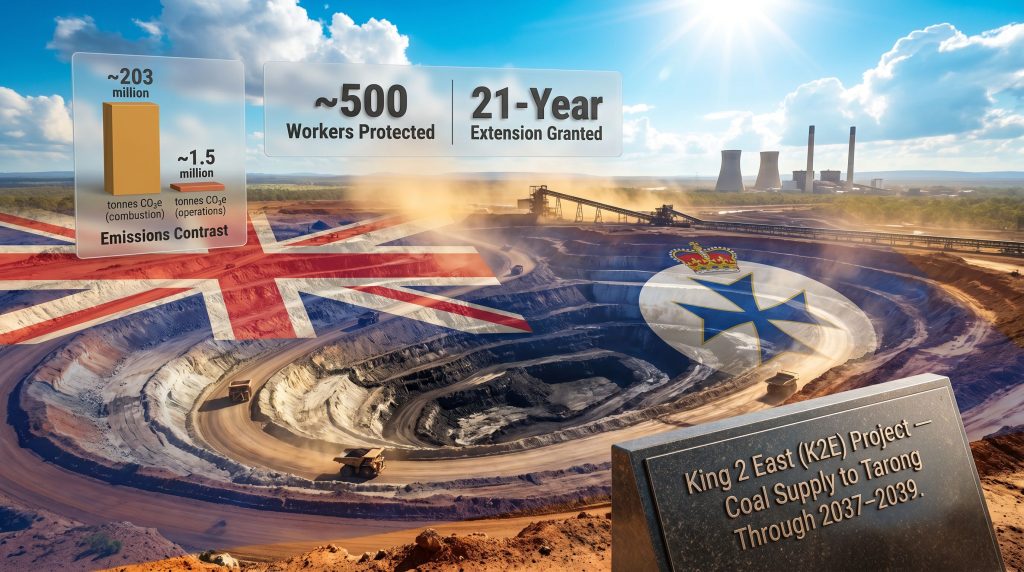
This distinction was central to how the K2E Project was assessed and ultimately approved at both federal and state levels. The Queensland Government granted a 21-year operational extension, while federal environmental approval was issued for the project as a brownfield expansion.
The Regulatory Framework: Dual Approval Architecture
Australia's coal mine approvals operate across two jurisdictional layers that can create complexity, and occasionally tension, in major resource decisions. State governments retain primary authority over mining leases and operational approvals, while the federal government exercises oversight through the EPBC Act where projects trigger biodiversity, water, or heritage thresholds.
For the Meandu coal mine extension, both approval streams were navigated. The brownfield classification streamlined the federal assessment process, as the project did not introduce a new landscape disturbance profile of the kind that would trigger the highest-order review requirements. However, approvals of this nature are rarely unconditional. Environmental management conditions attached to coal mine extensions in Queensland typically address groundwater monitoring, rehabilitation obligations, dust and noise management, and vegetation offset requirements.
Key Project Parameters at a Glance
| Parameter | Detail |
|---|---|
| Project Name | King 2 East (K2E) Project |
| Operator | Stanwell Corporation |
| Mine Location | Meandu Mine, Queensland |
| Project Classification | Brownfield extension (existing lease) |
| Land Area Expansion | |
| Extension Duration Granted | 21 years |
| K2E Mining Commencement | 2026 |
| Coal Supply Destination | Tarong Power Stations |
| Operational Supply Horizon | Through at least 2037-2039 |
| Workforce Protected | ~500 workers |
Coal Quality, Supply Dynamics, and the Tarong Relationship
The Meandu Mine produces sub-bituminous thermal coal, a classification characterised by moderate calorific value and relatively high moisture content compared to higher-rank black coal. Sub-bituminous coals are well-suited to mine-mouth power generation arrangements, where coal is transported short distances directly to adjacent power infrastructure, minimising handling losses and logistics costs. The Meandu-to-Tarong supply relationship is a textbook example of this model. Furthermore, the broader coal supply challenges facing Australia in 2025 make this kind of embedded supply relationship even more strategically valuable.
Mine-mouth arrangements like this carry a specific economic logic that is often underappreciated in broader energy policy discussions:
- Transport cost savings are substantial, because coal does not need to travel hundreds of kilometres to port or processing facilities
- Supply reliability is structurally embedded, given the physical proximity between mine and power station
- The operational interdependency means that neither asset can easily be repurposed in isolation without affecting the other's viability
- Long-term offtake arrangements reduce price volatility exposure for both the generator and the mine operator
This interdependency is precisely why the K2E extension carries such strategic weight. Interrupting coal supply to Tarong without an equivalent replacement generation source would create grid reliability risks that Queensland's current renewable buildout cannot yet absorb.
Emissions Profile: Confronting the Numbers Directly
No analysis of the Meandu coal mine extension is complete without engaging honestly with its emissions implications. Independent assessments suggest the project's lifetime contribution could reach approximately 203 million tonnes of CO2-equivalent from coal combustion at the Tarong power stations, with an additional estimated 1.5 million tonnes of CO2-equivalent attributable to direct mining operations. The combined figure approaches 204.5 million tonnes of CO2-equivalent over the project's operational life.
| Emissions Category | Estimated CO2-Equivalent |
|---|---|
| Coal combustion at Tarong (lifetime) | ~203 million tonnes CO2e |
| Direct operational emissions (mining) | ~1.5 million tonnes CO2e |
| Total estimated project emissions | ~204.5 million tonnes CO2e |
These figures sit at the centre of the project's most contested policy dimension. Australia's federal climate framework has historically separated Scope 1 emissions (direct operational) from Scope 3 emissions (downstream combustion), and federal EPBC assessments have not traditionally required proponents to internalise full combustion emission profiles as a condition of approval. Conservation organisations have argued this creates a systematic undercount of fossil fuel projects' true climate cost. For instance, the Australia Institute's analysis of the Meandu project specifically highlights this gap between assessed and actual emissions impact.
Critics of the approval process contend that assessing only the direct mining footprint, while excluding the far larger combustion emissions from end-use at Tarong, produces an incomplete picture of the project's climate alignment relative to Australia's international commitments.
The counterargument from Stanwell and Queensland Government proponents is that the relevant counterfactual is not zero emissions, but rather what generation source would replace Tarong's output if the coal supply were interrupted. Without equivalent dispatchable capacity, that gap would either draw on more carbon-intensive alternatives, require costly emergency imports, or simply produce supply shortfalls.
Workforce, Regional Communities, and the Just Transition Debate
The employment dimension of the Meandu coal mine extension is significant and should not be reduced to a footnote in the emissions conversation. Approximately 500 workers are directly employed at the Meandu Mine, representing a substantial portion of the local workforce in the mine's operating region. The 21-year extension provides these workers with a credible employment horizon rather than the uncertainty that has characterised workforce planning at coal operations facing imminent closure.
The concept of a just transition in the coal sector is one of the more contested phrases in Australian energy policy. At its core, it refers to a managed shift away from fossil fuel employment that provides affected workers and communities with genuine alternative economic pathways, rather than abrupt job losses. The Meandu extension highlights the gap between the principle and the practice:
- Near-term certainty is delivered for the current workforce, reducing the acute social disruption associated with sudden mine closures
- Long-term structural dependency on coal employment is arguably extended rather than transitioned away from
- Investment in retraining and alternative industries for the region remains a separate policy challenge, not resolved by the mine extension itself
- The 2037-2039 endpoint does create a defined planning horizon around which genuine transition programs could be structured, if policy commitment follows
The tension here is real. Extending coal operations provides social stability in the short term, but consequently only moves the transition challenge further down the timeline rather than addressing it. The decarbonisation benefits of investing earlier in alternative industries for coal-dependent regions are well documented, yet practical implementation consistently lags behind policy ambition.
The next major ASX story will hit our subscribers first
Comparing Australia's State-Level Thermal Coal Policy Responses
Queensland's decision to extend the Meandu Mine sits within a broader, uneven national picture on thermal coal asset management. In addition, Australia's resource and energy exports continue to shape the political and economic context in which these state-level decisions are made.
| State | Recent Thermal Coal Policy Direction |
|---|---|
| Queensland | Extended Meandu Mine by 21 years; balancing grid security with transition planning |
| New South Wales | Ongoing approval debates; multiple mines navigating closure timelines |
| Victoria | Brown coal (lignite) phase-out underway; Latrobe Valley transition programs active |
| Western Australia | Collie coal transition supported by state and federal programs |
Each state's approach reflects its unique grid architecture, generation mix, workforce concentration, and political economy. Queensland's grid is more heavily dependent on large-scale dispatchable thermal generation than Victoria, for example, which has a different renewable resource profile and storage investment trajectory. These structural differences mean that blanket national comparisons can obscure the real constraints each jurisdiction faces.
Long-Term Outlook: Stanwell's Post-2039 Energy Challenge
Stanwell occupies an unusual position in the Australian energy landscape. As a Queensland Government-owned corporation, it carries both a commercial mandate and a public interest responsibility. Its portfolio now spans legacy thermal assets, including Meandu and the Tarong stations, alongside a growing commitment to renewable energy in mining and broader clean energy development. The K2E extension is best understood as a bridge asset, one that maintains grid stability during a critical period while larger energy infrastructure transitions are completed.
Several unresolved questions will determine whether this bridge strategy proves sustainable:
- Battery storage and pumped hydro scaling: Queensland's Renewable Energy Zone (REZ) buildout and pumped hydro projects such as Pioneer-Burdekin need to reach sufficient capacity before Tarong's baseload role can be responsibly wound back
- Decommissioning obligations: Stanwell will face substantial mine rehabilitation and power station decommissioning costs post-2039, the scale of which will depend heavily on regulatory requirements at that time
- Grid transition coordination: The timing of Tarong's eventual exit must align with commissioning of replacement dispatchable capacity, a coordination challenge that remains incompletely resolved in current Queensland energy planning
Furthermore, broader efforts around mining decarbonisation will need to accelerate significantly if the sector is to meet its long-term climate obligations alongside these transitional commitments.
It is worth noting that all forward-looking projections regarding energy infrastructure timelines, emissions trajectories, and workforce outcomes involve significant uncertainty. Policy environments, technology costs, and regulatory frameworks are all subject to change, and readers should treat future-dated estimates as indicative rather than definitive.
Frequently Asked Questions: Meandu Coal Mine Extension
What is the Meandu coal mine extension?
The Meandu coal mine extension, formally the King 2 East (K2E) Project, is a brownfield expansion of Stanwell Corporation's Meandu Mine in Queensland. It adds approximately 186 to 187 hectares of operational area within the existing mining lease boundary and extends coal supply to the Tarong power stations through at least 2037 to 2039.
Who approved the extension?
The project received federal environmental approval as a brownfield expansion and a 21-year operational extension from the Queensland Government.
What are the estimated emissions from the K2E Project?
Independent analysis estimates approximately 203 million tonnes of CO2-equivalent from coal combustion at Tarong over the project's life, plus around 1.5 million tonnes from direct mining operations, for a combined total approaching 204.5 million tonnes CO2-equivalent.
When does mining begin in the K2E area?
Mining in the King 2 East expansion area is planned to commence in 2026.
How many workers does the Meandu Mine employ?
The mine supports approximately 500 direct workers, whose employment is secured by the approved extension.
For broader coverage of Queensland's energy sector, coal policy developments, and the Australian mining industry, The Australian Mining Review at australianminingreview.com.au provides ongoing reporting and analysis.
Want To Stay Ahead of Significant ASX Mining and Energy Discoveries?
Discovery Alert's proprietary Discovery IQ model delivers real-time alerts on significant ASX mineral discoveries — instantly turning complex data across more than 30 commodities into clear, actionable insights for investors at every level. Start your 14-day free trial today and explore how historic discoveries have generated substantial returns for those who acted early.