June 9, 2026
Deepwater Frontiers: Why the World's Energy Majors Are Betting on Africa's Atlantic Margin
Frontier basin exploration has always operated on a different logic to conventional oil and gas investment. Where mature basins offer predictability, frontier acreage offers something far more compelling to the right kind of operator: the possibility of discovering a resource system that nobody has yet priced into the market. This asymmetric dynamic explains why integrated energy majors with billions in annual capital expenditure continue to allocate exploration budgets to geologically unproven territories, even as energy transition pressures mount. The Eni Gambia offshore exploration deal, formalised on June 5, 2026, is precisely this kind of calculated frontier wager, and understanding why Eni made it requires examining the geological architecture, commercial history, and regional momentum that have quietly transformed West Africa's Atlantic coastline into one of the upstream sector's most watched investment corridors.
When big ASX news breaks, our subscribers know first
The MSGBC Basin: Structural Geology and the Making of an Investment Thesis
The Mauritania-Senegal-Gambia-Guinea-Bissau-Guinea corridor, widely referred to in the industry as the MSGBC Basin, sits along a passive continental margin formed during the Mesozoic-era separation of Africa and South America. This tectonic heritage is critically important. Passive margins of this type are characterised by thick sedimentary sequences deposited over tens of millions of years, creating the organic-rich source rocks, reservoir sands, and structural traps that define world-class hydrocarbon systems.
What separates the MSGBC Basin from many other Atlantic Margin plays is the combination of deepwater channel systems, submarine fan deposits, and salt diapirs that create complex but potentially prolific reservoir geometries. These are the same geological ingredients found in Brazil's pre-salt province and the Gulf of Mexico's deep shelf, both of which have delivered some of the largest offshore discoveries in history.
The basin's credibility as an investment destination was fundamentally transformed by two milestone events:
| Milestone | Country | Year | Significance |
|---|---|---|---|
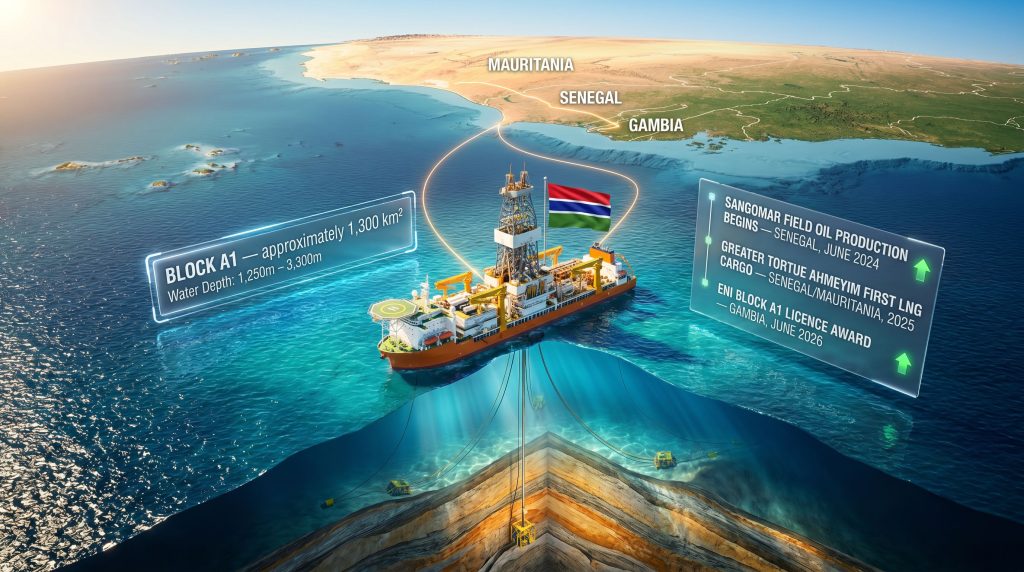
| Sangomar Field Oil Production Begins | Senegal | June 2024 | Senegal becomes a new African oil producer |
| Greater Tortue Ahmeyim First LNG Cargo | Senegal/Mauritania | 2025 | Both nations established as emerging gas exporters |
| Eni Block A1 Licence Award | Gambia | June 2026 | First major international oil company entry into Gambian offshore sector |
The Sangomar development, operated by Woodside Energy, confirmed that deepwater reservoirs along this margin could support commercial-scale production. Greater Tortue Ahmeyim, a cross-border LNG project developed by BP and Kosmos Energy on the Senegal-Mauritania maritime boundary, demonstrated that the basin's gas resources were sufficiently large and commercially viable to justify floating LNG infrastructure. Together, these projects transformed regional risk perception and created a data-rich environment that subsequent explorers, including Eni, can exploit.
It is worth noting, however, that geological continuity across a basin does not guarantee discovery replication. Reservoir quality, trap integrity, and charge history can vary dramatically across relatively short distances, and the fact that hydrocarbons were found in Senegalese and Mauritanian waters does not automatically de-risk Gambian acreage. Industry professionals are careful to distinguish between basin-level optimism and block-specific geological confidence, a distinction that becomes particularly important when evaluating Block A1's exploration history. Furthermore, the broader geopolitical landscape across West Africa continues to shape how operators assess and prioritise frontier acreage commitments.
Block A1: A Deepwater Asset With a Cautionary Track Record
Technical Profile
Block A1 covers approximately 1,300 square kilometres of Atlantic Margin acreage offshore The Gambia. Its water depth range of 1,250 metres to 3,300 metres places portions of the block firmly in ultra-deepwater territory, where drilling operations demand specialised rigs, equipment, and subsea engineering capabilities that only a handful of companies globally can deploy at scale.
Key Asset Metrics at a Glance:
- Total acreage: approximately 1,300 square kilometres
- Water depth range: 1,250 metres to 3,300 metres
- Classification: Deepwater to ultra-deepwater
- Location: Atlantic Margin, offshore The Gambia
- Licence type: Petroleum exploration, development and production agreement
A History of Exits Without Discovery
The block's exploration history is a study in the gap between geological potential and commercial delivery. African Petroleum Corporation held the licence prior to 2017, but the Gambian government revoked the agreement citing unmet contractual obligations. This type of regulatory enforcement is not uncommon in frontier jurisdictions where governments balance the need to attract investment against the requirement that operators fulfil work programme commitments.
BP subsequently acquired rights to the block, a development that briefly elevated confidence in the acreage given the British major's technical capabilities and balance sheet. Yet BP exited in 2021 without spudding a single exploration well, reaching a financial settlement with the Gambian government over outstanding licence commitments. BP's departure was part of a broader portfolio rationalisation the company undertook during that period as it redirected capital toward its energy transition strategy, but the exit nonetheless reinforced the perception of Block A1 as a high-risk, unproven asset.
Following BP's departure, the Gambia Petroleum Commission repositioned the block through a competitive tender process, ultimately selecting Eni as the preferred operator. The selection of an operator of Eni's scale and frontier exploration track record represents a qualitative upgrade from previous licence holders in terms of technical capability and financial resilience. According to Eni's official announcement, the agreement covers the full exploration-to-production lifecycle across Block A1's deepwater acreage.
Why Eni's Interpretation May Differ From Its Predecessors
One of the less-discussed aspects of frontier exploration is how dramatically the same geological data can be interpreted differently by different technical teams using different methodologies. Since BP's 2021 exit, the volume and quality of seismic and subsurface data generated by the adjacent Senegalese and Mauritanian production programmes has grown substantially. New regional datasets can illuminate structural features, fluid contacts, and charge pathways that earlier surveys missed or could not resolve with the technology available at the time.
Eni has developed a reputation within the industry for proprietary geological interpretation, particularly in complex deepwater settings. The company's track record in frontier basins suggests a willingness to see opportunity in acreage that others have passed over, a characteristic that has historically yielded both significant discoveries and significant dry holes.
Eni's West Africa Strategy: Reading the Atlantic Corridor Playbook
Portfolio Architecture and Production Scale
Eni's decision to pursue the Eni Gambia offshore exploration deal is consistent with a deliberate portfolio strategy that balances near-term production from established assets with medium-term growth from emerging basins and longer-term optionality from frontier exploration. The company reported total group hydrocarbon production of approximately 1.73 million barrels of oil equivalent per day in 2025, a scale that requires a continuous pipeline of exploration activity to sustain long-term resource replacement.
The Gambia licence fits the frontier category of that strategy, where geological risk is elevated but the potential upside from a commercial discovery is disproportionately large relative to the cost of the exploration phase. In addition, crude oil trends across global markets continue to influence how majors like Eni prioritise long-cycle frontier investments within their broader capital allocation frameworks.
Africa Track Record: The Credibility Benchmarks
Eni's credibility in frontier African exploration rests on a small number of very high-profile successes:
-
Egypt, Zohr Gas Field: Discovered in 2015 and described as the largest gas discovery in the Mediterranean at the time of its announcement, Zohr demonstrated Eni's capability to identify and rapidly develop giant deepwater gas resources in geologically complex settings. The field reached full production capacity ahead of schedule.
-
Ivory Coast, Baleine Field: Eni's Baleine discovery offshore Ivory Coast validated the company's Atlantic Margin thesis and proved that West African deepwater plays could yield material commercial resources outside of the established Niger Delta fairway.
-
Sierra Leone, Offshore Agreements (2025): Eni's signing of offshore agreements in Sierra Leone in the year immediately preceding the Gambia entry confirms a deliberate sequential approach to building acreage exposure along the Atlantic coastal corridor.
| Country | Asset | Status | Strategic Role |
|---|---|---|---|
| Egypt | Zohr Gas Field | Producing | Anchor asset, North Africa |
| Ivory Coast | Baleine Field | Development/Production | West Africa deepwater proof of concept |
| Sierra Leone | Offshore Blocks | Exploration (2025) | Atlantic corridor expansion |
| Gambia | Block A1 | Exploration licence (2026) | Frontier basin entry |
This geographic progression reveals a consistent logic: Eni is assembling a portfolio of Atlantic Margin exposure across multiple risk categories, using each new entry to expand its proprietary geological database and optionality across a region it has identified as structurally underexplored relative to its resource potential.
The Licence Agreement: What the June 5 Signing Actually Means
Scope and Obligations
The petroleum exploration, development and production licence agreement signed by Gambia's Minister of Energy and Petroleum, Nani Juwara, grants Eni the right to explore, and if warranted, develop and produce hydrocarbons from Block A1. The agreement covers the full exploration-to-production lifecycle, but the immediate obligations are confined to the exploration phase.
Cany Jobe, Director-General of the Gambia Petroleum Commission, publicly framed the agreement as the beginning of a structured offshore evaluation process rather than a resource confirmation event. This framing is deliberate and important: licence awards in frontier basins are frequently misinterpreted by media and public audiences as discovery announcements, when in reality they represent the starting point of a multi-year geological assessment. As reported by Upstream Online, Eni is entering acreage previously held by BP, making the strategic context of this licence transition particularly significant.
The Exploration Pathway: Step by Step
Before Eni can make any drilling decision on Block A1, a structured sequence of technical and regulatory work must be completed:
-
Geophysical data acquisition and reprocessing of existing seismic surveys across the 1,300 km² acreage, incorporating the latest processing algorithms and regional geological context.
-
Geological modelling and prospect identification, translating seismic data into three-dimensional subsurface models that identify potential reservoir structures and trap geometries.
-
Prospect maturation and internal investment case development, where Eni's technical teams assess the commercial viability of individual prospects and rank drilling candidates by risked resource potential.
-
Regulatory approval and environmental assessment, a mandatory process under Gambian petroleum legislation before any drilling activity can commence.
-
Exploration well spudding, the first direct physical test of Block A1's subsurface potential, likely to be the most capital-intensive single event in the exploration phase.
The Economics of Ultra-Deepwater Drilling
Exploration at the water depths encountered in Block A1 carries a cost profile that most observers significantly underestimate. Ultra-deepwater drilling operations in the 2,000 to 3,300 metre range can cost several hundred million dollars per well when rig day rates, subsea equipment, well construction, and logistics are aggregated. This cost structure means that only operators with substantial financial resources and technical expertise can meaningfully participate in frontier deepwater exploration at this scale.
It also means that the decision to drill is itself a major capital allocation event, one that Eni will not take without a high degree of internal confidence in the geological case. The exploration studies phase that precedes drilling is therefore not a formality but a genuine value-creation exercise that determines whether a well is ever spudded. Consequently, pipeline disruption risks and broader infrastructure vulnerability considerations also inform how operators sequence and prioritise their exploration commitments in offshore frontier environments.
Gambia's Energy Economy: Expectations, Timelines, and Realistic Scenarios
From Frontier Classification to Economic Transformation
For Gambia, one of West Africa's smallest and least resource-endowed economies, the Eni Gambia offshore exploration deal carries significance that extends beyond the geological. The country has launched multiple offshore licensing rounds over the past two decades without attracting an operator of Eni's standing. The licence award signals that Gambia's regulatory framework, as administered by the Gambia Petroleum Commission, has reached a level of credibility that can attract tier-one international operators.
However, the gap between exploration activity and economic benefit is vast, and managing national expectations during a multi-year assessment timeline is an important governance challenge. The history of African oil frontiers is littered with examples of premature optimism followed by disillusionment when exploration programmes fail to deliver commercial discoveries.
Realistic Production Timelines
| Phase | Estimated Duration | Key Milestones |
|---|---|---|
| Exploration studies and seismic work | 1 to 3 years | Prospect identification |
| Exploration drilling decision | 2 to 4 years post-licence | First well spud |
| Appraisal (if discovery confirmed) | 2 to 4 additional years | Resource size confirmation |
| Development and construction | 4 to 7 years post-appraisal | FPSO or subsea infrastructure |
| First production (optimistic case) | 10 to 15 years from licence | Revenue generation commences |
Important Context: Even under optimistic assumptions where exploration drilling confirms a commercial discovery relatively early in the programme, first production from a deepwater offshore development would realistically be a decade or more away from the June 2026 licence signing. The agreement is the beginning of a geological assessment process, not a production commitment.
Potential Economic Architecture of a Future Development
If commercial hydrocarbons are ultimately confirmed, the economic structure of any development would likely be governed by a production-sharing framework, the standard contract architecture for deepwater licences in West Africa. Under this model, the government typically receives a royalty on gross production plus a share of profit oil after the operator has recovered its capital costs, a structure that delays significant government revenue until development expenditure has been recouped.
Local content obligations, workforce development requirements, and infrastructure investment mandates are also standard components of West African deepwater production agreements and would form part of any development negotiation. For a small coastal economy like Gambia, the infrastructure requirements of a deepwater development — potentially including a floating production, storage and offloading vessel, subsea pipeline systems, and onshore processing facilities — would represent a transformative capital injection even before any production revenue flows.
The next major ASX story will hit our subscribers first
Risk Framework: What Could Prevent Delivery of Value
Geological Risk
Block A1 has no confirmed commercial discovery in its exploration history. While regional geological continuity provides a conceptual basis for optimism, the absence of any direct well data from within the block means that subsurface uncertainty remains at its maximum level. Key geological risks include:
- Reservoir quality degradation at ultra-deepwater depths where sediment compaction may reduce porosity and permeability
- Structural trap integrity uncertainty, particularly where seismic imaging quality decreases in deeper water sections
- Source rock maturity and charge history questions that cannot be fully resolved without well data
- Potential differences between the sedimentary architecture of Gambian offshore geology and the proven Senegalese and Mauritanian formations
Commercial and Macroeconomic Risk
Deepwater exploration projects operate on investment timelines that span multiple energy price cycles. A commercial discovery made in 2028 or 2029 would face a development decision sometime in the mid-2030s, a period when the trajectory of global oil demand, carbon pricing mechanisms, and the cost competitiveness of renewable energy alternatives will look very different from today. Frontier exploration projects must therefore be evaluated not just on their geological potential but on whether their expected production costs can compete with the prevailing economics of that future market environment.
Energy transition pressures are not an abstract threat to long-cycle deepwater projects. Several major oil companies have already declined to sanction discovered deepwater resources because the long-term demand and price assumptions required to justify development capital no longer meet internal return thresholds. Furthermore, oil price movements driven by trade policy and macroeconomic shifts add another layer of uncertainty to the commercial calculus for long-cycle frontier projects of this nature.
Regulatory and Contractual Risk
The revocation of African Petroleum Corporation's licence in 2017 is a reminder that contractual compliance is non-negotiable in Gambian offshore operations. Eni will be required to fulfil its work programme obligations within agreed timeframes to maintain its licence in good standing, and the Gambia Petroleum Commission has demonstrated a willingness to enforce those requirements. This is ultimately a positive regulatory dynamic for the country, even if it increases execution pressure on the operator.
Frequently Asked Questions: Eni Gambia Offshore Exploration Deal
What is the Eni Gambia offshore exploration deal?
Eni, the Italian integrated energy company, signed a petroleum exploration, development and production licence agreement with the Government of The Gambia on June 5, 2026. The agreement grants Eni rights to explore offshore Block A1, a deepwater acreage of approximately 1,300 square kilometres located in water depths between 1,250 and 3,300 metres.
Has oil or gas been found in Gambia before?
No commercial hydrocarbon discovery has been confirmed in Gambian waters. Block A1 has been held by multiple operators, including African Petroleum Corporation and BP, neither of which made a commercial discovery before relinquishing their interests.
Why did BP exit Block A1 in 2021?
BP exited the block in 2021 without drilling an exploration well and subsequently reached a financial settlement with the Gambian government. The exit was consistent with BP's broader portfolio rationalisation during that period, though the specific internal geological assessment that informed the decision was not publicly disclosed.
When could Gambia realistically see first oil or gas production?
Under optimistic scenarios involving an early exploration success, first production would realistically be a decade or more away from the 2026 licence signing. A more conservative timeline, accounting for appraisal, development planning, infrastructure construction, and regulatory approvals, could extend well beyond 2040.
What is Eni's production scale?
Eni reported total group hydrocarbon production of approximately 1.73 million barrels of oil equivalent per day in 2025, with Africa representing a significant portion of its upstream portfolio across North, West, and Central African operations.
What the Eni Gambia Deal Signals About West Africa's Upstream Future
The Eni Gambia offshore exploration deal is best understood not as an isolated transaction but as one data point in a larger pattern of investment behaviour reshaping West Africa's Atlantic margin. Several conclusions emerge from a careful analysis of the deal's context, structure, and history:
-
Eni's entry represents the most credible endorsement of Gambia's offshore potential by a major international oil company to date, and it materially improves the country's standing in the eyes of future investors and multilateral finance institutions.
-
The MSGBC Basin's investment credibility has been structurally reinforced by the Sangomar and Greater Tortue Ahmeyim production milestones, but block-specific geological risk in Gambia remains unresolved and should not be obscured by basin-level optimism.
-
Block A1's history of operator exits without discovery is a material data point that Eni's technical teams will have assessed carefully. The company's decision to proceed regardless suggests a degree of internal geological confidence based on reprocessed regional data, though this cannot be verified externally until drilling results are available.
-
The deepwater technical profile of the block demands significant capital commitment across a multi-year exploration programme before any drilling decision can be reached. Observers expecting near-term newsflow should calibrate their expectations to the realities of frontier deepwater exploration timelines. The oil market overview at the time of the licence signing reflects broader supply-side uncertainties that make frontier acreage positions strategically attractive to integrated majors.
-
For Gambia, the deal's most immediate value is institutional: it demonstrates that a credible regulatory framework, sustained through the work of the Gambia Petroleum Commission, can attract world-class operators to a frontier jurisdiction with a complicated exploration history.
Disclaimer: This article is intended for informational purposes only and does not constitute financial or investment advice. Statements relating to future exploration outcomes, production timelines, and economic benefits involve significant uncertainty and are subject to geological, commercial, and regulatory risks. Past exploration activity in adjacent jurisdictions does not guarantee outcomes in Block A1. Readers should conduct their own due diligence before making any investment decisions related to companies or projects discussed in this article.
Want to Track the Next Major Resource Discovery Before the Market Does?
While frontier basin exploration like Eni's Gambia offshore venture operates on decade-long timelines, significant mineral discoveries on the ASX can create immediate investment opportunities — and Discovery Alert's proprietary Discovery IQ model delivers real-time alerts the moment those discoveries are announced, turning complex geological data into actionable insights for both short-term traders and long-term investors. Explore how historic discoveries have generated substantial returns on Discovery Alert's dedicated discoveries page, then begin your 14-day free trial to ensure you're positioned ahead of the broader market.