June 8, 2026
The Infrastructure Layer That Mining Automation Has Always Needed
Every major wave of industrial transformation has depended on an invisible enabling layer that rarely makes headlines but determines whether advanced technologies actually deliver on their promises. Electrification needed reliable power grids. Computer-aided manufacturing needed programmable logic controllers. The current push toward autonomous and remotely operated mining faces exactly the same prerequisite challenge: without robust, deterministic communication infrastructure beneath every automated system, the technology stack above it simply cannot perform.
This is the fundamental reality driving the escalating importance of private cellular networks in global mining, and it is precisely the context in which the Epiroc and Ericsson LTE and 5G mining agreement, announced on June 8, 2026, carries genuine strategic weight.
When big ASX news breaks, our subscribers know first
Why Legacy Wireless Infrastructure Is Holding Mining Back
The limitations of traditional Wi-Fi and legacy radio systems in mining environments are not merely inconvenient — they are increasingly incompatible with the operational demands of modern mines. As ore bodies become deeper, as open-pit geometries expand, and as mining companies deploy more sophisticated autonomous equipment, the shortcomings of older connectivity infrastructure become structural barriers rather than manageable inconveniences.
Several dynamics are converging to make this problem more acute:
- Legacy Wi-Fi networks suffer from coverage gaps in underground tunnel networks, particularly in complex stope geometries and long decline drives where signal attenuation through rock mass is severe.
- Older radio systems lack the bandwidth headroom required to simultaneously support autonomous equipment control, real-time video feeds, sensor telemetry, and safety-critical communication on the same network.
- As mining companies build remote operations centres designed to control multiple sites from a single hub, the reliability requirements placed on connectivity infrastructure increase dramatically.
- Industry analysts have consistently identified unreliable connectivity as one of the primary barriers preventing mining companies from fully capturing the productivity value embedded in their automation investments.
What distinguishes private LTE and 5G networks from their predecessors is not simply speed. The critical differentiator is determinism — meaning the ability to guarantee consistent latency and throughput regardless of network load or environmental conditions. In a safety-critical mining environment, a collision avoidance system that works reliably 98% of the time is not acceptable. Private cellular networks are engineered to deliver the remaining 2%.
Furthermore, automation transformed mining has raised the bar for what communication infrastructure must deliver, making legacy systems structurally unsuitable for next-generation operations.
Private LTE and 5G networks are not simply faster Wi-Fi replacements. They represent a purpose-built industrial communication layer capable of supporting the full stack of digital mining applications simultaneously, each with independently guaranteed performance parameters.
What the Epiroc and Ericsson LTE and 5G Mining Agreement Actually Involves
From Exploration Cooperation to Commercial Alliance
Understanding the significance of the June 2026 announcement requires recognising what preceded it. Epiroc and Ericsson first formalised a cooperation framework in 2018, focused on investigating how private cellular technologies could be applied within mining operations. That relationship produced real-world testing, most notably at Epiroc's Kvarntorp test mine in Sweden, which served as a controlled underground environment for validating industrial cellular network performance under realistic mining conditions.
The 2026 agreement represents a qualitative change in the nature of that relationship. What was previously a structured research and exploration arrangement has now been elevated into a full go-to-market commercial alliance with direct distribution implications. Ericsson's expanded alliance with Epiroc targets scalable connectivity specifically for remote-controlled and autonomous mining solutions at a global level.
| Partnership Dimension | Detail |
|---|---|
| Agreement Announced | June 8, 2026 |
| Original Cooperation Established | 2018 |
| Technology Scope | Private LTE and 5G networks |
| Deployment Environments | Surface and underground mines |
| Commercial Structure | Epiroc as systems integrator and reseller |
| Geographic Reach | Global |
| Known Test Site | Kvarntorp test mine, Sweden |
Commercial Mechanics and Strategic Logic
Under the expanded agreement, Epiroc will integrate Ericsson's private LTE and 5G solutions directly into its customer-facing digital portfolio. Epiroc's global network of customer centres will function as both distribution channels and deployment partners for Ericsson's industrial cellular infrastructure. This positions Epiroc not merely as a mining equipment manufacturer but as a systems integrator operating across the boundary between operational technology and information technology.
The division of responsibilities reflects each company's core competencies:
- Ericsson contributes proven industrial cellular network infrastructure, drawing on deployment experience across ports, logistics, manufacturing, and energy sectors.
- Epiroc contributes mining domain expertise, an established global customer base, and an existing digital solutions portfolio that the connectivity layer is designed to underpin.
Epiroc's publicly stated philosophy of technology agnosticism is directly relevant here. Rather than developing proprietary connectivity infrastructure, the company has chosen to integrate best-in-class external technology into its offering, preserving flexibility for customers whose requirements vary by operation, geography, and automation maturity.
How Private LTE and 5G Actually Enable Mining Automation
The Technical Architecture of Industrial Cellular Networks in Mining
Private LTE and 5G networks deployed in mining environments are architecturally distinct from public carrier networks or enterprise office deployments. They are purpose-configured for industrial use cases, with specific design choices made to address the physical and operational characteristics of mining environments.
In underground applications, distributed antenna systems (DAS) and small cells are deployed along tunnel drives and within stope networks to maintain consistent signal coverage despite the severe radio frequency attenuation caused by rock mass and metallic infrastructure. Surface deployments focus on achieving seamless coverage across large geographic footprints, often in remote locations beyond the reach of public carrier infrastructure.
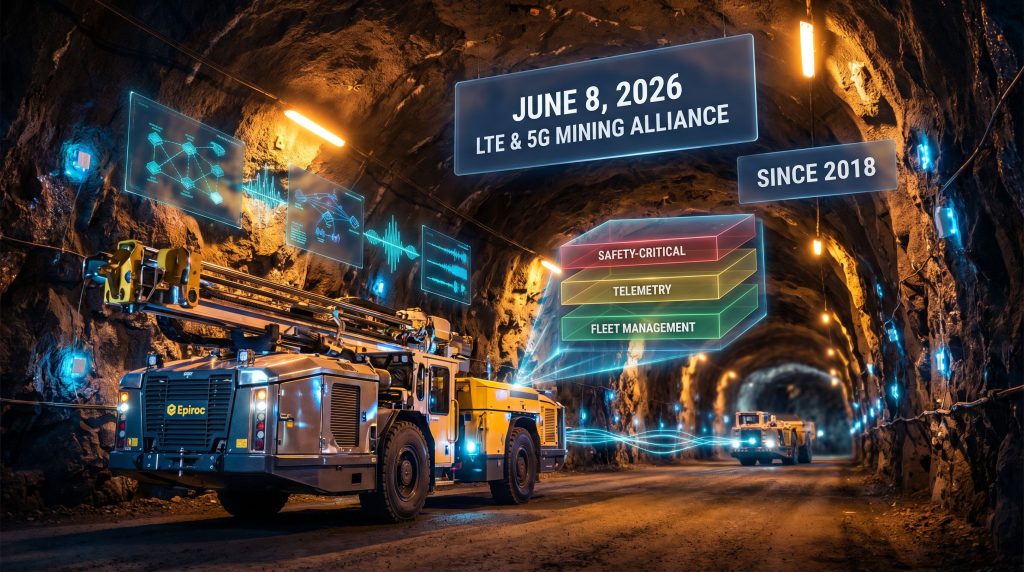
One of the most technically significant capabilities of 5G in this context is network slicing, which allows a single physical network to partition its resources into multiple virtual networks, each with independently guaranteed quality-of-service parameters. This means a mine can simultaneously run:
- A safety-critical slice for collision avoidance and emergency communication, with sub-100ms latency guarantees.
- An operational slice for autonomous equipment control and real-time telemetry.
- An administrative slice for general data traffic, without any of these competing with one another for bandwidth.
5G's ultra-reliable low-latency communication (URLLC) capability is specifically engineered for exactly this class of mission-critical industrial application, representing a qualitative improvement over what LTE can deliver for the most demanding use cases.
Core Use Cases Enabled Across Mining Operations
The operational applications that private cellular networks enable span safety, productivity, and efficiency domains. In addition, data-driven mining operations increasingly depend on these network capabilities to function at the required level of reliability:
- Autonomous equipment operation: Continuous low-latency connectivity is a hard prerequisite for autonomous drills, loaders, and haul trucks, particularly underground where GPS positioning is unavailable and machine guidance depends entirely on network-delivered data.
- Real-time telemetry and predictive maintenance: High-bandwidth cellular connectivity enables continuous machine health monitoring, allowing predictive maintenance programmes to identify failure signatures before unplanned downtime occurs.
- Collision avoidance and situational awareness: Safety-critical applications require deterministic network performance. A sub-100ms latency threshold is the operational benchmark for collision avoidance systems to function reliably — a threshold that private LTE/5G delivers consistently where legacy systems cannot.
- Remote operations centres: The viability of centralised control hubs managing multiple geographically dispersed sites depends entirely on reliable, high-throughput connectivity between the operations centre and the mine face.
- Data-driven fleet management: Real-time positioning and load data enables optimisation of haulage cycle times and fuel consumption across mobile equipment fleets.
Surface vs. Underground: Why the Environments Demand Different Solutions
| Factor | Surface Mining | Underground Mining |
|---|---|---|
| Primary Network Challenge | Coverage across large geographic area | Signal propagation through rock and tunnels |
| Typical Automated Equipment | Autonomous haul trucks, surface drills | LHDs, bolters, underground drills |
| Key Safety Applications | Collision avoidance, fatigue monitoring | Gas detection integration, emergency comms |
| Primary 5G Advantage | Massive IoT sensor density | URLLC for remote equipment control |
| Infrastructure Approach | Wide-area coverage, macro cells | Distributed antenna systems, tunnel small cells |
What Industry Leaders Have Communicated About This Partnership
Paul Bergström, President of Digital Solutions at Epiroc, has framed connectivity as an increasingly central component of the company's value proposition to mining customers. His position reflects an understanding that connectivity is not a peripheral service add-on, but the foundational layer upon which the entire digital mining technology stack rests.
Epiroc's approach positions the alliance as a deliberate effort to help mining operators build the communication infrastructure required to unlock the full value of their automation investments. Consequently, AI-powered mining efficiency tools can only realise their full potential when built upon a network layer capable of sustaining their demands.
From Ericsson's perspective, Pankaj Malhotra, Head of Product and Engineering at Ericsson Enterprise Wireless Solutions, has characterised the partnership as a mechanism for enabling mining modernisation at genuine operational scale. The framing from Ericsson emphasises the company's role as the enabling infrastructure layer behind Epiroc's digital and automation solutions, supporting mining companies in modernising their operations across global markets.
Both perspectives converge on the same central thesis: connectivity infrastructure is not a downstream consideration after automation decisions are made. It is a foundational prerequisite that determines whether automation investments deliver their intended value.
Operational Benefits: Safety, Productivity, and Efficiency in Quantifiable Terms
Safety Outcomes Enabled by Reliable Industrial Networks
The safety case for private cellular networks in mining is not abstract. Specific operational improvements with direct safety consequences include:
- Remote operation of equipment in hazardous zones — including blast areas, unstable ground conditions, and high-gas environments — removes personnel from physical risk while maintaining operational continuity.
- Emergency communication systems integrated into private cellular infrastructure provide more resilient fallback capabilities than surface-dependent radio systems, particularly in underground environments where surface connectivity may be severed by a seismic event.
- Consistent sub-100ms latency on private LTE/5G networks enables collision avoidance systems to function safely — a performance level that legacy wireless systems cannot reliably sustain under load.
Productivity and Efficiency Gains
The productivity case is equally compelling:
- Autonomous and remotely operated equipment achieves higher utilisation rates than manually operated equivalents, primarily because it eliminates shift change delays, can operate through environmental hazard periods, and is not constrained by fatigue management requirements.
- Predictive maintenance programmes enabled by continuous telemetry have demonstrated meaningful reductions in unplanned downtime across heavy industrial sectors, with some programmes in adjacent industries reporting availability improvements measured in percentage points.
- Fleet management optimisation through real-time positioning and load monitoring reduces haulage cycle times and fuel consumption — two cost lines that represent substantial proportions of total operating cost in large open-pit operations.
The next major ASX story will hit our subscribers first
Where This Alliance Sits Within Mining's Broader Digital Transformation
The Industry Context in 2026
The global mining industry's shift toward automation, digitalisation, and remote operations has accelerated significantly over the past decade. Several structural forces are driving this transition:
- Labour economics: Operating costs in remote and high-altitude mining environments make reductions in on-site personnel increasingly attractive from a financial standpoint.
- Ore body complexity: As shallower, higher-grade deposits become exhausted, mining companies are accessing deeper, more geologically complex ore bodies where autonomous equipment and remote operations offer safety and access advantages.
- ESG obligations: Reducing the physical exposure of workers to mining hazards has become a measurable component of mining company sustainability reporting and stakeholder expectations.
Private cellular networks have emerged as the connectivity infrastructure of choice for Tier 1 and Tier 2 mining operators globally, progressively replacing fragmented Wi-Fi and legacy radio deployments as operations scale their automation ambitions. This broader shift reflects mining infrastructure transformation occurring simultaneously across multiple technology domains.
The OEM-Telco Alliance Model as an Industry Pattern
The Epiroc and Ericsson LTE and 5G mining agreement is not occurring in isolation. It reflects a broader pattern of structured alliances forming between mining equipment OEMs and telecommunications infrastructure providers. The logic driving these alliances is straightforward: as connectivity becomes a prerequisite for the full performance of automated equipment, OEMs that cannot offer a credible connectivity solution alongside their hardware are delivering an incomplete product.
This dynamic is reshaping what it means to be a mining equipment supplier. The competitive differentiator is no longer purely machine performance metrics. Mining operators are increasingly evaluating OEMs on the quality and maturity of their broader digital ecosystem, which now explicitly includes connectivity infrastructure. For broader context on how these trends are converging, mining industry innovation in 2025 and beyond reflects precisely this shift in competitive dynamics.
As ore bodies become deeper, more geologically complex, and located in increasingly remote jurisdictions, the ability to operate mines with reduced on-site personnel through robust digital connectivity will transition from a competitive advantage to an operational necessity.
Epiroc's technology-agnostic approach positions it to assemble best-in-class technology stacks tailored to specific customer requirements, rather than constraining customers to proprietary solutions. The integration of Ericsson's network capabilities extends this philosophy into the network layer — a domain that has historically sat outside the scope of mining equipment manufacturers but is now firmly within it. Epiroc's connected mines strategy with Ericsson reflects precisely this expanded definition of what a mining equipment provider must now deliver.
Frequently Asked Questions: Epiroc and Ericsson LTE and 5G Mining Partnership
What is the Epiroc and Ericsson LTE and 5G mining agreement?
Announced on June 8, 2026, the agreement is a global go-to-market alliance through which Epiroc will offer Ericsson's private LTE and 5G network solutions as part of its digital portfolio for mining customers worldwide. It covers both surface and underground mining environments and builds on a cooperation relationship that began in 2018.
When did Epiroc and Ericsson first begin working together on cellular connectivity?
The two companies established their initial cooperation in 2018, with an initial focus on exploring the application of LTE and 5G technologies within mining operations. The 2026 announcement represents a formal expansion into a structured commercial go-to-market alliance.
What is the difference between private LTE and 5G for mining applications?
Private LTE provides robust, reliable connectivity suitable for most current mining automation use cases including telemetry and remote equipment control. Private 5G extends this with higher bandwidth, lower latency, and network slicing capabilities, enabling more complex simultaneous applications such as high-definition video, ultra-reliable machine control, and massive concurrent IoT sensor networks operating on a single shared physical infrastructure.
Why is connectivity considered foundational rather than supplementary for mining automation?
Without reliable, low-latency communication infrastructure, autonomous equipment cannot operate safely, remote operations centres cannot function effectively, and real-time safety systems cannot guarantee the performance thresholds required for mission-critical applications. Connectivity is the enabling layer upon which all other digital mining technologies depend, making it a prerequisite investment rather than an optional enhancement.
Where has the joint connectivity solution been tested?
Epiroc's Kvarntorp test mine in Sweden has served as the primary live proving ground for the partnership's underground cellular network deployments, providing realistic validation of network performance in genuine underground mining conditions.
Disclaimer: This article contains forward-looking statements and industry observations based on publicly available information. References to productivity improvements and operational benefits are indicative based on industry-wide data and do not constitute guarantees of specific outcomes for any individual mining operation. Readers should conduct independent research before making investment or operational decisions.
Want to Invest in the Companies Driving Mining's Next Technological Leap?
Discovery Alert's proprietary Discovery IQ model delivers real-time alerts the moment significant ASX mineral discoveries are announced, transforming complex data across 30+ commodities into clear, actionable insights for both short-term traders and long-term investors. Explore how historic mineral discoveries have generated extraordinary returns and begin your 14-day free trial today to stay ahead of the market.