
July 18, 2026
When Governance Cycles Repeat, Communities Pay the Price
Across the global mining industry, a recurring pattern has emerged in mineral-producing nations: regulatory frameworks expand rapidly in the immediate aftermath of catastrophic failures, legislative reforms are announced with urgency, and oversight agencies receive renewed mandates. Then, incrementally and often invisibly, budget pressures erode the operational capacity those reforms were meant to build. The gap between regulation on paper and enforcement in practice widens until the next disaster resets the cycle. Brazil tailings dams without oversight represent one of the most documented examples of this governance failure in action.
Brazil is currently mid-cycle, and the consequences are measurable.
When big ASX news breaks, our subscribers know first
The Architecture of Oversight and Where It Fractures
Brazil sits among the world's top five mineral-producing nations by output volume, yet the institutional infrastructure responsible for managing the safety of that production has not scaled proportionally with the industry it oversees. This mismatch is not accidental, nor is it recent. It reflects a structural tension embedded in how the country's regulatory model was originally designed and how it has been funded ever since.
The federal oversight model for tailings facilities divides responsibility between two distinct layers of authority. The National Mining Agency, known as the ANM, holds primary federal jurisdiction over dam safety, while state-level environmental bodies carry parallel inspection mandates. In theory, this creates overlapping coverage. In practice, it creates jurisdictional ambiguity that diffuses accountability and enables each layer to defer to the other when inspection capacity is stretched.
Compounding this structural issue is a conflict at the fiscal level. Mining revenues represent a significant component of both state and federal income in Brazil's major mineral-producing regions. The same governments that depend on those revenues are responsible for funding the agencies tasked with enforcing regulations against the industry generating them. This arrangement does not require deliberate negligence to produce underregulation. The structural incentive to underfund enforcement agencies is sufficient on its own. Government intervention in mining at the fiscal level often reinforces rather than resolves these tensions.
Understanding the Regulatory Lifecycle of a Tailings Facility
A tailings dam does not simply exist in a static condition between construction and decommissioning. It passes through a regulatory lifecycle that demands different types of oversight at each stage:
- Construction approval requiring geotechnical design verification
- Operational monitoring during active waste deposition
- Periodic independent inspection to assess structural integrity
- Decharacterisation once operations cease
- Post-closure surveillance to monitor long-term stability
Each phase requires specific technical expertise. When budget constraints force an agency to prioritise across these categories, the facilities most likely to receive attention are those that have most recently been subject to operator-submitted risk assessments classifying them as lower priority. This is not a minor administrative detail. It is the mechanism by which uninspected facilities accumulate.
The term inspection deficit describes what forms when scheduled inspections cannot be completed due to resource constraints. Unlike a simple backlog, an inspection deficit is dynamic: the longer a facility goes without external verification, the wider the divergence between the assumed condition of the structure and its actual state. Seepage pathways develop. Phreatic surfaces shift. Embankment settlement progresses. None of these changes announce themselves to a regulator who is not present to observe them.
Brazil Tailings Dams Without Oversight: How the Current Crisis Was Confirmed
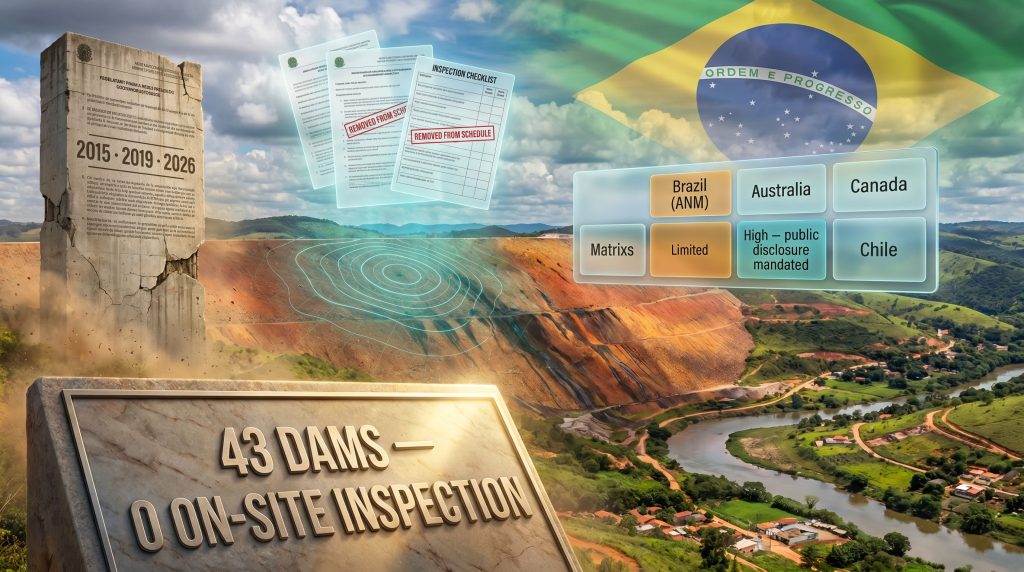
In June 2026, Mining Magazine reported that Brazil's National Mining Agency had confirmed it would cease on-site inspections of 43 dams and 18 tailings piles that had been formally scheduled for inspection before the end of the year. The reason cited was budgetary constraint. This was not a projection or an estimate produced by civil society researchers. It was a confirmation from the regulatory agency itself that facilities already on its inspection calendar would not receive visits.
This distinction matters considerably. The figure does not represent the total number of uninspected tailings facilities in Brazil. It represents the subset of facilities that were already scheduled, already identified as requiring attention, and will nonetheless receive no physical inspection due to funding limitations. The actual number of facilities operating without recent independent verification is materially larger.
The same Mining Magazine report noted that the ANM's budget constraints also affect the agency's capacity to conduct enforcement activities related to illegal mining operations and to administer mineral land auctions. This is significant because these functions draw from the same operational resource pool as dam inspections. Cuts in one area compound constraints across the others.
A Timeline of Regulatory Milestones
| Year | Event | Regulatory Significance |
|---|---|---|
| 2015 | Mariana dam collapse (Fundão) | Exposed inter-agency coordination failures and emergency response gaps |
| 2019 | Brumadinho dam failure, 270+ fatalities | Triggered sweeping legislative reform and upstream dam decharacterisation mandate |
| 2019 | Investigative reporting reveals 300+ uninspected dams | Confirmed structural depth of inspection backlog predating Brumadinho reforms |
| 2020-2022 | ANM upstream dam decharacterisation mandate | Required removal, stabilisation, or decharacterisation of upstream-construction dams |
| 2024-2025 | ANM budget crisis escalates | Inspection capacity contracts; civil society data access remains restricted |
| 2026 | 43 dams and 18 tailings piles removed from inspection schedule | Formal confirmation of oversight gap affecting year-end inspection targets |
The trajectory this timeline describes is not one of gradual improvement interrupted by a single budget crisis. It is a cycle in which reforms implemented after catastrophic events are progressively hollowed out by the same structural underfunding pressures that existed before those events occurred. Furthermore, the global tailings review has consistently emphasised that operators must earn community trust through demonstrable action, not merely regulatory compliance on paper.
The Self-Reporting Problem: A Structural Conflict of Interest
One of the least-discussed but most consequential features of Brazil's current oversight architecture is the role that operator-submitted risk classifications play in determining which facilities receive government inspection. Under the existing framework, mining companies submit assessments that directly influence inspection prioritisation. Facilities that operators classify as lower risk receive less regulatory attention.
When the regulated party's own risk assessment determines how much scrutiny it receives, the structural integrity of the entire oversight system depends on the accuracy and honesty of that assessment. This is not an edge case vulnerability. It is the central operating mechanism of the framework.
This arrangement does not require fraud to produce systemic underregulation. Conservative internal assessments made under cost pressure, by engineers retained by the operator, can systematically understate the case for external verification without any single act of deliberate misrepresentation. The Brumadinho disaster illustrated this precisely: the facility received a stability declaration from a contracted engineer shortly before its catastrophic collapse in January 2019, killing more than 270 people.
The peer-reviewed literature on regulatory design identifies this configuration as a structural vulnerability, not merely an implementation failure. Research into tailings dam failures confirms that effective oversight of potentially catastrophic infrastructure requires that risk assessment be performed by entities without financial dependency on the outcome. Brazil's current framework does not meet this standard.
The Legislative Gap: Filtered Tailings Facilities Outside the Registry
Brazil's post-Brumadinho legislative reforms established that upstream-construction tailings dams must undergo removal, stabilisation, or full decharacterisation by defined deadlines. A subsequent regulatory update introduced a minimum two-year post-closure monitoring requirement, acknowledging that structural risk does not end when active operations cease. These were meaningful advances.
However, a significant regulatory blind spot persists. Brazil currently has no specific legislative framework governing filtered tailings facilities, a technology that has seen growing adoption across the industry as an alternative to conventional wet tailings storage. Filtered tailings produce a drier, more structurally stable waste product, which reduces certain failure risks associated with liquid-saturated impoundments. Despite this, safety data for filtered tailings structures is excluded from the national dam registry entirely.
This creates a category of mining infrastructure that:
- Generates no data within the national safety registry
- Receives no scheduled inspection under the current framework
- Cannot be included in any quantitative risk assessment of Brazil's dam portfolio
- Expands as operators adopt the technology to meet post-Brumadinho compliance requirements
The regulatory irony here is considerable. A technology adopted partly in response to pressure for safer tailings management now operates in a legislative vacuum that makes its actual safety performance invisible to regulators. This gap is further compounded by the broader absence of natural capital in mining assessments, which fail to account for the full environmental and community cost of unmonitored tailings infrastructure.
What the Numbers Actually Reveal
The scale of Brazil's unmonitored tailings risk becomes clearer when multiple data points are considered together rather than in isolation:
| Metric | Figure | Source / Context |
|---|---|---|
| Dams removed from 2026 inspection schedule | 43 | ANM confirmation, June 2026 |
| Tailings piles removed from 2026 inspection schedule | 18 | ANM confirmation, June 2026 |
| Dams identified as uninspected in 2019 investigation | 300+ | Baseline predating post-Brumadinho reforms |
| Facilities classified as high destructive potential (2019) | 200+ | Pre-reform baseline figure |
| Specific legislation governing filtered tailings facilities | 0 | Current legislative status |
| Minimum post-closure monitoring requirement | 2 years | Post-Brumadinho regulatory update |
The 300-plus uninspected dams figure from 2019 pre-dates the legislative reforms that followed Brumadinho. It represents the baseline from which reform was supposed to improve. The fact that a fresh oversight gap involving formally scheduled facilities has emerged in 2026 suggests that improvement was not sustained.
Geographic Concentration of Risk
Tailings dam failures in Brazil have historically concentrated in specific states. Minas Gerais, Pará, and Maranhão represent the primary geographic zones of risk, where large industrial operations frequently intersect with artisanal and small-scale mining activity. Communities located in the dam break zones of uninspected facilities face what governance analysts describe as an asymmetric information problem: operators may hold internal structural data that local authorities and residents cannot access.
The practical consequence is that communities in these zones cannot make informed decisions about evacuation planning, land use, or emergency preparedness based on verified information about the condition of upstream facilities. They are dependent on information the regulatory system has not confirmed.
The next major ASX story will hit our subscribers first
How Brazil Compares to International Peers
| Jurisdiction | Regulatory Model | Independent Inspection Frequency | Operator Self-Reporting Role | Community Transparency |
|---|---|---|---|---|
| Brazil (ANM) | Dual federal/state | Variable; subject to budget constraints | High; shapes inspection priority | Limited; civil society access restricted |
| Canada (federal + provincial) | Multi-jurisdictional | Defined by facility risk tier | Supplementary to government review | Moderate; public registry exists |
| Australia (state-based) | Single jurisdiction per state | Risk-based; independent audits required | Supplementary | High; public disclosure mandated |
| Chile (SERNAGEOMIN) | Centralised national | Annual for major facilities | Supplementary | Moderate |
The comparison reveals that Brazil's reliance on operator self-reporting as the primary driver of inspection prioritisation is an outlier among peer jurisdictions. Both Australia and Canada treat operator submissions as supplementary inputs to regulatory decision-making rather than as the primary determinant of which facilities receive attention. In addition, the broader mining geopolitical landscape increasingly influences how international investors assess regulatory quality in mineral-producing nations.
The Global Industry Standard on Tailings Management (GISTM), jointly developed by the International Council on Mining and Metals, the United Nations Environment Programme, and the Principles for Responsible Investment, establishes that affected communities must have access to safety-critical information and that operators must demonstrate independent verification of risk assessments. By both criteria, Brazil's current framework falls materially short.
The Illegal Mining Nexus: An Underappreciated Risk Multiplier
The budget constraints affecting ANM's dam inspection programme do not operate in isolation from the agency's other regulatory functions. The same resource pool that funds on-site dam inspections also supports enforcement activities against illegal mining operations. When inspection capacity contracts, so does the agency's ability to identify and act on unregistered tailings-generating activity.
Illegal mining operations in Brazil frequently lack any tailings management infrastructure, discharging directly into waterways or creating informal impoundments that are never registered with any authority. These operations often occur in proximity to or upstream of regulated tailings facilities, introducing hydrological and geotechnical variables that no inspection programme can fully model when the upstream activity data is incomplete.
The implication is that the actual number of unmonitored tailings-generating activities in Brazil is higher than the registered dam count suggests. Budget cuts affecting enforcement capacity expand this invisible portion of the risk landscape precisely when the visible portion is already experiencing documented oversight gaps.
Pathways to Closing the Governance Gap
Immediate Interventions
- Emergency budget restoration to reinstate the 43-dam inspection programme before year-end
- Triage prioritisation based on proximity to populated areas, dam construction type, and facility age
- Deployment of satellite-based InSAR (Interferometric Synthetic Aperture Radar) deformation monitoring as an interim measure for facilities that cannot receive physical inspection
InSAR technology is capable of detecting millimetre-scale surface movement in tailings dam embankments using satellite data, providing early warning of structural deformation without requiring inspector access. While not a substitute for geotechnical inspection, it represents a viable stopgap for facilities in the current oversight gap. HR Wallingford's analysis of tailings dam failures similarly highlights the importance of early detection tools in minimising risk where physical inspection is constrained.
Medium-Term Structural Reforms
- Legislative extension to bring filtered tailings facilities within the scope of the national dam safety registry
- Mandatory independent geotechnical audits for high-consequence facilities, removing the conflict of interest embedded in operator-only risk assessment
- A legislatively protected minimum funding floor for ANM inspection operations, insulated from general federal budget cycles
Long-Term Governance Architecture
The most durable resolution to Brazil's tailings dam oversight deficit requires architectural reform rather than incremental funding increases. Specifically:
- Full public access to inspection reports, emergency action plans, and geotechnical data through a transparent national dam registry
- Formal inclusion of civil society and affected community representatives in inspection prioritisation processes
- International technical cooperation agreements to build ANM inspector capacity and adopt methodologies from peer jurisdictions
- Removal of the structural conflict of interest in the self-reporting model through legally mandated independent verification requirements
Furthermore, a robust mining claims framework that integrates community consent and transparency obligations offers a useful reference point for how governance architecture can be redesigned to distribute accountability more equitably.
ESG Implications for International Investors
For institutional investors applying ESG criteria to mining sector portfolios, Brazil's current trajectory creates a set of material considerations that extend beyond standard country-risk assessments. The formal removal of 43 facilities from the inspection schedule is a quantifiable, publicly disclosed governance event of the type that ESG risk frameworks should incorporate when assessing regulatory quality at the country level.
Companies operating tailings facilities in Brazil that voluntarily exceed minimum regulatory requirements through independent audits, GISTM alignment, and community transparency programmes carry materially different risk profiles than those relying solely on ANM oversight to define their compliance obligations. As post-Brumadinho litigation has established precedents for corporate liability in dam failure contexts, the emerging question for legal and ESG analysts is whether future failures at facilities with known, documented inspection gaps create co-liability exposure that extends beyond the operator.
Brazil's situation also reflects a broader challenge facing mineral-producing nations at the emerging market frontier: regulatory agencies are frequently under-resourced relative to the complexity of the industries they are mandated to oversee. The pattern of disaster, reform, and gradual budget erosion is not unique to Brazil. Investors seeking durable exposure to critical mineral supply chains need to incorporate regulatory capacity indicators into their country-level risk assessments, treating inspection deficit data as a forward-looking governance signal rather than a lagging safety metric. Analogous concerns have emerged in deep sea mining regulations, where oversight capacity is similarly challenged by rapid industry expansion.
Frequently Asked Questions: Brazil Tailings Dams Without Oversight
How many tailings dams in Brazil are currently without scheduled oversight?
As of mid-2026, Brazil's ANM has confirmed that 43 dams and 18 tailings piles scheduled for on-site inspection before year-end will not receive those inspections due to budget constraints. This figure covers only formally scheduled facilities removed from the programme and does not capture facilities that were never scheduled or those operating outside the formal registry.
What caused the Brumadinho dam disaster and what reforms followed?
The January 2019 collapse of the Córrego do Feijão tailings dam in Brumadinho, Minas Gerais, resulted in more than 270 fatalities. The facility had received a stability declaration from a contracted engineer shortly before the failure. Post-disaster reforms required the ANM to mandate decharacterisation of all upstream-construction dams and introduced a minimum two-year post-closure monitoring requirement.
Why does Brazil have no specific law for filtered tailings facilities?
Brazil's dam safety legislation was developed in direct response to wet tailings facility failures and does not address filtered tailings structures. As a result, safety data for these facilities is not captured in the national registry, creating a growing category of unmonitored infrastructure even as filtered tailings technology expands in adoption.
How does operator self-reporting create inspection risk?
Mining companies submit risk assessments that directly influence which facilities are prioritised for government inspection. Even without deliberate misrepresentation, internal assessments produced under financial or operational pressure can systematically understate risk, reducing the probability that a deteriorating facility receives timely external scrutiny.
What is InSAR and how can it help?
Interferometric Synthetic Aperture Radar is a satellite-based technology capable of detecting millimetre-scale surface deformation in tailings dam embankments. It provides an early warning of structural movement without requiring physical inspector access and represents a viable interim monitoring tool for facilities that cannot receive scheduled on-site visits.
What is the GISTM?
The Global Industry Standard on Tailings Management, published in 2020 by the International Council on Mining and Metals, the United Nations Environment Programme, and the Principles for Responsible Investment, establishes global baseline expectations for tailings facility governance including independent review, community engagement, and public transparency. Brazil's current regulatory framework does not fully meet these standards on either dimension.
Disclaimer: This article is intended for informational purposes only and does not constitute financial, legal, or investment advice. Specific figures relating to inspections and budgetary constraints are drawn from publicly available reporting. Forward-looking statements regarding regulatory reform or risk trajectories involve inherent uncertainty and should not be relied upon as predictions of future outcomes.
Want to Stay Ahead of ASX Mining Opportunities Amid Global Governance Risks?
While regulatory failures in mineral-producing nations like Brazil underscore the importance of informed investment decisions, Discovery Alert's proprietary Discovery IQ model delivers real-time alerts on significant ASX mineral discoveries, transforming complex data into clear, actionable insights for investors at every experience level. Explore how historic discoveries have generated substantial returns on Discovery Alert's dedicated discoveries page, and begin your 14-day free trial today to secure a market-leading edge.