July 18, 2026
The Structural Gap at the Heart of India's Mining Sector
India's mineral wealth is not in question. The country holds substantial reserves of iron ore, manganese, bauxite, limestone, copper, and an expanding portfolio of critical minerals demand including lithium, cobalt, and rare earth elements. What has long undermined this endowment is not geological scarcity but administrative friction: the persistent lag between a mine being awarded through auction and that mine actually producing ore.
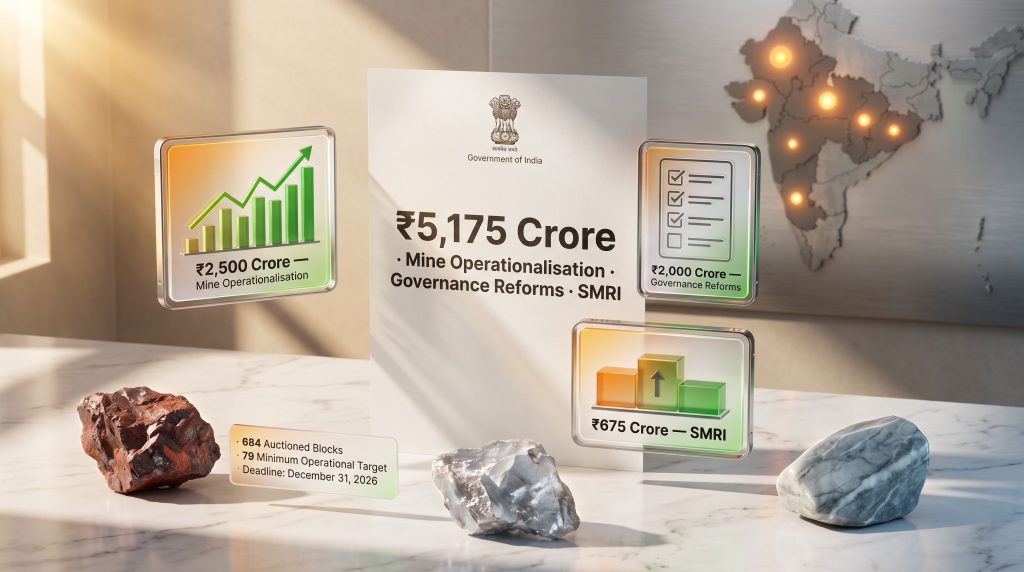
This operationalisation gap is one of the most consequential bottlenecks in India's industrial supply chain, and it is precisely the problem that a newly finalised set of guidelines from the Union Finance Ministry has been designed to address. Under the Scheme for Special Assistance to States for Capital Investment (SASCI) 2026-27, the Centre has structured a ₹5,175 crore performance-linked incentive framework targeting mining incentives for states in India, designed to activate a stalled pipeline of auctioned mineral blocks and simultaneously drive administrative reform at the state level.
When big ASX news breaks, our subscribers know first
Why Auctioned Blocks Remain Dormant: The Operationalisation Problem
Of the 684 major mineral and critical mineral blocks auctioned by states and the Centre up to March 31, 2026, a meaningful proportion remain non-operational. The reasons are not primarily geological. They are structural and administrative.
Forest clearances, environmental approvals, and land acquisition processes often run on independent bureaucratic timelines that are poorly coordinated with auction award schedules. When a mine developer wins a block at auction, they may find that the same regulatory approvals required to begin production are still months or years from completion. The result is a mine that exists on paper, contributes to auction revenue statistics, but produces nothing.
The concept of pre-embedded clearances directly confronts this failure mode. By requiring that forest, environmental, and land clearances be secured before a block is listed for auction, the scheme attempts to compress the post-award activation period significantly. This design principle acknowledges a fundamental truth about mining project development: the regulatory pathway, not geological complexity, is typically the longest lead-time item.
Furthermore, the mineral exploration importance of getting these blocks into production cannot be overstated, as dormant auctioned blocks represent both a lost economic opportunity and a drag on investor confidence in India's mining sector.
The SASCI framework represents a deliberate inversion of conventional mineral policy logic. Rather than rewarding states simply for auctioning blocks, it rewards states for getting those blocks into production.
How the ₹5,175 Crore Is Divided: The Three-Pillar Architecture
The total incentive pool is not distributed as a lump-sum grant. It is structured across three distinct components, each targeting a different dimension of mining sector performance.
| Incentive Pillar | Allocation | Primary Performance Trigger |
|---|---|---|
| Mine Operationalisation | ₹2,500 crore | Extraction and dispatch commencement from auctioned blocks |
| Mining Governance Reforms | ₹2,000 crore | Completion of mandated major and minor mineral reforms |
| State Mining Readiness Index (SMRI) | ₹675 crore | Competitive ranking across three state categories |
| Total | ₹5,175 crore | Multi-metric milestones with hard deadlines |
This architecture is intentional. By separating process-based reform incentives from production-based output rewards, the scheme prevents states from claiming capital transfers through administrative box-ticking alone. A state that reforms its digital mining portal but fails to operationalise any blocks will receive partial, not full, access to the incentive pool.
Pillar 1: Getting Mines into Production (₹2,500 Crore)
The Pre-Clearance Auction Premium
States receive ₹20 crore per major mineral block auctioned during FY 2026-27 where forest, environmental, and land clearances are already secured ahead of listing. The per-state cap under this sub-component is ₹200 crore, implying a maximum of 10 qualifying blocks per state.
This payment structure creates a direct fiscal incentive for state mining departments to invest upfront in clearance processing rather than treating it as a post-auction activity. For mining investors and developers, pre-cleared blocks represent a materially different risk profile compared to encumbered blocks, as the single largest source of project delay has already been resolved.
The Production Commencement Trigger
The more substantial portion of Pillar 1 rewards states where auctioned blocks have commenced both extraction and dispatch operations by December 31, 2026. This is a hard cutoff, not a guideline, and qualifying states must demonstrate that a minimum of 10% of their total auctioned block portfolio as of March 31, 2026 has reached operational status.
Numerically, that threshold translates to 79 blocks across the 684-block national pipeline. State-specific minimum targets are as follows:
| State | Minimum Blocks to Operationalise |
|---|---|
| Rajasthan | 13 |
| Madhya Pradesh | 13 |
| Odisha | 8 |
| Karnataka | 7 |
| Chhattisgarh | 7 |
| Gujarat | 6 |
| Maharashtra | 5 |
| Other States | Proportional to auctioned inventory |
Rajasthan and Madhya Pradesh carry the largest individual burdens, reflecting the size and diversity of their respective auctioned mineral inventories. Rajasthan's portfolio spans limestone, marble, copper, and lead-zinc, while Madhya Pradesh's mix of coal and diamond mining presents a multi-commodity coordination challenge across different regulatory frameworks.
Pillar 2: Governance Reform as a Precondition for Capital (₹2,000 Crore)
Five Non-Negotiable Major Mineral Reforms
To access this allocation, states must complete all five designated major mineral reforms by December 15, 2026:
- Digital portal integration with a nationally unified tracking system for real-time mine block monitoring
- Pre-auction committee establishment to resolve clearance and approval bottlenecks before block listing
- Annual auction calendar publication to improve forward visibility for investors and downstream industries
- Technology-based grade monitoring to prevent ore misclassification and close revenue leakage from grade substitution
- Formal declaration of non-imposition of state-level mineral taxes, including mineral-bearing land tax and environment cess, on the major minerals sector
The fifth condition is particularly significant from a policy architecture standpoint. It signals that the Centre is using incentive design to indirectly harmonise the fiscal environment across state mining jurisdictions, reducing what is sometimes described as jurisdictional arbitrage in mineral taxation. States that impose additional levies on mining operators create cost differentials that distort investment allocation across otherwise comparable mineral geographies.
Minor Mineral Reforms: A Flexible Qualification Track
States can also access up to ₹100 crore per state by implementing at least four of seven designated minor mineral reforms. Qualifying measures include transitioning minor mineral allocation from administrative discretion to competitive auctions, establishing a State Mineral Exploration Trust, and deploying digital dispatch monitoring at mine gates.
The First-Mover Disbursement Rule
A critical and often underappreciated feature of Pillar 2 is that reform incentives are disbursed on a first-come, first-served basis. The ₹2,000 crore pool is not divided equally among all qualifying states. States that complete reforms earlier access funds sooner, and if the pool is exhausted, late-completing states receive nothing.
This competitive disbursement structure creates urgency that formula-based grants typically cannot generate. It rewards institutional capacity and administrative speed rather than simply existing mineral endowment. According to the Financial Express, this first-mover mechanism is regarded as one of the scheme's most innovative design features.
Pillar 3: Competitive Benchmarking Through the SMRI (₹675 Crore)
The State Mining Readiness Index introduces a ranking-based performance layer on top of the absolute-threshold conditions embedded in Pillars 1 and 2. The SMRI evaluates states across multiple governance dimensions including auction pipeline depth, regulatory processing speed, and digital infrastructure maturity, then segments them into three size-based categories to enable like-for-like comparison.
The prize structure for each category is:
| SMRI Rank Within Category | Prize Amount |
|---|---|
| 1st Place | ₹100 crore |
| 2nd Place | ₹75 crore |
| 3rd Place | ₹50 crore |
With three categories, nine total SMRI prizes are distributed across the ₹675 crore pool. The categorisation prevents resource-rich, large-portfolio states from automatically outranking smaller states, ensuring the index rewards governance quality rather than portfolio volume. This distinction matters for emerging mining states that may have limited historical auction activity but strong institutional frameworks.
The next major ASX story will hit our subscribers first
Which States Face the Greatest Strategic Stakes?
High-Exposure: Rajasthan and Madhya Pradesh
Both states face the largest absolute operationalisation targets at 13 blocks each, but they also have the greatest potential payout under Pillar 1. Rajasthan's diversified mineralogy provides multiple commodity pathways to qualifying blocks, while Madhya Pradesh's experience in large-scale coal and mineral operations gives it implementation depth. However, the multi-commodity complexity also means that clearance requirements span several regulatory bodies simultaneously, creating coordination challenges.
Mid-Tier Strategic Value: Odisha, Karnataka, and Chhattisgarh
Odisha's concentration in iron ore and manganese makes its eight-block operationalisation target directly relevant to steel sector supply chains. Karnataka and Chhattisgarh, with seven blocks each and significant iron ore and coal assets respectively, sit at the intersection of industrial raw material security and critical mineral transition themes. These three states also carry above-average SMRI competitiveness potential, given existing digital governance infrastructure in their mineral departments.
Emerging Participants: Gujarat and Maharashtra
For Gujarat and Maharashtra, mining is secondary to their dominant industrial manufacturing identities. Their lower operationalisation targets of six and five blocks respectively reflect smaller auctioned portfolios, but both states have relatively efficient regulatory processing frameworks that could enable faster clearance-embedded auction pipelines than states with more complex land and forest tenure situations.
Capital Deployment Rules and Eligibility Conditions
The scheme imposes strict conditions on how released funds must be used. All SASCI transfers must be directed exclusively toward capital investment projects, with expenditure prioritised within mining districts to ensure geographic alignment between incentive receipts and productive investment. Previously released tranches face a March 31, 2026 expenditure deadline.
Eligibility extends to all states and Union Territories with legislative assemblies, ensuring federal participation across India's diverse mineral geography. Smaller UTs with limited mineral portfolios may still access the SMRI category-based tier even without major operationalisation targets, ensuring the incentive architecture does not inadvertently exclude emerging mineral jurisdictions.
The Critical Mineral Dimension: A Supply Chain Lens
The SASCI framework explicitly includes critical mineral blocks alongside conventional major minerals. This is not incidental. India's electric vehicle manufacturing targets, renewable energy infrastructure ambitions, and advanced battery materials processing aspirations are all directly dependent on securing domestic feedstocks for lithium, cobalt, nickel, graphite, and rare earth elements.
In addition, rare earth supply chains represent a strategically sensitive dimension of this framework, given India's desire to reduce import dependency on materials essential to clean energy manufacturing. Technologies such as direct lithium extraction are becoming increasingly relevant as India seeks faster, more efficient pathways to domestic battery-grade lithium production from its auctioned block inventory.
The gap between India's stated critical minerals strategy and its actual domestic production has been a persistent vulnerability. Import dependency for battery-grade materials exposes Indian manufacturers to price volatility, geopolitical supply disruptions, and foreign exchange risk. Accelerating the operationalisation of critical mineral blocks that have already cleared the auction stage represents one of the most capital-efficient interventions available to policymakers, since the discovery and competitive tender work has already been completed.
If India's 684-block auctioned pipeline were progressively operationalised over a multi-year horizon, the cumulative output across iron ore, manganese, copper, lithium, and rare earth categories could materially reduce the country's mineral import dependency across several industrial sectors simultaneously.
How SASCI Differs from Previous Central Mining Initiatives
Understanding the significance of this framework requires comparing it against the conventional architecture of central-state mineral transfers.
| Dimension | Traditional Central Mineral Transfers | SASCI Mining Incentives 2026-27 |
|---|---|---|
| Disbursement Basis | Population or area formula | Production and reform milestones |
| State Agency | Low, predetermined allocations | High, competitive performance required |
| Reform Conditionality | Minimal to none | Mandatory five major reforms |
| Timeline Pressure | Multi-year disbursement windows | Hard December 2026 cutoffs |
| Competitive Mechanism | Absent | First-come-first-served plus SMRI ranking |
Traditional mineral royalty-sharing mechanisms returned a portion of extraction value to states without any corresponding requirement to improve governance or accelerate new mine development. The SASCI model treats capital transfers as earned outcomes rather than formula entitlements. This distinction has significant long-term implications for how state mining departments are incentivised to invest in administrative capability, digital infrastructure, and pre-clearance processes.
The shift also carries a subtler message for mining investors: states that consistently perform well under SMRI and operationalisation metrics are demonstrating the institutional quality that supports predictable project timelines and reduced regulatory risk. SMRI rankings, once publicly available, could function as a practical due diligence tool for mining companies evaluating which state jurisdictions offer the most favourable development environment. Detailed information on India's broader metals and mining investment environment is available through Invest India, which outlines sector opportunities across states.
Key Takeaways: India's Mining Incentive Architecture at a Glance
- ₹5,175 crore in performance-linked capital transfers are available to Indian states under SASCI 2026-27
- The scheme targets 79 of 684 auctioned blocks, representing a 10% operationalisation floor as the minimum production trigger
- Three distinct incentive pillars reward operationalisation speed, governance reform quality, and competitive SMRI ranking performance
- Rajasthan and Madhya Pradesh carry the largest state-level targets at 13 blocks each, with the highest potential payout exposure
- The December 31, 2026 hard deadline for production commencement creates material urgency for state mining and regulatory departments
- Critical mineral blocks are explicitly included within the eligibility framework, directly linking mining incentives for states in India to the country's clean energy and advanced manufacturing supply chain objectives
- The first-come, first-served disbursement mechanism for reform incentives rewards institutional speed and administrative capacity over portfolio size alone
- The scheme represents a structural evolution toward performance-conditioned fiscal federalism in India's mineral governance framework
Readers seeking broader context on India's mineral policy landscape and state-level mining governance developments can explore ongoing reporting at ET EnergyWorld, which covers India's mining sector reforms and energy transition themes in depth.
Want to Identify the Next Major Mineral Discovery Before the Market Does?
Discovery Alert's proprietary Discovery IQ model delivers real-time alerts on significant ASX mineral discoveries, instantly transforming complex mineral data into actionable investment insights — explore historic discoveries and their exceptional returns to understand the magnitude of opportunity, then begin your 14-day free trial and position yourself ahead of the broader market.