July 18, 2026
When Industrial Silence Ends: Understanding the Forces Behind the BHP Port Hedland Strike
Across most mature industrial economies, collective bargaining in extractive industries is treated as standard practice. Yet in Western Australia's Pilbara region, the opposite dynamic has prevailed for the better part of three decades. Individual contracts, non-union enterprise frameworks, and a fly-in, fly-out workforce model have combined to produce an environment in which organised labour has had remarkably little formal influence over wages and conditions in iron ore operations. That long-established equilibrium was disrupted on 16 July 2026, when the BHP strike in Port Hedland saw workers at the company's port operations walk off the job in the first protected industrial action at the site since the year 2000.
Understanding what drove this moment, what it actually achieved, and what it signals for the future of Pilbara labour relations requires looking well beyond the raw numbers reported on the day.
When big ASX news breaks, our subscribers know first
A Generation of Industrial Quiet, Then a Sudden Break
The Pilbara's reputation for labour stability is not accidental. It reflects a deliberate and sustained industry strategy built around individual employment contracts and enterprise agreements negotiated directly between employers and workers, without union involvement. The Chamber of Minerals and Energy of Western Australia (CMEWA) has long described this as a model of direct collaboration between workers and companies, and for decades the approach held firm.
The last time a strike occurred anywhere in the broader iron ore sector was in 2008, when Rio Tinto train drivers took protected industrial action. Before that, the most recent disruption at BHP's Port Hedland operations specifically dated back to 2000. Many of the workers who walked off the job on 16 July 2026 had never experienced, or even worked alongside, a colleague who had participated in a Pilbara mining strike.
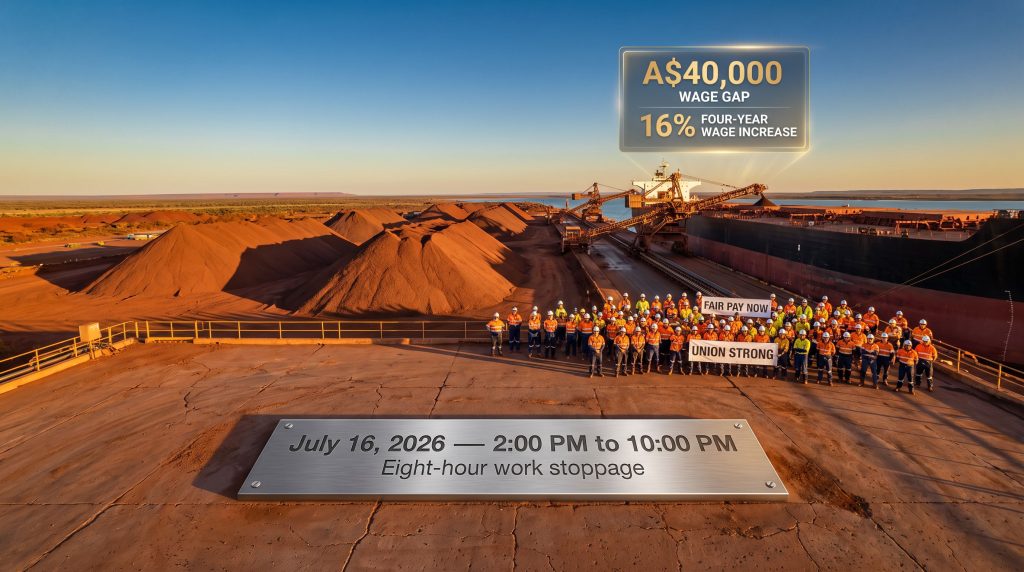
That context matters enormously. The eight-hour work stoppage, running from 2:00 PM to 10:00 PM, was not a spontaneous reaction to a single grievance. It was the culmination of approximately seven months of failed enterprise agreement negotiations between BHP and the Combined Ports Unions, a coalition comprising the Electrical Trades Union (ETU), the Australian Manufacturing Workers' Union (AMWU), and the Western Mine Workers Alliance.
The Wage Gap at the Heart of the Dispute
The numerical core of the dispute is stark. Workers performing equivalent roles at BHP's Port Hedland port operations were earning up to $40,000 less annually than counterparts at the company's inland mining sites, including South Flank and Mining Area C. This gap existed within the same corporate structure, under the same brand, exporting the same commodity.
The unions entered negotiations with a clear set of demands:
- A $25,000 pay rise per worker to begin closing the intra-company wage divide
- Standardised employment contracts providing greater transparency and consistency
- Pay conditions aligned with the 16% wage increase over four years recently secured by BHP's inland mining workforce
- Safer working conditions and clearer progression pathways
The absence of a union-negotiated enterprise agreement at Port Hedland has historically been the structural mechanism that allowed this wage gap to persist. Under individual contracting frameworks, each worker's pay is determined separately, which limits the ability to establish sector-wide benchmarks or challenge internal discrepancies through collective pressure.
Furthermore, the BHP iron ore strategy of prioritising individual contracts over collective agreements has come under increasing scrutiny as workers compare their conditions across sites.
The tension at the core of this dispute is not simply about dollars. It reflects a broader question about whether the individual contracting model, which has shaped the Pilbara's labour landscape for a generation, can sustain itself as workers increasingly compare their conditions across sites and sectors.
Seven Months of Breakdown: The Negotiation Timeline
| Milestone | Detail |
|---|---|
| Negotiations commenced | Approximately December 2025 |
| Fair Work Commission mediation attempt | 14 July 2026, failed to produce agreement |
| Strike notice formally served | Prior to 16 July 2026 |
| Eight-hour work stoppage | 16 July 2026, 2:00 PM to 10:00 PM |
| Next FWC bargaining session (Port Hedland) | Tuesday, 22 July 2026 |
| Scheduled FWC session (Newman high-voltage workers) | Thursday, 24 July 2026 |
A Fair Work Commission conciliation session held just two days before the strike failed to generate the concessions unions were seeking. According to reporting from the ABC, union representatives indicated that a credible shift in BHP's position could have prevented the walkout entirely.
BHP, for its part, affirmed its commitment to good faith bargaining and expressed a preference for FWC-facilitated resolution over direct union-negotiated agreements — a framing that itself signals the company's reluctance to legitimise collective bargaining as the primary mechanism for setting wages in its port operations.
Competing Participation Figures and What They Actually Mean
The dispute over how many workers struck is as revealing as the strike itself. Three distinct figures circulated in the immediate aftermath:
- Up to 200 workers anticipated by union estimates before the action
- 63 workers recorded by the CMEWA as having formally stopped work
- More than 100 individuals observed on the ground by independent reporting, including union officials and supporters
Each figure serves a purpose in the competing narratives. CMEWA Chief Executive Aaron Morey used the lower industry figure to argue that unions were out of step with the broader workforce. ETU State Secretary Adam Woodage countered that every electrician covered by the protected action participated, making the turnout complete within the relevant trade classification.
Why Do the Participation Figures Differ So Significantly?
What both framings obscure is an important legal reality. Under the Fair Work Act, eligibility to participate in protected industrial action is determined through a formal ballot process. Not every worker on site was legally entitled to stop work. The 63 figure may represent those formally eligible and participating, rather than a measure of broader worker sentiment.
Edith Cowan University work and employment relations lecturer Alexis Vassiley offered the most analytically useful perspective: the symbolic weight of the action exceeded its participation count. Breaking a 26-year drought of industrial action at BHP Port Hedland, and an 18-year drought across the entire iron ore sector, carries significance that no headcount can fully capture.
An often-overlooked detail further complicates the CMEWA's narrative. BHP's own contingency response — which involved rescheduling staff to cover an afternoon shift format that had not been used at the site for many years — is itself evidence that the stoppage created meaningful operational disruption. Companies do not restructure shift patterns for actions that have no consequence.
Economic Impact: Separating Signal from Noise
| Economic Metric | Estimated Figure |
|---|---|
| BHP iron ore export value per day | Approximately A$120 million (roughly US$83 million) |
| Estimated revenue exposure during eight-hour window | A$40 million to A$50 million |
| Western Australian government royalty exposure | Approximately A$7 million |
| Ships loaded during the work stoppage | 7 vessels confirmed |
BHP confirmed that seven ships were loaded during the eight-hour stoppage, including the Liberian-flagged Iron Southern Cross, which departed Port Hedland on schedule for Qingdao, China. The company disputed union claims regarding delays at one of its large iron ore rail car dumpers.
Did BHP Actually Lose Money?
Woodage himself acknowledged post-strike that BHP likely did not absorb a substantial direct financial loss. The pre-strike warnings of tens of millions of dollars in losses circulated by the CMEWA were characterised by some observers as strategically calibrated pressure rather than objective economic forecasting — a tactic designed to discourage participation before the event rather than document actual damage after it.
WA Deputy Premier Rita Saffioti drew a measured comparison, noting that weather events and storms regularly interrupt iron ore loading operations in Port Hedland without triggering investor alarm, suggesting the operational impact fell within manageable bounds.
That said, the CMEWA's broader point about productivity carries internal logic worth examining. If sustained industrial action constrains productivity, it theoretically limits the revenue pool from which wage increases can be funded. This is the argument Morey advanced, framing union action as economically self-defeating for the very workers it claims to represent. However, for context, the global iron ore market faces a range of pressures beyond domestic labour disputes, which complicates any single-cause analysis of pricing or supply risk.
The next major ASX story will hit our subscribers first
Three Escalation Scenarios: What Comes Next
| Scenario | Trigger Conditions | Likely Outcome |
|---|---|---|
| Negotiated Settlement | BHP makes substantive wage concessions at FWC sessions | New multi-year EBA; potential precedent for union bargaining across iron ore ports |
| Prolonged Campaign | BHP holds firm; ETU members vote for rolling stoppages | Escalating disruption; increased investor scrutiny; possible FWC arbitration |
| Stalemate and Attrition | Neither party concedes; FWC unable to broker agreement | Extended uncertainty; reputational costs to both sides; risk of unprotected action |
Two FWC bargaining sessions were scheduled for the week following the strike. The first addressed the Port Hedland port dispute directly. The second involved BHP's high-voltage power grid workers in Newman, who separately voted in favour of protected industrial action, adding a second front to the union campaign.
After each session, the ETU indicated it would return to members for instructions, leaving open three pathways: continued FWC-facilitated negotiation, direct bilateral talks with BHP, or authorisation of further protected strike action.
Could Strikes Spread Across the Pilbara?
Woodage was explicit in cautioning against assumptions of sector-wide contagion. The Fair Work Act's ballot requirements mean that protected industrial action cannot be rapidly replicated across multiple employers. Each bargaining unit requires its own process, its own ballot, and its own Fair Work authorisation.
No other Pilbara mining operator was at the relevant stage of that process at the time of the July 16 stoppage. The legal architecture of Australia's industrial relations framework acts as a genuine constraint on rapid escalation, regardless of how successfully the Port Hedland dispute resolves. In addition, the Pilbara rail operations managed by other major operators remained unaffected at this stage, further limiting the immediate spread of disruption.
The Precedent Question: Why This Moment Matters Beyond BHP
The deepest significance of the BHP strike in Port Hedland lies not in the eight hours of disruption it caused, but in what a successful enterprise agreement outcome would represent structurally.
Vassiley's analysis from Edith Cowan University frames it clearly: a union-negotiated collective agreement at BHP's port operations would be the first of its kind outside the train driver cohort in the iron ore sector in decades. That would establish a wage benchmark and conditions framework capable of being cited by other resource sector unions in future negotiations, fundamentally altering the reference points available to workers across the Pilbara.
The shift from individual to collective bargaining also changes the fundamental power asymmetry. A single worker negotiating against one of the world's largest mining corporations operates under enormous structural disadvantage. An organised workforce capable of coordinated economic pressure operates under an entirely different dynamic — one the Pilbara's labour model has been specifically designed to prevent from taking hold.
For international investors monitoring Australian resource sector stability, the trajectory of these negotiations matters considerably. Port Hedland handles a disproportionate volume of Australia's iron ore exports, making it a critical node in global steel supply chains, particularly given current China steel demand conditions. Furthermore, the iron ore demand outlook for the coming years means sustained disruption at this chokepoint carries downstream consequences for spot pricing, shipping schedules, and long-term supply contract reliability. According to Reuters, workers had already voted in favour of strike action prior to the July stoppage, signalling that the dispute had deep roots within the workforce.
Frequently Asked Questions: BHP Strike in Port Hedland
What Caused the BHP Strike at Port Hedland in 2026?
Seven months of unresolved enterprise agreement negotiations led to the action. Workers at BHP's port operations sought pay parity with inland mine site employees, who had secured a 16% wage increase over four years. The pay gap for comparable roles was estimated at up to $40,000 per year.
How Long Did the BHP Port Hedland Strike Last?
The protected industrial action ran for eight hours, from 2:00 PM to 10:00 PM on Wednesday, 16 July 2026.
Which Unions Were Involved?
The Combined Ports Unions coordinated the action, comprising the ETU, the AMWU, and the Western Mine Workers Alliance.
When Was the Last BHP Strike Before 2026?
The last recorded strike at BHP's Port Hedland operations occurred in 2000. The last industrial action anywhere in the broader iron ore sector involved Rio Tinto train drivers in 2008.
What Does the Fair Work Commission's Role Involve?
The FWC serves as the independent statutory body facilitating bargaining meetings between BHP and the unions. It can convene conciliation sessions, issue recommendations, and under certain conditions move toward binding arbitration if negotiations remain deadlocked. Both parties are legally required to engage in good faith bargaining under the Fair Work Act.
Could Further Strikes Occur?
BHP's Newman-based high-voltage power grid workers separately voted in favour of protected industrial action following the Port Hedland stoppage, with a FWC session scheduled for late July 2026. Port Hedland workers retained the option of authorising additional strike action depending on the outcome of upcoming bargaining sessions.
Disclaimer: This article contains forward-looking analysis and scenario projections based on publicly available information as of July 2026. Outcomes in enterprise bargaining proceedings are inherently uncertain. Nothing in this article constitutes legal, financial, or investment advice. Readers should consult qualified professionals before making decisions based on the matters discussed.
Want to Stay Ahead of ASX Mineral Discoveries Shaping the Resources Sector?
As labour dynamics and commodity supply chains shift across the Pilbara, the next significant mineral discovery could emerge from anywhere — Discovery Alert's proprietary Discovery IQ model delivers real-time alerts on significant ASX mineral discoveries, turning complex data across more than 30 commodities into clear, actionable insights for investors at every level. Explore historic discovery returns on Discovery Alert's dedicated discoveries page and begin your 14-day free trial to position yourself ahead of the broader market.